A Blackpool garage that grew into one of the world's best-known specialist sports car makers, with Ford V8 power, several near-collapses and a Welsh factory plan.
TVR is a British sports car maker founded by Trevor Wilkinson in Blackpool in 1946. It built lightweight cars with Ford V8 power, went into liquidation in 1964 and has changed owners several times, most recently in 2025. Its cars are built on lightweight chassis with powerful engines.
TVR Electric Vehicles Limited is a British sports car maker that started as a small engineering business in Blackpool. The company once claimed to be the third-largest specialist sports car manufacturer in the world, and it has changed owners many times, with its cars built on lightweight chassis and powerful engines. Its most recent change of hands came in November 2025, when Charge Holdings bought the brand.
Where did TVR begin?
The name comes from the initials of founder Trevor Wilkinson, whose first garage carried the letters T, V and R. Wilkinson was born in Blackpool on 14 May 1923 and left school at 14 to train as an engineer at a local garage, before setting up on his own.
In 1946 he acquired a former wheelwright's premises on Beverley Grove, Blackpool, and launched Trevcar Motors. It did general engineering and servicing for cars and trucks, and in 1947 a local enthusiast, Jack Pickard, joined. The firm became TVR Engineering after the name was trimmed of several letters from Wilkinson's own first name.
Wilkinson left the company's active leadership in 1962 and died on 6 June 2008, aged 85, after retiring to Menorca.
From a Blackpool wheelwright's workshop to Ford V8 sports cars, several near-collapses and a 2025 sale.
What did the first TVR cars look like?
The company produced its first home-designed chassis in 1949. It used a Hotchkiss-style rear suspension with the live axle from a Morris Eight, a front trailing-arm layout, and a Ford 1,172 cc sidevalve engine taken from a 1936 van and tuned to 35 hp.
The body was built in aluminium and painted British racing green. The first successful test drive happened on the Squires Gate aerodrome runway in 1949, and that first car was sold to Wilkinson's cousin for GBP 325 before being crashed and salvaged for parts.
The second car used the same chassis, with a wishbone front arrangement and a single transverse leaf spring. The third used a 1,200 cc, 40 hp Austin A40 engine and a blunter nose. David Hives, who later became a key employee, was introduced to the management through the club events where that third car competed in 1952 and 1953.
How did the Sports Saloon and Jomar come about?
In 1953 Wilkinson and Pickard began designing a new chassis that could take Austin A40 running gear and was intended for sale as a kit with a fibreglass body. Atalanta bodies from a special builder were used on early examples, and the car was marketed as the TVR Sports Saloon. The kit went on sale in 1954 for GBP 650.
TVR's brochure quoted a weight of 635 kg (1,400 lb) and a sprint to 60 mph in 13 seconds (0-97 km/h). The first version of the TVR badge appeared on this car, designed by a young art student who was a friend of Wilkinson's.
In 1955 the company moved to a semi-spaceframe chassis with a central backbone, which lowered the seats to about six inches from the ground. Volkswagen Beetle trailing arms served at both ends of the car, setting a precedent for all-independent suspension on later TVRs.
The chassis attracted attention in America. Ray Saidel, a racing driver in Manchester, New Hampshire, ordered chassis that were fitted with bodies in the United States and sold under the Jomar name. The Jomar Mk2 was named after Saidel's children, Joanna and Marc, and he later imported Open Sports and Coupe cars to try to sell them there.
What were the Open Sports, Coupe and Grantura?
In mid-1956 the company created its first original body style, the Open Sports, fitted to the Jomar-style chassis. Between three and four were built, and one went to an Autosport writer, who called its steering response and grip superb. Records are incomplete, so the exact tally is unknown.
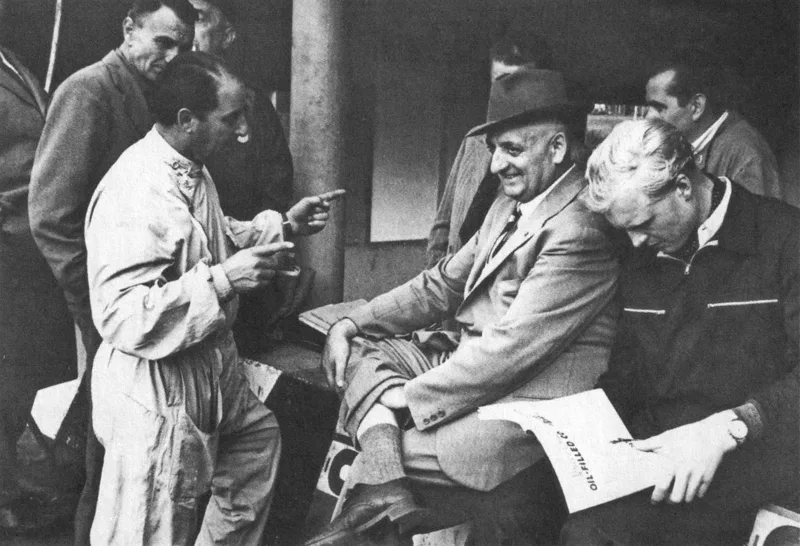
Customers wanted something more practical, so the designers produced a fixed-head notchback body on the same chassis. It became the TVR Coupe, and its first public appearance was on 10 January 1958 at a showroom in Manchester. One Coupe was used as a factory demonstrator and driven by Mike Hawthorn.
Saidel's sales were modest, and he asked the factory for a fastback. The answer was the Grantura Mk1, which put a fastback body on the existing trailing-arm chassis. Its interior was cramped, and the short doors and large steering wheel made getting in and out awkward, though Climax-powered cars received leather.
Why did TVR run into trouble in the early 1960s?
By October 1958 the company's bank debt was close to GBP 10,000, orders from America had almost stopped, and the factory had finished only ten cars that year. A financier, Fred Thomas, had apparently planned to close TVR and claim the loss against tax, but the directors instead reformed the business as Layton Sports Cars Ltd in December 1958.
A sister firm, Grantura Engineering, was set up in February 1959 to avoid UK Purchase Tax on kit cars. Production remained slow, about one car per month, and the board replaced Wilkinson with Henry Moulds as production manager. Negotiations with Saidel broke down in 1959 after the chairman, Derek Harris, pressed for fifty cars a year when twenty-five had been agreed.
Early in 1961, Keith Aitchison and Bryan Hopton, who ran a Lotus and TVR dealership in Chester, came on board. In September 1961 their company acquired a controlling share, and Hopton made himself chairman and renamed the business TVR Cars Ltd. Orders doubled in the following months, but the new leadership spent heavily on racing.
In March 1962 Hopton sent three Grantura Mk2As to the 12 Hours of Sebring, and only one finished. The directors lost faith in the new leadership's spending, and Trevor Wilkinson's resignation was accepted on 5 April 1962. TVR's Le Mans entry that June was a disaster, with a single car overheating and retiring on the third lap.
By late 1962 the company was in serious trouble again. The Mk3 Grantura had come late, two home market distributors had closed, Canada imposed a 10% duty on cars from the United Kingdom and a US importer had not paid for his orders. Staff were let go in October 1962, and TVR Cars Ltd went into receivership.
What was the Griffith and why did TVR collapse in 1964?
The Griffith story began in New York. By October 1963 a prototype had been finished by Dick Monnich, Jack Griffith and the mechanic George Clark, who set a Ford 289 V8 into a Grantura Mk3 body. Its acceleration impressed, but the brakes and chassis were not up to the engine, and David Hives built a better-developed second prototype at Hoo Hill.
Hives then helped set up a production line at Griffith's business on Long Island, and cars were finished there from engineless bodies sent from England. That production demanded more output from the Blackpool factory than it could manage, and reliability problems and customer complaints grew through 1964.
A dock strike in the United States damaged Griffith's ability to import cars in 1964. Griffith could not meet his obligations to Ford, which stopped supplying drivetrain parts, and ties with TVR were severed. A director meeting at TVR in September 1964 announced the end of production, and the company went into liquidation that November.
How did the Lilleys bring TVR back?
Late in 1965 the Lilleys, Arthur and son Martin, acquired the assets to cut their losses on TVR shares. On 30 November 1965 TVR Engineering Ltd came into being, with Arthur as chairman. Hives returned as general manager and design engineer, and the new workforce grew confident as the Lilleys proved committed to the business.
The 1965 Trident prototypes, built by Carrozzeria Fissore, had been shown at Geneva in March 1965, but the design rights were later taken by Bill Last, who built the car as the Clipper. Gerry Sagerman took over the American side, opening a showroom in Lynbrook, Long Island, in April 1967.
In January 1967 TVR unveiled the Tuscan V8 in short and long wheelbase forms. The Tuscan did not give the boost the Lilleys had hoped for, and it sold in low volume. The Vixen Series 1 debuted at the October 1967 British motor show and proved popular and brought back in-house fibreglass body production.
In early 1968 the steel-bodied Tina project was cancelled, and the two prototype cars were all that were built. Bill Last had proposed a merger to build the Trident in volume, and TVR declined.
What were the M Series and the Tasmin?
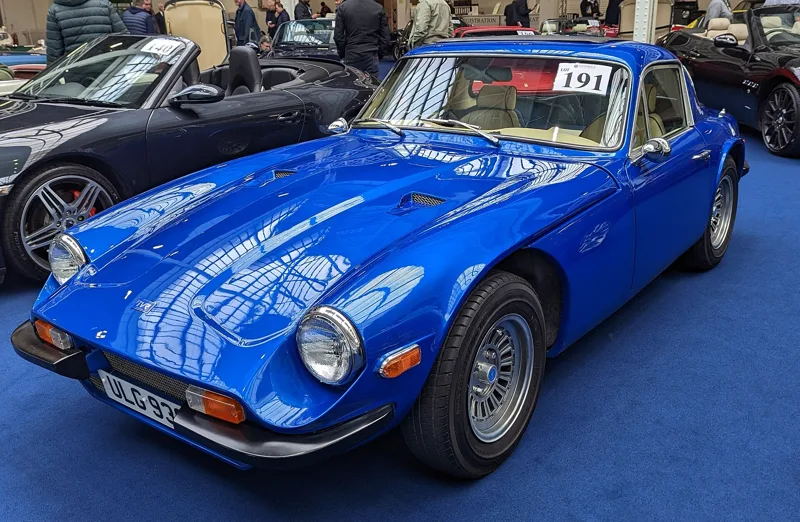
The M Series replaced the Vixen-based cars from 1972. Mike Bigland designed its chassis, which was more rigid, safer and cheaper to build, and models including the 2500M, 3000M, 1600M, Taimar and 3000S were produced until 1980. TVR offered a five-year no-corrosion guarantee from 1974, and roughly three in five cars left for mainland Europe or America.
On 3 January 1975 a fire broke out at the factory, probably caused by faulty wiring in a 3000M demonstrator. Several complete cars were destroyed, and the damage was estimated at GBP 200,000. Production for the year was roughly 150 cars, and only about 20 were exported to America, which hurt Sagerman's business.
The next model, the Tasmin, was meant to break with the Vixen and M Series styling. Oliver Winterbottom styled a two-seat coupe, and its chassis was designed by Ian Jones. It used a fuel-injected 2.8 Ford Cologne V6 and started road tests in January 1979. Its name came from blending Tamsin with the Tasman Series.
Although reviewers praised its chassis and handling, the Tasmin was not a sales success, because of its styling and price, which was GBP 5,000 more than the discontinued Taimar. Sales fell during the early 1980s recession, and in December 1981 Martin Lilley transferred control to Peter Wheeler, a wealthy businessman and TVR customer.
How did Peter Wheeler reshape TVR?
Wheeler, a chemical engineer who had made components for the oil industry, moved TVR from V6 engines to large V8s. The Rover V8 became the core engine, and displacement climbed from 3.5 to 5 litres. A Holden 5.0-litre V8, obtained through Tom Walkinshaw, went into the White Elephant prototype in 1988.
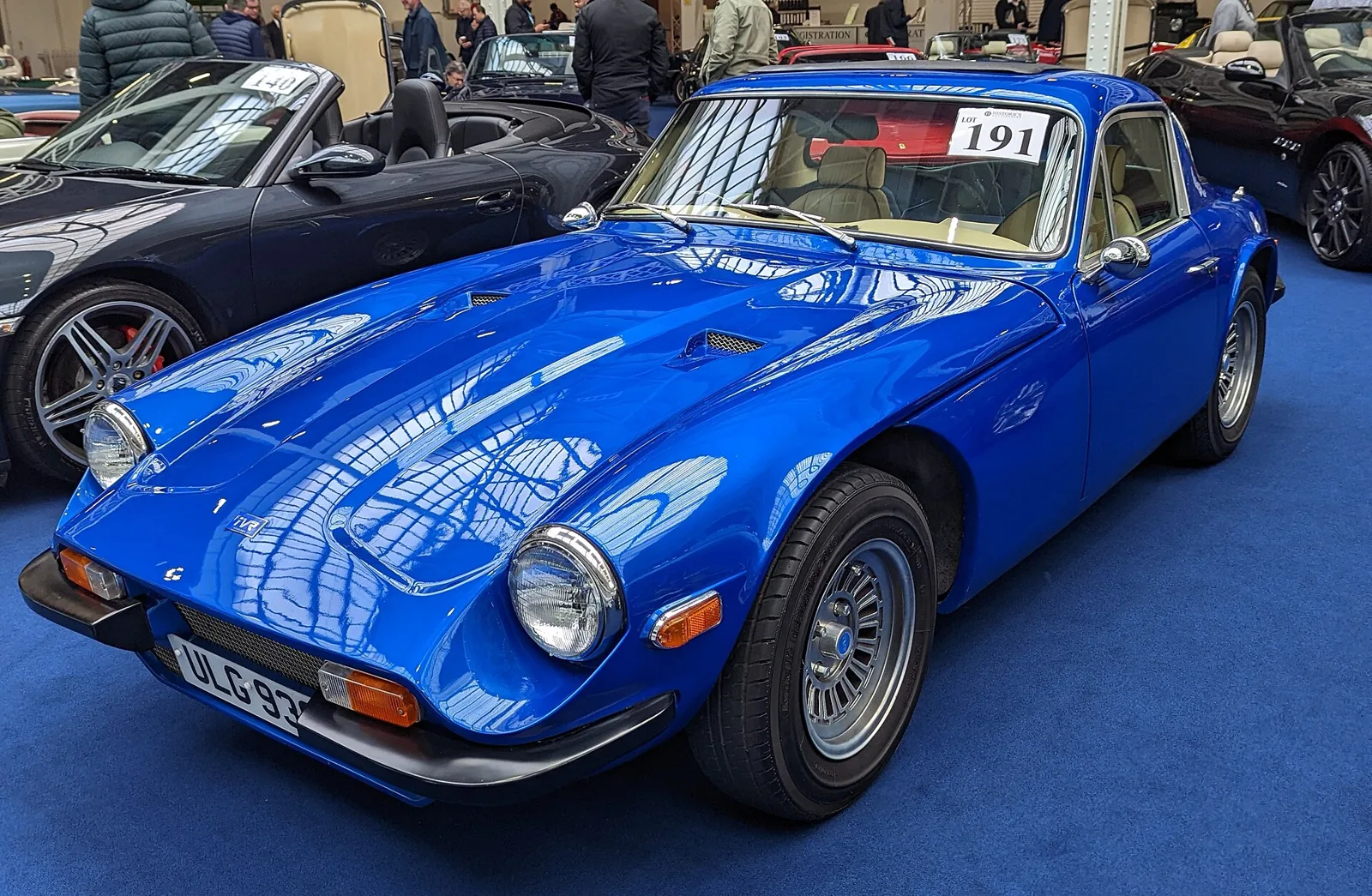
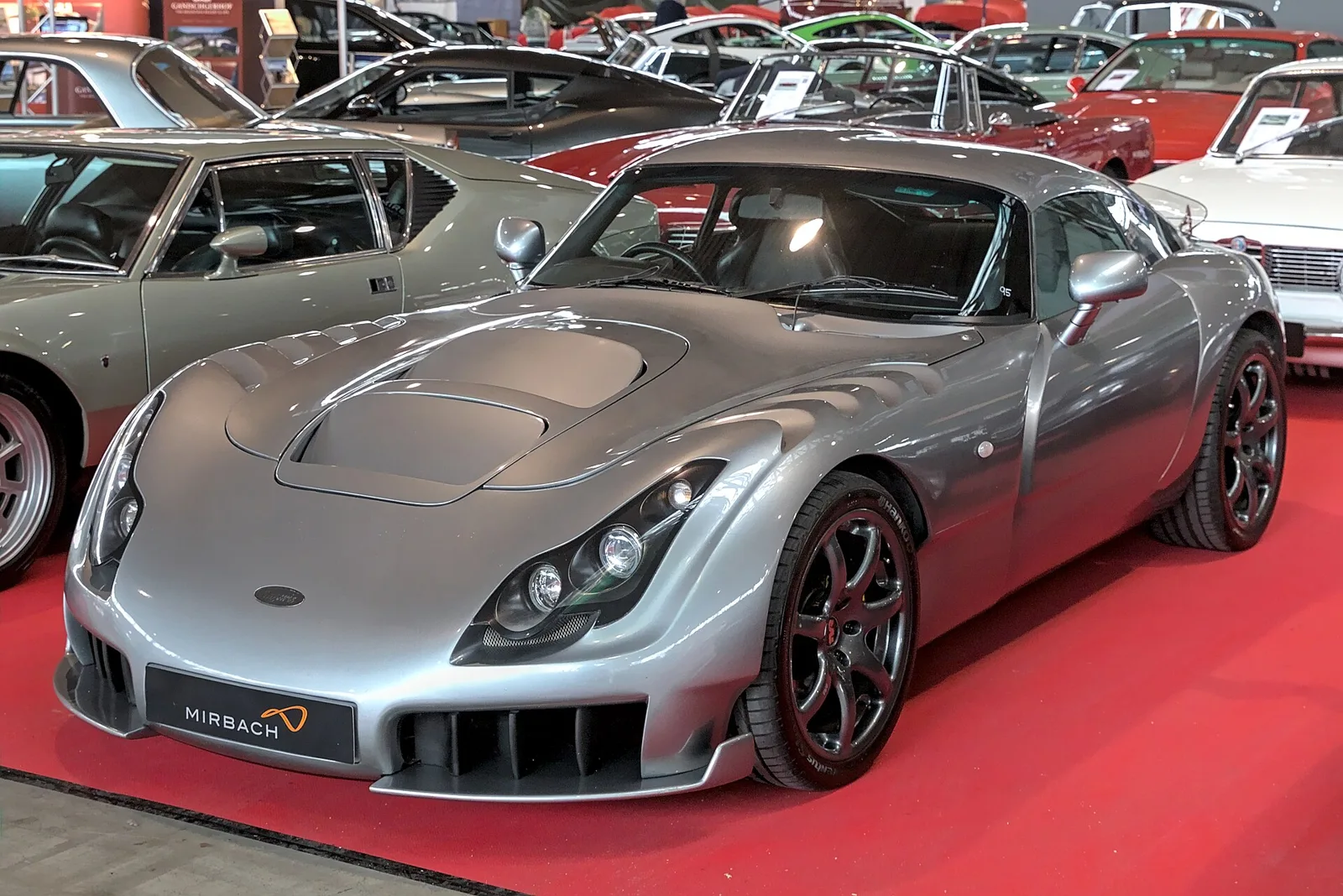
The S Series, first produced in 1986, brought back the traditional M Series design cues and became a major success. Later bodies came thick and fast, among them the Sagaris, Typhon, T350, Tamora, Tuscan, Cerbera, Griffith and Chimaera.
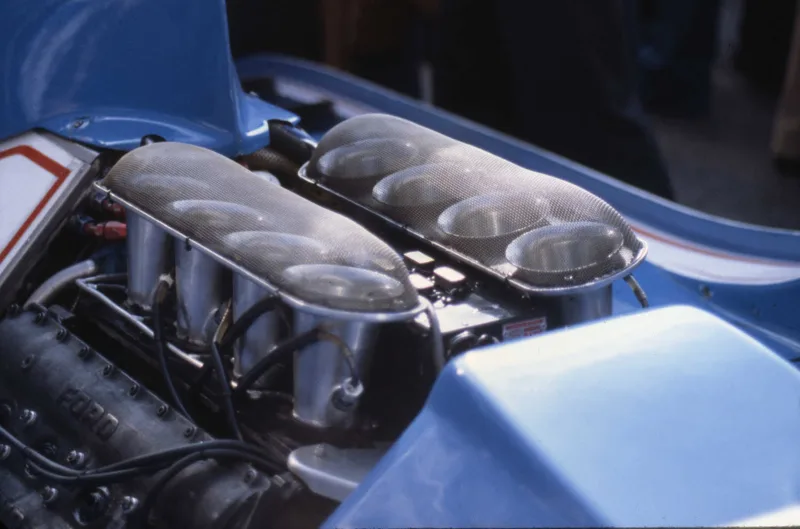
During that decade the company developed its own lightweight alloy V8, the AJP8, with engineering consultant Al Melling, John Ravenscroft and Wheeler. A straight-six derivative, the Speed Six, was cheaper to build, and it powered most of the late-model TVRs apart from the Cerbera, which could also use the AJP8.
What happened under Nikolay Smolensky?
Nikolay Smolensky bought TVR from Wheeler in July 2004. Although he was Russian, he said he wanted the company to remain British. Demand then fell, and in April 2006 TVR laid off around 300 staff, while the factory's lease was due to expire.
In October 2006 Smolensky said body work and final assembly would shift to Turin, with only engines still built in the UK. Owners protested through central London on 26 November 2006 in an event called London Thunder. By December 2006 the business had been split into several companies, and Blackpool Automotive went into administration by 24 December.
By 22 February 2007 Smolensky was again the owner after winning the bid. In June 2010 the German firm Gullwing, which held a minority share, announced plans for a new car, and its boss suggested that alternative drivetrains, even electric ones, were possible.
Where is TVR now?
In June 2013 Smolensky sold his stake to TVR Automotive Ltd, a British firm run by Les Edgar and John Chasey. In 2014 the company launched a parts initiative, TVR Parts Ltd, to secure supply for classic cars, and it bought the parts business of a classic specialist the following year.
In June 2015 TVR revealed a new car, codenamed T37, developed with Gordon Murray and Cosworth. It was to have a front-engined, rear-wheel-drive layout and a 5.0 L Ford Coyote V8 modified by Cosworth to produce 450 to 500 hp depending on the variant.
In March 2016 the Welsh Government announced that the factory would be built in Ebbw Vale beside the Circuit of Wales, creating 150 jobs. The government later bought a 3% stake for GBP 500,000 and provided a loan. The Griffith was shown for the first time during the Goodwood Revival weekend, 8 September 2017, in the marque's 70th anniversary year.
TVR raised a GBP 25m bond on Euronext Dublin in 2020 and agreed a joint venture with Ensorcia Metals in November 2021. Ensorcia's investment repaid the Welsh debt in 2022. In December 2023 TVR lost exclusive rights to the Ebbw Vale site, and in November 2025 Charge Holdings purchased the brand to revive it.
What are the key TVR figures?
| Item | Detail |
|---|---|
| Founded | 1946, Blackpool, by Trevor Wilkinson |
| First chassis | 1949, Ford 1,172 cc sidevalve, 35 hp |
| Sports Saloon kit | 1954, GBP 650, 635 kg, 0-97 km/h in 13 seconds |
| Grantura Mk1 run | 100 cars |
| Griffith prototype | 1963, Ford 289 V8 in a Grantura Mk3 |
| Liquidation | November 1964 |
| Factory fire | 3 January 1975, damage about GBP 200,000 |
| Peter Wheeler | Took control in December 1981 |
| Ebbw Vale | 150 jobs, opened under Welsh Government backing |
| Current owner | Charge Holdings, November 2025 |