A glass-reinforced sports car family from 1972 to 1979, with a backbone chassis, Essex V6 power, a turbo option and a US import dispute.
The TVR M series was a range of sports cars built from 1972 to 1979, sharing one backbone chassis and body style. It included the 1600M, 2500M, 3000M, Taimar and 3000S, with turbocharged versions of the 3000M, 3000S and Taimar.
The TVR M series was a family of sports cars that the British maker TVR built between 1972 and 1979. The cars shared one chassis and a common body style, and they replaced the outgoing Vixen and Tuscan models.
The layout was front mid-engine with rear-wheel drive, on a body-on-frame structure, a pattern TVR kept across many of its models. The bodies were made from glass-reinforced plastic, and the era is closely linked with Martin Lilley, who took ownership of the company with his father on 30 November 1965.
What did the TVR M series include?
The series comprised the 1600M, 2500M, 3000M, 3000S and Taimar, and the 3000M, 3000S and Taimar also came in turbo form. A few Ford V8 conversions were also made, sold as the 5000M through the Canadian importer.
Production began with the 2500M in March 1972, following a 1971 prototype. A total of 2,465 M-series cars were built over nine years, and the American market stayed financially very important to the company throughout.
Hand-building in small numbers means no two cars of a model are quite alike. The differences trace back to parts supply and small changes made during the build process.
Reviewers of the day found the cars loud and fast with excellent roadholding. The trade-off was awkward ergonomics and climate systems that could be unreliable.
A glass-reinforced sports car family that combined a shared backbone chassis with V6 power and a turbo option.
Who designed the M-series chassis?
The backbone chassis was designed by automotive engineer and dealer Mike Bigland in 1971. Lilley hired Bigland after Bigland had reworked the suspension and steering of John Burton's 1967 Tuscan SE, which impressed him.
The chassis used a central backbone with perimeter tubes. Round and square 14-gauge and 16-gauge steel tube was used in the construction, and the square sections made it easier to join the frame to the body. Lilley upgraded the workshop with fixtures that let two welders produce five units per week.
During testing Bigland drove a gold-painted prototype between his own workshop in Halesowen and the TVR factory several times a week. Those trips tested the chassis on real roads before production began.
The company promised five years' protection against rust on the chassis, a rare offer at the time. Rust was kept at bay by coating the metal with a residue of the manufacturing oil, sealing the tube ends, and fitting components without drilling through tube walls.
How safe was the M-series chassis?
The radiator was shallow enough to let the spare wheel sit in front of the engine. That freed up luggage space behind the seats, where the spare had been stored on earlier models, and it also gave some extra crash protection to the occupants.
An M-series car went to the Motor Industry Research Association in 1971 for crash testing. Among the vehicles tested, this was the only one still steerable after a 30 mph (48 km/h) front-end impact into a concrete wall. The engine stayed in position through the impact, the doors could still be opened, and the steering column had moved forward, away from the driver.
That last result almost led MIRA officials to ask for a re-test, because they assumed such a result was impossible and blamed their measuring instruments. Bigland demonstrated that the result was genuine, and approval was granted.
How did the M-series suspension, brakes and steering work?
The suspension used double wishbones and coil springs at both ends. The wishbones and aluminium hub carriers were an original TVR design, but many other components came from other manufacturers.
The brakes came from the Triumph TR6, with 11-inch discs at the front and 9-inch drums at the rear. Steering on every car was rack-and-pinion, with the rack made by Alford and Alder, while the steering column was a British Leyland part.
Several parts, including the differential carrier and the front wishbones, were TVR's own designs and were made in the company's welding shop. The running gear was therefore a mix of in-house and bought-in work.
Production overlap meant that some earlier models were built with pre-M bodywork over an M-series chassis. These included the last series of the TVR 2500, the Vixen S4s and the final TVR 1300 cars.
What was the M-series body like?
The M-series body grew out of the outgoing Vixen and Tuscan. Its doors, roof, forward bulkhead and windscreen carried over, and only the bonnet and rear were restyled. Bigland styled the bonnet, while Lilley handled the rear with help from Joe Mleczek, a company man since 1959.
Paint came after a bake at 140 degrees F (60 degrees C) and an etch coat. Six primer coats followed, then three coats of nitrocellulose lacquer. Partway through production the paint shop changed to a two-pack acrylic process.
John Bailie, a graphic artist, came up with the contrasting side stripe. It debuted on the turbo cars in 1976 and was later available on request across the M series. Lilley also designed the interior and trim.
Many parts came from Ford models, including the Consul windscreen fitted to every M-series variant except the 3000S. The taillights began as Ford Cortina Mark II units, then moved to Triumph TR6 lights before smaller square Lucas lamps arrived in a 1976 facelift.
The corduroy seats were finished by Callow and Maddox of Exhall, Coventry. Their foam padding tends to crumble, which leads some owners to look for replacements, and few aftermarket seats fit the glassfibre tub. During production TVR dealt with more than two hundred external suppliers and stored about three months' worth of components.
What was the 1600M?
The 1600M arrived in June 1972 with the Ford Kent 1.6L engine borrowed from the Capri GT. The gearbox was a four-speed Ford unit paired with a Triumph Spitfire differential, and the car cost 1,980 pounds in October 1972.
The car was discontinued in April 1973, but it returned for the 1975 model year to meet demand for fuel-efficient cars after the 1973 oil crisis. Production ended in 1977, and a total of 148 were built.
What made the 2500M different?
The US market was always important to TVR, so the 2500M used the 2.5-litre straight-six from the Triumph TR6, an engine that had already been certified for US emissions. Its gearbox, differential and front suspension uprights were also borrowed from the TR6.
The 2500M was sold only in the UK until 1973. The 3000M was faster, so the 2500M was dropped from the home market once that car arrived. Triumph stopped the 2.5 L engine when the TR7 came along, and TVR ended the 2500M when its engine supplies ran out in 1977.
The engine had an inherent fault in this car: it tended to overheat in traffic or at high revs. The car itself sold for 2,151 pounds in October 1972, and 947 were sold between 1972 and 1977.
What were the 3000M, Taimar and 3000S?
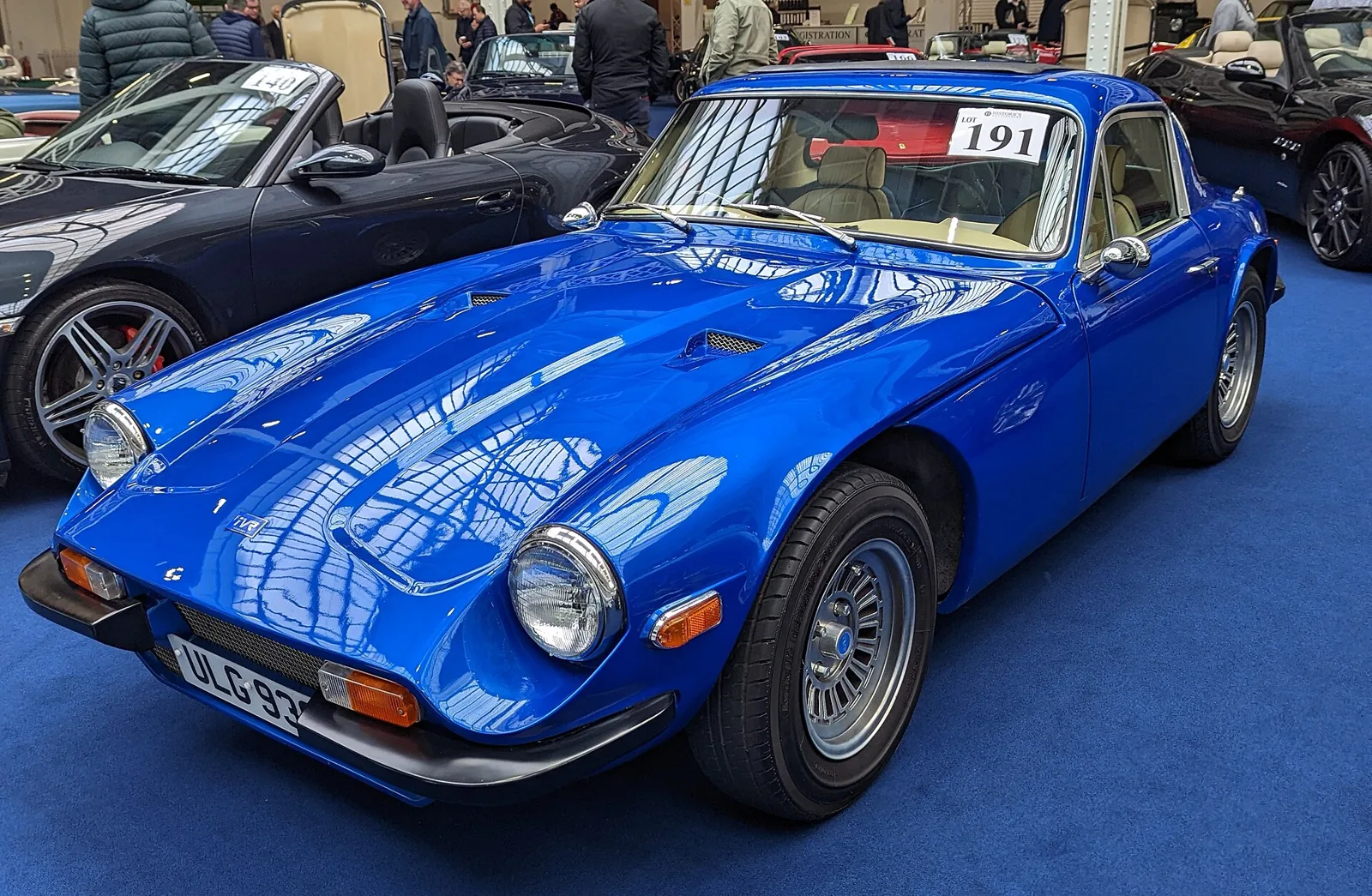
Positioned above the 1600M and 2500M, the 3000M made its bow at the October 1972 Earl's Court Motor Show. It used the 3.0 L Ford Essex V6, cost 2,278 pounds in October 1972 and could be fitted with a switchable Laycock de Normanville overdrive.
The 3000ML was a luxury version built for one year, between 1973 and 1974. It had a walnut veneer dashboard, leather trim, Wilton carpets and a sunroof. In total 654 naturally aspirated 3000Ms were built, including both standard and luxury trim levels.
The Taimar was the first major change to the body. It arrived as a hatchback at the October 1976 British International Motor Show and used the same mechanicals as the 3000M. A solenoid latch, released by a button on the driver's doorjamb, operated the hatch electrically, which made loading luggage far easier than over the seats. A total of 395 normally aspirated Taimars were built over three years.
The 3000S arrived in 1978 as an open roadster. It was mechanically identical to the 3000M, but only the nose of the car matched the earlier coupes. Its windscreen and convertible top were adapted from the Jensen-Healey roadster, and the sidecurtains could be removed and stowed in a separate boot compartment.
Production of the 3000S ended with 258 cars built, and each cost 8,730 pounds when new. Of those, 67 were left-hand drive and 49 went to North America.
To mark the first decade of Lilley's ownership, twelve 3000M anniversary cars were built. The first ten were individually numbered, from Martin 1 to Martin 10, because the company had first planned to build exactly ten.
Were there turbocharged M-series cars?
Broadspeed, the engine tuning firm run by Ralph Broad, was brought in to build a turbo system for the Essex V6. The result was unveiled at the 1975 British International Motor Show before going into production.
Instead of fuel injection, a carburettor ran inside a pressurised box on top of the engine. The turbocharger sat low and forward, which meant the exhaust manifolds had to exit forward, and the compression ratio was lowered to reduce internal stress. The turbo cars also had Koni dampers and wider tyres.
Four turbo cars were built to the Special Equipment specification, with leather, flared wheel arches, large Compomotive split-rim wheels and a limited-slip differential. Three were Taimar Turbo SEs, and one was a 3000S Turbo SE that Lilley used as his own transport until he sold it.
Production counts were 20 3000M Turbos, 32 Taimar Turbos and 13 3000S Turbos. The chassis numbers for turbo cars fell within the ranges used by their normally aspirated counterparts.
How did US emissions rules shape the M series?
Because Triumph's 2.5 L inline-six carried federal certification, TVR could fit it to US-bound cars under lighter testing, even after Triumph stopped making it in 1976. Olson Engineering, a Californian firm, was hired to modify the Essex V6 for EPA certification in 1976.
A legislative change also meant the Essex engine could be certified through the less demanding route. Essex-engined cars rated at 142 hp (106 kW) started arriving late in 1977, as 1978 models. Emissions control combined a catalytic converter with exhaust gas recirculation and air injection.
The US side of the business then ran into trouble. Between October 1979 and January 1980, four shipments containing twenty-eight 3000S cars arrived at an import business run by Pierre Arquin. Those cars had been marked as emissions compliant without the Olson kit being fitted, and dealers were pressed into buying at least two each.
Authorities seized eighteen of the twenty-eight. The other ten had already gone to a third party. The impounded cars were stored outside for a long time, deteriorated and were vandalised before they were re-exported and sold in Germany.
What was the 5000M?
A 1974 project led by John Wadman, head of TVR North America, swapped the yellow 2500M's Triumph six for a Ford 302 cu in Windsor V8. The conversion needed new mounts, a different radiator and new springs, and the resulting car appeared at the Toronto auto show in 1975.
After a 1975 fire damaged the TVR factory in Blackpool, TVR North America pre-paid for six cars. The factory later supplied five M-series coupes without engines or transmissions for V8 installations. In 1978 it built one more car, painted white with a brown stripe, and gave it the 5000M designation.
Since 1980, six Taimars have also been converted to the Ford V8.
What were the M-series specifications?
| Model | Engine | Power | Top speed | 0-60 mph | Built |
|---|---|---|---|---|---|
| 1600M | 1,598cc inline-four, Ford Kent | 86 bhp (64 kW; 87 PS) at 5,500 rpm | 105 mph (169 km/h) | 10.4 seconds | 148 |
| 2500M | 2,498 cc straight-six, Triumph TR6 | 106 bhp (79 kW; 107 PS) at 4,900 rpm | 109 mph (175 km/h) | 9.3 seconds | 947 |
| 3000M and Taimar | 2,994 cc V6, Ford Essex | 138 bhp (103 kW; 140 PS) at 5,000 rpm | 121 mph (195 km/h) | 7.7 seconds | 654 and 395 |
| 3000S | 2,994 cc V6, Ford Essex | 138 bhp (103 kW; 140 PS) at 5,000 rpm | 121 mph (195 km/h) | 7.7 seconds | 258 |
| Turbo versions | Essex V6 with Broadspeed turbocharger | 230 bhp (172 kW; 233 PS) at 5,500 rpm | 155 mph (249 km/h) | 5.7 seconds | 20 3000M, 32 Taimar, 13 3000S |
What became of the M series after production?
The M series ended in 1979, but its tooling and its story lived on. After production stopped, the production rights and tooling for many M-series parts, GRP bodies among them, went to David Gerald TVR Sportscars Ltd.
The short-term cost of the impounded US cars was damaging to the development of the M-series replacement, the Tasmin. Owner rebuild pages and an M-series technical library remain among the references for the model's history.