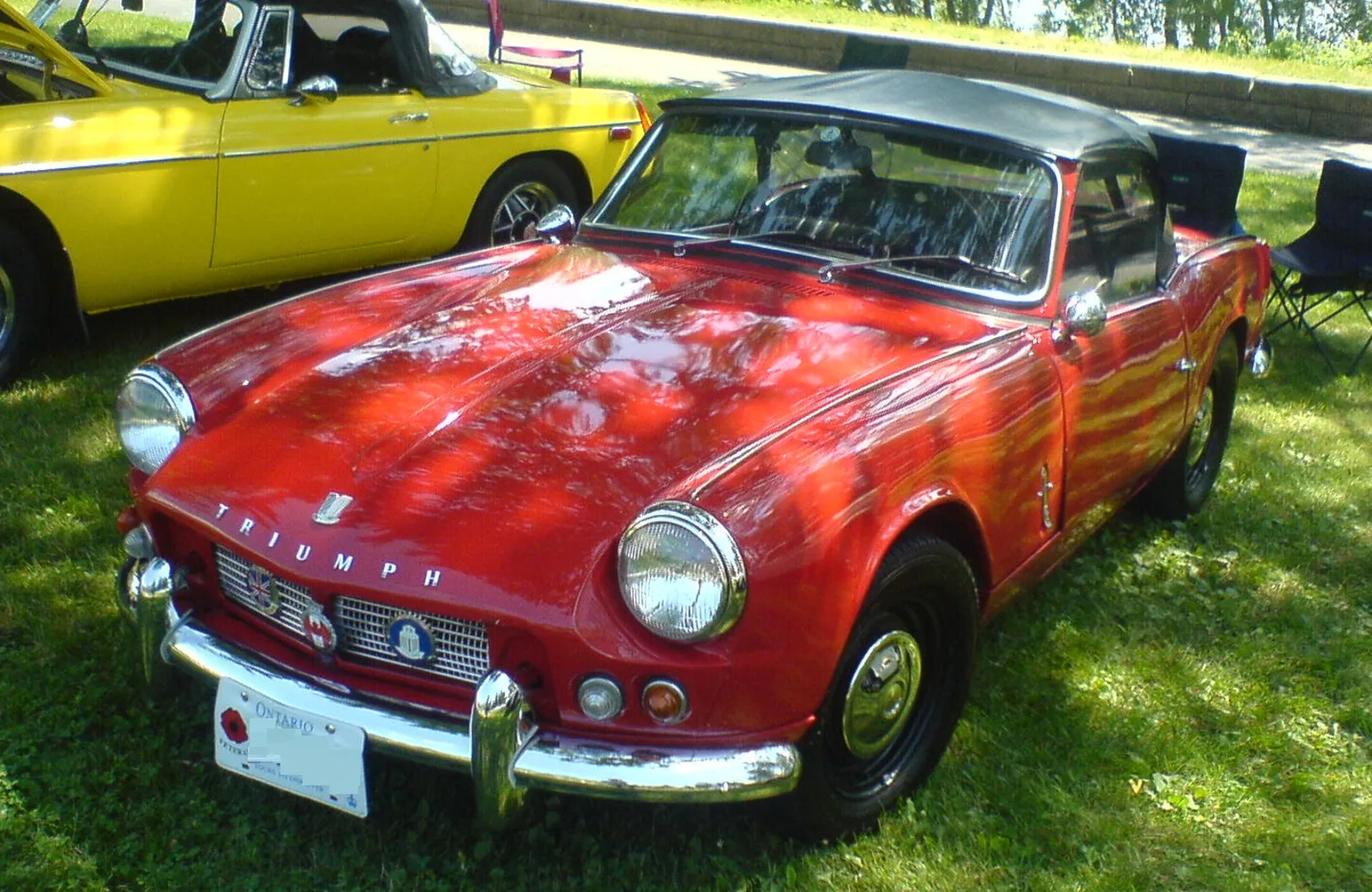
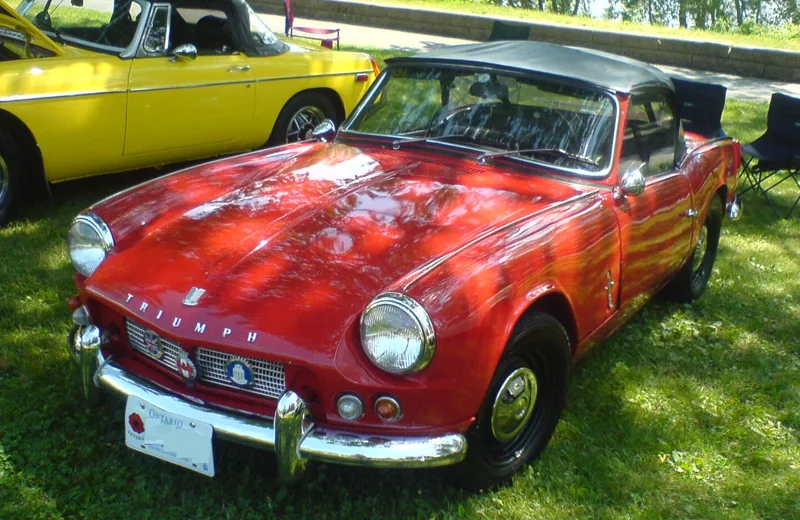
A small British roadster built on Herald mechanicals from 1962 to 1980, from its Project Bomb origins to the last car built at Canley.
Standard-Triumph's Spitfire was a Herald-based roadster that Giovanni Michelotti styled. It began as a rival to the Austin-Healey Sprite, using Herald mechanicals under a new body. About 315,000 were produced between 1962 and 1980, and the name came from the Second World War fighter.
The Triumph Spitfire was a small British roadster built by Standard-Triumph at its Canley works from 1962 to 1980. It was styled by Giovanni Michelotti, used Herald mechanicals, and about 315,000 were produced over 18 years.
The Spitfire took its name from the Supermarine fighter of the Second World War, and it appeared at the London Motor Show in 1962. Michelotti had styled the car as far back as 1957, but financial troubles delayed its launch until after Leyland had taken over Standard-Triumph.
Where did the Spitfire come from?
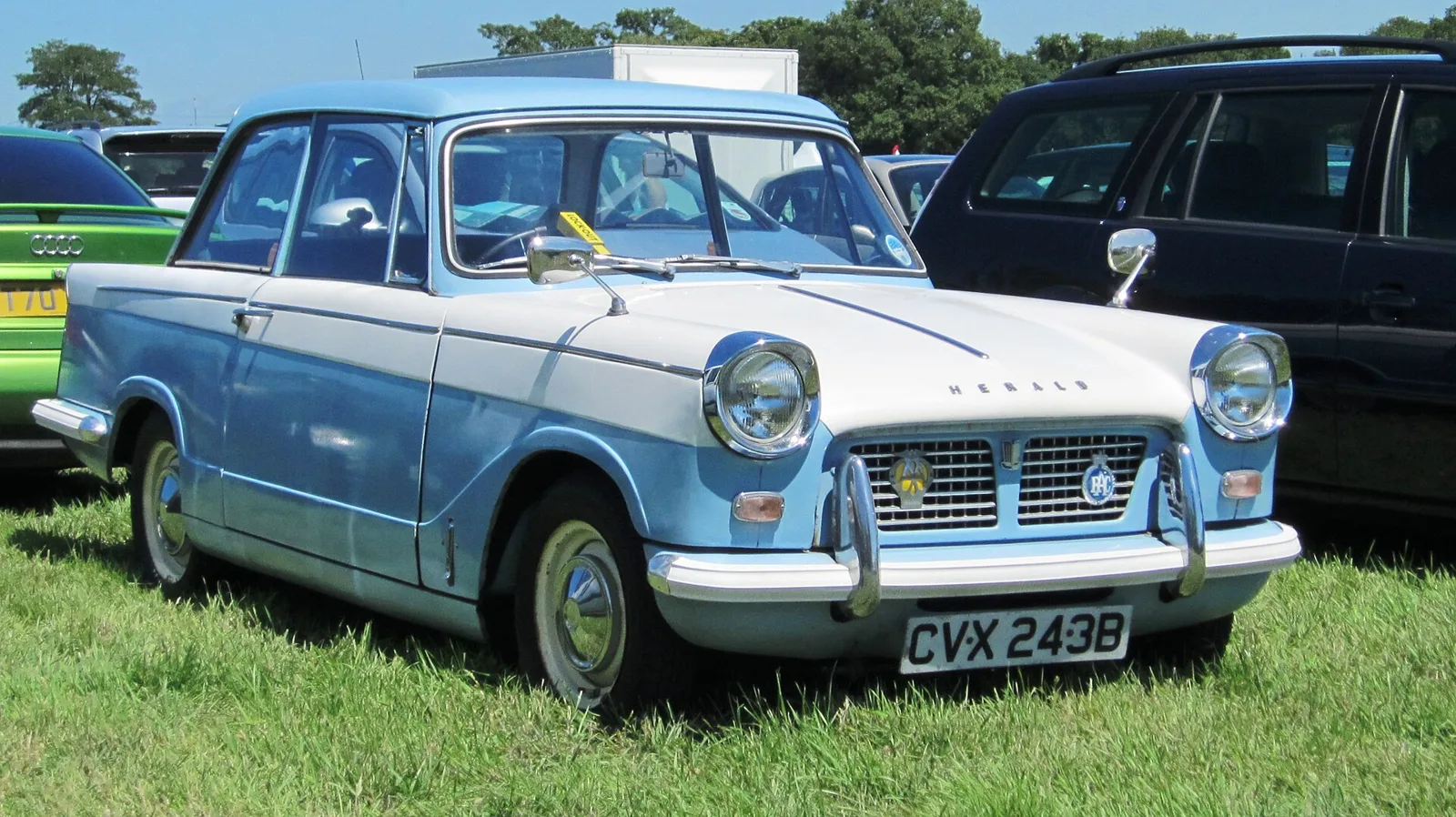
Standard-Triumph developed the Spitfire, codenamed Project Bomb, to compete with the Austin-Healey Sprite. It used the mechanical parts of the Triumph Herald saloon on a shortened chassis, while the Sprite used the Austin A30 and A35 drivetrain in a new lightweight body.
The Herald had a separate backbone chassis, where the Austin A30 used unitary construction. Triumph could downsize the Herald chassis, which spared Triumph the expense of a wholly new chassis and body unit.
Designer Giovanni Michelotti, who had also drawn the Herald, gave the bodywork its shape. He fitted wind-down windows, unlike the side curtains of the Sprite and Midget, and a cowl formed by the bonnet and wings, hinged at the front for engine access.
The launch was held back by the company's financial troubles in the early 1960s. Once Leyland had taken over, its managers came across the prototype hidden under a dust sheet and approved it for production.
A Herald-based roadster that began as a rival to the Sprite and ran for 18 years.
What did the first Spitfire offer?
The first Spitfire, now called the Mark I or Spitfire 4, kept the steering rack and the coil-and-wishbone front suspension borrowed from the Herald. Its 1,147 cc four-cylinder engine developed 63 bhp (47 kW) at 5,750 rpm in UK trim, and front disc brakes came as standard.
The design barely moved on from the prototype. Two part bumpers with overriders curved around each corner in place of a full-width rear bumper, and the bodywork was bolted to a much-modified Herald chassis with structural outer sills.
Early cars were sometimes called Spitfire 4s, a name that hinted at a six-cylinder version which never arrived. The rear end was the weak point. A single transverse-leaf swing axle could change the camber of the rear tyres sharply in fast corners, leading to oversteer. Triumph later fitted a swing spring arrangement in 1970 to tame the problem.
Trim was basic, with rubber mats and a large plastic wheel, though wind-down windows and exterior door locks kept it comfortable by the standards of the day. The quoted top speed was 92 mph (148 km/h), and 60 mph came up in 16.4 seconds. An overdrive became optional for 1964, and buyers could choose wire wheels or a hard top too.
How did the Mark II improve on the original?
The Mark II arrived in March 1965 with a retuned engine that produced 67 bhp (50 kW) at 6,000 rpm. A Borg and Beck diaphragm-spring clutch replaced the coil-spring design, and the interior gained carpet and rubber-cloth seat covers. The 0-60 mph time fell to 14.8 seconds.
Pricing made the car attractive. The base price was 550 pounds sterling, against 505 pounds for the Austin-Healey Sprite and 515 pounds for the MG Midget. Triumph quoted 96 mph (154 km/h) as the top speed for the Mark II.
The factory claimed 38.1 miles per imperial gallon at a steady 70 mph (110 km/h), which translates to 7.41 L/100 km and 31.7 mpg-US.
What changed with the Mark III?
The Mark III arrived in March 1967 as the first major facelift. Its engine grew to 1,296 cc, producing 75 bhp (56 kW) at 6,000 rpm in twin SU form, and it reached 60 mph in 13.4 seconds before topping out at 95 mph (153 km/h).
The front bumper was raised for new crash rules, and rear overriders disappeared in favour of bumper-mounted reversing lights. Inside, the instruments gained a veneered wood surround and the steering wheel shrank to 15 inches. A folding hood replaced the earlier design.
The 1,296 cc unit came from the Herald 13/60 and Triumph 1300 saloons, and a quieter exhaust reduced cabin noise. Buyers could add wire wheels, a works hardtop or a Laycock de Normanville overdrive.
In February 1968 George Turnbull drove the 100,000th Spitfire off the Canley line. More than three-quarters of that total had been exported, with 45% going to the United States and 25% to mainland Europe.
The 1968 car added dual-circuit brakes with a warning device, and the distributor retarded idle timing to address emissions. The Mark III continued into 1971, well after the Mark IV had arrived.
How did the US-spec Spitfire differ?
From 1969 US-bound cars were federalised to meet safety and emissions rules. Compression fell to 8.5:1, power dropped to 68 bhp, and the 0-60 mph time rose to 14 seconds, although the car remained quicker than the Mark II in that respect.
The instruments moved ahead of the driver, and the seats gained built-in headrests to reduce whiplash injuries. The wooden dash gave way to a matt black finish meant to resemble an aircraft cockpit.
The 1970 car received integrated reverse and number-plate lamps, a steering column ignition switch and a black spoked steering wheel. Some North American cars had a single Zenith-Stromberg carburettor, and a limited number of US cars carried an RAF-style badge.
What was the Mark IV like?
The Mark IV, built from 1970 to 1974, had a reworked tail, close in style to the Stag and 2000, both also styled by Michelotti. Its full-width dashboard placed the instruments ahead of the driver, and the car kept the 1,296 cc engine.
UK engines made 63 horsepower, with 9:1 compression and twin SU HS2 carburettors. The taller 3.89:1 final drive, replacing 4.11:1, and the extra weight made the car slower than the Mark III.
The heavily criticised rear was improved by decambering. One leaf was removed and only the bottom leaf was rigidly fixed to the differential, while the others pivoted freely. Triumph called it a swing spring.
Triumph's GT6 Mk II and Vitesse Mk 2 took a different route, relying on lower wishbones and Rotoflex couplings at the half-shafts. Both approaches improved handling on those cars.
UK buyers could order the Mark IV from late 1970, starting at 735 pounds. Its weight rose to 1,717 lb (779 kg), and the 0-60 mph time grew to 15.8 seconds while the top speed fell to 90 mph (140 km/h).
What was the Spitfire 1500?
The Spitfire 1500 reached North American buyers in 1973 and other markets in 1975, using a 1500 engine on the Mark IV body. Its 87.5 mm stroke boosted torque, which made it easier to drive in traffic. The engine was rough, though, and it failed more often than earlier units.
The US car kept a single Zenith-Stromberg carburettor and 7.5:1 compression. It produced 53 bhp (40 kW) DIN and needed 16.3 seconds for 0-60 mph.
In the UK the 1500 used 9:1 compression and larger HS4 carburettors, producing 71 hp (DIN) at 5,500 rpm. Torque was 82 lb-ft (111 N-m) at 3,000 rpm, and the car reached 100 mph (160 km/h) and 60 mph in 13.2 seconds.
Suspension changed too, with longer swing axles, a lower spring mounting point and a wider rear track. The wider stance produced an average skid pad figure of 0.87g, and the gearbox gained synchromesh on bottom gear.
US cars are recognised by their plastic over-riders and reflectors set into the wings. From 1979 chrome gave way to rubber bumpers that carried their own over-riders.
Interior details improved. Reclining seats with chequered nylon panels and head restraints arrived in 1977, along with column stalk controls like those on the TR7. Late cars had a wooden dash, hazard warning flashers and an electric washer for the windscreen.
Buyers still ordered hardtops, tonneau covers, map lights and overdrive, but wire wheels were dropped. The final model was the heaviest of all at 1,875 lb (850.5 kg), and in 1980 a US buyer paid $7,365 and a UK buyer 3,631 pounds at list.
How did the Spitfire perform in competition?
Spitfires were strong in club and rally competition. They took several SCCA class titles in America, mainly in the F and G Production classes, finished second overall after winning their class in the 1964 Tour de France rally, and won the 1964 Geneva Rally.
A year later, a Spitfire took the class prize at the Alpine Rally. The car was popular in both street and rally racing.
How did the Spitfire production end?
After 18 years, the line stopped. Production ended at Canley in August 1980, a short time before the works shut. The final car was an Inca Yellow UK model with the factory hardtop and overdrive, and it was never sold to a customer.
That last car is now kept on show at the British Motor Museum.
What are the Triumph Spitfire specifications?
The Spitfire was a roadster with body-on-frame construction and a manually operated convertible top. The table sets out the engine, performance and weight figures for each main model, and figures are for UK specification unless stated otherwise. The final model is also the heaviest in the range.
| Specification | Detail |
|---|---|
| Production span | 1962 to 1980, five production iterations |
| Mark I engine | 1,147 cc, 63 bhp (47 kW) at 5,750 rpm |
| Mark I performance | 92 mph (148 km/h) top speed; 0-60 mph in 16.4 seconds |
| Mark II engine | 67 bhp (50 kW) at 6,000 rpm |
| Mark II performance | 96 mph (154 km/h) top speed; 0-60 mph in 14.8 seconds |
| Mark III engine | 1,296 cc, 75 bhp (56 kW) at 6,000 rpm, twin SU carburettors |
| Mark III performance | 95 mph (153 km/h) top speed; 0-60 mph in 13.4 seconds |
| US 1969 cars | 68 bhp with 8.5:1 compression; 0-60 mph in 14 seconds |
| Mark IV weight | 1,717 lb (779 kg) |
| Mark IV performance | 90 mph (140 km/h) top speed; 0-60 mph in 15.8 seconds |
| 1500 UK | 71 hp (DIN) at 5,500 rpm; 100 mph (160 km/h); 0-60 mph in 13.2 seconds |
| 1500 US | 53 bhp (40 kW) DIN; 0-60 mph in 16.3 seconds |
| Final model weight | 1,875 lb (850.5 kg), 1980 |
| Total built | About 315,000 over 18 years |
.jpg)