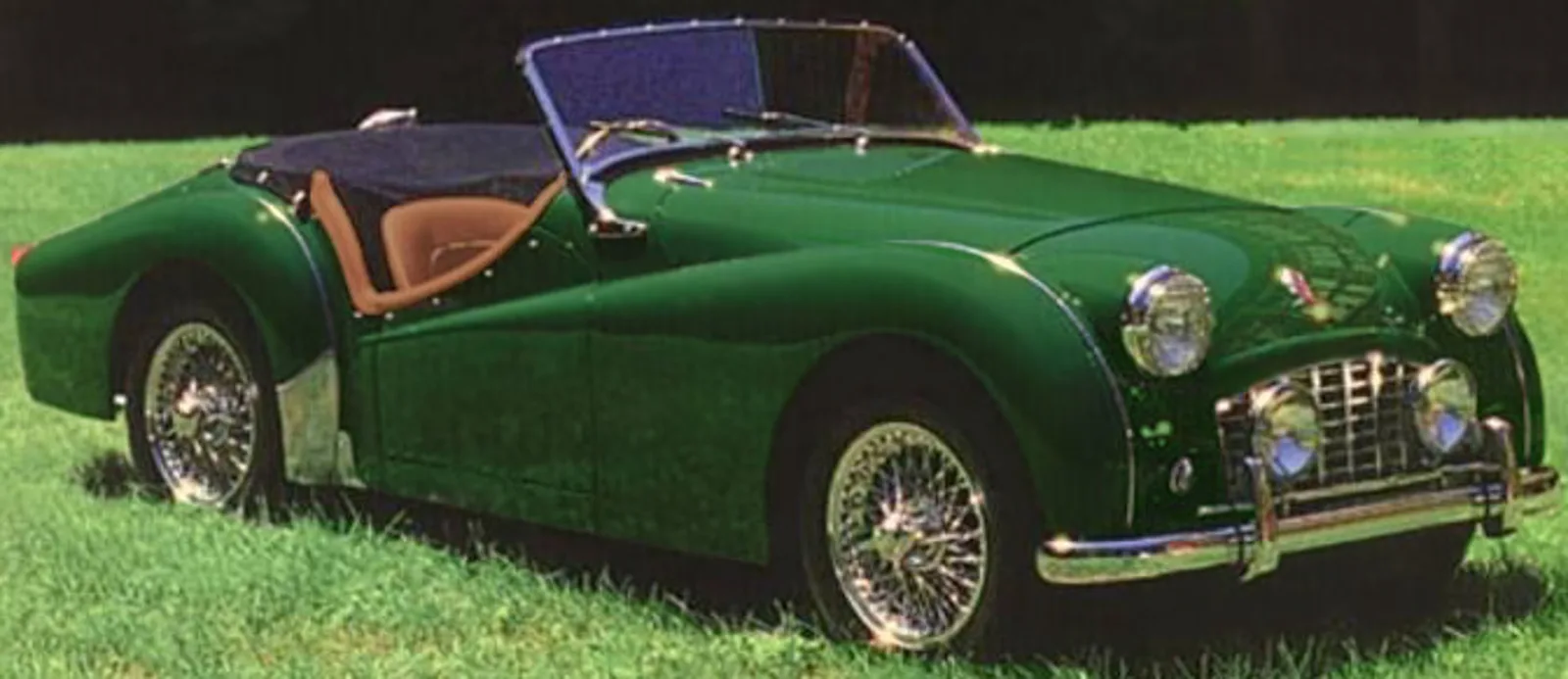
Built by the Standard Motor Company from 1955 to 1962, the TR3 was a sidescreen two-seater with a 1,991 cc four, a strong rally record and a short-lived TR3B finale.
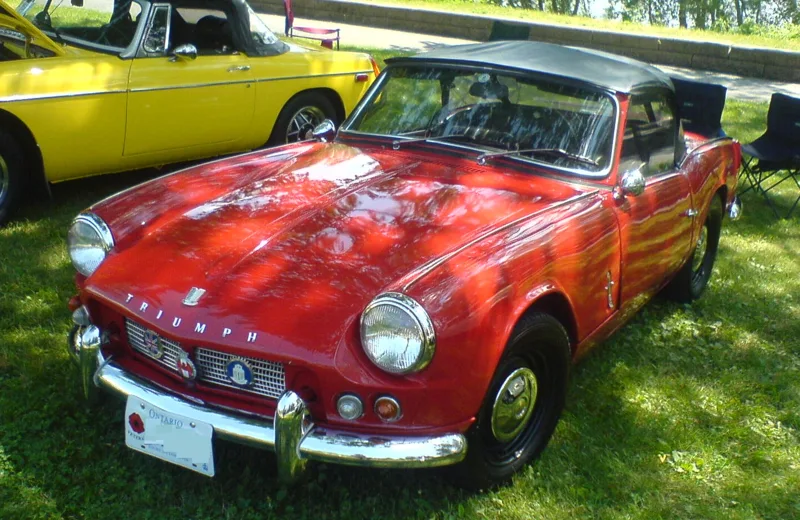
Built by the Standard Motor Company between 1955 and 1962, the Triumph TR3 was a sidescreen two-seater with a 1,991 cc four-cylinder engine producing 95 bhp at first. It was succeeded by the Michelotti-styled TR4, and around 74,800 TR3s were sold across all variants.
The Triumph TR3 was a British open two-seater built by the Standard Motor Company in Coventry from 1955 to 1962. It evolved from the TR2 with greater power and better brakes, and around 74,800 were sold across all variants. Its removable side curtains earned it the sidescreen TR nickname.
Where did the Triumph TR3 come from?
The TR3 grew out of the TR2, with more power and sharper braking. It kept the open two-seat layout and the removable plexiglass side curtains that gave the car its name. Its sales and motorsport record made it one of the most important cars in the Triumph range.
Around 74,800 TR3s were sold across all variants, making it the company's third best seller in the TR range. The TR7 sold 111,500 units and the TR6 sold 94,500. Unofficial names, TR3A and TR3B, label the updated versions from 1957 and 1962.
The TR3 was succeeded by the mechanically similar TR4, which was styled by Giovanni Michelotti. The TR4 was already in development while the final TR3s were being built.
A sidescreen roadster that won rallies, sold around 74,800 examples and brought front disc brakes to British series production.
What engine and performance did the TR3 offer?
The TR3 used a 1,991 cc Standard wet-liner overhead-valve straight four. It initially produced 95 bhp (71 kW; 96 PS), five horsepower more than the TR2 thanks to larger SU H6 carburettors. A high-port cylinder head and an enlarged manifold later lifted output to 100 bhp at 5000 rpm.
A four-speed manual gearbox could be supplemented by an electrically engaged overdrive, switched from the dashboard. The Motor tested a hardtop with overdrive in 1956 and recorded a top speed of 105.3 mph (169.5 km/h). It accelerated from 0-60 mph (97 km/h) in 10.8 seconds and managed 27.1 mpg-imp, or 22.6 mpg-US and 10.4 L/100 km.
A 1977 Road and Track article on the TR3A reported 0-60 mph in 12.0 seconds and 100 bhp at 4800 rpm. Kerb weight was 2,090 lb (950 kg), and fuel use came to 28 mpg-imp (10 L/100 km; 23 mpg-US).
How did the chassis and steering behave?
The TR3 used unequal-length double wishbones with coil springs and telescopic dampers at the front, and a live rear axle on leaf springs with lever arm dampers. The steering was a worm and peg system with considerable play, which grew with wear. Under most conditions the car was responsive and forgiving.
The chassis, shared with the TR2, TR3A, TR3B and TR4, had limited wheel travel. In very hard cornering the inside rear wheel could lift, causing sudden oversteer as load moved to the outside tyre. The problem was worse with radial tyres, because the original suspension was built for crossply tyres.
Wheels measured 15 inches in diameter and 4.5 inches wide, having been widened from 4 inches after the first few TR2s. Forty-eight-spoke wire wheels were optional, and they were usually painted in body colour or argent, although matte and bright chrome were also available.
How was the TR3 designed for British weather?
The TR3 was designed for sunny weather, with rain protection that could be fitted when needed. Its hood snapped on and off, and removable side curtains allowed very low doors, padded where the driver's arm rests. The optional heater was poor, and its shut-off valve sat under the bonnet.
Holes in the floor, closed with rubber plugs, allowed the originally supplied jack to be used from inside the car. The arrangement recalls the Jaguar XK120.
Options were extensive, from overdrive and wire wheels to a steel hardtop kit, a push-button radio, leather upholstery and fog lamps. Triumph also offered a continental touring kit with spares for travel in remote regions.
How many TR3s were built, and how many survive?
About 13,377 examples of the original pre-facelift TR3 were produced. Of these, 1,286 were sold in the UK, and the rest were exported, mainly to the United States. The TR3A, built from 1957 to 1962, reached a total of 58,236 cars.
DVLA registration figures showed about 826 licensed and 115 SORN TR3 and TR3A cars in the first quarter of 2011. It is estimated that only 9,500 of the 58,000 TR3As built survive today.
Demand for the TR3A was so strong that the first panel press tooling wore out and had to be replaced.
What changed on the TR3A?
The 1957 TR3A was the revised model, still badged as a TR3. The update brought a new wide front grille, outside door handles and a boot handle that could be locked. The full tool kit became standard, and the front disc brakes carried over from the later TR3s, which gave the car superior braking.
In 1959 the car gained raised stampings under the bonnet, under the boot hinges and under the door handles, along with a redesigned rear floor section. The windscreen was bolted rather than fixed with Dzus fasteners. New options included a 2138 cc engine and 60-spoke wire wheels.
The braking made the TR3A an autocross favourite, and it is still competitive in the SCCA E-production class despite being more than 50 years old.
What was the TR3B?
The TR3B is the unofficial name for the final TR3, produced in 1962. It ran alongside the TR4, which began production in 1961, as a short run answering dealer concerns that buyers might not welcome the TR4. Most looked like the late US-model TR3A.
Two series were made: 530 cars with TSF commission numbers, 29 of which were built as Triumph Italias, and 2,804 cars with TCF numbers. The TSF cars kept the 1991 cc engine, while the TCF series had the 2138 cc unit with a 9:1 compression ratio and two SU H6 carburettors.
The 2138 cc engine made 105 hp (78 kW) at 4,650 rpm and 172 Nm (127 lbf ft) of torque at 3,350 rpm. On the road it managed roughly 20 to 30 miles per US gallon, equal to 11.8 to 7.8 L/100 km or 24 to 36 mpg-imp. The gearing limited top speed to about 110 mph (177 km/h) unless overdrive was fitted, and the car weighed 2,137 lb (969 kg).
An electrically operated Laycock de Normanville Type A overdrive worked on second, third and fourth gears and was offered as an option.
What were the TR3 Speciale and the TR3 Beta?
After Triumph's managing director Alick Dick introduced Giovanni Michelotti to the company, Michelotti produced a concept car known as the TR3 Speciale, or TR Dream Car. Built by Vignale on an unmodified TR3 chassis, it debuted at the Geneva International Motor Show in March 1957. Triumph judged it too costly to build for sale.
Its styling borrowed American ideas such as tailfins, a broad grille, lidded headlamps set into the front wing tops and two-tone paint. Triumph did give Michelotti the job of designing the new Triumph Herald.
The TR3 Beta was a prototype with wider front and rear tracks, revised mechanicals and wider wings. It appears several times in the minutes of the Standard-Triumph board meeting of 19 September 1960. Ray Bates led the team, and Ray Henderson cut chassis X693 in half lengthwise and widened it.
The Beta took its fully synchronised gearbox, rack-and-pinion steering and bigger engine from the TR4. After the company became part of Leyland Motors, the parent funded the TR4 body tooling, and work on the Beta stopped. Only two examples were built, the Black Beta and the Red Beta.
How did the TR3 perform in competition?
Across Europe and North America the TR3 appeared in races, hill climbs and rallies, collecting outright, team and class wins. After the 1955 Le Mans disaster, French rules favoured grand touring coupes, so Triumph's competition manager Ken Richardson bolted steel hard tops to 100 TR3s to homologate the car as a grand touring machine.
TR3s competed in the RAC, Monte Carlo, Circuit of Ireland and Acropolis rallies, among others, collecting six Coupes des Alpes awards. Its robust engine also made it a popular hill climb competitor at Ollon Villars and Eberbach, and it ran in the 12 Hours of Sebring and the Mille Miglia.
Three heavily modified TR3S cars took part at Le Mans in 1959, running with glass fibre bodies, six inches longer than the production car, and with prototype 1,985 cc Triumph Sabrina engines. The Jopp/Stoop car ran as high as seventh overall before mechanical trouble ended its race.
Triumph TR3 specifications at a glance
| Specification | Detail |
|---|---|
| Production period (basic model) | October 1955 to summer 1957 |
| Engine | 1,991 cc (121.5 cu in) Standard wet-liner four |
| Output | 95 bhp (71 kW; 96 PS), later 100 bhp at 5000 rpm |
| Original price | GBP 950 for the basic model |
| Brakes | 10-inch drums at first; front discs from 1956 |
| Top speed (The Motor, 1956) | 105.3 mph (169.5 km/h), hardtop with overdrive |
| TR3B engine | 2138 cc, 105 hp (78 kW) at 4,650 rpm |
| TR3B weight | 2,137 lb (969 kg) |