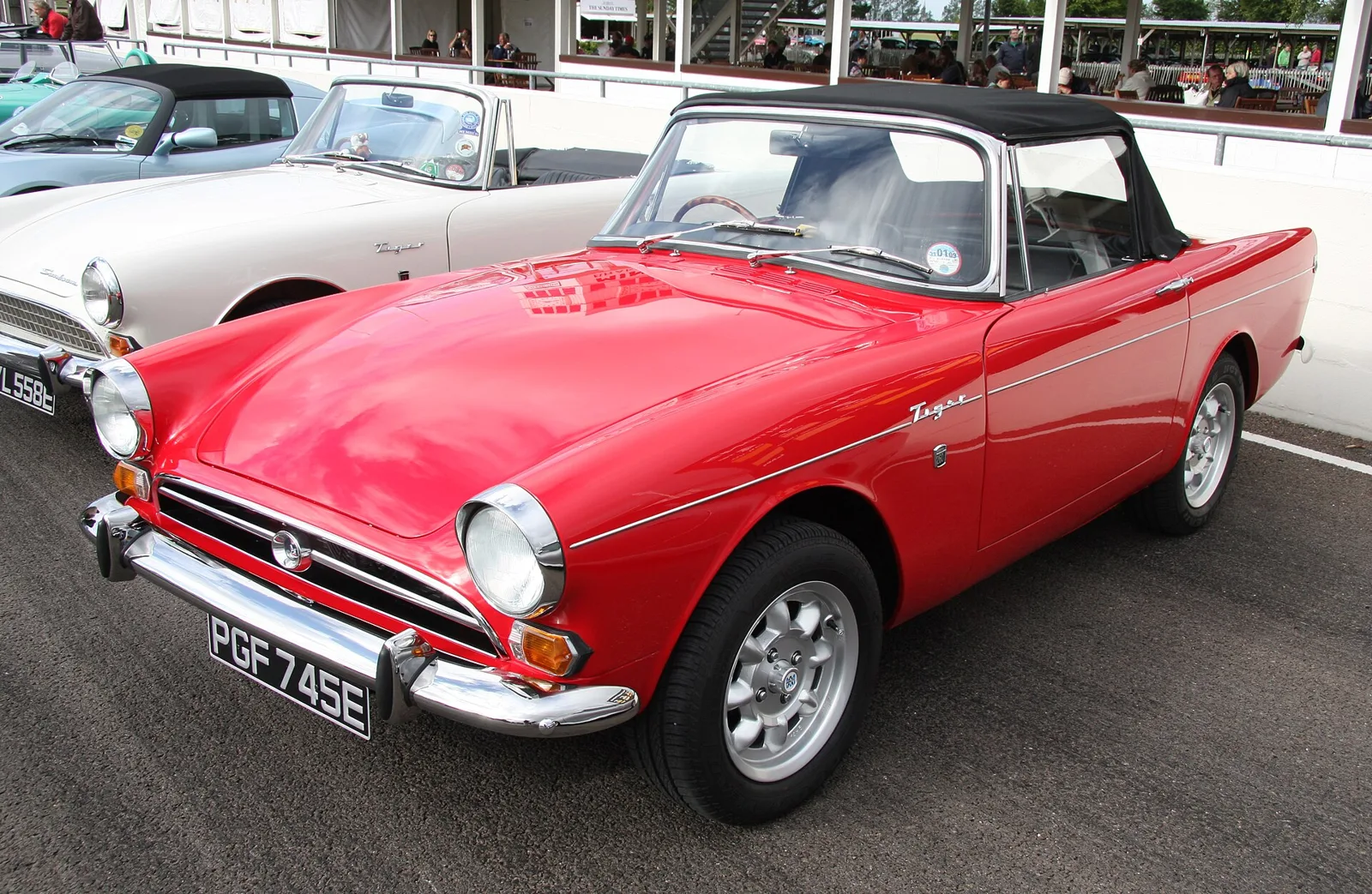
A Rootes roadster given a Ford V8 after a Brabham suggestion, a Shelby prototype, a Jensen factory and a production run that ended with Chrysler.
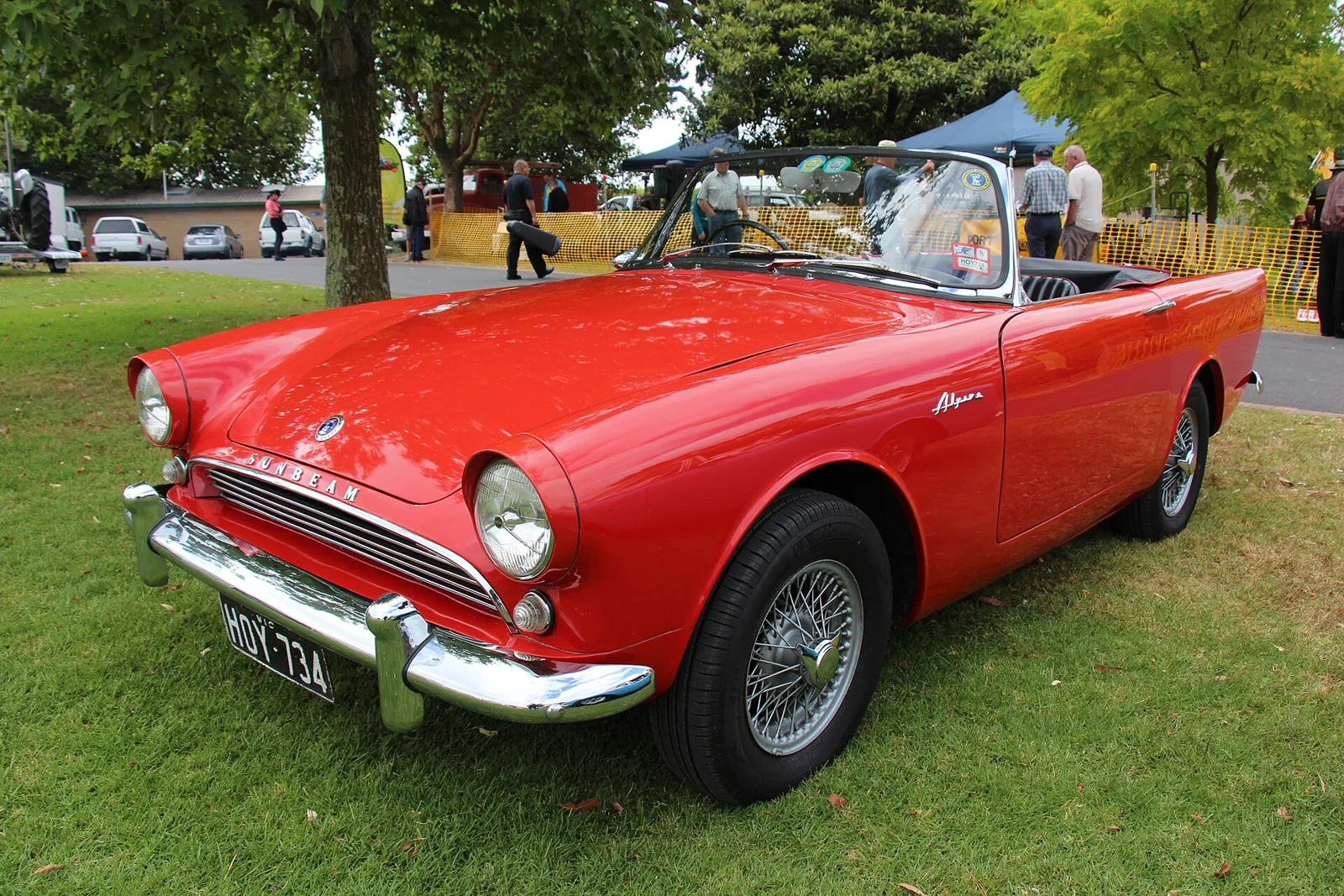
The Sunbeam Tiger was a V8 version of the Rootes Alpine roadster, built by Jensen from 1964 to 1967 with Ford 260 and 289 engines. Carroll Shelby helped design it, and 7128 cars were produced across three series, with Mark I and Mark II versions.
The Sunbeam Tiger was a high-performance V8 version of the Sunbeam Alpine roadster from Britain's Rootes Group. Carroll Shelby helped design it, and it was built by Jensen from 1964 to 1967. Its American engine turned a small British roadster into a fast, unusual grand tourer that remained rare in standard form.
Where did the Sunbeam Tiger come from?
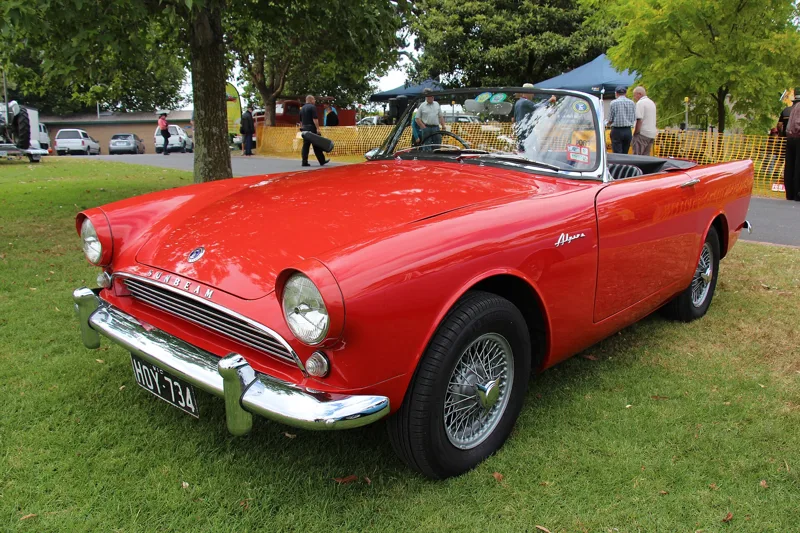
The Tiger grew out of the Alpine series, which Rootes introduced in 1959. Rootes knew the Alpine needed more power to compete in world markets, but it lacked a suitable engine and the money to develop one. It approached Ferrari about redesigning the standard four-cylinder, but the negotiations failed.
In 1962 the racing driver and Formula One champion Jack Brabham suggested to Rootes competition manager Norman Garrad that a Ford V8 could fit the Alpine. Garrad relayed the idea to his son Ian, the company's West Coast sales manager, who lived near Carroll Shelby's operation, which had already fitted a similar V8 to the AC Cobra.
A small British roadster with an American V8 that started as a Ford engine idea from a racing driver and ended with Chrysler's takeover.
How was the Ford V8 fitted to the Alpine?
Ian Garrad sent his service manager, Walter McKenzie, to local dealerships to find a suitable V8. McKenzie came back with the Ford unit, which weighed 440 lb (200 kg) and only just fitted the Alpine's engine bay. Shelby estimated that a prototype would take eight weeks and cost $10,000.
Garrad was impatient to test the idea and did not want to wait for a full timetable, so he commissioned Ken Miles, a racing driver and fabricator, to build a second prototype. Miles worked to a $800 limit with a Series II Alpine, a Ford V8 and a two-speed automatic, and within about a week he had a running conversion. Shelby's own prototype, the white car, followed in April 1963 and was soon running trials around Los Angeles, where its handling impressed the team.
Lord Rootes decided the car should be launched at the New York Motor Show of 1964, only eight months away, even though the company's normal development cycle ran three to four years. Ford agreed to supply the engines, and Rootes placed an initial order for 3000 of them. The working name Thunderbolt gave way to Tiger shortly before that show, a name taken from Sunbeam's 1925 land-speed-record car.
John Panks, who ran Rootes Motors Inc. in North America, and Ian Garrad were impressed. Panks reported to Brian Rootes that the car handled extremely well and had performance close to an XK Jaguar. Lord Rootes was grumpy about the work done without his knowledge, but after driving the car he agreed to put it into production.
Why was the Tiger built in England?
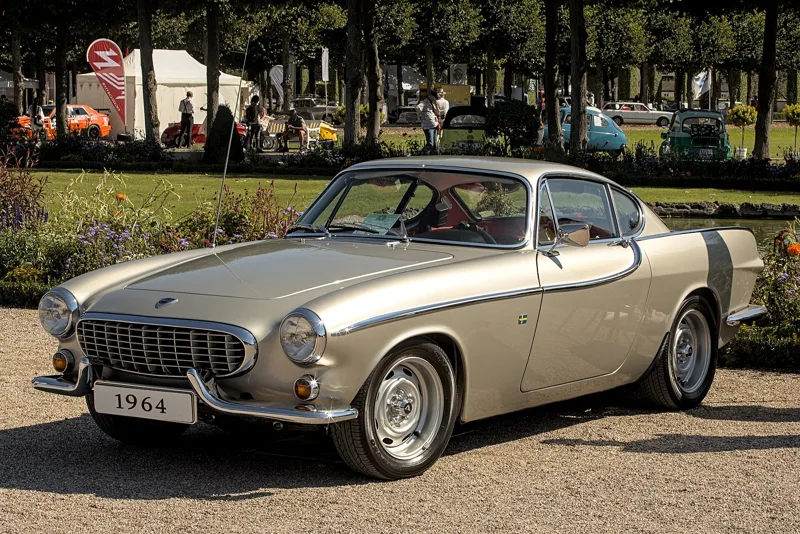
Shelby had hoped to produce the Tiger in America, yet Rootes was wary of how close he was to Ford, so England was chosen. Rootes' Ryton plant did not have the capacity, so the job went to Jensen at West Bromwich, which had lost its Volvo P1800 assembly contract. Shelby still received a royalty on each car.
Two Jensen men, chief engineer Kevin Beattie and assistant Mike Jones, had once worked for Rootes and knew the company's ways. Jensen's first prototypes, 14 in all, used the Series IV body shell, and production of the Tiger began in June 1964.
Fitting the V8 meant more than an engine swap. The Burman recirculating-ball steering gave way to rack and pinion, and the front springs were stiffened to carry the extra weight. The Tiger was about 20 per cent heavier than the Alpine, but its front-to-rear weight split of 51.7/48.3 stayed very close to the original car's.
What were the Mark I and Mark II Tigers?
Production reached 7128 cars over three series. The factory named two versions, Mark I and Mark II, and enthusiasts call the later Mark I cars Mark IA. The Mark I used the 260 cu in (4.3 L) Ford V8, while the Mark II used the 289 cu in (4.7 L) unit.
The Mark I produced 164 bhp at 4400 rpm and ran 0-60 mph in 8.6 seconds, reaching 120 mph (190 km/h) flat out. Its front discs measured 9.85 in (250 mm), and a Panhard rod was added to locate the rear axle. All Tigers used 4.5 in (110 mm) steel disc wheels. The stock car weighed 2,653 lb (1,203 kg), compared with 2,220 lb (1,010 kg) for the standard Alpine.
The Mark II was intended mainly for export to America and was never sold in Britain, although six right-hand-drive models went to the Metropolitan Police. It had a compression ratio of 9.3:1, up from 8.8:1, and it reached 0-60 mph in 7.5 seconds and 122 mph (196 km/h).
How fast was the Sunbeam Tiger?
The original 260 engine was only mildly tuned at 164 hp, and some dealers offered modified versions producing up to 245 hp for an extra $250. Those upgrades were most noticeable above 60 mph, but they stressed the standard suspension and tyres, which had been set up for the stock engine.
Rootes priced the Mark I at $3499 in North America, where it carried Powered by Ford 260 badges. British buyers paid 1,446 pounds sterling from March 1965, and a South African car sold at R3350 under the Sunbeam Alpine 260 name.
The engine bay was tight. The left bank of spark plugs could only be reached through a hole in the bulkhead, which was normally closed with a rubber bung. The oil filter sat on the right side, behind the alternator. The Mark II also had upgraded valve springs and an oil cooler.
In 1965 Motor Sport concluded that the American V8 and British chassis pairing was about as good as it could be.
Why did production of the Tiger end?
Rootes was always short of capital. Losses from a long strike at a subsidiary, along with the cost of launching the Hillman Imp, left the company in serious trouble by 1964. Chrysler bought a large but not controlling stake that June, and later took control in 1967.
In 1967 the Minister of Technology, Anthony Wedgwood Benn, approached BMH and Leyland to see whether either would buy Chrysler out and keep Rootes British. Neither had the resources, so Chrysler was allowed to take a controlling interest for a further 20 million pounds sterling.
Chrysler was unwilling to keep a rival's engine under its new car's bonnet, and its own small-block V8 would not fit without major changes. The last Tiger came off the Jensen line on 27 June 1967, once the stock of Ford V8 engines ran out. The Tiger name was resurrected in 1972 for a rally-oriented Avenger.
Roy Axe, Rootes' design director, later described the Alpine and Tiger as misfits within the group's line-up, and felt Chrysler neither understood them nor cared about them as it did the family cars.
How did the Tiger perform in competition?
Three racing Tigers were built for Le Mans in 1964, with fastback bodies from Lister. They were 66 lb (30 kg) heavier than road cars, and a Borg-Warner T10 racing gearbox allowed a top speed of 160 mph (260 km/h), but both entered cars suffered early mechanical failures. Shelby refunded the development costs to Rootes, and all three cars survive.
The Tiger also raced in the Pacific Coast Division, where Jim Adams took third place in 1965, and it finished twelfth overall at the 1965 Daytona Continental. On quarter-mile strips the car held its class record with the American Hot Rod Association for two years, reaching 108 mph in 12.95 seconds. Shelby, busy with the Ford GT40 programme, passed the racing work to the Hollywood Sports Car dealership.
Rootes also entered the car in European rallies. Tigers took first, second and third in the 1964 Geneva Rally, and one finished fourth overall at the 1965 Monte Carlo Rally, the best result by any front-engined, rear-wheel-drive car on the event. Low-slung sports cars were unsuited to the rougher stages that followed, and the car was withdrawn after the 1966 Acropolis Rally. Earlier, a forward-facing scoop on the bonnet had cured the overheating that had troubled the engine. Ian Hall, who drove a Tiger on that Acropolis event, judged the car past its best.
Where did the Tiger appear on screen?
Maxwell Smart drove a Mark I Tiger in the spy comedy Get Smart. It appeared in the opening credits for the first two seasons and in several later episodes. Because the car could not carry the gadgets the show required, some scenes used rebadged Alpine models instead.
Don Adams, who played Smart, later kept the Tiger and gave it to his daughters. Rootes had also advertised the car heavily in Playboy, and it gave Jo Collins, the 1965 Playmate of the Year, a pink car with matching interior to use for a year. The 2008 film adaptation used a replica built on a standard Alpine, and the production team recorded a genuine Tiger owned by a Los Angeles collector, editing that sound into the film.
What are the Sunbeam Tiger specifications?
| Specification | Detail |
|---|---|
| Maker | Rootes Group, built by Jensen at West Bromwich |
| Production years | 1964 to 1967 |
| Total production | 7128 cars |
| Mark I engine | 260 cu in (4.3 L) Ford V8, 164 bhp at 4400 rpm |
| Mark II engine | 289 cu in (4.7 L) Ford V8, compression 9.3:1 |
| Mark I 0-60 mph | 8.6 seconds |
| Mark II 0-60 mph | 7.5 seconds |
| Mark I top speed | 120 mph (190 km/h) |
| Mark II top speed | 122 mph (196 km/h) |
| Kerb weight, Mark I | 2,653 lb (1,203 kg) |
| Price, North America | $3499 Mark I; $3842 Mark II |
| Final production day | 27 June 1967 |
.jpg)