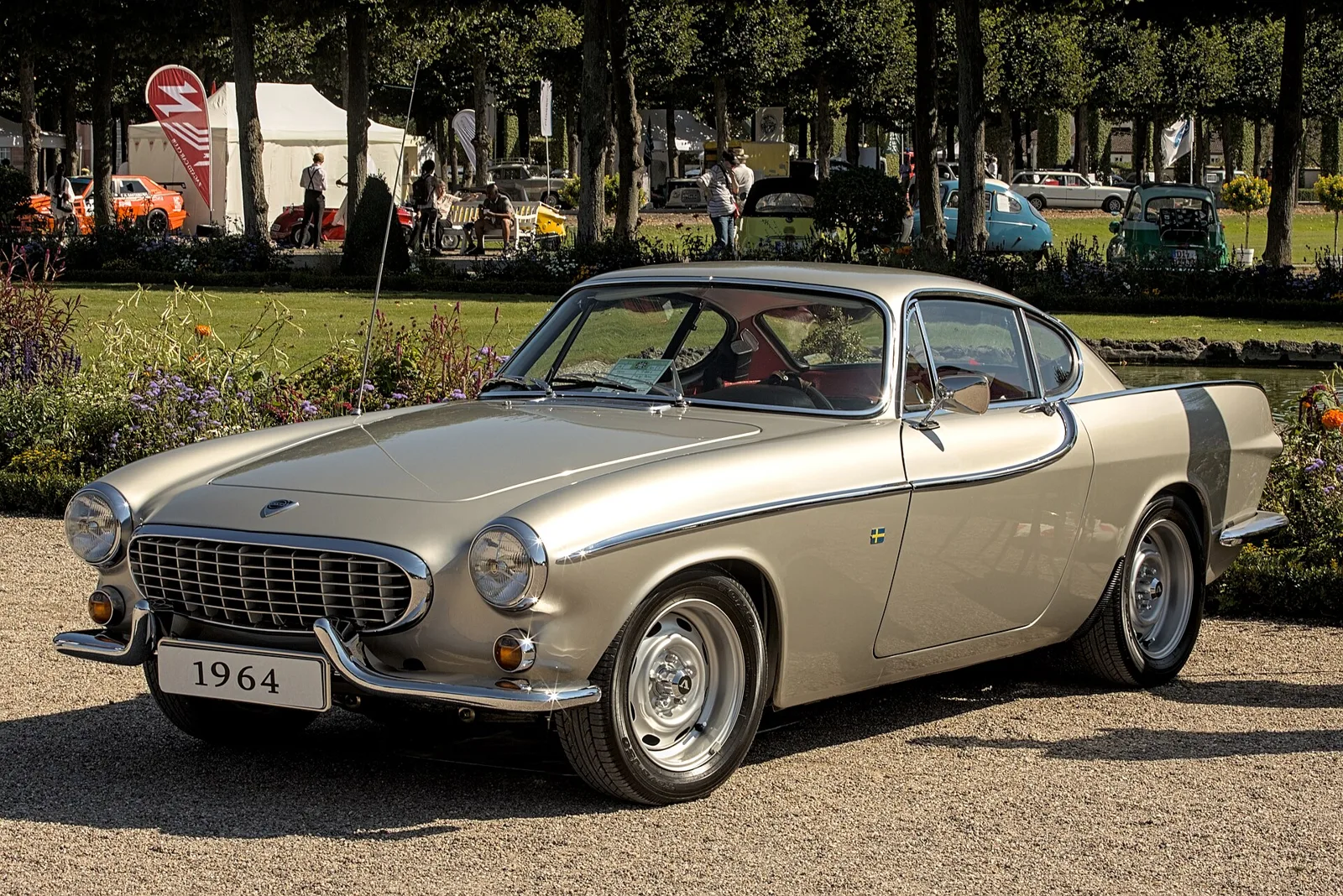
A Frua-influenced sports coupe that Volvo built from 1961 to 1973, famous for its role in The Saint and for one car that became a long-distance legend.
The Volvo P1800 was a 2+2 sports car built by Volvo Cars from 1961 to 1973, first as a coupe and then as a shooting brake. Jensen Motors built the early cars in England, and the model became famous through Roger Moore's role in The Saint.
Volvo Cars marketed the P1800 as a touring car rather than a pure sports car. It had a front engine driving the rear wheels, and it was a coupe until 1972, when a shooting brake version closed out the line in 1973.
Where did the P1800 idea come from?
Volvo began the project in 1957 because it wanted a sports car for the United States and Europe. Its earlier P1900 had found only 68 buyers. Helmer Petterson, a Volvo engineering consultant who had worked on the PV444, led the programme.
The styling came from his son, Pelle Petterson, who worked under the Italian stylist Pietro Frua while Frua worked through a studio owned by the Ghia coachbuilder. Volvo long presented the design as Frua's own, and it did not formally credit Pelle Petterson until 2009.
Frua's firm produced the first three prototypes from September 1957 until early 1958. Volvo later labelled them P958-X1, P958-X2 and P958-X3, a code built from the project month and year.
A Jensen-built sports coupe from Volvo that became a television star and ended its life as a shooting brake.
Why did Karmann and other German firms turn the P1800 down?
Karmann, in Osnabruck, was the first firm Volvo approached to build the car in volume. Its engineers had already begun drawings from Frua's styling buck, but Volkswagen, Karmann's largest customer, reportedly blocked the deal, leaving Karmann to offer design and tooling help only.
Helmer Petterson drove the first hand-built prototype, X1, to Osnabruck in December 1957, and Volvo's chief engineer, Thor Berthelius, joined the talks there. Had the plan gone ahead, the first cars might have reached buyers as early as December 1958.
Karmann would not take on full construction. NSU, Drauz and Hanomag also submitted quotes, with NSU the most expensive, but none of them won the work.
How did the P1800 reach production at Jensen?
After the German talks stalled, Helmer Petterson sought backing from two investment houses to buy parts and sell the car himself. A press release with a photograph forced Volvo to acknowledge the car, and the company then showed it at Brussels in January 1960 and signed Jensen Motors for 10,000 cars.
Jensen had spare production capacity. Pressed Steel, at its Linwood plant in Scotland, stamped the unibody shells, which went by rail to West Bromwich for final assembly. The first Jensen-built car rolled out in September 1960 as a 1961 model.
Jensen's quality control caused problems, and Volvo ended the arrangement after 6,000 cars had been built. Production then moved to Volvo's own plant at Lundby in Gothenburg.
What engine did the P1800 use?
The first P1800 engine was the B18B, a 1800 cc four-cylinder fed by twin SU carburettors and rated at 100 hp (75 kW). Its compression ratio was higher than that of the twin-carb B18D fitted to the Amazon 122S, and it had its own camshaft.
The name draws on the Swedish word for petrol, bensin, and the engine's 1800 cc capacity. Some have linked the B18 to the B36 V8 in Volvo's trucks, though the engines differ enough that many dispute the link. The B18 had five main crankshaft bearings, a sturdy base for a small four.
How did the gearboxes and overdrive affect performance?
The B18 first mated to the M40 manual gearbox. From 1963 to 1972 the M41 box, with electric Laycock de Normanville overdrive, proved popular with buyers, and the overdrive units changed from the D-type to the J-type in 1969. The overdrive was an option, not standard.
The J-type ratio was 0.797:1, while the D-type stood at 0.756:1. The overdrive functioned as a fifth gear, which helped fuel economy and reduced wear on the drivetrain.
Cars without overdrive carried a numerically lower final drive, so they could reach the redline in top gear. That left them just short of 120 mph (193 km/h) flat out, while overdrive cars managed roughly 110 mph (177 km/h).
What changed when the 1800S arrived?
From 1963 the car was built at Volvo's Lundby plant and renamed the 1800S. The S stood for Sverige, the Swedish name for Sweden. The engine was improved with an extra 8 hp (6 kW) during the move, and by 1966 the four-cylinder was rated at 115 bhp (86 kW).
By then the 1800S could reach 175 km/h (109 mph). Then in 1969 the B18 gave way to a 2-litre B20B rated at 118 bhp (88 kW), although the car kept the 1800S name.
Why was the 1800E significant?
The 1800E arrived in 1970 as the fuel-injected model, replacing the carburettors that had been fitted since launch. Its B20E engine used Bosch D-Jetronic injection, and its camshaft was revised, giving 130 bhp (97 kW) while keeping economy in check.
The car could reach roughly 190 km/h (118 mph), with 0 to 100 km/h taking 9.5 seconds. The 1970 model also brought disc brakes to all four wheels, which had not been fitted before.
In 1972 Volvo added the lower-compression B20F for certain markets, mainly the United States, to meet emissions rules. It came with a new F-type head, a revised control unit, a manifold pressure sensor and a new head gasket.
What made the 1800ES unusual?
The 1800ES came out in 1972 in two-door shooting brake form with a frameless, all-glass tailgate and a rear seat that folded flat to make a long loading area. It was the last P1800 variant, and the tailgate became its most recognisable feature.
Volvo had considered two Italian prototypes, one by Sergio Coggiola and one by Pietro Frua. Both were judged too futuristic, so the company picked the Beach Car, designed in-house by Jan Wilsgaard. Frua's prototype, nicknamed Raketen, meaning the Rocket, is kept in the Volvo Museum.
The ES engine was detuned to 125 bhp (93 kW) by a thicker head gasket that lowered the compression ratio. Peak power fell a little, but the engine was less peaky and the everyday performance was arguably better. A three-speed Borg-Warner automatic was offered as an alternative to the manual.
How many P1800s were built?
Volvo built 47,492 P1800s from 1961 to 1973. Production ended on 27 June 1973, and only 8,077 of the ES shooting brake were made across its two model years, while the 1973 model year offered only the ES. Those totals cover every coupe and every shooting brake from the first 1961 car onward.
Talks with Coggiola about a possible P1800ESC took place as the line came to a close, but no such car reached production. The Volvo 262C coupe later served as an indirect successor.
Stricter American safety and emissions rules were due in 1974, and Volvo chose not to spend the sum a redesign would have needed on the small-volume ES.
Was there a factory convertible P1800?
No. Volvo never built a convertible P1800, but Volvoville of New York converted stock coupes and sold about 30 of them between 1964 and 1969 through its own dealership. From the factory, the range only ever came as a coupe or a shooting brake.
Pricing shows the gap. A 1800S listed at US$3,695 in the United States, and a convertible added US$1,000 to that price. Volvo's management in Gothenburg disliked both the name and the open cars, so a compromise let Volvoville keep the name but stop making convertibles.
Nicknames followed too. Swedish owners called the 1800ES the Fiskbilen, or fish van, while German and Swiss drivers called it Schneewittchensarg, or Snow White's coffin, because of its glass hatch.
Why did The Saint make the P1800 famous?
A white 1962 P1800 carrying the number plate ST1 appeared in The Saint, which ran from 1962 to 1969, with Roger Moore as Simon Templar. The car became closely tied to the show, and it raised Volvo's profile during the run.
Jaguar had been offered the chance to supply a Mark X for the series and declined, so the P1800 took the role. Both cars had been launched at the 1961 Geneva Motor Show. Volvo lent two cars, one for static studio shots and one for moving scenes, and an early car was cut up for interior work once the P1800S arrived.
Moore later bought a white P1800 of his own, so he drove the Volvo both on screen and on British roads.
Later screen appearances included Major Samantha Carter's silver-grey 1963 P1800 in Stargate SG-1, which ran from 1997 to 2007, and a red 1800ES shooting brake in the 2023 Goosebumps series.
Who holds the P1800 mileage record?
Irv Gordon of East Patchogue, New York, drove a 1966 P1800S for more than half a century. The Guinness Book of World Records recognised the car in 1998 for its certified mileage, which then stood at 1.69 million miles (2.72 million km).
Gordon reached the one million mile mark in 1987. He and the car appeared on The Tonight Show with Jay Leno in April 2002, after passing two million miles.
In 2011 the car was featured on PBS's Nova ScienceNow. In June 2013, with the odometer near 4,822,000 km (about 2,996,000 miles), Volvo's North American arm ran a publicity campaign, and by September 2013 the car had passed three million miles in Alaska.
The odometer had passed 3.2 million miles (5.1 million km) when Gordon died on 15 November 2018.
What are the Volvo P1800 specifications?
The table lists engine and performance figures across the P1800's run. Where a figure applies to one engine or model year, the table says so, which keeps the coupe, the injected 1800E and the ES apart. Top speeds and acceleration are listed separately from the engine data.
| Specification | Detail |
|---|---|
| Body | 2+2 coupe (1961-1972); two-door shooting brake, 1800ES (1972-1973) |
| Layout | Front engine, rear-wheel drive |
| Early engine | 1800 cc B18, dual SU carburettors, 100 hp (75 kW) |
| 1966 1800S engine | 115 bhp (86 kW); top speed 175 km/h (109 mph) |
| 1969 engine | 2-litre B20B, 118 bhp (88 kW) |
| 1970 1800E engine | B20E fuel injection, 130 bhp (97 kW); 0 to 100 km/h in 9.5 seconds |
| 1800E top speed | Around 190 km/h (118 mph) |
| 1800ES engine | B20F, 125 bhp (93 kW), thicker head gasket |
| Overdrive | Laycock de Normanville; D-type to 1969, J-type to 1973 (ratio 0.797:1) |
| Top speed, non-overdrive | Just under 120 mph (193 km/h) |
| Top speed, overdrive | Roughly 110 mph (177 km/h) |
| Brakes | Front discs and rear drums; four-wheel discs from 1970 |
| Production | 47,492 units, 1961 to 1973 |
| 1800ES production | 8,077 units across two model years |
How was the 50th anniversary celebrated?
The 50th anniversary was marked in France on 13 June 2010 at the Viking Classic Auto Show. It recalled the car's first public showing at Brussels in 1960, and Volvo Cars Heritage promoted the event, a fitting way to mark the car's half-century.
More than 350 Volvo cars attended, including about 80 P1800s from across Europe, along with the original prototype P958-X1. Designer Pelle Petterson and Irv Gordon took part.
Frequently asked questions
Did the P1800 have four-wheel disc brakes?
Yes, from 1970. Earlier cars had front discs and rear drums, and 1970 was the first year any 1800 had discs at all four corners.
Did Volvo make a convertible P1800?
The factory never offered one. Volvoville of New York made around 30 convertibles from 1964 to 1969, and Volvo later let it keep the name in return for ending the conversions.
Why was the P1800 built in England?
The German options fell through, and Volvo turned to Jensen Motors in West Bromwich, which had spare production capacity. Bodies pressed in Scotland were assembled there until Volvo ended the arrangement after 6,000 cars.
How fast was the 1800E?
The 1800E could reach around 190 km/h (118 mph) and went from 0 to 100 km/h in 9.5 seconds. Its 130 bhp (97 kW) came from the fuel-injected B20E engine.
_Classic-Gala_2021_1X7A0260.jpg)