A Paris-area voiturette builder that won the Indianapolis 500, made the D6 and D8 luxury cars and was absorbed by Delahaye before a 2019 revival.
Delage was a French luxury and racing marque founded in 1905 by Louis Delage near Paris. Its Type Y won the 1914 Indianapolis 500, its D6 and D8 luxury cars followed, and Delahaye absorbed it in 1935. A 2019 revival produced the D12.
Delage is a French luxury car and racing company founded in 1905 by Louis Delage in Levallois-Perret, near Paris. It made some of the era's most celebrated racers and then luxury sedans before Delahaye absorbed it in 1935, and production ended in 1953. A new Delage was announced in 2019, built around a 1,100 hp hybrid called the D12.
Where did Delage begin?
Louis Delage borrowed 35,000 francs to start the business, giving up a salary of 600 francs a month to do so. The first premises were on the Rue Cormeilles in Levallois-Perret, with just two lathes and three employees, one of whom had been Peugeot's former chief designer. The early work was limited, because the company first made parts for the firm Helbe, which assembled the De Dion-Bouton engine and chassis while Delage added only the body.
The first model under the company's own name was the Type A voiturette of 1906, which used a single-cylinder De Dion-Bouton rated at 4.5 or 9 hp. In 1907 the factory moved to the Rue Baudin in Levallois, where a 4,000 m2 workshop allowed it to grow. A move to Courbevoie followed in 1910, and by 1912 about 350 workers were producing more than 1000 cars a year.
A Levallois workshop that won the Indianapolis 500, sold luxury sixes and eights, and returned in 2019 as a 1,100 hp hybrid.
How did Delage win its early races?
Like other early carmakers, Delage raced. It entered the Coupe de Voiturettes at Rambouillet in November 1906 with a 9 hp racer, and although it did not win the event, its works driver Menard finished second behind a Sizaire-Naudin. The two-cylinder cars were outclassed in 1907.
Racing success returned in 1908, when Delage won the Grand Prix des Voiturettes on 6 July. The race covered six laps of the Dieppe circuit, with 47 starters. Albert Guyot, a Delage dealer, won at an average of 49.8 mph (80.1 km/h) without stopping for fuel, and all three Delages finished. Sales for that year passed 300 cars.
In 1911 Paul Bablot won the Coupe de l'Auto at Boulogne at an average of 55.2 mph (88.8 km/h). Delage then moved up to Grand Prix racing in 1912 with a car designed by Leon Michelat, which used a four-valve four-cylinder of 118 hp and carried 43 imperial gallons of fuel for the 569 mile Amiens Grand Prix.
Which Delage car won the Indianapolis 500?
The Type Y arrived in 1913 and recorded the quickest lap of the French Grand Prix held at Le Mans. The same car went on to win the 1914 Indianapolis 500 with Rene Thomas at the wheel. The Delage racers that followed, with twin-cam engines and four-wheel brakes, were quick but unreliable, and only one of them finished the 1914 French Grand Prix.
War curtailed racing for a time. In 1914 the company had created the type O Lyon Grand Prix car, while moving toward large six-cylinder luxury machines. After the war Louis Delage returned to competition with the 12-cylinder 2-litre type 2 LCV, which won the 1924 European Grand Prix at Lyon and the 1925 Grand Prix of the ACF at Montlhery.
How did the 1920s make Delage famous?
The 1920s were the first Golden Age of the marque. The CO of 1918 was a 4,524 cc six producing 20 hp, and it was the first passenger car with front brakes. The DE and DI were about 2-litre fours of around 11 hp, while the GL, aimed at Hispano-Suiza, had a 5,954 cc engine producing 30 hp.
The best-selling car in the brand's history was the six-cylinder DR, designed by the engineer Gaultier. The 1926 DM was another emblem of the period, with a six-cylinder engine that was followed by the high-performance DMS, which had a hotter cam and twin valve springs.
Delage also built a 12-cylinder hillclimb car that broke the course record at Gaillon with Thomas driving. Thomas used it to set a land speed record at Arpajon in 1924 at 143.24 mph (230.52 km/h). A 10.5-litre 12-cylinder DH later beat a world speed record on the highway at 230 km/h.
Which Grand Prix cars did Delage build in the late 1920s?
A Plancton-designed four-overhead-cam V12 of 1,984 cc powered a Grand Prix car that won at Montlhery and Lasarte in 1925 after a supercharger was added. Its successor of 1926 was a Lory-designed supercharged 1.5-litre straight eight of 170 hp, which was capable of 130 mph and became the company's last Grand Prix entrant.
Louis Delage also designed an eight-cylinder 1500 cc car, the type 15 S 8. It won four European Grands Prix in 1927, and it earned the marque the title of World Champion of Car Builders that year. In 1926 a 155 B took victory in the inaugural British Grand Prix, with Louis Wagner and Robert Senechal at the wheel.
What made the D6 and D8 the classic Delage cars?
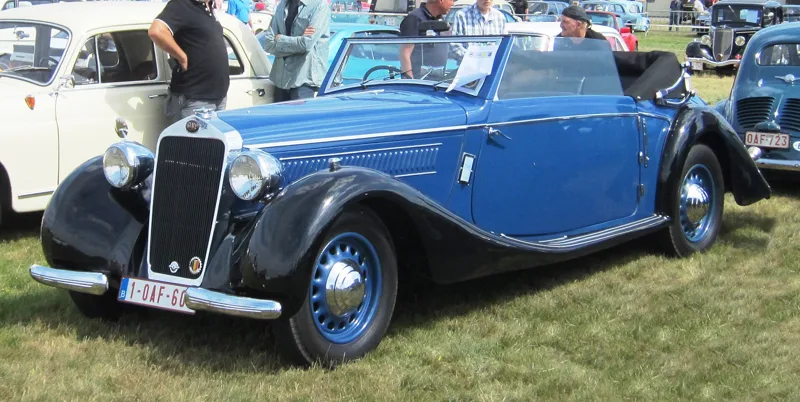
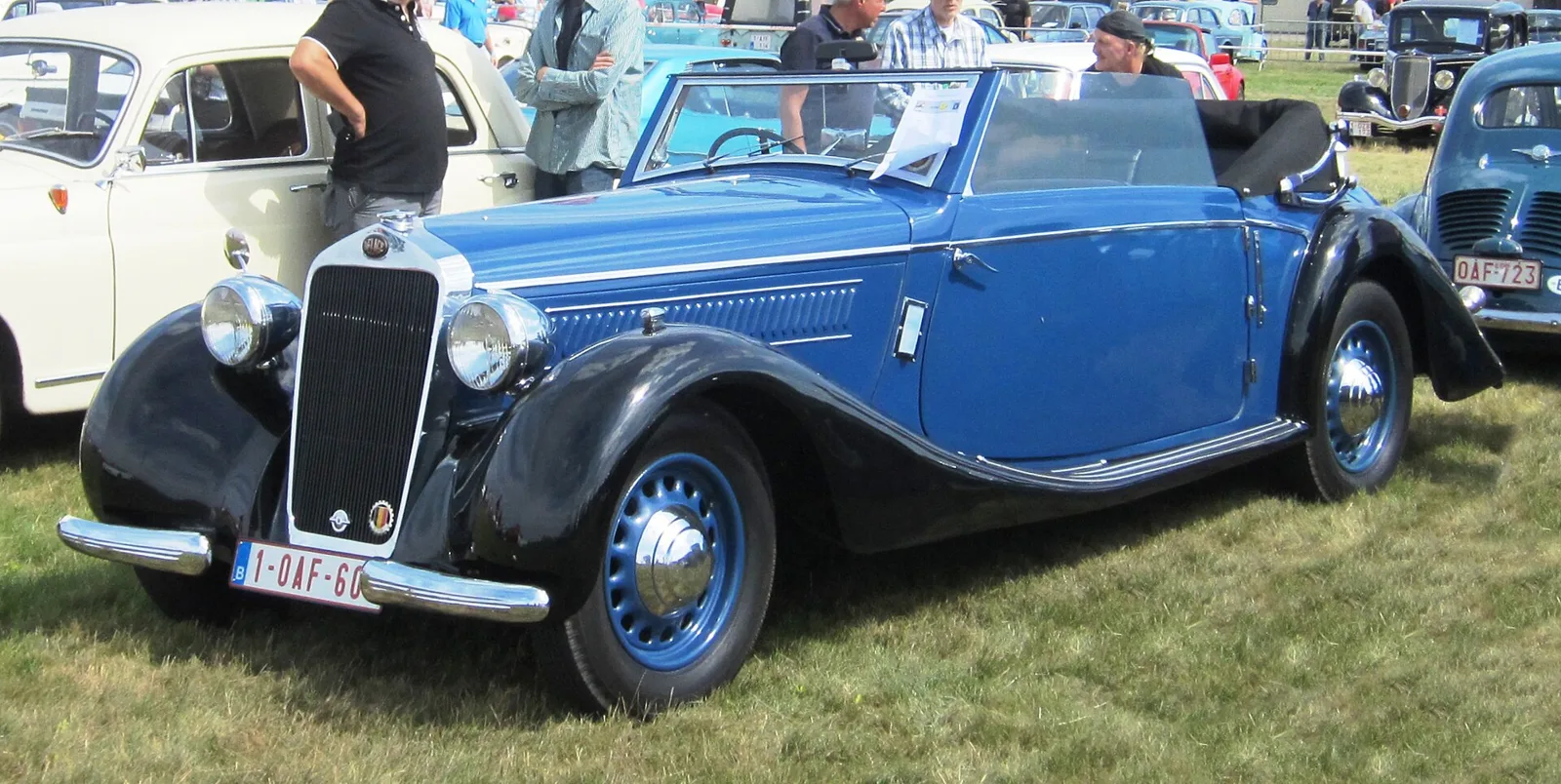
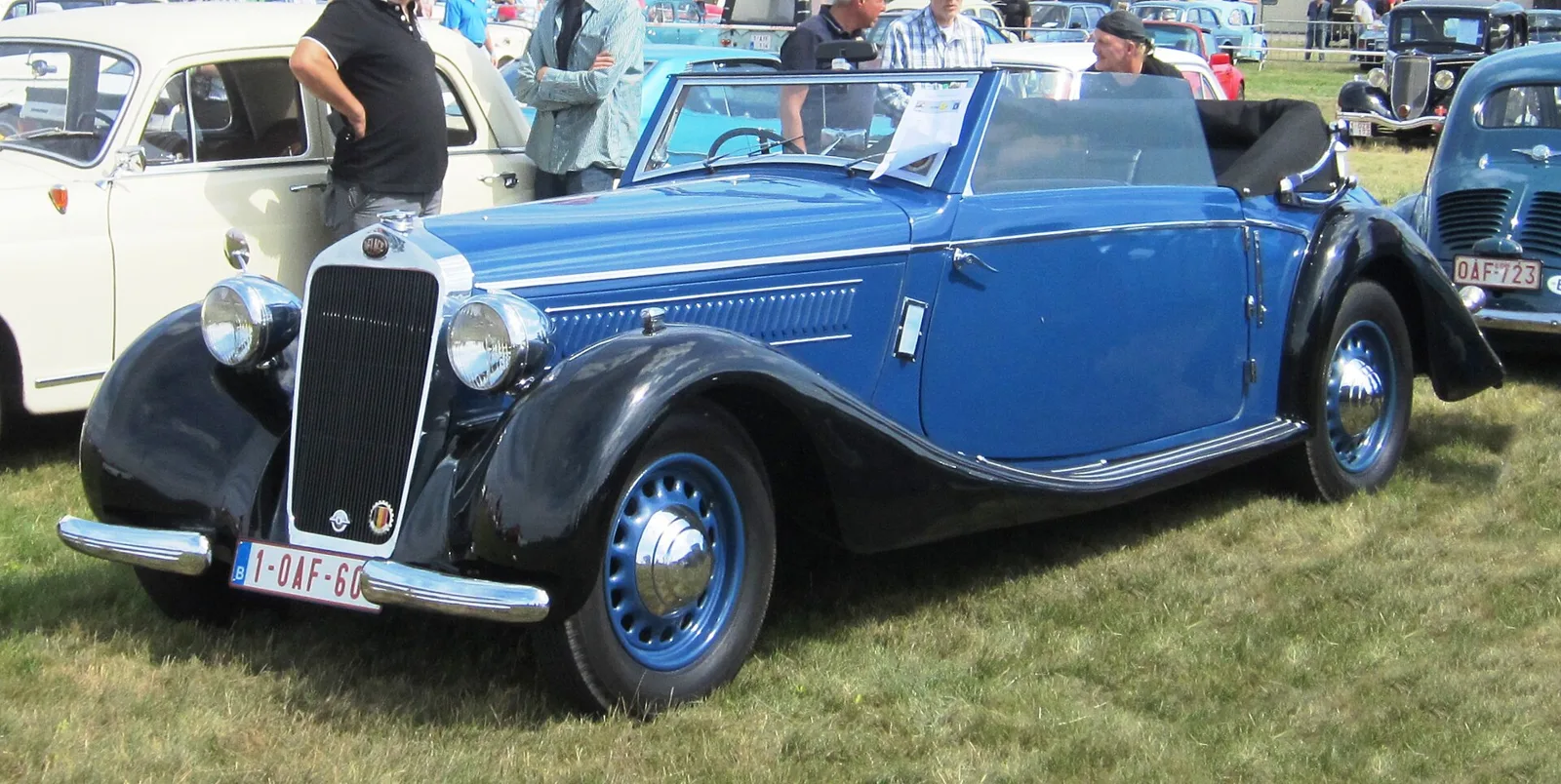
In 1930 the six-cylinder D6 launched and became the mainstay of the passenger car range until 1954. The same year Maurice Gaultier designed a 4,061 cc straight eight, which evolved into the D8 S, the Sport version of the eight-cylinder car. The D8 was the pinnacle of the marque and was capable of 85 mph (137 km/h). The Grand Sport of 1932 reached 100 mph (160 km/h).
The economic crisis that followed 1929 hit luxury makers across the world. In 1932 Delage introduced the D6-11, a six of 2,101 cc, and two years later the D8-15, an eight of 2,768 cc. Both used independent front suspension, which was licensed by Studebaker for its own cars, but neither lifted sales. Delage also built a few lowered D6-11S cars in 1933 and 1934.
The junior D6s used Delahaye front suspension and hydraulic brakes, and they shared the Cotal gearbox with the D8. The D6/70 of 1936 had a 2,729 cc six, the 1938 D6/75 a 2.8-litre six, and the postwar D8/3L Olympic a 3-litre six. At the bottom of the range was a 1.5-litre four that lasted until 1936.
Why did Delage fall to Delahaye in 1935?
Money was always tight. In 1932 Louis Delage took out a 25 million franc loan to finance the tooling for the D6, and talks with Peugeot about using its dealer and service network went nowhere. Personal money problems forced him to sell his expensive home on the Champs-Elysees, which eased the pressure only briefly.
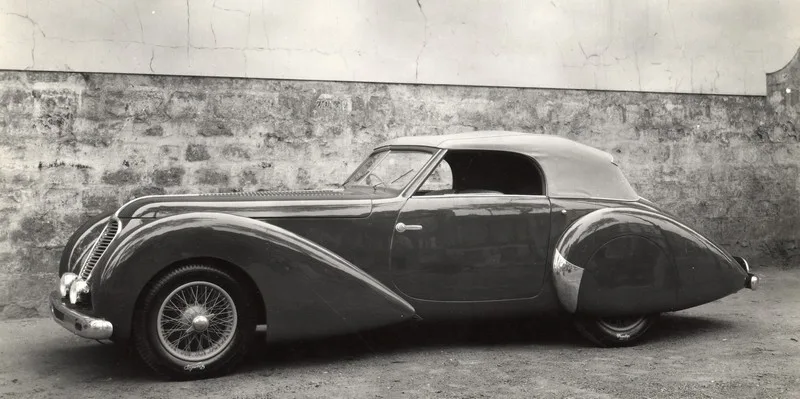
The last models from Courbevoie were the D6-65, D8-85 and D8-105, designed by Michelat. On 20 April 1935 the Courbevoie factory went into voluntary liquidation, and the company was absorbed by Delahaye.
How did the name survive the war years?
Louis Delage would not accept defeat. With help from the British businessman Walter Watney he created the Societe Nouvelle des Automobiles Delage, known as SAFAD, to sell Delage cars assembled from Delahaye parts. It produced the four-cylinder DI 12, the D8 120 and the six-cylinder D6 70.
Watney was obliged to leave Paris in June 1940, and by December of that year SAFAD had passed under the control of Delahaye. During the war the business worked on a project to fit the more powerful eight-cylinder D8 120 engine to the Hotchkiss H39 tank, and it also produced two types of racing aero-engine in the early 1930s.
How did the postwar cars sell?
A large D-180 limousine prototype appeared at the 1946 Paris Motor Show but went no further, and by 1947 it had disappeared. The single model shown at the 1947 show was the six-cylinder 3-litre D6, which was offered with bodies from firms such as Chapron, Letourner and Marchand, and Guillore.
Louis Delage died in December 1947, after living in relative isolation since the bankruptcy of 1935. Motoring taxes rose sharply in 1948, hitting cars with engines over 2 litres. In 1950 Delahaye built 235 cars, including a number of Delages, but the combined figure for the two brands fell to 77 in 1951 and to 41 in 1952. Delage production ended in 1953, and the company was absorbed into Hotchkiss along with Delahaye in 1954.
What is the Delage D12 revival?
On 7 November 2019 Les Amis de Delage, a collectors' association that had acquired the name in 1956, and the entrepreneur Laurent Tapie, son of Bernard Tapie, signed an agreement to relaunch the brand at the Lyon Epoqu'auto show. Tapie became president of Delage Automobiles, and the new car is the D12.
The D12 is a hybrid street-legal sports car with a normally aspirated V12 producing 990 hp (728 kW), plus an electric motor of 110 hp (81 kW), for a combined output of 1,100 hp (809 kW). It was presented in Los Angeles and Orange County in December 2019, then in Monaco, Geneva and Dubai during 2020. Racing driver Jacques Villeneuve joined as development driver.
The jury of the Automobile Awards 2020/2021 gave the D12 its best design prize and named it the most beautiful car in the world. Only 30 units are planned, at over 2 million euros each as of 2026, and three had been delivered to owners by mid-2026. The company was also working on a second model called the Torpille 100A.
How many Delages were built?
During its years of independence Delage made almost 40,000 cars at its workshops in Levallois and Courbevoie. After production was folded into Delahaye, about 2,000 Delage-badged cars were built between 1935 and 1940. Delahaye built a further 330 Delage cars between 1946 and 1953.
Delage key models and figures
| Model | Years | Detail |
|---|---|---|
| Type A voiturette | 1906 | One-cylinder De Dion-Bouton, 4.5 or 9 hp |
| Type Y racer | 1913 to 1914 | Fastest lap at the French Grand Prix, won the 1914 Indianapolis 500 |
| CO | 1918 | 4,524 cc six, 20 hp |
| DR | 1920s | Best-selling Delage six, designed by Gaultier |
| Type 2 LCV | 1923 to 1925 | 12-cylinder 2-litre, won at Lyon and Montlhery |
| D6 | 1930 to 1954 | Six-cylinder mainstay of the range |
| D8 | 1930s | Straight eight of 4,061 cc, capable of 85 mph (137 km/h) |
| D6-11 | 1932 | 2,101 cc six with independent front suspension |
| D8 120 | After 1935 | Eight-cylinder from SAFAD production |
| D12 | 2019 onward | Hybrid, 990 hp V12 plus 110 hp motor, 1,100 hp combined |