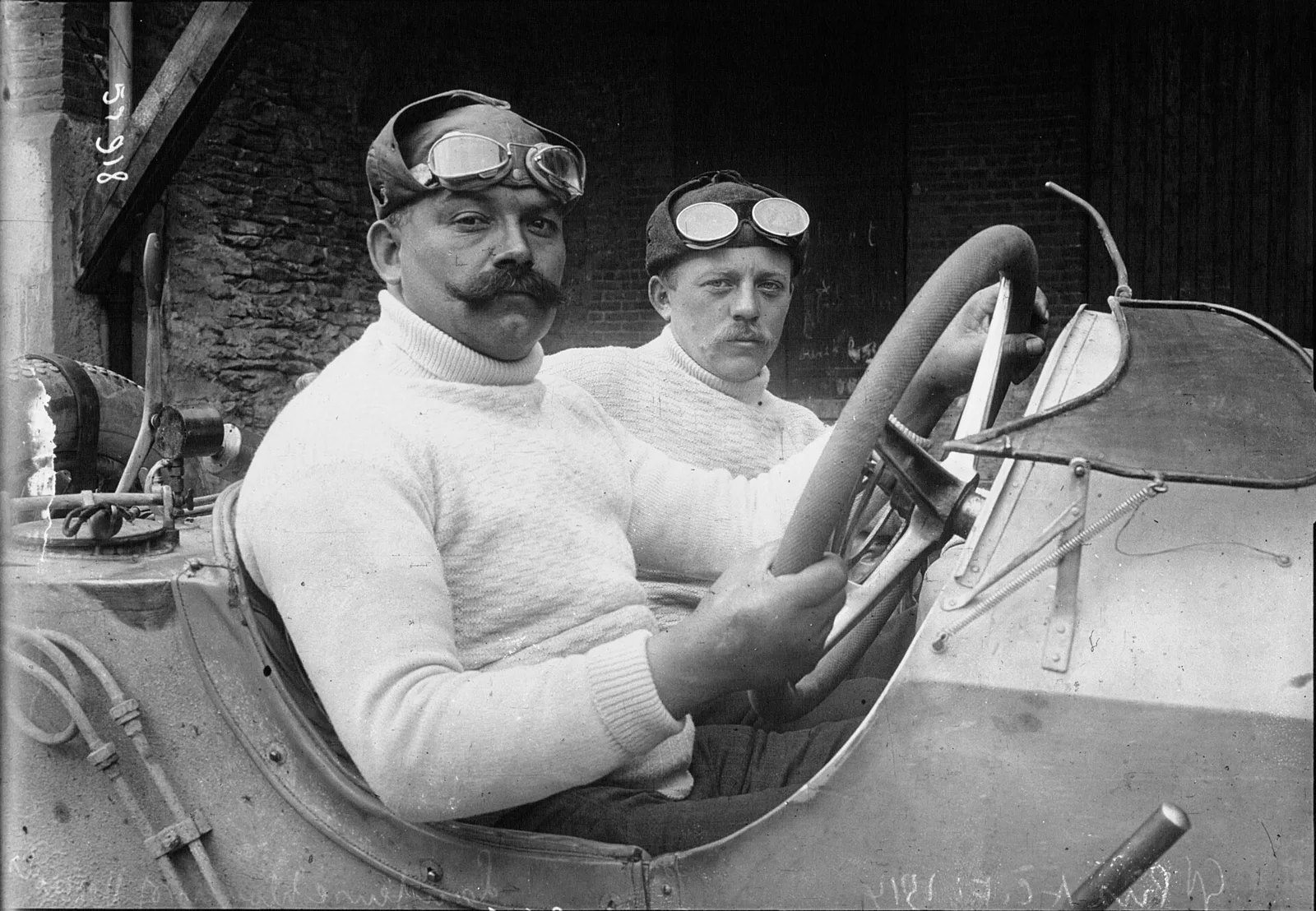
Mercedes swept the top three places at Lyon under a new engine cap, while Peugeot's Georges Boillot led for much of the race before his engine gave out on the final lap.
The 1914 French Grand Prix was held at Lyon on 4 July 1914 and was the first Grand Prix run to an engine capacity limit. Mercedes took a 1-2-3 result, with Lautenschlager winning at 105.7 km/h (65.7 mph) ahead of Peugeot's Boillot, whose engine failed on the last lap.
The 1914 French Grand Prix was run at Lyon on 4 July 1914, pitting the French Peugeots against the German Mercedes. Christian Lautenschlager won for Mercedes, averaging 105.7 km/h (65.7 mph), and his duel with Peugeot's Georges Boillot lasted about seven hours.
Why was the 1914 race so important?
The race is remembered as one of the great contests of the early Grand Prix years and as the first to be run to an engine capacity limit of 4.5 litres. Mercedes filled the top three places, while Boillot fought them until his engine failed on the final lap.
The limit was the work of the Automobile Club de France, which had spent several years trying to reduce engine sizes. It believed the higher speeds of big engines were becoming dangerous, and earlier French races had restricted cylinder bore instead.
The result also reflected a wider shift in the sport. Peugeot and Delage had dominated recent voiturette racing, and the new rules favoured their nimble cars over the big-engined machines from Italy and Germany.
Three Mercedes in a row, and a Peugeot driver whose last-lap engine failure ended the most dramatic contest of the year.
What were the engine and weight rules for 1914?
The race imposed a maximum engine capacity of 4.5 litres and an allowable weight range of 800 to 1,100 kg (1,764 to 2,425 lb), excluding fluids and tools. Each manufacturer could enter five cars, and privateers were excluded from the field.
The rules obviously suited the French manufacturers, which had the light, nimble machines the formula rewarded. Mercedes faced a harder task, because its previous Grand Prix win in 1908 had come with much bigger engines, well over 10 litres.
Under the new limit the German engines needed higher revs to make power. Superchargers were still years away, so Mercedes needed a unit that revved far beyond anything it had previously produced. Paul Daimler brought in the aero-engine division to help. The design used cast-in cylinders with four valves apiece and one overhead camshaft, giving 106 bhp at peak engine speed. The chain drive was replaced by a lighter live rear axle, although the cars kept rear brakes only.
Where was the circuit and what did it demand?
Lyon's authorities offered generous subsidies to host the event, and the race used a 37.6 km road circuit laid out clockwise to the south of the city. The course used public roads, included a steep downhill switchback nicknamed the death trap, and covered twenty laps totalling 752.6 km.
The Les Sept Chemins hairpin marked the northernmost point of the course. The start and finish sat about 800m south of it, and the route ran south west beside the Gier, a tributary of the Rhone, to Chateauneuf. The circuit then turned north-east for a 12 km (7.5 mi) straight.
The surface was prepared with care. In late June the two hairpins were concreted, the course was relaid with granite chips to stop it breaking up, and calcium chloride was applied to limit the dust.
Who was on the grid?
The race drew 37 starters from 13 manufacturers and six countries, one of the strongest fields assembled up to that point. Peugeot arrived as favourites after winning in 1912 and 1913, while Mercedes returned for the first time since its 1908 victory.
Peugeot's EX-5, also called the L-45 after its 4.5-litre engine, was driven by Boillot, Jules Goux and Victor Rigal. Its four-cylinder engine had twin overhead camshafts and produced 112 bhp. The car gained four-wheel brakes and a streamlined tail that carried two spare tyres. At Brooklands, Boillot's testing showed the top speed rising by 8%.
Delage's new five-speed Type S cars went to Albert Guyot, Arthur Duray and Paul Bablot. Alva persuaded Ferenc Szisz, who had won the first Grand Prix in 1906, to return from retirement and lead its squad.
Mercedes fielded five of the six 18/100 cars it had built, with Christian Lautenschlager, the 1908 victor, at the head of the team. Otto Salzer, the young Max Sailer, Louis Wagner and the Belgian Theodore Pilette completed the line-up. Opel brought a development of its 4.0-litre 1913 model, and Carl Jorns led a team of three in cars that were the lightest in the field.
How did practice shape the race?
Mercedes prepared with care. In January the company sent people to France to study the road and work out gearing ratios, and two cars were tested in April. The tail was trimmed to reduce weight, and engineers advised a five-speed gearbox, but there was no time to fit one.
The ACF arranged only two pre-dawn sessions of 90 minutes each on the public roads, three weeks before the race, which left most teams unhappy. Vauxhall's cars were not ready even then.
Peugeot expected its four-wheel brakes to pay off in the corners, yet the course had just two tight, slow bends. Most of the lap was fast, so the top speed from the DOHC engine and the streamlined tail looked decisive. Mercedes expected its lower centre of gravity to give better road holding, and it ran Continental tyres where the French used Dunlops. Its engineers calculated that each car would need only a single tyre stop.
During practice the Peugeot drivers complained of poor handling, since the spare tyres in the tail skewed the weight. For Mercedes the sole problem came from Pilette, who botched a shift and over-revved.
How did the race unfold?
The weather was warm and bright, and roughly 300,000 people packed the route. Crowded city trains left many fans arriving after the 8am start. Cars left in pairs, 30 seconds apart and in numerical order, a first for the event.
Sailer led on elapsed time from the start, with an 18-second advantage, and he pushed the pace from the beginning to draw Boillot into a speed contest. Jorns stopped on the first lap for radiator repairs, which took him out of contention.
Boillot made an unplanned stop on the third lap, which handed Sailer the road lead. Pilette retired at about the same moment, his gearbox damaged in practice having finally given way. Sailer then set the race's quickest lap on lap four and pushed his margin over Boillot to nearly three minutes.
Then Sailer pushed too hard. Whether through inexperience, or a rivalry with team leader Lautenschlager that he wanted to settle, he stopped on lap six with a broken connecting rod by the Gier. Nobody at Mercedes described a deliberate plan to use him as a pacemaker to break the Peugeots.
After seven laps Boillot led Lautenschlager, with Goux up to third ahead of Duray's Delage. At the halfway point on lap 10, Wagner and Salzer, plus Resta in his Sunbeam, had also got past the Delage. Lautenschlager was short of brakes, and his stop turned into a mess: the usually slick Mercedes crew cost him 2 to 3 minutes.
Peugeot's Dunlops were wearing far faster than the Mercedes tyres, and Boillot needed six pitstops for tyre changes. Even so, he kept a lead of roughly two to three minutes through skill and a readiness to gamble.
On the eleventh lap a dangerous accident happened. Szisz had stopped at the roadside to fit a new wheel when Breckheimer's Opel hit him, the Opel having been hidden by dust. He broke an arm, and his less injured mechanic had to nurse the car back to the pits.
The Peugeots' stops cost them their edge, and the Mercedes chase grew relentless. Wagner pitted on lap 15 for tyres, and Salzer got by Goux for fourth. When Boillot stopped on the seventeenth lap, Lautenschlager cut the two-minute gap to 14 seconds and went past near Givors.
Boillot's Peugeot had been driven to the edge and was disintegrating, with only three cylinders firing. By the end of lap 18 he was 30 seconds behind. On the last lap the engine gave out as he climbed away from the Gier valley, having been pushed past its limit. He sat hunched over the steering wheel, weeping at the failure.
Who finished, and who was left behind?
Seven hours after the start, Mercedes had a 1-2-3, with Lautenschlager ahead of Wagner and Salzer. Goux finished fourth, nearly ten minutes back, and Fagnano's FIAT came home last in 11th, well over an hour after the winner. Boillot, Sailer and Pilette did not reach the finish, so no French driver stood on the podium.
| Finish | Driver and car | Result |
|---|---|---|
| 1st | Christian Lautenschlager, Mercedes | Victory, 105.7 km/h (65.7 mph) average |
| 2nd | Louis Wagner, Mercedes | Second, inside the Mercedes 1-2-3 |
| 3rd | Otto Salzer, Mercedes | Third, completing the sweep |
| 4th | Jules Goux, Peugeot | Best-placed Peugeot, nearly ten minutes back |
| Retired, last lap | Georges Boillot, Peugeot | Led much of the race until his engine expired |
| Retired, lap 6 | Max Sailer, Mercedes | Broken conrod along the Gier River |
| Retired, lap 3 | Theodore Pilette, Mercedes | Gearbox damage from practice |
| 11th | Fagnano, FIAT | Last classified finisher, over an hour behind |
The French crowd was silent at the finish, and Goux's fourth place offered little consolation. Fagnano had throttled back, and it was suggested the team's decision was prudent. Scrutineers had found that the total engine cylinder volume exceeded the 4500cc limit, a finding that would normally disqualify the team. FIAT's strong past support of the race allowed it to keep its place.
What happened to the race winners afterwards?
Less than a month later, war had engulfed Europe, and racing on the continent paused for four years. Lautenschlager received 25000 francs in prize money, retired from racing and used it to build a house, while Boillot's own story ended in the same war.
Boillot first served Marshal Joffre as a driver, then flew fighters with the French Air Force. Over Verdun in April 1916 he was downed in combat and died in the wreckage.
After the race, one Mercedes, probably Lautenschlager's, went on display at a London dealership, alongside two of the Opels. War broke out soon afterwards, and the car was commandeered and handed to Rolls-Royce, where it was carefully taken apart. The single-overhead-camshaft valve train of the Grand Prix engine found its way into the Rolls-Royce Eagle aero engine and into Bristol fighters.
How did the 1914 race influence later events?
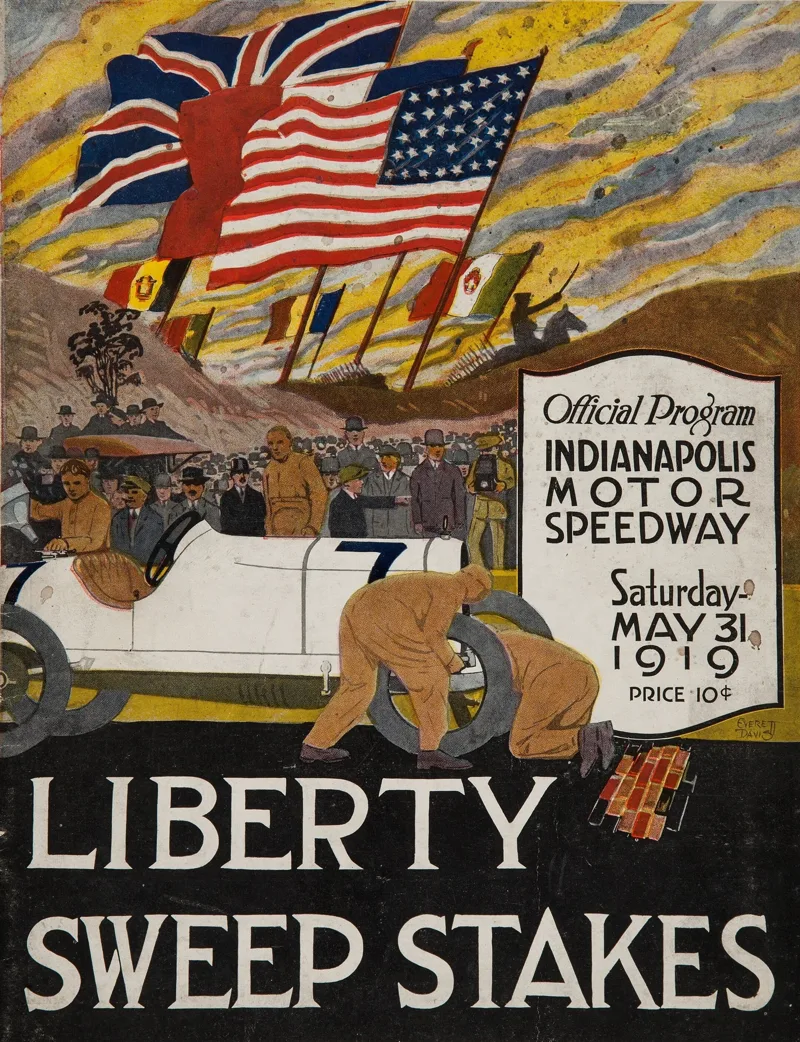
Ralph DePalma bought one of the Mercedes Grand Prix cars after the race and later drove it to win the 1915 Indianapolis 500. He finished three and a half minutes clear of Dario Resta, who was in a Peugeot EX-5. Resta took his revenge in the shortened 1916 race, and a Peugeot won again in 1919.
Carl Fisher, a member of the Indianapolis 500 organising committee, acquired a pair of EX-5s. On arrival in America he gave them to the Premier Motor Corporation, which built three replicas.
Historians still disagree about which Mercedes chassis reached London and which reached America. The car DePalma drove is believed to have been Wagner's No. 40, and the wider confusion over the Mercedes chassis has never been fully resolved.