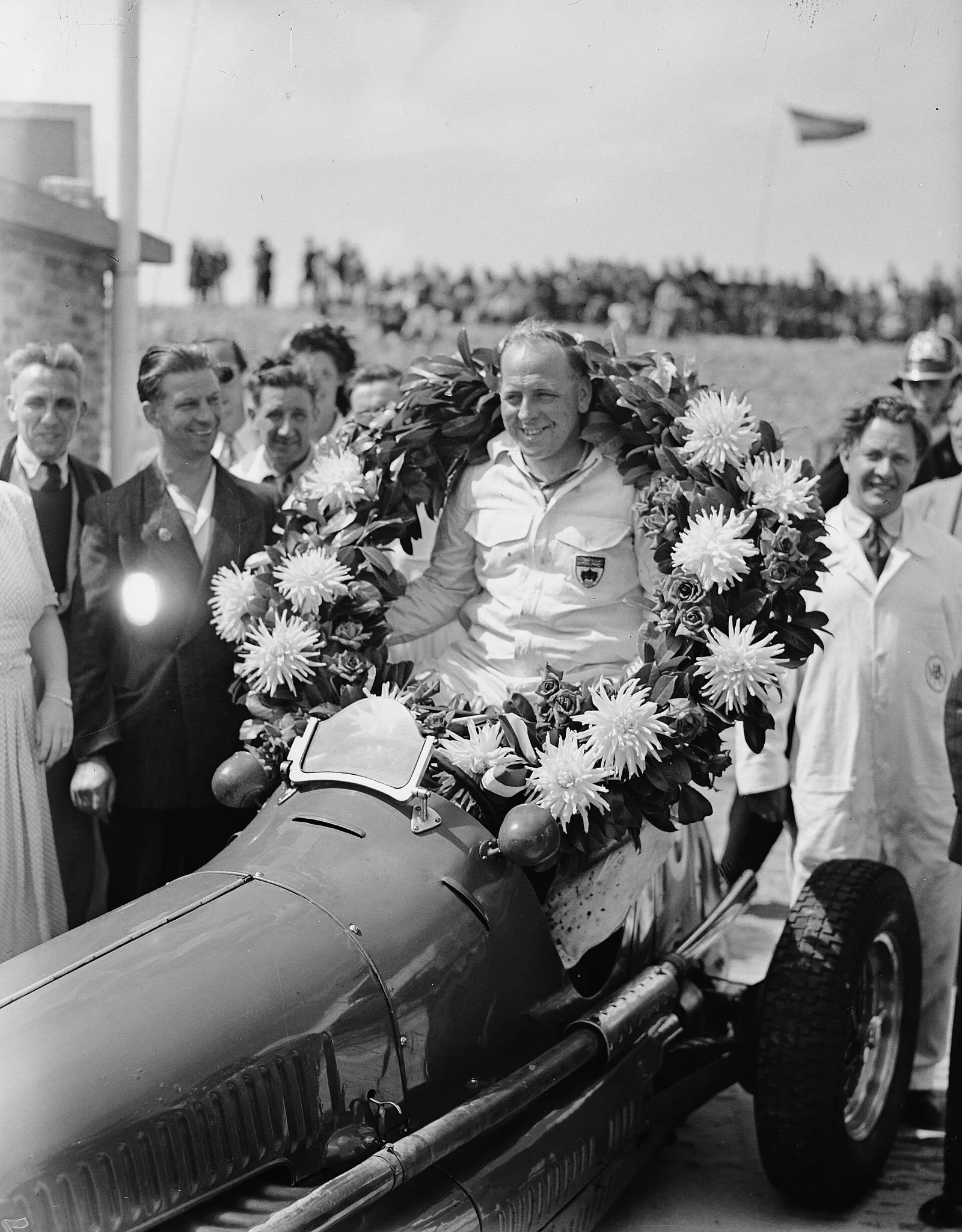
The Derby driver who won the 1947 Swedish Winter Grand Prix, finished third in the first World Championship race and later managed Aston Martin and Yeoman Credit.
Derby-born Reg Parnell raced cars and managed teams in England. He started seven World Championship Grands Prix, scored nine points and took one podium, and he later ran Aston Martin's team and the Yeoman Credit operation before dying in 1964 at the age of 52.
Reg Parnell was a racing driver and team manager from Derby, England. He competed in seven World Championship Grands Prix, finished on the podium once and scored nine championship points. As a team manager, he kept shaping British motorsport until his death in January 1964, when he was only 52.
Parnell was both a competitor and a dealer in racing cars. Before the war he bought up machinery, and after it he sold those cars to start many post-war entries. He drove an enormous range of makes before turning to management, which took him into Formula One with Aston Martin and then to the Yeoman Credit team.
How did Parnell start racing in Derby?
Parnell came from a family that ran a garage business in Derby. He decided to try the sport after watching the first motor race at Donington Park in 1933, and by 1935 he had bought an old 2-litre Bugatti single-seater for 25 pounds. A broken rear axle at its first meeting led him to replace it with an MG Magnette K3.
The Bugatti broke its rear axle in the paddock at its first meeting, and spare parts were too expensive to justify keeping it. The MG took over, and Parnell went on to win races at both Brooklands and Donington Park. His early results showed the speed that later made him a force in post-war racing.
In 1937, the year of a practice crash at Brooklands before the 500 Mile race, he lost his licence. The accident happened when he tried to pass Kay Petre, losing control of the MG and striking her Austin 7 from behind. She was seriously injured and never raced competitively again. The RAC revoked his licence for two years.
Being banned meant he could not race his own cars during 1938, so he lent them to other drivers instead. That arrangement kept him involved in the sport and probably helped develop the management skills he later used. When his licence was restored in 1939, he drove a 4.9-litre Bugatti-engined single-seater known as the BHW, which was particularly successful at Donington Park.
A driver who sold cars, managed teams and won the first Formula One race on ice with a second pair of wheels.
What did Parnell do during the war years?
During the war Parnell finished his own voiturette, the Challenger, and built a large collection of racing machinery from Alfa Romeo, ERA, Riley, Delage, MG and Maserati. He also sold race cars and made a name for himself in the trade. When the war ended he returned to driving at once, in 1946.
The Challenger was intended for the pre-war voiturette class, the forerunner of Formula Two. The outbreak of war came before its potential could be realised, and the best years of his career were lost to it. He still managed to finish the car during the war.
How did Parnell win the first Formula One race?
Parnell won the 1947 Swedish Winter Grand Prix at Rommehed, the first race for cars built to the newly introduced Formula One rules. He had fitted extra wheels to his ERA to grip the ice, and his ERA cars took the podium. The race was rerun as the Stockholm Grand Prix on Lake Vallentuna, and that win made him the first winner of a Formula One race.
1947 was Parnell's strongest year as a winner. He began it with two ice races in Sweden, using his ERA A-type. His main rivals, the French drivers, were stranded miles from the circuit on a ship trapped in the ice, and that left the field open to the British cars.
Between the two Swedish races Parnell had an idea for the second one. He added a second pair of rear wheels to his ERA, for grip on the ice. The lead French driver, Raymond Sommer, objected when he saw them, but Parnell had checked the regulations and found nothing that ruled the arrangement out.
The extra wheels made a real difference in the bitter cold, and Parnell skated to victory. He later won the Jersey Road Race in a Maserati 4CLT. He would also have won at Ulster, but his recently acquired ERA E-type broke a de Dion tube before the finish.
What did Parnell win in the two seasons after the war?
Parnell was Britain's most successful racing driver in 1947 and won the BRDC Gold Star for that achievement. He repeated the honour the following year, when he finished third at the inaugural meeting at Zandvoort and won the Goodwood Trophy at the first meeting on the Sussex circuit. He also took a Maserati to strong results elsewhere in Europe.
The following season he took the new Maserati 4CLT/48 to Zandvoort, where it finished third in the circuit's first meeting. At the Sussex circuit he won the Goodwood Trophy, was second in the Penya Rhin Grand Prix and finished fifth in the Gran Premio d'Italia.
Goodwood became his favourite hunting ground. His many wins there earned him the nickname Emperor of Goodwood. In 1949 he kept winning on the Maserati at circuits across Europe, and he also raced in the early-season events in South America.
How did he reach the first World Championship race?
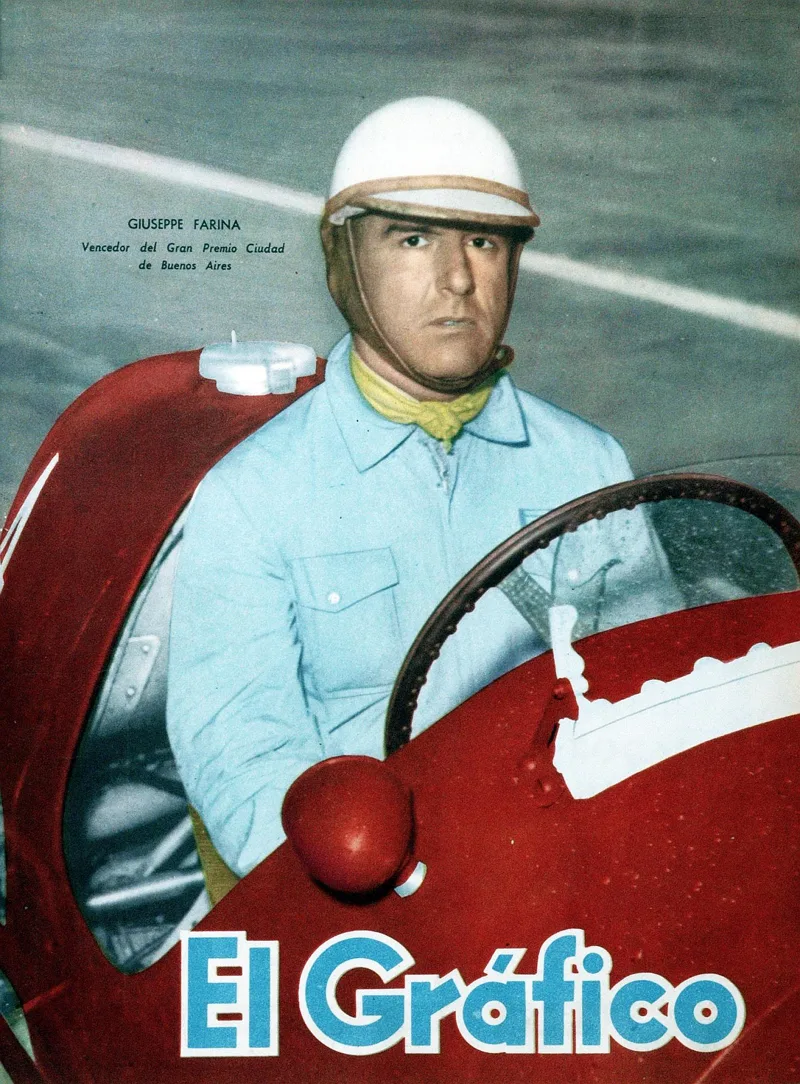
Alfa Romeo asked Parnell to drive its fourth works car in the inaugural World Championship Formula One race at Silverstone in 1950. He finished third, sharing the podium with teammates Giuseppe Farina and Luigi Fagioli. He was the only British driver to race for the all-conquering factory team.
While racing his Maserati under the Scuderia Ambrosiana banner, he became involved with BRM. He began as a test driver for the original V16 and later became lead driver of the BRM Type 15, but the team rarely appeared at races. He remained under contract to BRM for 1951, but the team could never provide him with a car, so he kept racing his Maserati.
In 1951 the BRM finally delivered results at Goodwood, where Parnell won the Woodcote Cup and then the Goodwood Trophy later the same day. Tony Vandervell then offered him the Thinwall Special, a modified Ferrari 375, and he drove it in a series of Formula One races.
At the 1951 BRDC International Trophy at Silverstone he led a race that was held in heavy rain and floods. The race was stopped after six laps because the circuit was too dangerous to continue. No official winner was declared, but Parnell had been a minute clear of the Italian cars when it was halted.
What did he achieve in the rest of 1951 and 1952?
At the Festival of Britain Trophy at Goodwood, Parnell won the first heat and broke the outright lap record on his first lap from a standing start. He then won the final after a long battle with Farina. Those wins came with the Maserati, while the Thinwall Special was his main Formula One car.
At Dundrod's Ulster Trophy, Farina arrived with a works Alfa Romeo 158. Parnell took the lead when Farina pitted for fuel, but a lap later Farina passed him and won, with Parnell second.
At the Grand Prix de l'A.C.F. at Reims he finished fourth in the Thinwall Special. At Winfield he took the Scottish Grand Prix, which closed his season in strong form.
In June 1952 he won a Formula Two race at Boreham on a Cooper-Bristol T20, in front of over 25,000 spectators. It was his only Formula Two victory.
How did his sports car career go?
Parnell raced for Aston Martin's sports car team after the 1950 British Grand Prix. He finished sixth at Le Mans in a DB2 with Charles Brackenbury, who finished second in class. He followed that with a class win and fourth overall at the Tourist Trophy at Dundrod.
In 1952 he won class races at Silverstone and Boreham in the DB2. At Goodwood that year a pit fire seriously injured John Wyer, and Parnell took over as Aston Martin's team manager. It was an early sign of the managerial role he would take on for the rest of his career.
The 1953 Mille Miglia was a standout result. With a throttle that broke and had to be wired fully open, he and navigator Louis Klemantaski finished fifth in a DB3. That was the highest finish ever by a British car in the great Italian classic, and it followed a second place at the 12 Hours of Sebring.
He also finished second at the RAC Tourist Trophy, and he won the Goodwood Nine Hours. In 1954 he took his own Ferrari 625 to wins at Goodwood, Snetterton and Crystal Palace in Formula One events, as well as further wins for Aston Martin.
In 1956 he crashed a Rob Walker Connaught B-type at Crystal Palace, breaking a collar-bone and cutting a knee. After recovering he went to New Zealand, where he won the New Zealand Grand Prix and the Dunedin Trophy early in 1957 with a Ferrari 555/860 entered by Scuderia Ambrosiana.
He stepped away from driving at the close of 1957, aged 45. The last race of his international career was at Ryal Bush in New Zealand, a second place in a Ferrari 555/860.
What did he achieve as a team manager?
Parnell became Aston Martin's team manager, and he oversaw a famous one-two finish at the 1959 24 Hours of Le Mans. Roy Salvadori and Carroll Shelby led home Maurice Trintignant and Paul Frere. Aston Martin then entered Formula One, with Parnell running the programme until it was abandoned at the end of 1960.
In 1961 the Samengo-Turner brothers asked him to take over the management of the Yeoman Credit racing team from Ken Gregory of the British Racing Partnership. He ran two Cooper T53 Low-Line cars for John Surtees and Roy Salvadori, and between them the drivers collected a handful of championship points.
For 1962 the team was renamed Bowmaker-Yeoman Racing and ran Lola Mk4 chassis, again with Climax engines. Surtees finished fourth in the drivers' championship with 19 points, and he also took pole at the season-opening Dutch Grand Prix. Surtees gave Parnell his first podium finishes as a manager, with second places at the British and German events. Salvadori had a difficult season and failed to finish a single race.
After Bowmaker left Formula One in late 1962, Parnell founded his own outfit. The new Reg Parnell Racing operated from Hounslow in its first stage, with a car for the young driver Chris Amon.
A historian, Dr Bartrip, wrote that Parnell prepared a car meticulously and was an astute judge of drivers. He spotted the potential of John Surtees, Chris Amon and Mike Hailwood, and that eye for talent was a large part of his reputation in the paddock.
How did Parnell's life end?
Parnell died on 7 January 1964 from peritonitis, after complications following an appendix operation. He was 52. Shortly before his death he had commissioned a design for a new car for the 1964 season.
His son Tim, who also raced, took over the team management. Tim developed a strong working relationship with BRM during the late 1960s.
What is Parnell's legacy?
Parnell's Formula One record is small: seven World Championship Grands Prix, one podium and nine points. His influence came through the cars he drove, sold and managed, and through the drivers he helped to develop.
Career summary by role
| Role | Period | Standout result |
|---|---|---|
| Driver, post-war racing | 1947 onwards | First Formula One race win at the 1947 Swedish Winter Grand Prix |
| Driver, World Championship | 1950 to 1951 | Third at the 1950 British Grand Prix; nine points overall |
| Sports cars | 1950 to 1957 | Fifth at the 1953 Mille Miglia |
| Team management | 1952 to 1964 | Aston Martin one-two at Le Mans in 1959 |