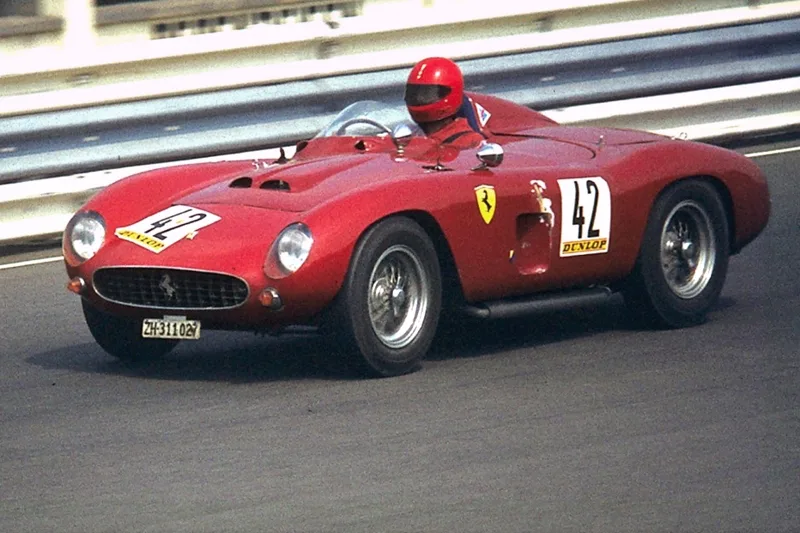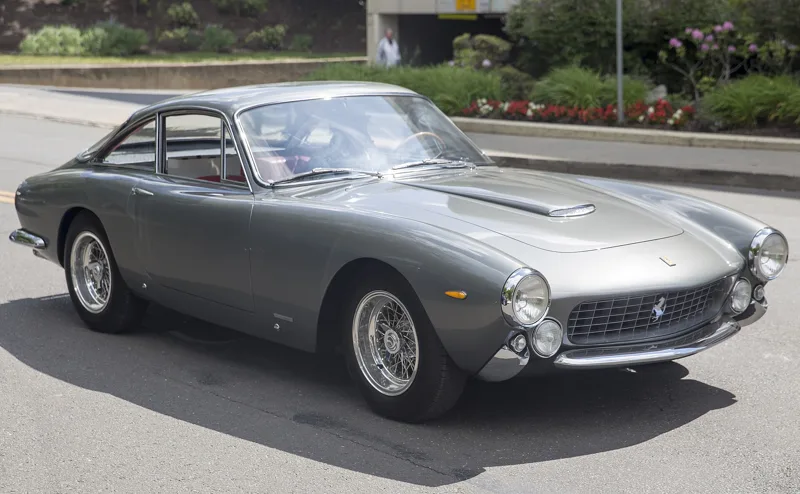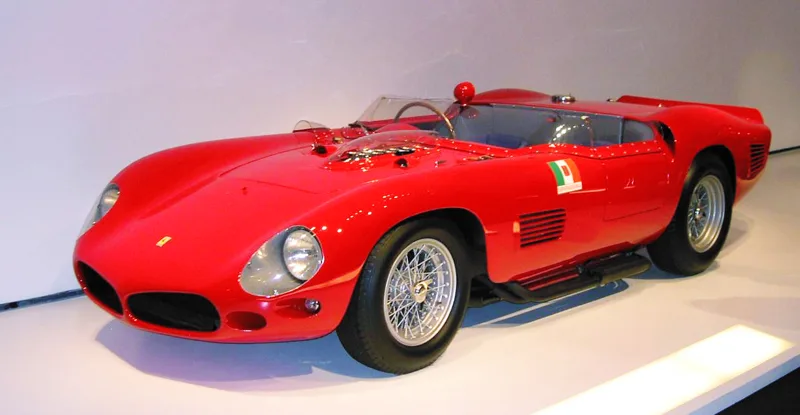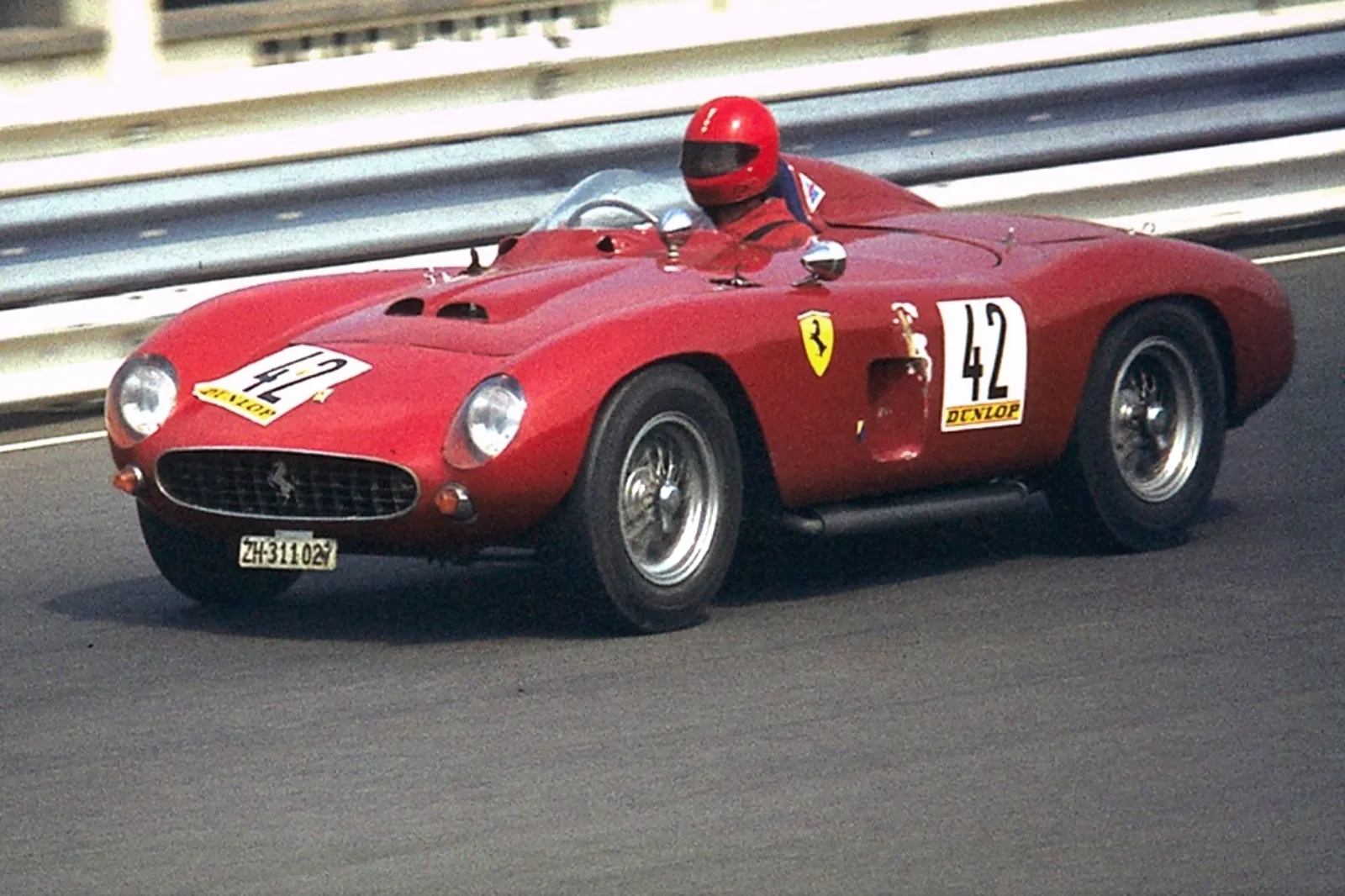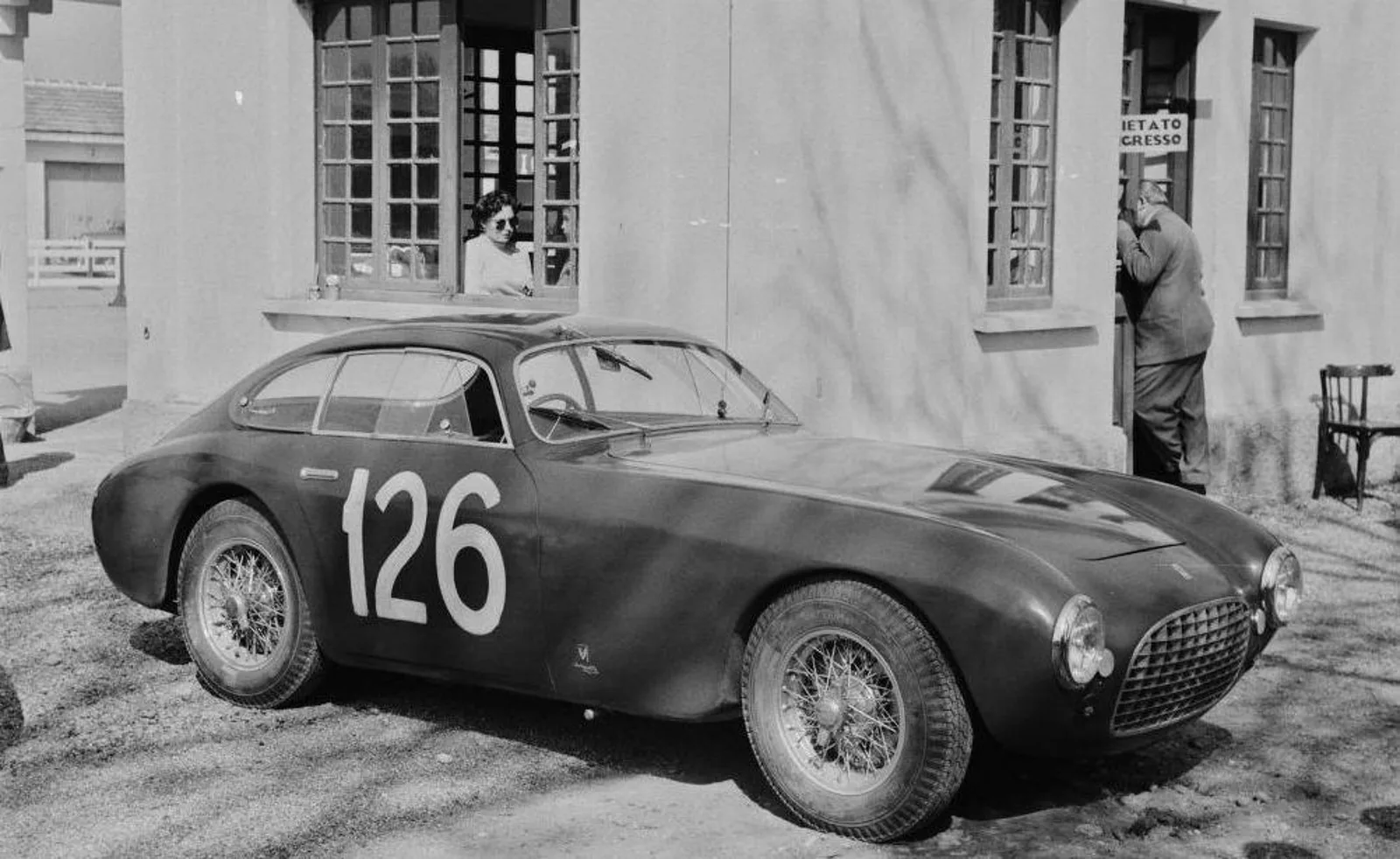
Touring and Vignale coachwork, a 2.6-litre V12 and a 1-2-3 finish at the first Tour de France automobile in 1951.
The Ferrari 212 Export was a 2.6-litre V12 sports racing car built in 1951 and 1952. Ferrari made twenty-seven examples, most of them raced, and the model won the Tour de France automobile, the Giro di Sicilia and several endurance events.
Ferrari built the 212 Export in 1951 and 1952 as a step up from the 195 S, pairing a bigger V12 with a newly built chassis. The car spent its short career in endurance racing, winning the Giro di Sicilia, the Tour de France automobile and the 10 Hours of Messina among other events.
Where did the 212 Export come from?
The 212 Export was a race model that evolved from the 195 S, with a larger engine and a new chassis. It sat beside a road-going car called the 212 Inter. Twenty-seven 212 Exports were made, and most went racing. The first car in the series was the 212 MM, which was later renamed the 212 Export.
The Export label debuted on chassis 0072E, a 166 Export Vignale Spyder, and it took the place of the usual Sport label for the 212 racers. Ferrari intended the 212 Export as a sports car for overseas markets. Many chassis numbers end in E, but 0070M carries an M, because the factory named that car for the Mille Miglia.
A V12 sports racer that carried Touring and Vignale coachwork to the track and swept the first Tour de France automobile.
How was the 212 Export bodied?
Carrozzeria Touring supplied most of the bodies, and it built eight Touring Barchetta open cars and four closed berlinettas. Carrozzeria Vignale produced ten competition bodies, while Motto and Fontana built a few cars each. This variety of coachwork is one reason the 212 Export range looked so different from car to car.
Vignale's ten competition bodies were three open spiders and seven closed berlinettas, the latter built to a Giovanni Michelotti design. Motto bodied two 212 Exports, including spyder 0094E, which had triple headlights and was owned by the Italian racing driver Piero Scotti before it ended up in Argentina.
Fontana made a spyder for 0086E with an open body in the style of a Sicilian cart, finished with cycle-fenders. That one-off shape set it apart from the Touring cars in the same range.
Which individual 212 Exports have notable histories?
Several cars have unusual stories. Touring Barchetta 0102E was re-bodied by Carrozzeria Autodromo in 1953 and 1954 and later appeared in a Hollywood film. Chassis 024MB was rebuilt after a crash, and 0070M was the only car the factory named for the Mille Miglia.
Fox Studios in Hollywood acquired 0102E and used it in the 1955 film The Racers, which starred Kirk Douglas and Bella Darvi and was directed by Henry Hathaway. The car also ran the 1954 Mille Miglia, filming material for The Green Helmet, a 1961 film starring Sid James and Bill Travers.
Chassis 024MB was recreated after a serious accident split the car in two. In 1950 Count Giannino Marzotto received a new body designed by Franco Reggiani and built by Carrozzeria Fontana, and in 1951 the car gained a 2.6-litre engine from 212 Export 0084E. Because of its unusual shape, the car was nicknamed l'Uovo, meaning the egg.
Vignale also built two road-going convertibles, 0106E and 0110E. The second was ordered by the Portuguese ambassador to France. Competition-bodied spyder 0076E, shown at the Turin Motor Show, was possibly owned by Roberto Rossellini and never raced.
Franco Cornacchia of Scuderia Guastalla owned the 212 MM, chassis 0070M, which carried a Vignale berlinetta body. It was raced until 1955, when Giovanni Brinci died in a fatal accident during the Mille Miglia. In 1995 the car was offered for US$349,000, and it later belonged to Jon Shirley, a former president of Microsoft.
Some cars were later converted to 225 specification by fitting a 2.7-litre engine. Chassis 0104E, 0112E and 0158ED are among the examples that received the upgrade.
What engine did the 212 Export use?
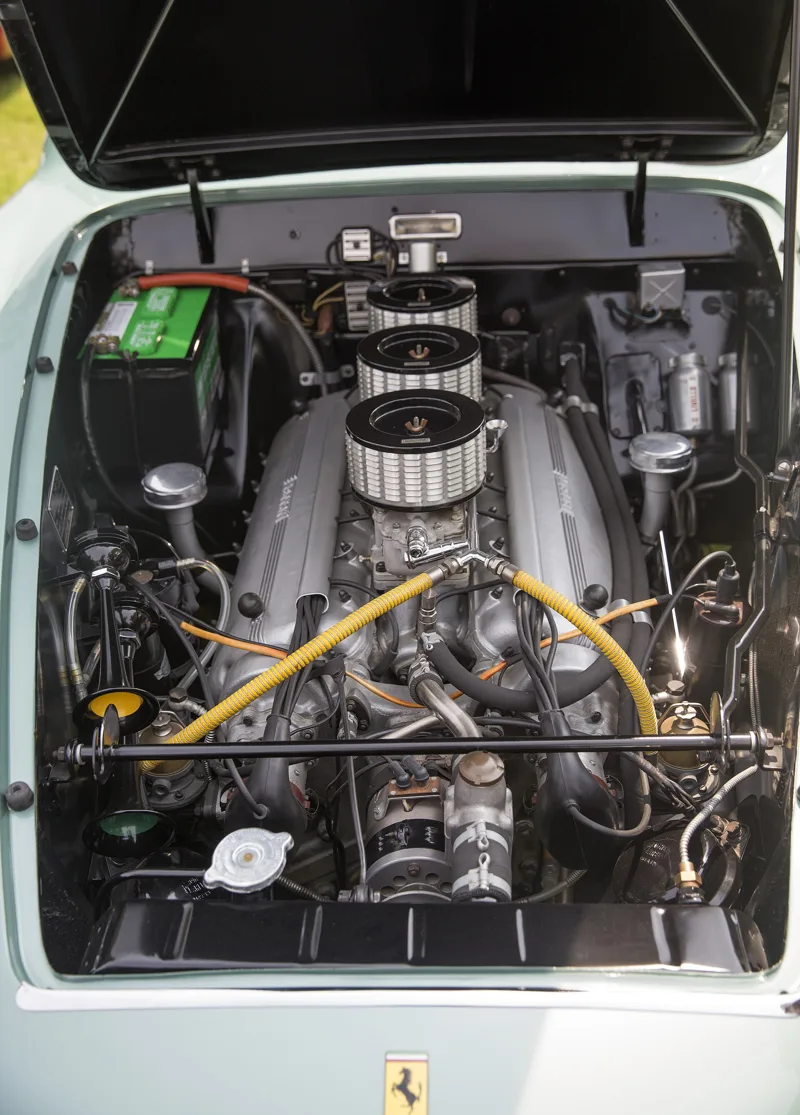
The 212 Export used a 2,562.51 cc V12 with a single overhead camshaft and two valves per cylinder. Output began at 150 PS (110 kW; 148 hp) at 6,500 rpm and peaked at 165 PS (121 kW; 163 hp) at 7,000 rpm, according to the carburettor fitted. Its five-speed gearbox was not synchronised.
The engine was a Colombo V12 with a bore of 68 mm (2.7 in) and a stroke of 58.8 mm (2.3 in), giving a compression ratio of 8.4:1. Each cylinder had one spark plug, served by two coils, and a wet sump handled the lubrication.
Fuel came from three Weber 32DCF carburettors, or three Weber 36DCF units as an alternative. Only the 212 MM ran triple quad-barrel Webers, while a few early cars made do with one carburettor.
How was the chassis built?
The chassis was a new design built from steel tubes with an elliptical section, and it kept the 195 S wheelbase of 2,250 mm (88.6 in). Later cars could use a Gilco-designed Tuboscocca trellis frame, which used smaller diameter tubes for extra rigidity. Suspension combined double wishbones at the front with a live rear axle.
Front suspension used transverse leaf springs with Houdaille hydraulic shock absorbers. At the rear, a live axle ran on semi-elliptic springs, again with Houdaille dampers. Brakes were hydraulic drums on all four wheels, and the fuel tank held 120 litres.
How did the 212 Export perform in 1951?
In 1951 the 212 Export won its first race at the Giro di Sicilia and took a 1-2-3 finish at the Tour de France automobile, the first edition of that twelve-day event. It also finished second at the Targa Florio and won the Coppa della Toscana.
The Giro di Sicilia opened the season, with three 212 Exports entered and one of them winning. Vittorio Marzotto and Paolo Fontana took victory in the Fontana spyder 0086E. The next win came at the Coppa Inter-Europa, where Luigi Villoresi drove a 212 MM to victory and set the fastest lap.
At the Mille Miglia, four 212 Exports were entered but only two finished. For half the race Giannino Marzotto and Marco Crosara were in front, until a flat tyre ended their run. The 212 MM finished 17th overall with Cornacchia and Mariani. The Motto spyder 0094E was third overall.
The Coppa della Toscana went to 024MB, driven by Giannino Marzotto and Marco Crosara. At the Circuito do Porto a single Export finished second overall, behind the 340 America. At Le Mans, all three Exports were privately entered, and the best result was ninth overall for the Vignale berlinetta 0096E, driven by Norbert Jean Mahe and Jacques Peron.
Charles Moran Jr. and Franco Cornacchia finished 16th at Le Mans in Touring Barchetta 0100E. Jean Lariviere was killed on his fifth lap after Touring Barchetta 0078E spun out at Tertre Rouge.
Further 1951 results included Giovanni Bracco's win at Vila Real in Portugal, with the fastest lap in his Vignale spyder. Pietro Palmieri and Vallecchi took second place and won their class at the Giro delle Calabria. In the Targa Florio, 0086E finished second overall with the fastest lap.
The Tour de France automobile was the race that produced the 1-2-3 result. Pierre Boncompagni and Alfred Barraquet won in Touring Barchetta 0078E, a car with a soft-top. Jacques Peron and R. Bertramnier were second in Vignale berlinetta 0096E, and Elio Checcacci with Harry Schell took third in Motto berlinetta 0074E.
Who drove the 212 Export in competition?
Many 212 Export entries came from privateers and independent teams, and the drivers included Luigi Villoresi, Giovanni Bracco and Franco Cornacchia, among others. Phil Hill and Harry Schell also raced Exports, in the Carrera Panamericana and the Tour de France automobile.
Giannino Marzotto and Marco Crosara drove for Scuderia Marzotto in several races, while Cornacchia shared the 212 MM with Guido Mariani and later with Clemente Biondetti. The American Charles Moran Jr. privately entered a 212 MM at Le Mans in 1952, partnering Cornacchia for the race.
What happened to the 212 Export in 1952?
The 1952 season opened with the Mille Miglia, where four Exports entered and only one finished, Franco Cornacchia's 212 MM in 20th place. Cornacchia then teamed with Clemente Biondetti to win the 10 Hours of Messina, and Phil Hill and Arnold Stubbs took a Vignale berlinetta to sixth overall in the Carrera Panamericana.
The Gran Premio di Pergusa in 1952 went to Luigi Bordonaro, who also set the fastest lap in his Touring Barchetta. Bordonaro kept racing the car in minor events through 1952 to 1955 before passing it to Edouard Margairaz.
Touring Barchetta 0134E served Hans-Karl von Tscharner across hillclimbs from 1952 to 1956, bringing ten wins, five of them in class.
Why are 212 Exports valuable today?
Collectors prize the 212 Export, since many examples carry real racing pedigree and early V12 Touring Barchetta bodies are especially wanted. Auction results have climbed in recent years, with examples selling for US$1.87 million in 2011 and US$3.19 million in 2014.
Owning an early Ferrari also allows entry to historic rallies and races, which adds to the model's appeal for enthusiasts who want to drive their cars in competition.
The Motto Spyder carried a pre-sale estimate of CHF2.8-3.8 million in 2008. Gooding and Company sold one of two Export cabriolets above its estimate, for US$1.87 million in 2011.
In 2014 Bonhams sold Touring Berlinetta 0088E for US$3.19 million. RM Sotheby's sold the penultimate Export, Touring Barchetta 0158ED, for 6.72 million euros in 2015. Collectors searching for an early V12 Touring Barchetta have pushed prices higher.
What are the 212 Export specifications?
| Specification | Detail |
|---|---|
| Engine | 2,562.51 cc V12, SOHC, two valves per cylinder |
| Bore and stroke | 68 by 58.8 mm (2.7 by 2.3 in) |
| Compression ratio | 8.4:1 |
| Power | 150 PS (110 kW; 148 hp) at 6,500 rpm to 165 PS (121 kW; 163 hp) at 7,000 rpm |
| Carburettors | Three Weber 32DCF or 36DCF |
| Transmission | Five-speed, non-synchronised |
| Wheelbase | 2,250 mm (88.6 in) |
| Suspension | Front double wishbones; rear live axle |
| Brakes | Hydraulic drums all round |
| Fuel tank | 120 litres |
| Cars built | Twenty-seven, from 1951 to 1952 |