Jaguar's works team had gone, but five Jaguars still filled the top six places, and the winning D-Type spent only 13 minutes and 9 seconds in the pits.
Flockhart and Bueb took the 1957 race for Ecurie Ecosse, a private team, after the works Jaguars had been withdrawn. Their car finished ahead of the Lawrence and Sanderson Jaguar, and four Jaguars took the first four places overall. The race was run over 24 hours on the Circuit de la Sarthe.
Ecurie Ecosse won the 1957 24 Hours of Le Mans with a Jaguar D-Type, while the works Jaguar team was absent. Jaguars filled five of the top six places, and the Ferrari of Stuart Lewis-Evans in fifth was the only other car to get among them. The winning car spent only 13 minutes and 9 seconds in the pits across the whole 24 hours.
Who won the 1957 24 Hours of Le Mans?
Ron Flockhart and Ivor Bueb won in a dark blue Ecurie Ecosse Jaguar D-Type, eight laps ahead of the sister car of Lawrence and Sanderson. The two Ecosse cars finished in formation, as they had the year before, and the result was the team's finest hour.
The win was built on a steady run after the Ecosse team took the lead in the third hour. Flockhart and Bueb held the top spot for the rest of the race, while the Ferrari and Maserati challengers fell away one by one. Their average speed over the race was 183.22 km/h (113.85 mph).
It was also Jaguar's greatest triumph. Four Jaguars crossed the line in the first four places, and a fifth finished sixth.
Five Jaguars in the top six, and a private team on top of them all.
Why could a private team beat the factory opposition?
Jaguar's works team had retired at the end of 1956, so the defending champions put their support behind their customer teams. Ecurie Ecosse entered a 3.8L fuel-injected D-Type, and its win over manufacturer-backed rivals was even more striking for a private team.
Ecurie Ecosse also ran a 3.4L car that Paul Frere had crashed in the previous year's race, still in its British Racing Green from the Jaguar factory. Frere himself raced for the Equipe Nationale Belge, using the car that the team had finished fourth with in 1956.
Ecurie Ecosse had won the race in 1956 with Flockhart and Sanderson, and Bueb was now sharing the winning car with Flockhart. The Jaguar name was present in every part of the top field, even with the works team absent.
What rules changed for the 1957 race?
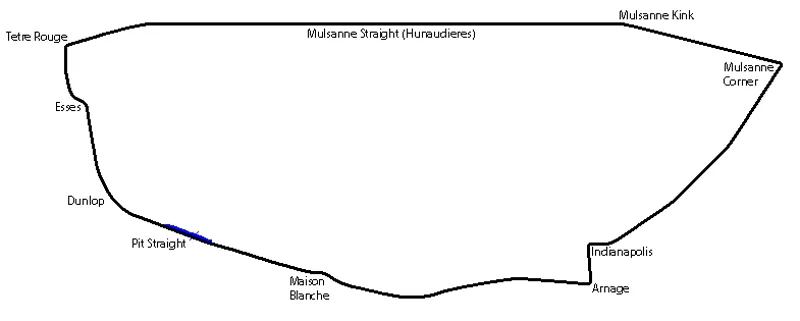
The Automobile Club de l'Ouest dropped its engine-size limit for prototypes, so the open-class cars could again run as large as their makers wished. The maximum single stint for a driver was cut to 36 laps, down from 72, and refuelling came every 30 laps, down from 34.
Cars now needed at least two doors, with both seats the same size in a cockpit at least 1.2m wide. Windscreens could now be 15 cm tall at minimum, down from 20 cm, and the fuel tank was limited to 120 litres.
The ACO also made its ban on women drivers formal, following Annie Bousquet's death at Reims in 1956. Disqualification for falling behind the Index distance was tightened to every 6 hours, rather than every 12.
Who was in the 1957 field?
A total of 82 racing cars were registered, of which 58 were allowed to practise for the 55 starting places. The big talking point was the absence of the works Jaguars and the arrival of Maserati in strength in the top class.
Ferrari arrived with two of its 335 S cars, with 4.0L V12 engines capable of about 390 PS, plus two 250 TR prototypes and privately entered 290 MM cars. Maserati's Frank Costin-designed coupe was shared by Moss and Harry Schell, and a 450S spyder with a 4.5L V8 of 420 bhp was run by Jean Behra and Andre Simon.
Aston Martin, now managed by Reg Parnell after John Wyer became general manager, brought the new DBR2 and two DBR1/300s. The DBR2 was a one-off built on the defunct Lagonda frame, with the 3.7L engine of the DB4 road car producing 290 bhp.
Porsche entered six cars in the S-1500 class, with a works team of 550A and 718 RSK cars. Lotus took the S-1100 class with the FWA-Climax engine, and a small Lotus with a short-stroke 750cc Climax engine contested the S-750 class for Allison and Hall.
What happened in practice?
Mike Hawthorn set the first sub-four-minute laps in practice in the Ferrari. Fangio then went quicker in the Maserati spyder, setting the fastest single lap of the decade in practice.
Moss's special large brakes locked as he approached Mulsanne at top speed. He went back to the pits and had the regular brakes fitted instead, and the works Ferraris had to fit experimental pistons, one of which failed on a Testarossa before it ran.
The Lotus-Climax cars were about 25 seconds per lap quicker than the rest of the small French cars in practice. Chapman's own 1475cc Lotus broke the S-1500 lap record but dropped a valve, and it had to be withdrawn.
How did the race start?
The race began at 4pm in cloudy, humid weather, with a crowd of around 250,000. Moss was slowed in his cramped Maserati coupe, so the first car to clear the start line was the Ferrari of Peter Collins, which left a trail of rubber.
Collins led the first lap from a standing start, but his engine seized after lap two and he retired at the pits. Talbot's transmission broke as it left the start box, so Bruce Halford had the shortest debut recorded at the race.
Hawthorn then led the field, followed by the Maseratis of Moss and Behra. Moss's car began to smoke heavily, and Harry Schell took over after a long pit stop. The Maserati was soon out with rear axle trouble.
Why did the Italian cars fail?
Attrition hit the Italian cars early. Hawthorn stopped for a tyre change and lost time while a marshal stopped him from climbing back in. Behra and Simon's Maserati lost its rear axle, and Simon crashed on the opening lap out of the pits, splitting the fuel tank.
Musso's Ferrari suffered another seized piston on the Mulsanne straight in the fourth hour, just before dusk. That left Gendebien and Trintignant as the sole Ferrari challengers running near the front.
Hawthorn refuelled and handed the Ferrari to Musso, and the team began to move back up the field. The attrition handed the lead to the Ecurie Ecosse car of Flockhart and Bueb at the start of the third hour, and the team never let it go.
What happened during the night?
Just before 10:30pm the Whitehead brothers had to retire their Aston Martin out of the top ten, when its gearbox finally broke. The Scarlatti and Bonnier Maserati then retired with clutch failure, which finished the works team's race after only six hours.
Soon after midnight Gendebien retired from third with a holed crankcase. Salvadori's Aston Martin also retired around 2am, when its gearbox failed after he had been running with only fourth gear for most of his stint.
At 1.50am Brooks's Aston Martin, two laps down and still stuck in fourth gear, came out of Tertre Rouge, lost control and rolled. Maglioli, closing in the Porsche 718, hit the wreck. Brooks went to hospital with severe cuts and bruises.
Hamilton's Jaguar was held up by a burnt exhaust that filled the cockpit with fumes. When he pitted, his crew welded the exhaust and patched the burned cockpit floor with a plate of steel cut from an unattended gendarmerie wagon.
How did the Jaguars hold the lead?
By half distance the order at the top had settled, with the leading Jaguar having completed 165 laps. The leading car held a comfortable advantage, and the Jaguars of Ecurie Ecosse and Equipe Nationale Belge kept the top places through the night.
Freddy Rousselle, running second in the Belgian Jaguar, came to a halt at Mulsanne with ignition trouble. He got the car moving again, rejoined in sixth place and later climbed back to fourth with rapid times.
At 5.30am the mist turned into heavy fog, the only bad weather of the weekend. Drivers slowed to 50 km/h at times, but the leading Jaguars were not much affected. By 10am the fog had lifted and the four Jaguars were holding the top places over a 16-lap spread.
What was the finish like?
In the final hour, the Porsche that had been as high as fifth ran out of fuel near Maison Blanche. The Storez car could not be refuelled inside its 30-lap window, and it could not complete the final lap in the required time.
At 4pm the chequered flag fell. Flockhart and Bueb took the win in a formation finish with the second Ecosse car, and the margin was eight laps. The car had spent only 13 minutes and 9 seconds in the pit lane during the whole race.
A Stanguellini that had come into the pits stuck in top gear was pushed by its driver for half a mile to the top of the Dunlop hill. He bump-started it on the downhill and still took the last finishing place, to the cheers of the crowd.
Results and class placings
| Position | Crew | Car | Result |
|---|---|---|---|
| 1 | Ron Flockhart and Ivor Bueb | Ecurie Ecosse Jaguar D-Type | Winners, eight laps clear |
| 2 | Lawrence and Sanderson | Ecurie Ecosse Jaguar D-Type | Second |
| 3 | Lucas and Mary | Jaguar | Two laps behind the winners |
| 4 | Rousselle and Frere | Equipe Nationale Belge Jaguar | 17 laps behind the winners |
| 5 | Lewis-Evans | Ferrari | The only non-Jaguar in the top five |
| 6 | Hamilton and Gregory | Jaguar D-Type | Lost two hours overnight |
| 8 | American Porsche | Porsche | Sole S-1500 finisher |
| 14 | Lotus 750cc | Lotus | Won the Index of Performance |
How did the smaller classes finish?
The Mackay-Fraser and Chamberlain Lotus won the S-1100 class by a huge margin of 26 laps over its team-mates, and it took the Biennial Cup. Lotus had entered four cars, and all four finished.
The Ferrari Testarossa of the Equipe Nationale Belge finished seventh and won the S-2000 class by seven laps from the AC Ace. The aged French Aston Martin took the S-3000 class by finishing 11th.
The 1957 race was also the last appearance for the French stalwarts Talbot and Gordini. None of their cars reached the end, and Arnott and DKW had only one entry each.
What did the 1957 win mean for Ecurie Ecosse?
The result was the team's finest hour. It won with private cars against the big manufacturers, after its own 1956 win in the same race.
Roger Masson pushed his Lotus for four miles after it ran out of petrol on the Mulsanne straight in the early hours. It was refuelled and went on to finish 16th, which is a reminder of how much the race asked of its entrants.
Before his retirement, Hawthorn had set the new lap record in his Ferrari. The race also set a new distance record, beating the 1955 mark by 138 miles (222 km). That record came in a year when the ACO's Golden Jubilee had been postponed from 1956, and the event was run again as a full part of the championship.