From a Saxon steam-fittings works to the world's largest motorcycle maker, and the front-drive two-strokes that made DKW a car brand.
DKW was a German marque founded in 1916 that built cars and motorcycles on two-stroke engines. It joined Auto Union in 1932 and made the F-series front-drive cars, with the F102, the last model to start production, built until 1966.
DKW was a German marque that built both cars and motorcycles, and its car models used two-stroke engines from the first Typ P in 1928 until car production ended in 1968. It was one of four companies that combined to form Auto Union in 1932, which makes it a direct ancestor of today's Audi.
Where did DKW come from?
The company began in 1916, when Danish engineer Jorgen Skafte Rasmussen set up a factory in Zschopau, Saxony, to make steam fittings. The initials stand for Dampfkraftwagen, the German for a steam power-wagon, after an early attempt at a steam car that was unsuccessful.
In 1919 Rasmussen turned to small two-stroke engines, which he sold as toys under the name des Knaben Wunsch, or the boy's wish. A slightly modified version went into a motorcycle he called das kleine Wunder, the little wonder. By the late 1920s the company had become the largest motorcycle manufacturer in the world.
DKW's finances were shaky during Germany's hyperinflation, and in September 1924 it bought Slaby-Beringer, which rescued the firm from collapse. Rudolf Slaby then became DKW's chief engineer.
A two-stroke marque that began with steam fittings, then gave Auto Union its front-drive cars.
When did DKW start building cars?
DKW's first car was the Typ P, which went on sale on 7 May 1928 and was built at the company's Spandau plant in Berlin until 1931. It was a small and fairly crude machine that began as a roadster and was later offered as a basic sports car, but it marked the start of the car business.
The company's more important cars came from Zwickau. In 1928 Rasmussen became the majority owner of Audi Werke AG, and the Zwickau plant he acquired built a long series of inexpensive cars. That plant made the front-drive models that gave DKW its reputation in Europe.
The 1932 combination of DKW, Audi, Horch and Wanderer produced Auto Union. The new group kept the DKW name on its small cars, and after the Second World War the German car business continued under that umbrella until its final two-stroke models ended in the 1960s.
Why did DKW use two-stroke engines?
DKW car engines were always two-strokes, a choice that fitted a firm whose best-known product was the motorcycle. By the close of the 1920s it was the world's biggest motorcycle maker, and the same engine layout carried over into its cars.
The two-stroke layout stayed with DKW for almost four decades of car production. By the 1960s the design was at the limit of its development, and that limit helped to end the marque's car line.
Two-stroke technology also spread to other manufacturers. Saab used DKW engines as the model for the two-stroke unit in its first production car, the Saab 92, and other makers copied the DKW motorcycle design.
What were the F-series front-drive cars?
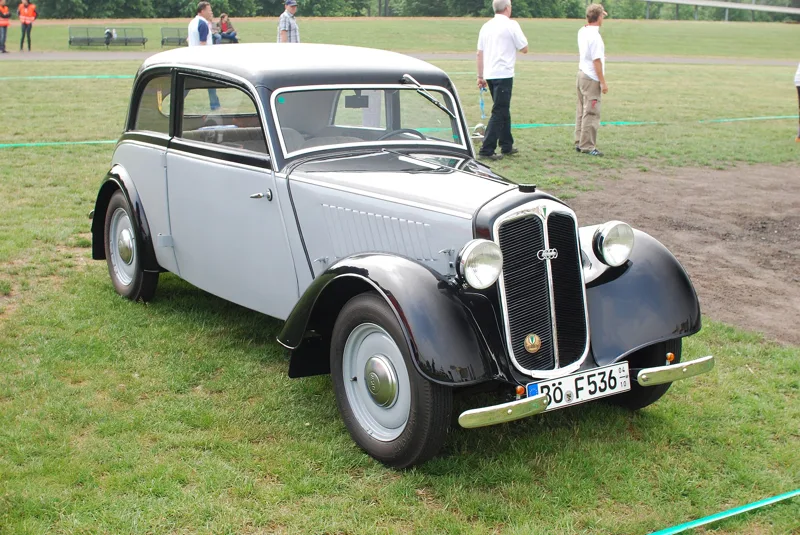
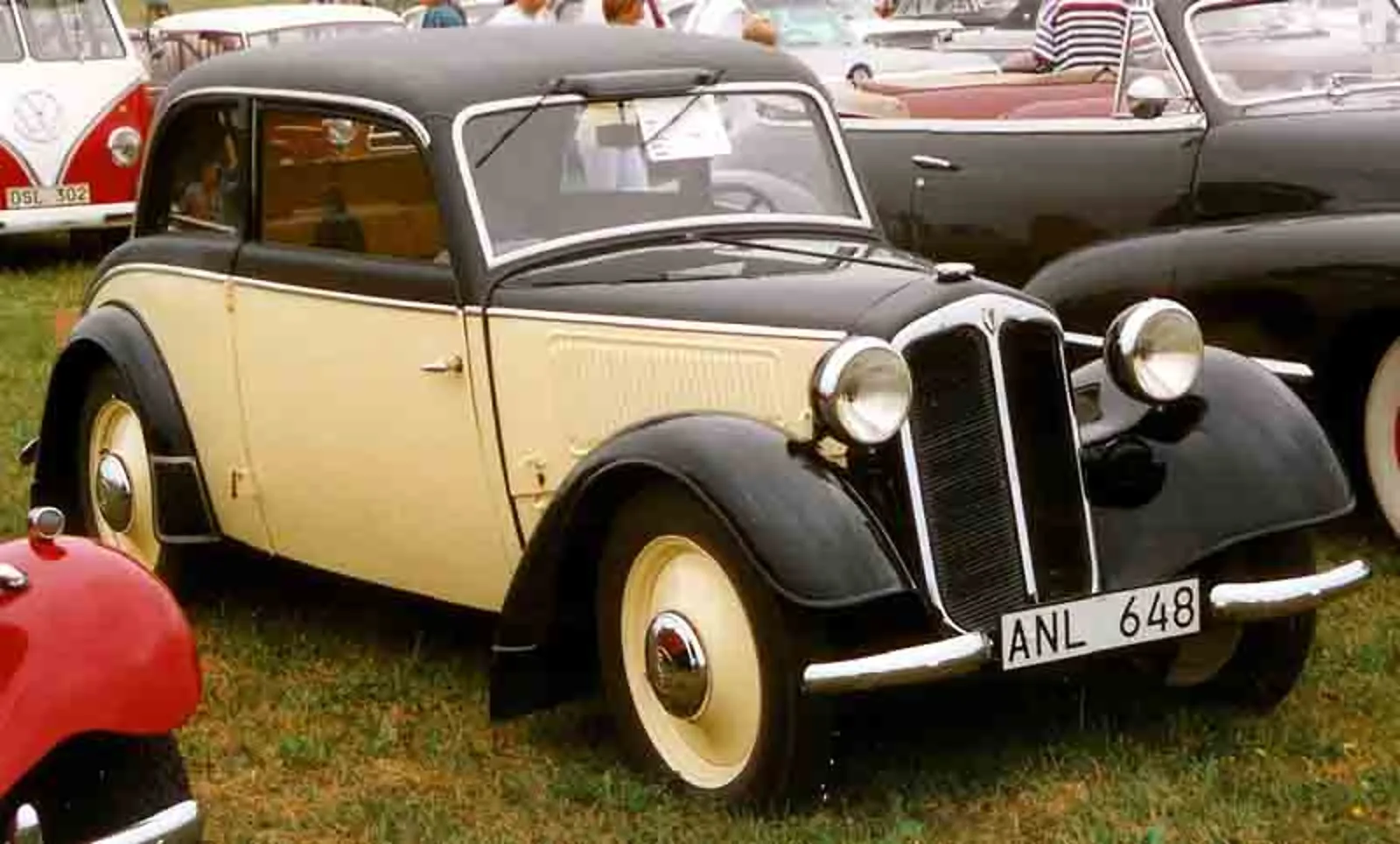
The F1 to F8 cars (the F stands for Front) were produced from 1931 until 1942, and they were the first volume-production front-drive cars in Europe. They used transversely mounted two-cylinder two-stroke engines of 584 or 692 cc, and early versions produced 15 PS.
From 1931 a choice of 18 or 20 hp was available. A Dynastart mounted directly on the crankshaft served as both generator and starter. Zwickau built about 218,000 F-series cars between 1931 and 1942, and most went to the home market.
The F-series was a commercial success. DKW sold 189,369 of these cars from 1931 to 1938, taking more than 16% of the German market. By 1934 it had moved into second place in German car sales, and it stayed there.
What were the rear-drive V4 cars?
DKW also built a rear-drive family of cars called Schwebeklasse and Sonderklasse. These models had two-stroke V4 engines, first of 1,000 cc and later of 1,100 cc, which looked like V6 units from the outside. They are less remembered today than the F-series, which makes them an interesting footnote.
Two of the cylinders worked as air compressors for forced induction rather than as firing cylinders. The front pair therefore had no spark plugs, which made the engine an unusual and technically intriguing design.
How did DKW rebuild after the war?
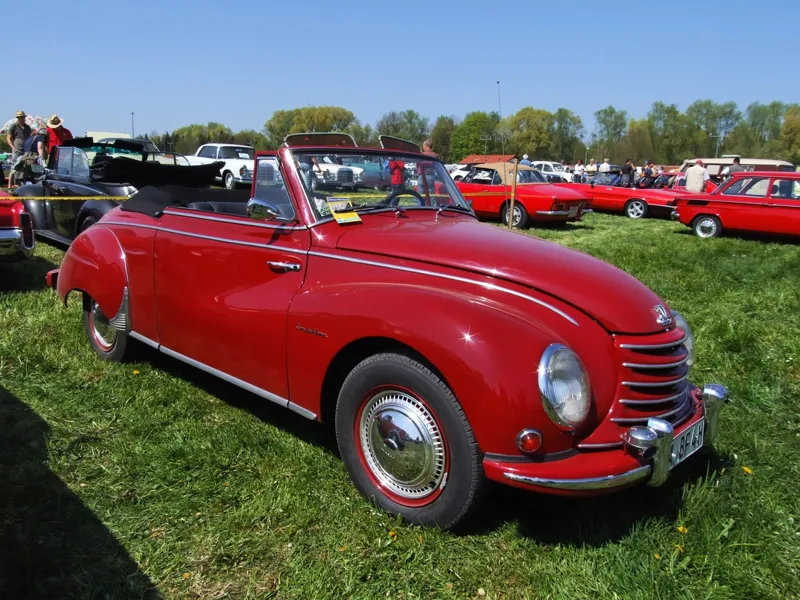
Auto Union had its roots in Saxony, which became part of East Germany, so the company had to rebuild in the West. It was registered as Auto Union GmbH in West Germany in 1949, and it started with spare parts before producing motorcycles and a van. Its first car was the F89, which reused the body of a pre-war prototype.
The three-cylinder engine became the core of the post-war range. A 900 cc three-cylinder two-stroke powered the F91 and F93, and the company later introduced the Auto-Union 1000, whose two-stroke unit displaced 1,000 cc. Its production shifted from Dusseldorf to Ingolstadt, where Audi still builds cars today.
Some later options were ahead of their time. The Auto-Union 1000 could be fitted with a saxomat automatic clutch from 1957, the only small car offering that feature at the time, and the last 1000S versions could be ordered with disc brakes.
The Junior and F12 cars
From 1959 the Junior range, a modern design of its time, became a popular part of the post-war line. The series included the Junior, Junior de Luxe, F11, F12 and F12 Roadster, and the cars were popular enough that many of them were built.
The sporting Auto-Union 1000 SP was a 2+2 seater offered from 1957 to 1964, first as a coupe and later as a convertible. It showed that the 1000 platform could still be made sporting even late in its life.
What was the DKW V6 project?
A 1960 V6 came from pairing two three-cylinder two-stroke units, giving 1,000 cc in total. The engine was later enlarged to 1,300 cc, and the 1966 version produced 83 hp in its standard two-carburettor form. Much of the work stayed in development rather than production.
Four carburettors lifted output to 100 hp, and a six-carburettor version reached 130 hp. The V6 weighed only 84 kg and was planned for the Munga and the F102. Some F102 and Munga cars received the unit during the 1960s.
What happened to the F102 and the DKW car line?
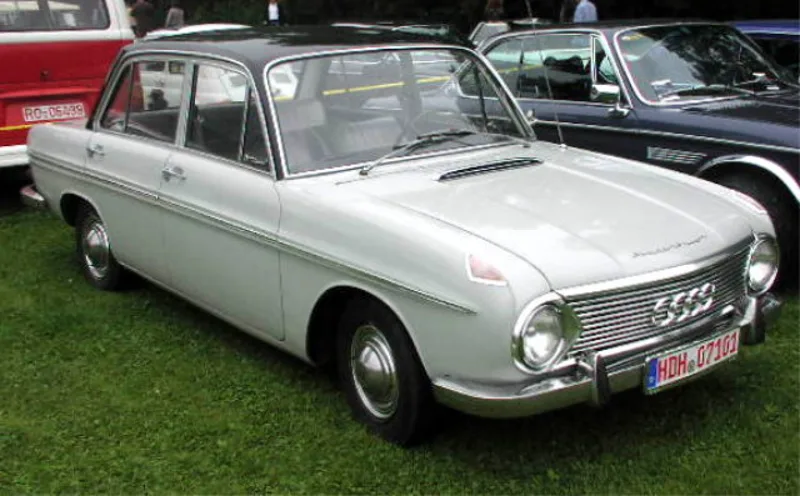
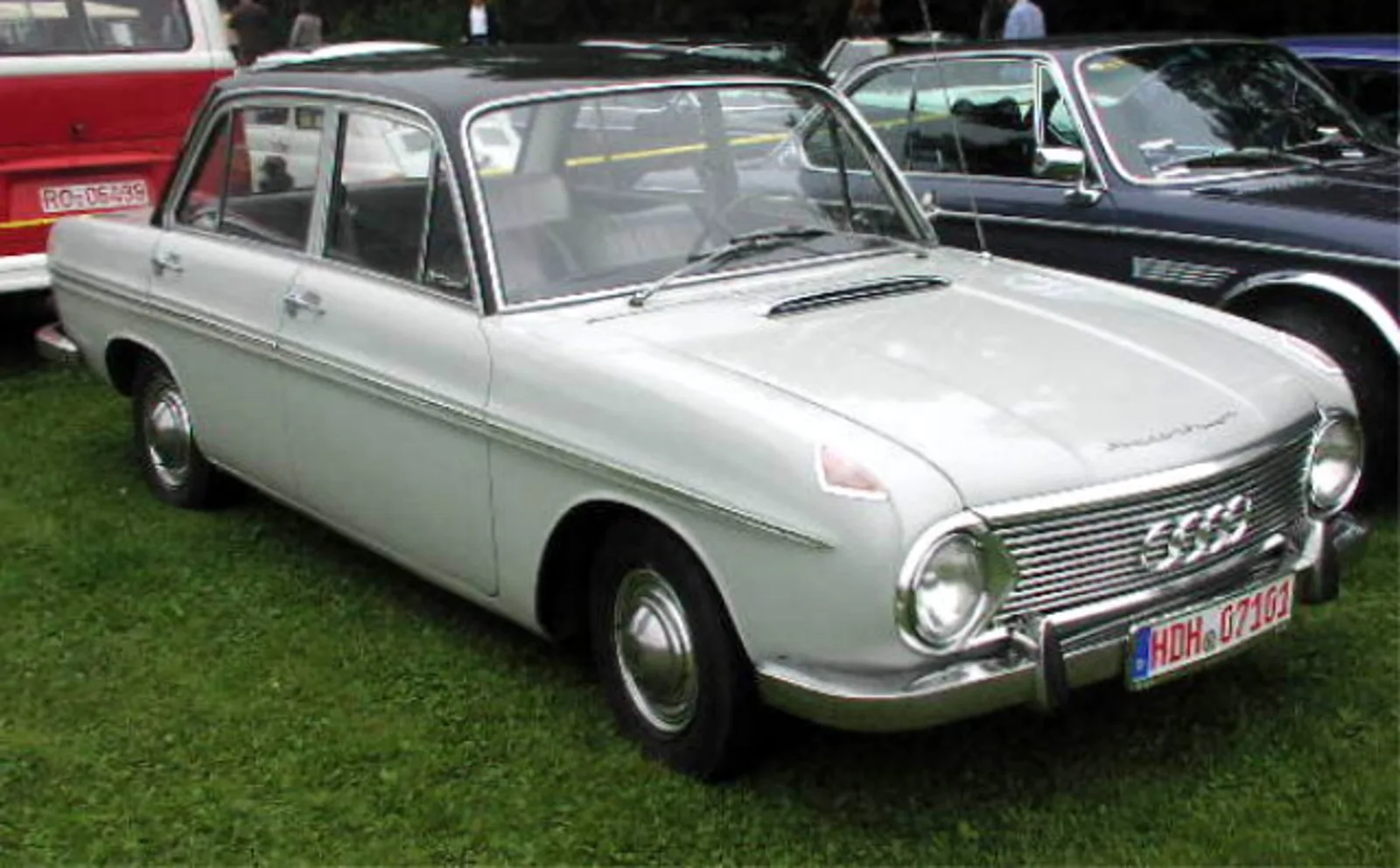
The F102 was the last DKW car model to start production. It replaced the old-looking Auto-Union 1000 but sold poorly, largely because its two-stroke engine technology was at the limit of its development. The model was built until 1966, the year the German-built car line effectively ended.
Auto Union's parent, Daimler-Benz, sold the company to Volkswagen, and VW re-engineered the F102 with a four-stroke engine. The result was the Audi F103, which marked the end of the DKW car and the return of the Audi name to the front of the range.
How did DKW build cars overseas?
DKW cars were built under licence or assembled from kits in several countries, from Brazil to Ireland. Local partners carried out the assembly, often using bodies and chassis shipped from Germany. Some of these operations lasted a decade or more, carrying the DKW name in markets far from Saxony.
Brazil
Vemag, a Brazilian firm that had been assembling Scania-Vabis trucks, produced DKW cars from 1957 until 1967. Vemag planned to build the Munga off-roader, a utility vehicle and a saloon with four doors, and the sedan and estate became the Belcar and Vemaguet in the early 1960s.
Vemag produced 109,343 DKW-Vemag cars before Volkswagen bought the rest of the Vemag stock in 1967. The Brazilian business also produced the GT Malzoni coupe, whose racing project became the foundation of the Puma sports car brand.
Argentina and Ireland
IASF built DKW vehicles in Argentina from 1960 to 1969 at Sauce Viejo in Santa Fe. The most admired model was the Fissore coupe, and the Auto Union 1000 S sedan reached 21,797 units before production ended.
An assembly plant in Ballincollig, County Cork, Ireland, ran from 1952 to 1964 and turned out roughly 4,000 vehicles. It was the only DKW factory in Europe outside Germany, and its large DKW sign remained visible on the wall for years after the closure.
Denmark, the Netherlands and Yugoslavia
Denmark was one of the biggest export markets for DKW. Local assembly built about 3,000 F5 cars before German occupation halted production in April 1940, and the bodies came from Zwickau, to be fitted to chassis delivered from Germany.
In the Netherlands, Hart, Nibbrig and Greve assembled cars at Sassenheim from 1956 to 1961, working from kits shipped from Germany. In Yugoslavia, the IMV company began assembling DKW passenger cars from 1962, with a capacity of at most 1,500 vehicles per year.
Did DKW win races and rallies?
DKW's three-cylinder two-stroke cars formed the basis of a long run of rally results after the war. For several years the marque was the most successful brand in the European rally league, which gave the small two-strokes a reputation well beyond their modest size.
The DKW Monza was a sporting two-seater with a glassfibre body on an F93 frame. It was put into small-scale production in 1956 on a private initiative, and its name came from the long-distance records it set at the Autodromo Nazionale Monza in December 1956. Its runs included 48 hours averaging 140.961 km/h, plus a 72-hour run averaging 139.459 km/h.
Only about 75 Monzas were built, and 50 survived. The cars were produced by several small coachbuilders in Germany, and production finished at the end of the decade.
In motorcycle racing, Arnold Zoller's split-single design from 1931 made DKW the dominant machine in lightweight and junior racing between the wars. The company also scored notable results at the International Six Days Trial.
What became of DKW's motorcycles and refrigerators?
The motorcycle division was the company's original strength. Its RT 125 was a well-known model before and after the war, and after the war production in East Germany became MZ, which built machines of several sizes. The design drawings of the RT 125 went to Harley-Davidson and BSA as war reparations.
Harley-Davidson's version was loosely known as the Hummer, while BSA used the design for its Bantam. Many small two-stroke motorcycles from other makers, including Yamaha and Maserati, later bore a close resemblance to the DKW layout.
DKW also had a refrigeration business. Rasmussen acquired a licence in 1927 for scroll compressors and refrigerators, and the work was so successful that the company was renamed DKK in 1931. DKK had 1,200 employees by 1938.
How did Auto Union change hands after the war?
After the merger in 1932, Auto Union was rebuilt in West Germany and placed under Daimler-Benz ownership in 1957. Volkswagen then acquired the company in 1964, which led directly to the F102 and the move to four-stroke engines under the Audi name.
Auto Union GmbH, a fully owned subsidiary of Audi AG, now holds the DKW trademark along with other historic rights from the combine. That legal link is why the DKW name still belongs to the Audi family of companies.
What were the main DKW figures?
| Item | Detail |
|---|---|
| Founded | 1916, Zschopau, Saxony |
| First car | Typ P, 7 May 1928 |
| Auto Union | Formed in 1932 from four companies |
| F-series | F1 to F8, 1931 to 1942; front-wheel drive |
| Pre-war output | Almost 250,000 units, about 218,000 front-drive |
| Engine layout | Two-stroke throughout; three-cylinder from 1939 prototype |
| Munga | 46,750 cars, 1956 to 1968 |
| Vemag, Brazil | 109,343 DKW-Vemag cars, 1957 to 1967 |
| IASF, Argentina | Auto Union 1000 S sedans: 21,797 units to 1969 |
| Last German-built car | F102, ended 1966 |