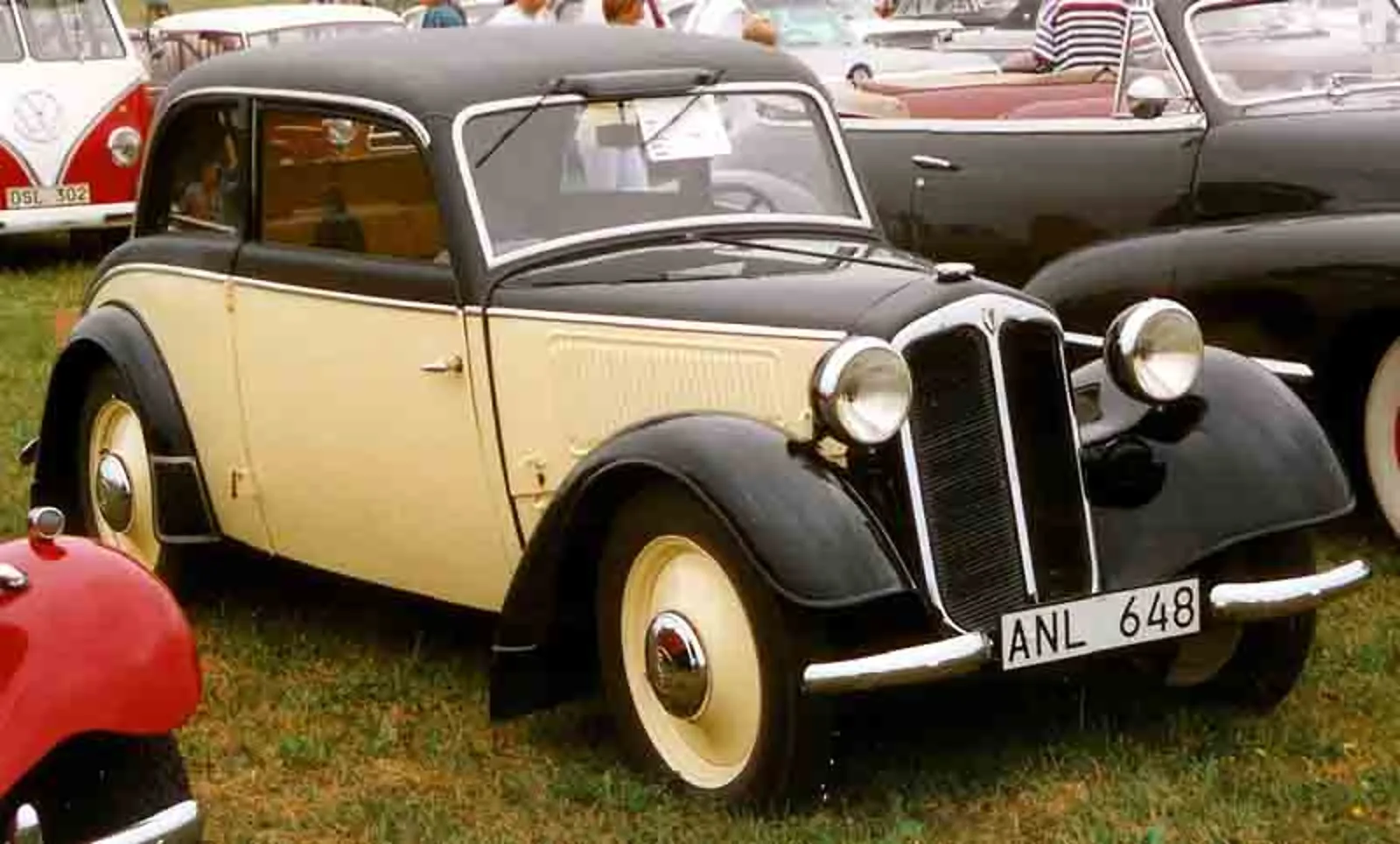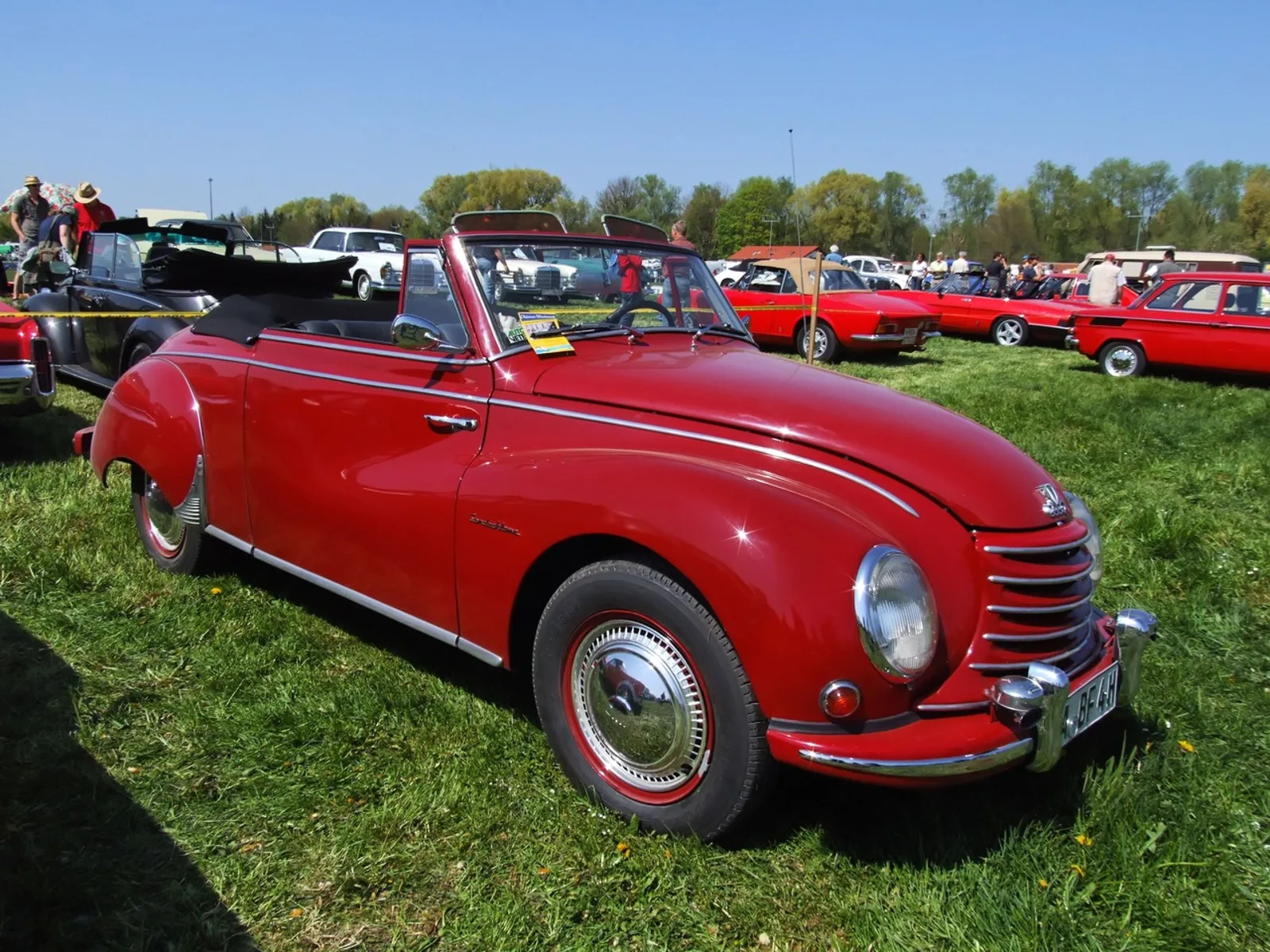
DKW's rear-drive medium car from 1932, its troubled two-stroke V4, the 1937 rebirth on a steel chassis and 10,482 cars built by July 1940.
A rear-wheel-drive medium car from DKW, built from 1932 to 1940 with a break for the Schwebeklasse. Its early two-stroke V4 suffered overheating and high consumption, and the 1937 rebuild on a steel chassis finally sold well, with 10,482 cars built in total.
The Sonderklasse was DKW's medium car from 1932 to 1940, with a gap in the middle when the Schwebeklasse filled its place. Its early two-stroke V4 engine never shook off overheating and high consumption, yet the 1937 rebuild on a steel chassis finally found buyers. The story is one of repeated false starts before a sensible car appeared.
Where did the first Sonderklasse come from?
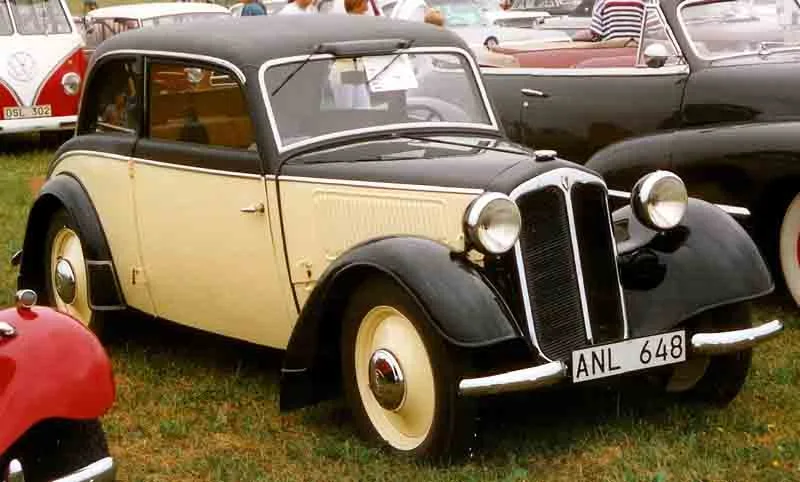
The first cars, coded 432, appeared in February 1932, only months before the Saxon giant Auto Union was born. They were a luxury version of the V1000, distinguished by a chromed spare-wheel housing and a raked windscreen. Sales were poor, and only 966 had been built by the end of 1932.
Mechanically the 432 carried over the 988 cc (60.3 cu in) V4 of the V1000. This two-stroke used an auxiliary piston on each bank to push the mixture into the four working cylinders. The working pistons had a deflector on top, which steered the incoming charge towards the exhaust ports and kept the outgoing and incoming flows apart.
The four-speed gearbox had a very long fourth gear, at 0.79:1, which let the car cruise economically. Third gear gave direct drive and the top speed. The rigid rear axle with transverse leaf springs, the hydraulic foot brake and the load-bearing wooden body shell all came from the V1000.
The engine's faults never went away. Overheating, piston seizure and excessive consumption could not be solved, but engineers found ways around them. The 432 was first planned as a convertible-limousine alone. In June 1932 a two-door saloon joined the range, and a very small number of van versions were built.
A rear-drive DKW that spent its early years fighting its own engine, then found its feet on a steel chassis.
What changed with the 1001 and 1002?
The definitive 1001, launched in January 1933, had a 26 PS (19 kW; 26 hp) engine and a new floating-axle rear end, patented for the Auto Union brands. It was priced at 3,350 Reichsmarks (RM), falling to 3,100 RM in June, when a cheaper 1002 arrived at 2,995 RM.
The 1001 was first offered as a convertible-limousine, just as the 432 and the earlier V800 and V1000 had been. Its 1002 sibling had a simpler, less luxurious trim. The 26 PS engine was the same unit as in the 432 and the V1000. Work had gone on a piston-less two-stroke with a crested head, but that design proved hard to apply to a V4, so the existing engine stayed. The gearbox gained a freewheel device, which made fourth gear the direct-drive ratio.
The floating-axle layout placed a transverse leaf spring at the height of the centre of gravity, which reduced the effect of centrifugal force in corners and cut body roll. It was a rigid axle with the spring carried above it, and the patent was held only for the Auto Union brands.
Styling also changed. The Paris prototype had a raked-back windscreen followed by a front door whose leading edge followed the pillar, with doors hinged on the centre pillar. The production car used front-hinged doors with the leading edge square to the horizontal. The grille still leaned back to echo the windscreen, and the grille was modelled on the F2 Meisterklasse, which had been launched shortly before.
Inside, the dashboard lost its contrasting instrument cluster and became one colour. Two glove compartments were added at the ends of the facia, and the 1001 wore a single-piece bumper and larger headlamps in place of the two-bar bumper of the earlier car.
Why did the four-door saloon struggle?
The four-door saloon was launched in September 1933 and shown at the Paris show that October. It was priced at 3,375 RM, later reduced to 3,295, which proved too high for buyers. Sales were weak, and the saloon was removed from the list in May 1934. The cheaper 1002 also disappeared early in 1934.
Sales director Carl Hahn pushed hard for the saloon, since competitors had done well with cars of similar bodywork. Rear-wheel-drive DKWs had never offered a four-door saloon before, and the 1001 version carried the raked front door edges and rear hinges of the Paris prototype.
The rise of the Nazi regime brought attention from the state. Auto Union, with its products spanning several segments of the transport industry, was noticed by the regime, which ordered 1001s with Kubelwagen bodywork and others with torpedo bodywork, the latter called Phaeton. Members of the regime criticised these versions as well, because of the same technical shortcomings and the high consumption.
The year 1934 was one of steep decline for the 1001. The Schwebeklasse was introduced in the summer to replace it in the rear-drive range, and the 1001 stayed on sale for a few more months until the spring of 1935.
How did the Schwebeklasse years interrupt the story?
Between 1935 and 1937 the Sonderklasse name was absent, because the Schwebeklasse had taken its place. The name returned in 1937. The Schwebeklasse had been introduced urgently in the summer of 1934 to deal with a commercial situation that had become disastrous for the Sonderklasse.
The gap followed directly from the poor sales of the earlier cars. The Schwebeklasse was replaced in 1937 by a new model that took up the Sonderklasse name.
What did the 1937 Sonderklasse bring?
The 1937 car sat on a separate steel chassis, with a body of steel and wood bolted to it, and its 1,054 cc (64.3 cu in) V4 produced 32 PS (24 kW; 32 hp) at 3,800 rpm. A partial cylinder deactivation system helped cut consumption.
Makers such as Chevrolet, Mercedes-Benz and Audi adopted similar systems much later. The 1937 model also kept the rigid swinging-axle rear end of its predecessors. Otherwise it was a very different car from the earlier Sonderklasse models built up to 1935.
How was the 1937 car built and styled?
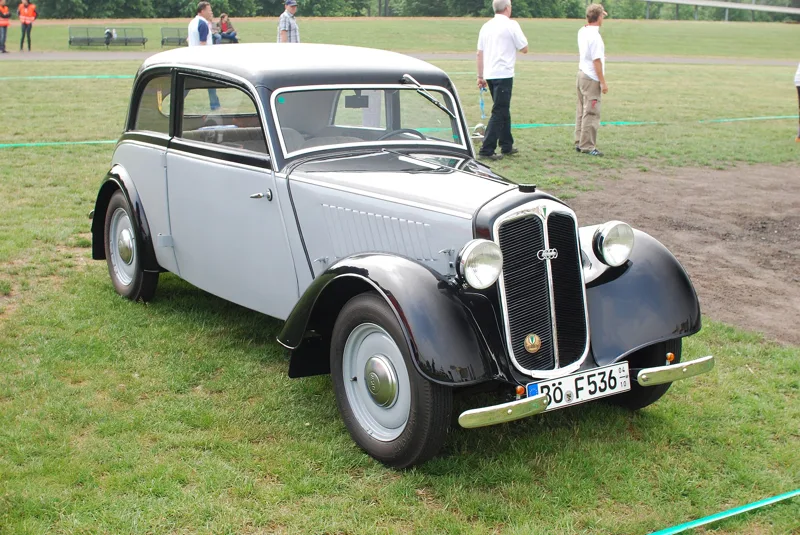
The separate frame had already been prepared by Wanderer for its new W24, which was also launched in 1937. That made it one of the first clear examples of economies of scale, since Wanderer was one of the Auto Union brands. The Sonderklasse also took the W24's independent front suspension, with upper wishbones and a transverse leaf spring.
The gearbox was no longer supplied by Prometheus but by Hurth of Munich. The foot brake stayed hydraulic, while the handbrake still acted on the propeller shaft rather than on the rear end, as it did on the W24. A separate frame was not new in itself, but a steel frame carrying a steel-and-wood body was new for the Sonderklasse. The car lost the load-bearing wooden shell of the earlier models, which had required specialist labour and stacking space for the wood.
The styling borrowed the rounded forms of the late thirties from the W24. Only the grille differed, being more oval and carrying the white-and-green badge of the Zschopau company. The wheelbase came out 15 cm shorter, at 2.6 metres (8.5 ft), and the fuel tank moved to the rear, just behind the spare wheel.
Refuelling did not need the spare wheel removed. The filler neck was built into the fixing hub, so removing the hub cap was enough.
Why did sales finally take off, and what held them back?
The new Sonderklasse went on sale in April 1937 as a saloon and a convertible-limousine. Demand grew strongly, and a waiting list formed. The company could not meet it, and the limit was raw materials rather than its plants. The arms build-up took so much steel that car production suffered.
The cylinder deactivation system was not at fault in its design. The Nazi regime was stockpiling fuel reserves for its own vehicles, so ordinary drivers were left with poor-quality petrol, which reduced the effect of the system. It was dropped from the engine in March 1938. The range hardly changed afterwards, because there was little point in new body variants without raw materials to build them and fuel to run them on the road.
Technical data
| Specification | Detail |
|---|---|
| Early engine (432 and 1001) | 988 cc (60.3 cu in) two-stroke V4 |
| Power (1001) | 26 PS (19 kW; 26 hp) |
| Engine from 1937 | 1,054 cc (64.3 cu in), 32 PS (24 kW; 32 hp) at 3,800 rpm |
| Wheelbase from 1937 | 2.6 metres (8.5 ft) |
| Fuel tank | 42 litres, raised to 45 litres in June 1938 |
| Launch price, 1001 | 3,350 RM, reduced to 3,100 RM in June 1933 |
| Price, 1002 | 2,995 RM |
| Four-door saloon | 3,375 RM, later 3,295 RM |
| Total production | 10,482 examples, up to July 1940 |
How did the 1938 updates and the war affect the Sonderklasse?
In June 1938 the Sonderklasse received numerous updates to meet the new German Highway Code, which had been in force for two months. The changes included new rear lamps, a fuel tank enlarged from 42 to 45 litres, and a revised rear end with new thrust struts.
In 1939 DKW unveiled the F9 prototype, which was meant to foreshadow the heir to the Sonderklasse. The outbreak of the Second World War ended that plan, although the project was taken up again after the conflict. The Sonderklasse itself kept running until July 1940, and a total of 10,482 examples had been built by then.