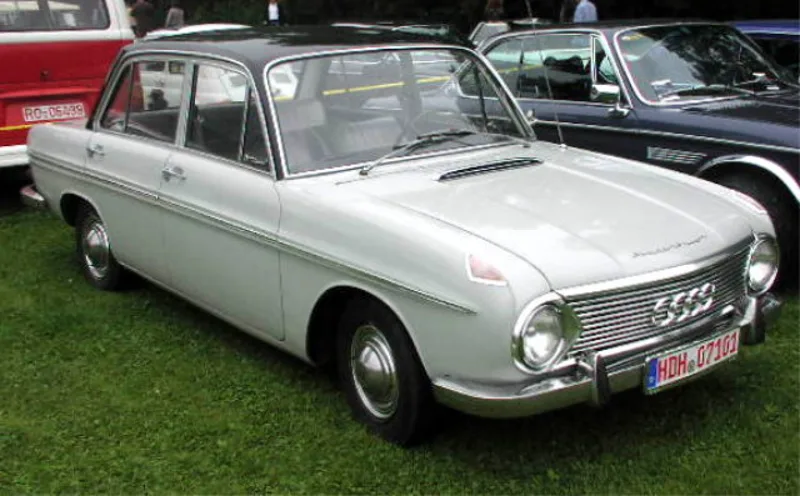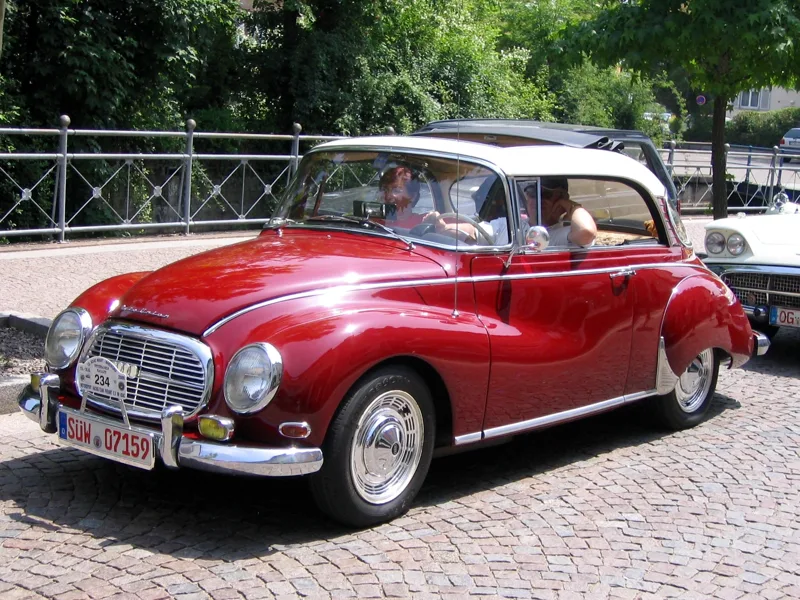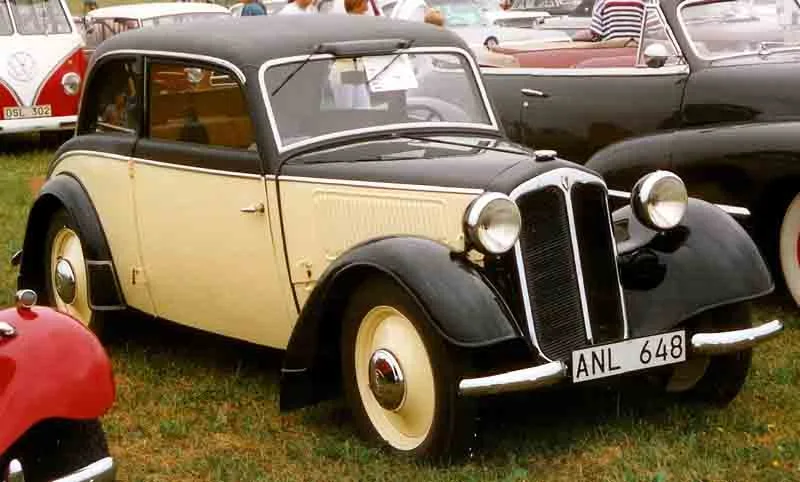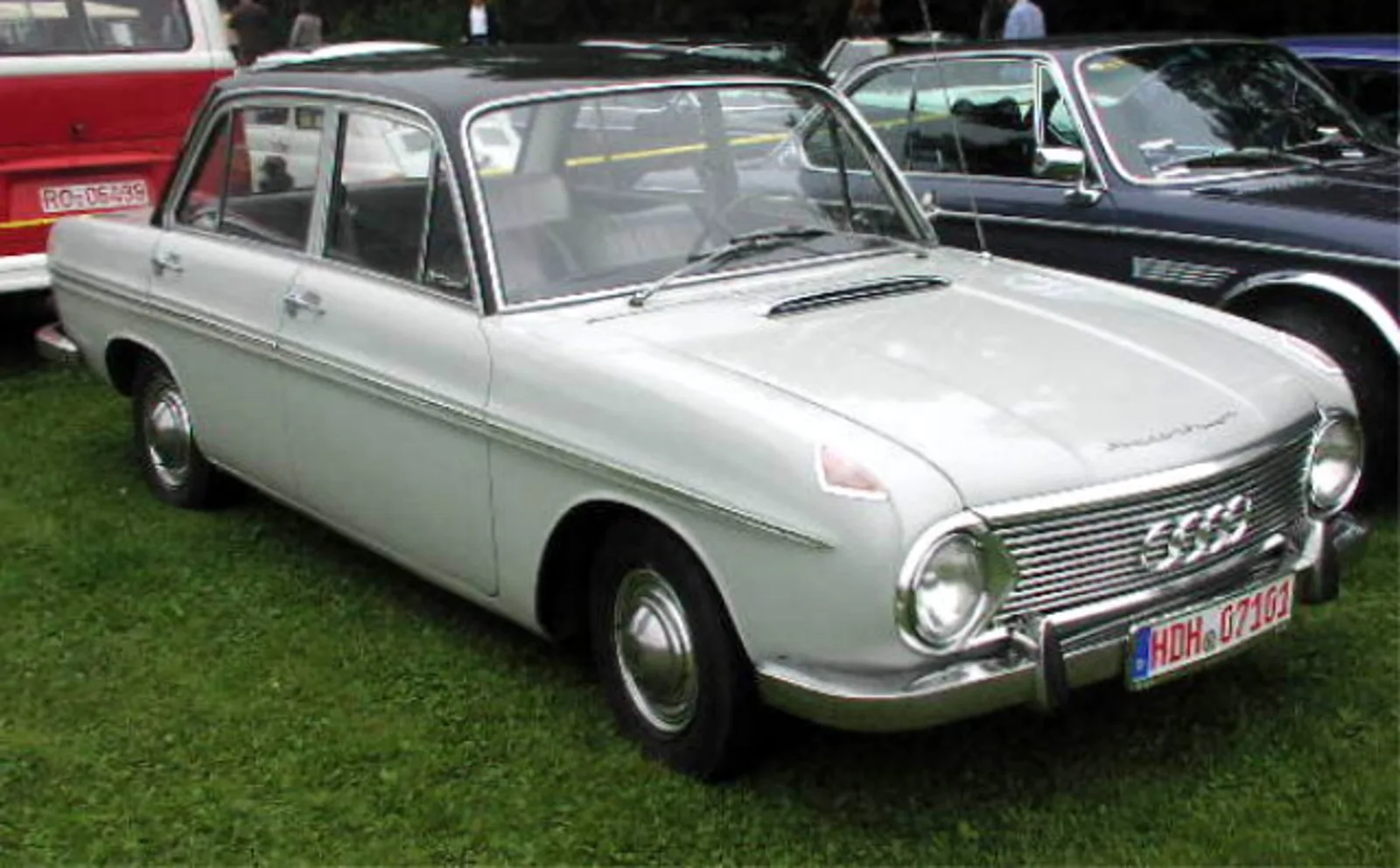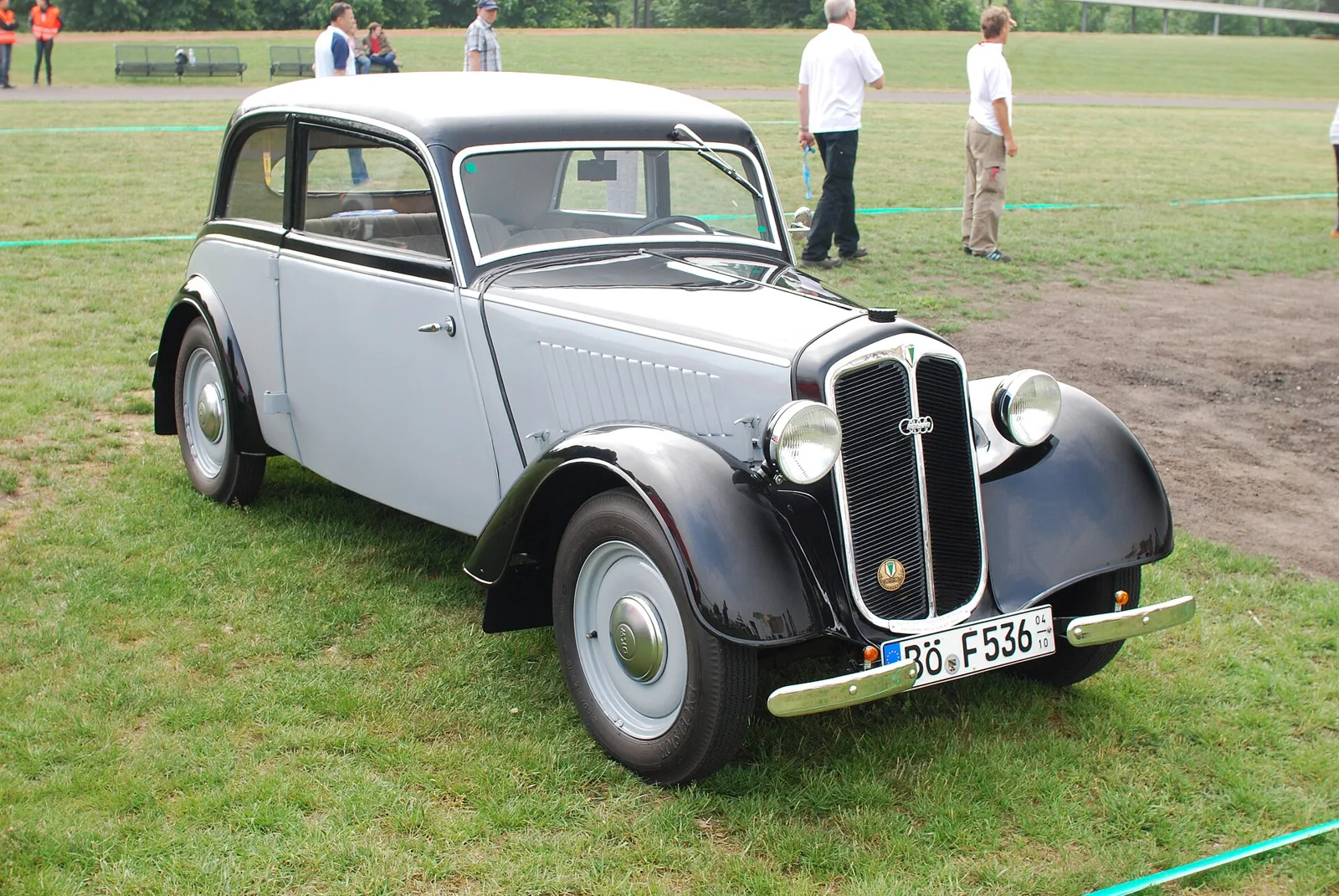
A prewar saloon the army ignored and East Germany kept building, and a postwar small car that Volkswagen shut down almost as soon as it bought the company.
The DKW F8 was a front-wheel-drive two-stroke saloon introduced in 1939, built about 50,000 times before 1942 and again as the IFA F8 in East Germany until about 1955. The DKW Junior was Auto Union's small two-stroke car from 1957, becoming the F12 in 1963 before Volkswagen ended DKW in 1965.
After 1945 the DKW F8 got an unexpected advantage: soldiers found it dull. Military personnel in the first half of the 1940s considered its modest size and performance unappealing, and that often let the cars slip past requisition, so plenty of prewar F8s were still around to roll onto German roads when peace came. That quirk is only part of a long life. The F8 was built in Zwickau in East Germany into the 1950s, and its two-cylinder two-stroke engine ended up in the Trabant. Two decades on, the Junior met a harder fate: the market had turned against two-strokes, and a new owner shut the line almost at once.
DKW F8, the front-wheel-drive saloon of 1939
The DKW F8 is a compact front-wheel-drive saloon with a two-stroke engine, introduced in 1939. The "F" stood for "Front", a reference to the driven wheels. Today the car is almost always called the F8 to tell it from the F7 before it and the F9 that was meant to follow, but DKW's own publicity for 1939 called it simply the "DKW Front". Despite a marginally longer wheelbase, it was slightly shorter overall than the F7.
The basic model was the Reichsklasse, or "National Class", and it was built only until 1940. The Meisterklasse sedan carried on until 1942, and cabriolet versions were offered alongside the saloons.
Soldiers found the F8 too modest to bother with, and that spared many cars from requisition.
DKW F8 two-stroke engines and gearbox
A two-stroke engine fires on every turn of the crankshaft, rather than every second turn as in a four-stroke, which is why small two-strokes can be so simple and light. The Reichsklasse kept the twin-cylinder two-stroke of the F7, bored out a fraction to 589 cc. Its claimed output of 18 PS (13.2 kW) and top speed of 80 km/h (50 mph) were as before.
The Meisterklasse inherited a similar engine of 692 cc, with a claimed 20 PS (14.7 kW) and a top speed of 85 km/h (53 mph). This is the larger engine that came back in the IFA F8 of 1949, although IFA worked out the displacement as 690 cc. The IFA car claimed the same top speed.
Power reached the front wheels through a three-speed manual gearbox with a lockable freewheel on all three ratios. A freewheel lets the wheels turn faster than the engine, so the car can coast, and the lock lets the driver turn that off when engine braking is wanted. The engine was started with a Dynastart, a single unit that worked as both starter motor and generator.
Body and chassis: from fabric and timber to duroplast
The F8's body sat on a box frame, which made it easy to fit different bodies, including the light vans and trucks built in the IFA period. The outer skin mixed steel panels with, in the central section, a fabric-covered timber frame. After 1953 key panels were made of duroplast, which cut weight and pointed ahead to the lightweight methods later used for the Trabant.
The Swiss coachbuilder Holka built its own bodies on imported F8 chassis. Chassis imports began in 1939 and carried on in small numbers until 1944, even though production had stopped in 1942. In 1944 Holka designed and built, in very small quantities, a cabriolet of its own, to replace one it had previously imported. The last Holka-bodied car was finished in January 1945.
How long the DKW F8 stayed in production
The F8 replaced the F7 after only two years of the earlier car's life. In the 1930s small DKWs counted among Germany's best-selling small cars, and replacing models often was a deliberate part of Auto Union's successful marketing. The F8 itself seems to have been scheduled for fairly quick replacement by the steel-bodied DKW F9, but war intervened. Reichsklasse and Cabriolet production ended in 1940, and the Meisterklasse ran to 1942. By then, when passenger car production at Zwickau stopped, about 50,000 F8s had been built. Sales of new cars and chassis continued until 1944, and Holka was still fitting bodies to new chassis in 1943 and 1944.
The car came back at the Leipzig Fair in 1947, badged DKW-IFA F8. The eastern IFA F8, with no DKW badges, went back into production in or before 1949 at Auto Union's Zwickau factory, which lay in the Soviet occupation zone and had been expropriated to become the Volkseigener Betrieb (People Owned Enterprise) Automobilwerke Zwickau, or AWZ. It stayed in production there until about 1955. As well as the sedan and cabriolet, postwar bodies included a panel van and an estate.
By 1955 a further 26,267 had been built as IFA F8s, it is believed. Under an inter-zone trade agreement of 1950/51, about 1,000 were exported to what had become, in effect, the separate country of West Germany. In 1953 a Luxus-Cabriolet appeared with streamlined coachwork from VEB Karosseriewerk Dresden (Glaser), meant mainly as an export special for western buyers.
When the IFA brand was phased out, the last F8s seem to have been badged as Wartburgs. A handful of Luxus-Cabriolets were finished in 1956 and 1957, and replacement bodies for the F8 Kombi were still being made until 1964. East German media that year remarked on the outmoded and labour-intensive construction of the Kombi, noting that its body took twice as long to build as one of the new Trabant estates. The 700 cc two-stroke engine, meanwhile, lived on in the Trabant.
DKW Junior, the small car from Auto Union
The DKW Junior is a small front-wheel-drive saloon made by Auto Union AG. DKW itself was founded in 1916 by the Danish engineer Jorgen Skafte Rasmussen in Germany, and the letters first stood for "Dampf-Kraft-Wagen", which translates as steam-powered vehicle. Four makers came together in 1932 as Auto Union AG: DKW, Audi, Horch and Wanderer. Within the group DKW handled the small cars and the motorcycles.
The car was first exhibited as the DKW 600 at the Frankfurt Motor Show in March 1957 and received a positive reaction. When it went into volume production in 1959 it was the DKW 750, and that was when it was given the Junior name. The Junior did not survive an upgrade in January 1963, after which it was the DKW F12. Besides the saloon, a pretty F12 Roadster, a cabriolet, was made in limited numbers.
Two-stroke power was the Junior's defining trait. Several European makers built two-stroke cars in the 1950s, but by the time the Junior arrived the market was starting to resist them, as the industry settled on four-stroke, four-cylinder engines that were getting cheaper to build. Some buyers saw two-strokes as rough and noisy by comparison.
In size and price the Junior sat just below the Auto Union 1000, which was itself upgraded and renamed from DKW to Auto Union in 1957. That made the Junior the only DKW-branded car from its introduction until August 1963.
DKW Junior design and engine
The Auto Union 1000 closely followed a prototype first shown in 1938. The smaller Junior was uncompromisingly modern: a ponton, three-box shape filled out to the corners, with tail fins of a kind that were only just appearing on one or two of Europe's most fashionable designs. Despite the modern shape, the body sat on a separate chassis.
The prototype of 1957 had a two-cylinder, 660 cc two-stroke engine reminiscent of the one last seen in the DKW F89 Meisterklasse, which was phased out in 1953. Auto Union built a new plant at Ingolstadt to make the car, since DKWs had been assembled at Dusseldorf since the war. When production began, the prototype's engine had given way to a 741 cc three-cylinder two-stroke, claimed to produce 34 bhp (25 kW). A four-speed manual gearbox was worked through a cable linkage from a column-mounted lever.
In Germany in 1961 the Junior retailed for 4790 Marks. Against the market-leading Volkswagen Beetle it had a roomier boot and a wider cabin. A buyer who ticked the optional heater, at 160 Marks extra, also got a car that warmed up much faster than the air-cooled Volkswagen.
Junior de Luxe, F11 and F12
The Junior de Luxe appeared in 1961. It is not clear whether it was meant to replace or to complement the original Junior, which was withdrawn in 1962 in any case. Its cylinders were bored out, giving 796 cc in total. Claimed power was unchanged, torque rose slightly, the wheels grew from 12 to 13 inches and the claimed top speed went from 114 to 116 km/h (71 to 72 mph).
In January 1963 the DKW F12 replaced the Junior de Luxe. Outwardly little had changed beyond a more angular C pillar, but the engine had grown to 889 cc, with a claimed 40 bhp (30 kW). The bigger news was the brakes: the F12 was the first car in its class with front disc brakes. The motoring press received it enthusiastically, though high import duties limited sales in some countries. In July 1965 the F11 and F12 sold in New Zealand for 998 and 1198 pounds respectively. The Junior's 796 cc engine returned in August 1963 in the DKW F11, which was in effect an F12 with a reduced specification.
The F12 roadster of 1964 took 45 bhp (34 kW) from the 889 cc three-cylinder engine, and the saloon could have that stronger unit for a few months from February 1965. Motorman magazine in New Zealand called the standard F12 a pleasant car with quiet, comfortable motoring, and CAR magazine in South Africa judged that subtle changes had made it substantially different from the Junior.
Junior and F12 development
| Model | Engine | Notes |
|---|---|---|
| DKW 600 prototype, 1957 | 660 cc two-cylinder two-stroke | Shown at Frankfurt, March 1957 |
| Junior, 1959 | 741 cc three-cylinder two-stroke, 34 bhp (25 kW) | Four-speed column shift; 4790 Marks in 1961 |
| Junior de Luxe, 1961 | 796 cc, claimed output unchanged | 13-inch wheels; 116 km/h (72 mph) |
| F12, January 1963 | 889 cc, 40 bhp (30 kW) | First in class with front disc brakes |
| F12 roadster, 1964 | 889 cc, 45 bhp (34 kW) | Saloon offered the stronger engine from February 1965 |
The end of two-stroke DKW
Early in the summer of 1965 Volkswagen bought the Auto Union business from Daimler-Benz, and production of the two-stroke DKWs was almost immediately terminated. In the showroom the DKWs had been finding it harder to compete with similar-sized four-strokes of greater power, first from Volkswagen and latterly from Opel. Before the year ended, the former Auto Union plant was turning out Audi-badged cars. They had four-cylinder four-stroke engines that had been designed with Mercedes-Benz before the ownership changed.