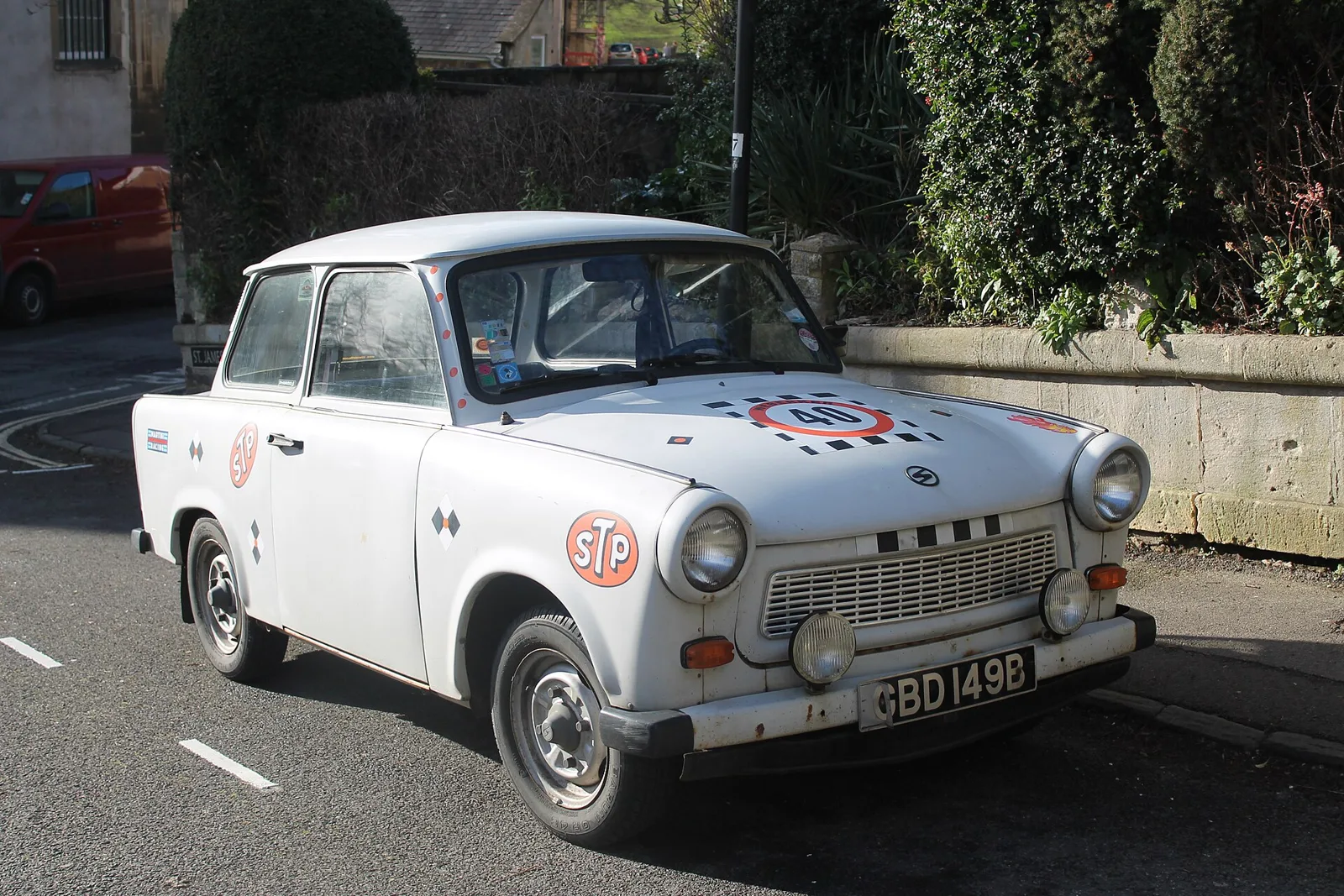
A duroplast-bodied microcar that stayed almost unchanged for three decades and became the symbol of the Berlin Wall's fall.
Built at Zwickau in Saxony, the Trabant was a two-stroke microcar that East Germany produced from 1957 to 1991. Its body and drivetrain changed little for decades, and the Volkswagen-engined 1.1 that ended production in April 1991 came too late to change the car's reputation.
The Trabant was a small East German car built by VEB Sachsenring Automobilwerke at Zwickau from 1957 to 1991. Its duroplast body and two-stroke engine barely changed in three decades, and 3,096,999 cars were produced before the Volkswagen-engined 1.1 ended production in April 1991. Its name means satellite or companion, and it became a symbol of the state that built it.
Where did the Trabant come from?
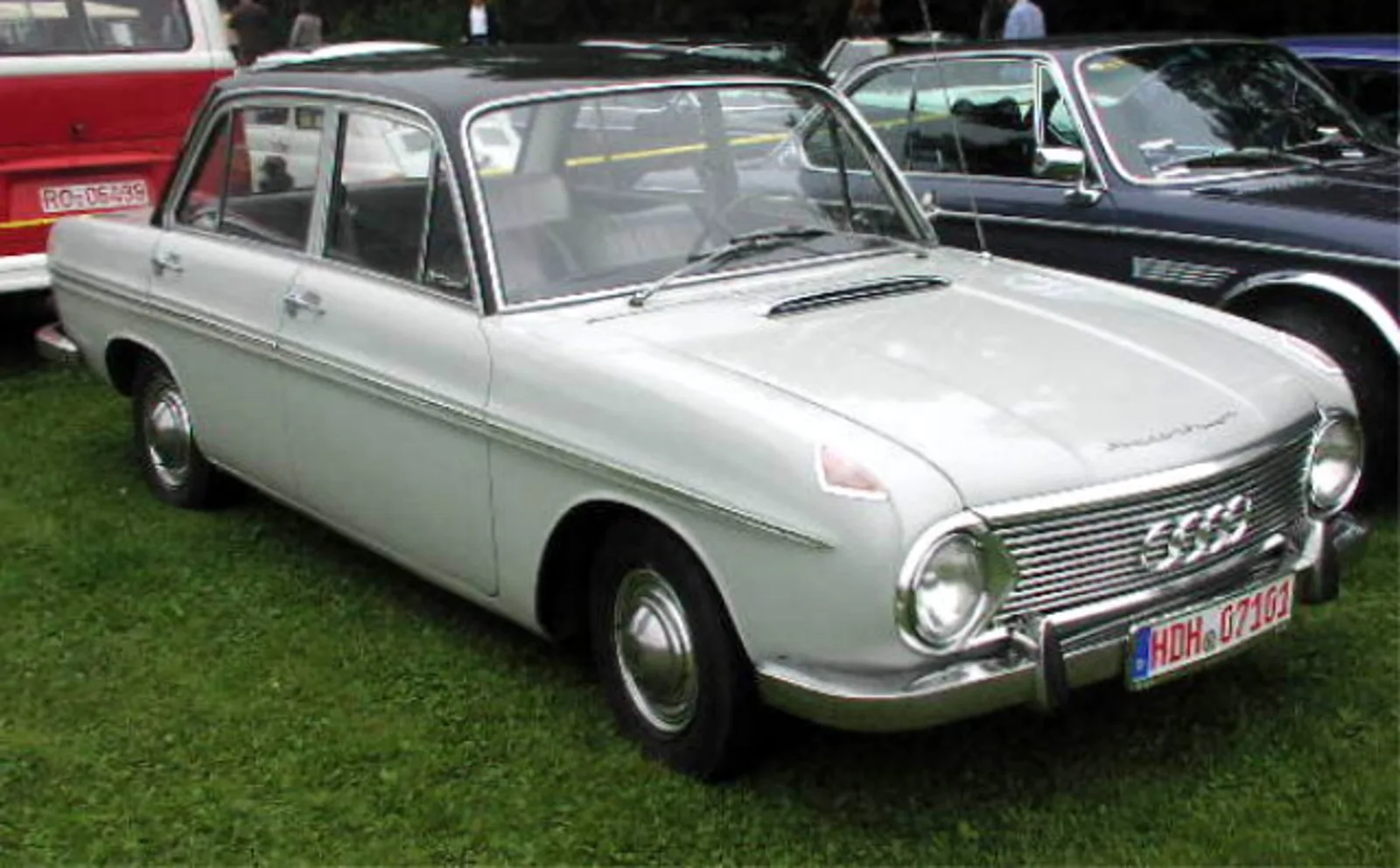
The Trabant was made at the Zwickau factory in Saxony, which had its origins in the former Auto Union and DKW business that had operated on the site before the Second World War. After the partition of Germany, Auto Union re-established itself in West Germany, where it later evolved into Audi. The Zwickau plant was left with the two-stroke engine inherited from DKW.
The project grew out of a planning exercise to design a three-wheeled motorcycle. The name Trabant is an astronomical term for a moon, and it was inspired by the Soviet Sputnik satellite. The first car rolled off the Zwickau line on 7 November 1957, and the formal introduction followed the next year.
A car built on a two-stroke and a duroplast body that barely changed in three decades, then came to symbolise the Wall's fall.
Why did the Trabant use a two-stroke engine?
The two-stroke was the car's greatest shortcoming. Rivals such as the Renault 4CV ran four-stroke units that were both cleaner and more economical by then. Budget constraints and raw-materials shortages left the Trabant with an outdated but cheap two-stroke instead.
The car was technically comparable to the West German Lloyd, another small car with a two-cylinder four-stroke engine. The Trabant's front-mounted transverse engine and front-wheel drive were unusual for the period, when many European cars still used rear-mounted engines or rear-wheel drive. Its two-stroke made it obsolete by the 1970s and limited exports to Western Europe.
The engine itself was derived from a pre-war DKW design, with minor alterations over its life. Its air-cooled 500 cc unit was upgraded to 600 cc during the 1962-63 period, while the first Saab car had used a larger 764 cc water-cooled two-stroke, and Wartburg used a three-cylinder one-litre two-stroke from DKW.
How was the Trabant body made?
The Trabant had a steel frame with detachable body panels in duroplast. That hard plastic was built from recycled cotton scraps from the Soviet Union and phenol resins from a dye industry in East Germany, and it gave the car a light, durable skin.
The Trabant was the second car with a body made from recycled material. The first was the AWZ P70 Zwickau, built from 1955 to 1959. The material proved durable, and the average Trabant lasted 28 years, which was a long life for a car with such modest build quality.
The body's build quality was poor, though, and the car was loud and slow. Its design remained essentially unchanged from its late-1950s introduction, and the nickname spark plug with a roof reflected its small size.
Which Trabant models were built?
The Trabant range was built around four principal models: the P 50, also known as the Trabant 500, the 600, the 601 and the 1.1. The P 50 was the original car, introduced in 1958, and its 500 cc, 17 PS (13 kW) engine evolved into a 20 PS (15 kW) version with a fully synchronised gearbox in 1960.
The P 60 arrived in 1962 with a 23 PS (17 kW) engine of 594 cc. The updated P601 followed in 1964, a facelift of the P 60 with a new front fascia, bonnet, roof and rear, but with the original P50 underpinnings. It stayed largely unchanged until the end of its production, apart from the addition of 12V electrics and rear coil springs.
Several special versions were built. The 601 Kubel was a doorless jeep with a folding roof, the 601 Tramp was a civilian version exported mainly to Greece, and the 601 Hycomat had an automatic clutch for drivers unable to use their left leg. The 800RS was a rally version of the car.
What was the Trabant like to drive?
The Trabant weighed about 600 kg (1,323 lb), and it took 21 seconds to reach its top speed of 100 km/h (62 mph). Its later two-stroke delivered 26 PS (19 kW) from 594 cc, so the car was never quick.
Fuel consumption was 7 L/100 km (40 mpg-imp; 34 mpg-US). Because the engine was a two-stroke, oil had to be added to the 24-litre (6.3 U.S. gal; 5.3 imp gal) tank at a ratio of 50:1 or 33:1 with every fill-up. Petrol stations in countries where two-strokes were common sold a premixed fuel for the purpose.
The Trabant had no fuel pump, so its tank sat above the engine and fed the carburettor by gravity. That arrangement raised the risk of fire in front-end accidents. Early cars had no fuel gauge, so owners measured the remaining petrol with a dipstick pushed into the tank.
How polluting was the Trabant?
The exhaust was very smoky, and the car was a notable polluter. Its hydrocarbon output ran at nine times that of an average 2007 European car, and its carbon monoxide at five times. When the cars were driven to West Germany in 1989, they polluted the air at about four times the European average.
The Trabant's emissions were a symbol of the GDR's wider problems. The 1980s model had no fuel gauge, no tachometer and no rear seat belts. For comparison, the West German Volkswagen Beetle received a number of updates over a similar period.
How hard was it to buy a Trabant?
Trabants were manufactured by a state monopoly, and a buyer could wait about ten years to take delivery. East German buyers faced waiting lists of up to thirteen years, and the wait depended on how close they lived to Berlin. The official state price was 7,450 GDR marks, and demand outstripped production by 43 to one in 1989.
Used cars on the open market commanded more than twice the price of a new one. That showed how scarce they were and how far the official system fell short of demand.
How many Trabants were built?
Production started at 34,000 cars a year in 1964 and reached 100,000 in 1973. The output peaked at 150,000 in 1989, when the car was at its most common in the country. The total figure is reported as 3,096,999 cars, although other totals put the number of vehicles at 3.7 million.
The production method was extremely labour-intensive, and the factory relied on government subsidies. The Trabant was produced without major changes for nearly 30 years, which made it the most common automobile in East Germany.
What role did the Trabant play in 1989?
In mid-1989 thousands of East Germans loaded their Trabants with as much as they could carry and drove through Hungary or Czechoslovakia on the so-called Trabi Trail towards West Germany. Many needed special permission to drive into the West, and their cars did not meet West German emissions rules.
The car became a symbol of the country during the fall of the Berlin Wall in 1989. Images of East Germans crossing the border were broadcast around the world, and the Trabant was a vivid part of those pictures. It is now regarded as symbolic of the fall of the Eastern Bloc.
What was the Trabant 1.1?
The Trabant 1.1 was a 601 with a 1,043 cc Volkswagen Polo engine producing 45 PS (33 kW). The first prototypes were built in 1988 and pre-series cars appeared in 1989, but mass production did not start until May 1990, when reunification was already agreed.
The 1.1 had front disc brakes, MacPherson struts in place of leaf springs, and a floor-mounted gearshift. Its wheel assembly was borrowed from Volkswagen, and it was quieter and cleaner than the two-stroke it replaced. Many parts from older P50, P60 and 601 models remained compatible with it, apart from the engine and transmission.
The 1.1 was discontinued in April 1991, after only eleven months of production. After reunification the car had no obvious market, since the labour-intensive line had survived only on subsidies.
What happened to the Zwickau factory?
Volkswagen bought the Mosel works at Zwickau, while the rest of the company was renamed HQM Sachsenring GmbH. The site was then converted into an engine production centre, and it also builds some Golf and Passat models.
Many Trabants were abandoned by owners who migrated west after the fall of the Berlin Wall. In the early 1990s they could be bought for as little as a few Deutsche Marks, and many were simply given away.
Why are Trabants still popular?
Trabants have become collectors' cars, and older models are sought by American collectors because of their low cost and fewer restrictions on importing antique cars. The car also has a following among tuning and rallying enthusiasts.
American Trabant owners hold the Parade of Trabants every early November in Washington, D.C., a rally sponsored by the International Spy Museum. Performance artist Liz Cohen transformed a 1987 Trabant into a 1973 Chevrolet El Camino for her Bodywork project.
In 1997 the Trabant passed the moose test without rolling over, a result that the Mercedes-Benz W168 had also achieved. Solomon Passy, a former Bulgarian foreign minister, owned a Trabant that was blessed by Pope John Paul II in 2002, and he donated it to the National Historical Museum of Bulgaria in 2005.
Did the Trabant compete in motorsport?
The Trabant's competition story is mostly one of enthusiasts rather than factory teams. The 800RS was the rally version of the car, and tuners and rally drivers adopted the Trabant for their own projects.
Was there a Trabant revival?
The Herpa company, a Bavarian maker of miniature vehicles, bought the rights to the Trabant name. It showed a scale model of a newTrabi at the 2007 Frankfurt Motor Show, and a Trabant nT concept was unveiled in Frankfurt two years later.
The Trabant nT was planned as an electric car with a 45 kW (60 hp; 61 PS) asynchronous motor and a lithium-ion battery. The consortium behind it included Herpa, the parts maker IndiKar and the engineering firm IAV, and it aimed to build the car in Zwickau with sales planned for 2012.
An earlier revival attempt in Uzbekistan went no further. An American-Uzbek venture called Olimp tried to produce the Trabant there in the late 1990s, but only a single example was assembled before the project ended.
What are the Trabant specifications?
The Trabant's core specification was a light, front-drive car powered by a small two-stroke. The table below shows the main figures for the early and late cars, along with the production and pricing data that define its story.
| Specification | Detail |
|---|---|
| Built by | VEB Sachsenring Automobilwerke Zwickau |
| Production years | 1957 to 1991 |
| First car | 7 November 1957 |
| Early engine | Two-cylinder two-stroke, 500 cc, 17 PS (13 kW) |
| P60 engine | 594 cc, 23 PS (17 kW) |
| Final two-stroke | 594 cc, 26 PS (19 kW) |
| Final engine | 1,043 cc Volkswagen Polo, 45 PS (33 kW) |
| Curb weight | About 600 kg (1,323 lb) |
| 0 to 100 km/h | 21 seconds |
| Top speed | 100 km/h (62 mph) |
| Fuel use | 7 L/100 km (40 mpg-imp; 34 mpg-US) |
| Fuel tank | 24 litres (6.3 U.S. gal; 5.3 imp gal) |
| Oil ratio | 50:1 or 33:1 |
| State price (1989) | 7,450 GDR marks |
| Waiting list | Up to thirteen years |
| Total cars | 3,096,999 |