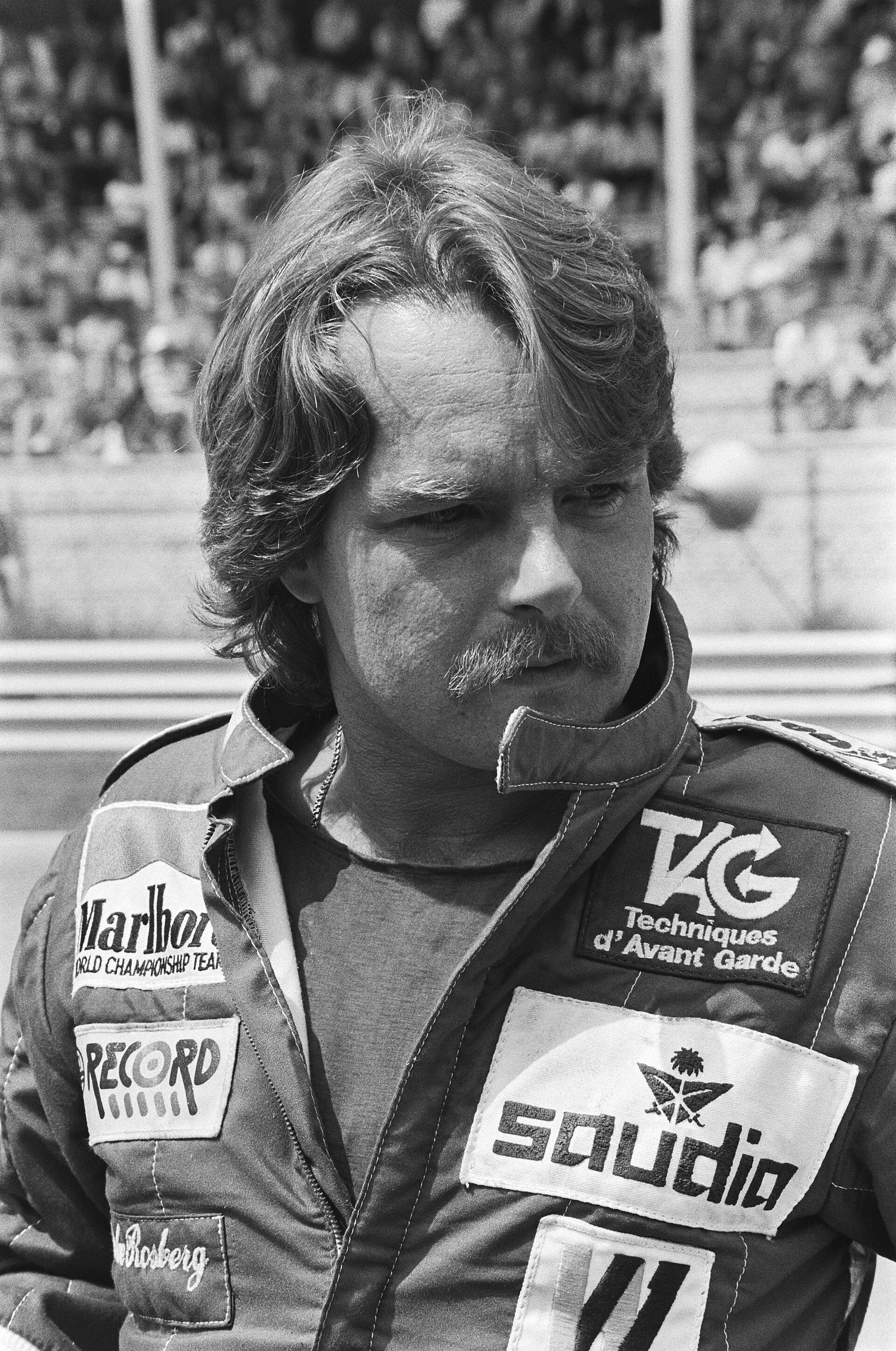
A late starter from Finland who won the 1982 title with Williams on consistency alone, then built a second career as a team owner and driver manager.
Keke Rosberg was a Finnish driver born in Sweden in 1948. He debuted in Formula One at 29 and won the 1982 World Drivers' Championship with Williams, the first title for a Finn. He won five Grands Prix in his career and later ran Team Rosberg and managed young drivers.
Keke Rosberg was a Finnish racing driver who became his country's first Formula One World Champion when he won the 1982 title with Williams. He started in Formula One late, at 29, and won five Grands Prix in nine seasons, most of them on street circuits. After retiring he built a second career as a team owner and a manager of young drivers.
How did Keke Rosberg start racing?
Rosberg came up through karting and Formula Vee in the early 1970s, then won the German Formula Super Vee title in 1975. He raced in European Formula Two from 1976 to 1979, alongside his first Formula One outings, and he was already 29 when he made his debut.
Keijo Erik Rosberg was born on 6 December 1948 in Solna, Sweden, where his father was studying veterinary science. His parents were both from Hamina in Finland, and the family moved back in the spring of 1950. The young Rosberg struggled at first with language, because the Swedish-speaking village school he attended in Lapinjarvi used a language his Finnish family did not share. The family later moved to Hamina, Oulu and Iisalmi.
He began in karting before moving into Formula Vee in 1972. The following year he won the Finnish Championship, and he then progressed to Formula Super Vee. In 1975 he took the German Championship in that category, and from 1976 to 1979 he raced in European Formula Two, a feeder series that many of his rivals used on the way to Formula One.
Along the way he also raced in Can-Am, Formula Atlantic and Formula Pacific. In the early part of his Formula One career he drove for the American patron Fred Opert.
A late starter from Finland who won a world title on consistency, then built a team and raised a champion son.
How did Rosberg's Formula One debut come about?
Rosberg debuted for the Theodore team at the 1978 South African Grand Prix, aged 29. In only his second race with the team, he won the non-championship BRDC International Trophy at Silverstone, where a heavy downpour caught out many of the big names.
His first Formula One season was a patchwork. Theodore's car design was scrapped, and he drove for ATS for three races before returning to Theodore when it acquired chassis from the Wolf team. Neither car was competitive, and he finished the year with ATS.
In 1979 he joined the Wolf team in the middle of the season, taking over from James Hunt from the French Grand Prix onwards. Wolf struggled to stay solvent, and reliability was a problem, so Rosberg moved on again when the team left Formula One.
Fittipaldi Automotive had bought the remains of the Walter Wolf squad, so the move was a matter of circumstance rather than choice. The car he took over was not competitive, and the team's progress depended on sorting out its basic reliability.
He signed with Fittipaldi for 1980 and partnered Emerson Fittipaldi. He scored his first two points of his career that year and a podium at the season-opening race in Buenos Aires. The car was often uncompetitive, however, and in 1981 he failed to score at all.
How did Rosberg win the 1982 World Championship?
Rosberg won the 1982 title with Williams by consistency rather than by winning often. He took his first victory in the Swiss Grand Prix, which was held in France at Dijon-Prenois because Switzerland had banned racing after the 1955 Le Mans disaster, and he added five more podiums over the season.
The Williams FW07C used the normally aspirated Ford DFY V8, which was out-matched by the turbo cars that dominated the period. No driver won more than two races that year. Gilles Villeneuve died at Zolder and Didier Pironi was injured at Hockenheim, and Rosberg took the title by five points from Pironi.
The title race was also shaped by the turbo cars' poor reliability. Brabham kept changing between the Ford V8 and the BMW turbo, so Rosberg's steady points-scoring carried him ahead of rivals who fell away with breakdowns.
He won only one race in the championship season, and that tied the record for the fewest wins by a driver who went on to win the title, a mark he still shares with Mike Hawthorn from 1958. He was the first World Champion from Finland, and the last title for the old Cosworth DFV engine family went to his car. Frank Williams gave him two days off from testing to celebrate.
What happened at Williams from 1983 to 1985?
Rosberg could not defend his title in 1983. The Williams cars were still on the old engine while rivals had turbos, although he won the non-championship Race of Champions and the Monaco Grand Prix that season. Honda's turbo engines arrived at the end of 1983, and the new Williams FW09 immediately showed promise.
In 1984 he won the Dallas Grand Prix, but the FW09B chassis could not cope with the power of the 850 bhp (634 kW; 862 PS) Honda V6, and he finished eighth with 20.5 points. A second place at the Australian Grand Prix that November came in a non-championship race at Calder Park.
He had travelled to Melbourne with Niki Lauda, Andrea de Cesaris and Francois Hesnault for the Calder Park event. He spent much of the qualifying day at an air show at nearby Essendon Airport with Lauda, his teammate for the race, yet still qualified fourth in his Ralt RT4 Ford. He finished second behind Roberto Moreno, who had won the race for the third time in four years.
The 1985 Williams FW10 was a big step forward, with an all carbon fibre chassis. Rosberg won the Detroit Grand Prix, took pole at Paul Ricard and at Silverstone, and set a lap at Silverstone that remained the fastest lap of any circuit in Formula One until 2002. His pole-winning lap there was 1:05.591, an average of 259.01 km/h (160.94 mph), and that record stood until Juan Pablo Montoya beat it at the 2002 Italian Grand Prix at Monza.
His final Grand Prix win came in Adelaide, where he won by 43 seconds. Four of his five Grand Prix wins came on street circuits, and that record earned him a reputation as a street circuit specialist.
What was Rosberg's year at McLaren like?
Rosberg left Williams for McLaren at the end of 1985. McLaren had won the title in 1984 and 1985, but the 1986 car was underpowered, and his teammate Alain Prost clearly had the better of him. He won no races that year and took only one pole, at the German Grand Prix.
The McLaren MP4/2C had been designed around smoother driving, and Rosberg had never shed the style of braking late and throwing the car into a corner. It was only when designer John Barnard left for Ferrari that Rosberg was allowed to change the set-up to suit his style, which coincided with his only pole of the season. Elio de Angelis, a close friend, died testing a Brabham at Paul Ricard in May 1986, and that loss hit him hard.
He decided to retire at the end of 1986, although he had decided in 1984 that he would race for only two more years. At the Australian Grand Prix that year he had a 30-second lead when a rear tyre let go on lap 62. He later revealed that he would not have won anyway, because he had planned to let Alain Prost take the title.
A lap after Rosberg retired, Nigel Mansell suffered a similar tyre failure, though in far more spectacular fashion. Prost went on to win the race and the championship, which was the outcome Rosberg had been working towards.
What did Rosberg do after Formula One?
Rosberg moved into sportscars and touring cars after leaving Formula One. He was a key member of Peugeot's sportscar squad in the early 1990s, where he achieved two victories and a failed attempt at Le Mans. He then moved to the German Touring Car Championship, racing for Mercedes-Benz and Opel, and in 1995 he set up Team Rosberg and retired from driving to run it.
Team Rosberg ran in the DTM for a year and then in Formula BMW, German Formula Three, Formula Three Euroseries and A1 GP. It returned to the DTM in 2000 with two Mercedes, and it later raced with Audi in 2006.
Rosberg then became a manager of young drivers. He looked after his countrymen JJ Lehto and Mika Hakkinen, and he managed his son Nico until 2008. Nico entered Formula One with Williams in 2006, and the two became the first father and son to win at Monaco in 2013, 30 years apart. In 2016 Nico won the World Drivers' Championship, making them the second father and son to win the title after Graham Hill and Damon Hill.
What was Rosberg's helmet design and public profile?
Rosberg's helmet moved from a plain karting design to a Formula One scheme painted by Sid Mosca, with a blue circle on top and a striped visor band. A yellow trapezium replaced the blue rectangles in 1984. He also became a familiar figure in popular culture, appearing in a game, a song and an advertisement.
In karting he wore a white helmet with a blue stripe. For Formula One, Sid Mosca, a designer whose clients included Ayrton Senna, Rubens Barrichello and Emerson Fittipaldi, painted it white with a blue circle on the top. The stripe was reworked into a large blue rectangle over the visor, with smaller blue rectangles behind it, a look similar to Didier Pironi's helmet.
The rectangles gave way to a yellow trapezium in 1984. His son Nico later wore a design with some similarities to his father's, with grey in place of blue and flame motifs, before switching to a new look in 2014.
Rosberg's profile reached beyond the paddock. A 1985 track titled Keke Rosberg formula rock came from a band fronted by the Finnish actor Matti Pellonpaa. In 2020 he featured with Nico in a Heineken spot discouraging drink-driving. Rovio's Angry Birds also featured a caricature of him, showing him in a racing car perched on the year 1982.
Career summary
| Years | Team | Highlights |
|---|---|---|
| 1978 | Theodore and ATS | Debut at South African Grand Prix, won BRDC International Trophy |
| 1979 | Wolf | Joined from French Grand Prix, unclassified finish |
| 1980 | Fittipaldi | First points, podium at Buenos Aires |
| 1981 | Fittipaldi | No points |
| 1982 | Williams | World Champion, first win at Dijon-Prenois |
| 1983 | Williams | Monaco win, non-championship Race of Champions win |
| 1984 | Williams | Dallas win, eighth with 20.5 points |
| 1985 | Williams | Detroit and Adelaide wins |
| 1986 | McLaren | Only pole in Germany, retired at season end |