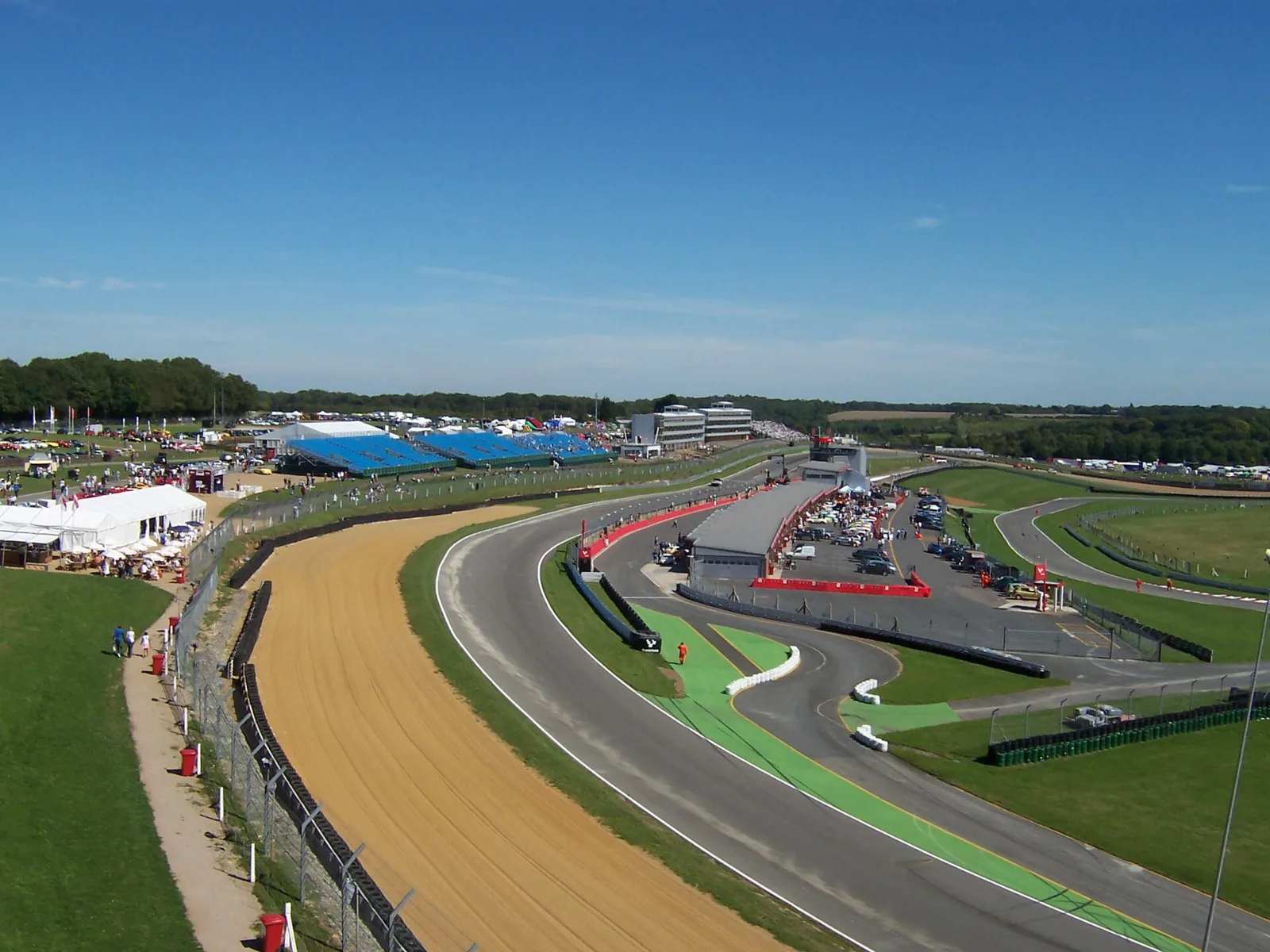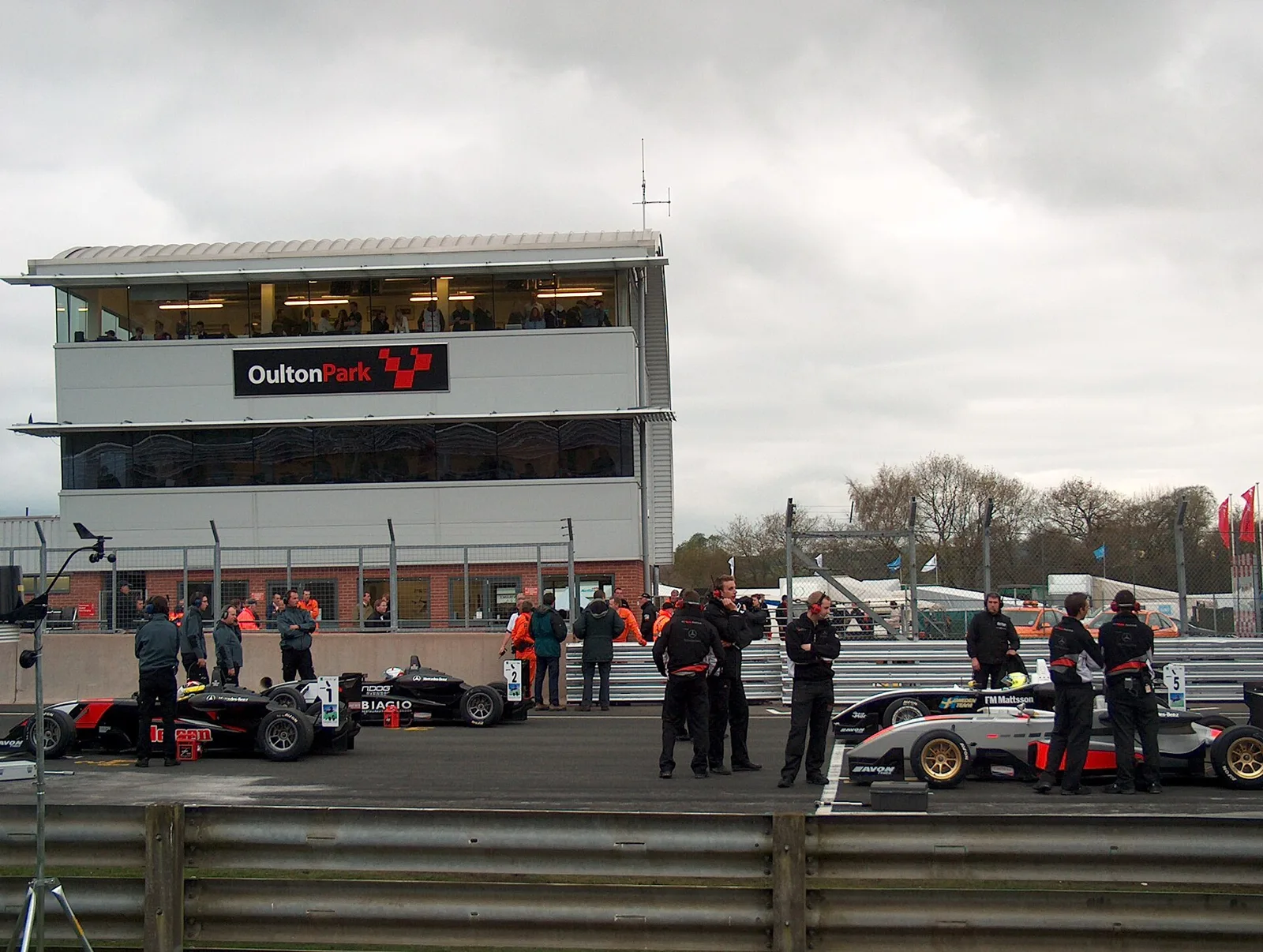
A Cheshire circuit carved from a country estate in the early 1950s, known for its blind crests, its Knickerbrook corner and the Gold Cup.
Oulton Park is a hard-surfaced circuit in Cheshire, England, with a full lap of 4.332 km (2.692 mi). It opened in 1953, is owned by MotorSport Vision, and hosts the Gold Cup, British touring cars, British Superbikes and the British GT Championship.
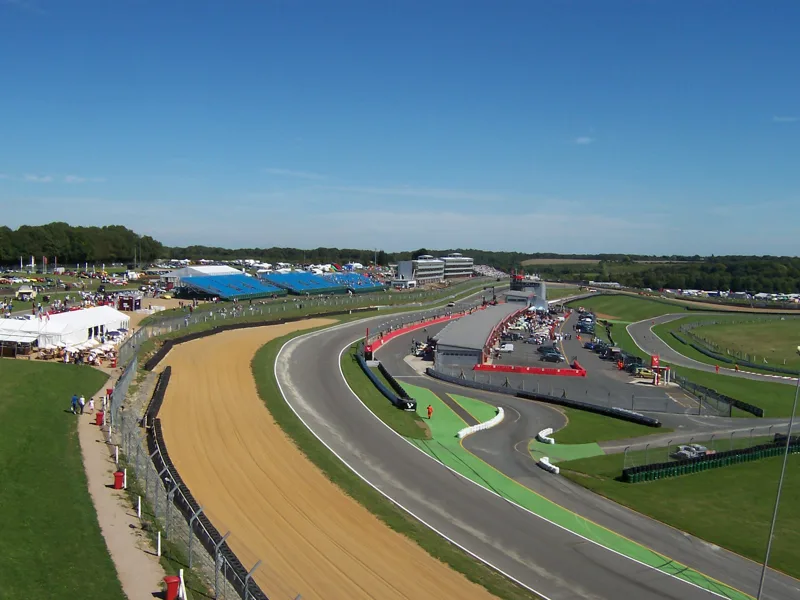
Oulton Park is a motor racing circuit in Cheshire, England, laid out across part of a former country estate. Its steep changes in gradient and its blind crests have earned it comparisons with the Nordschleife, and its Gold Cup meeting is among the largest historic events in Britain. The circuit can also be hired for private testing and track days, which keeps it busy well beyond race weekends.
Where is Oulton Park and what is the circuit like?
The circuit lies close to Little Budworth, about 21 km (13 mi) from the centre of Chester and within easy reach of the Mid-Cheshire Line. The full course measures 4.332 km (2.692 mi), and its highest point is known as Hill Top.
Few corners are straightforward here. The road rises and falls sharply, hides the next braking point over crests, and tightens through several bends, so each lap asks for constant attention from the driver.
A shorter layout, Foster's, measures 2.672 km (1.660 mi). It uses half of the Cascades corner, the Hislop's chicane and Knickerbrook before climbing Clay Hill, then returns to the start-finish straight.
From 2007 each marshalling station was rebuilt with protective cages. The work followed a run of incidents in 2006 in which cars struck marshalling posts, and a caged station was also built near the chicane that precedes Knickerbrook.
A Cheshire circuit with blind crests and a Gold Cup dating from 1954 still rewards drivers who will commit fully.
What makes Knickerbrook so famous?
Knickerbrook takes its name from an incident involving the demolition expert Blaster Bates, who was clearing tree stumps with dynamite near the corner. Its later reputation was grimmer, because the bend was linked with accidents and driver fatalities. Before the chicanes arrived it was known as a racers' corner that demanded full commitment from anyone who took it.
Before the changes, the corner was a fifth-gear, off-camber right-hander at the bottom of a downhill run called Hilltop. Raised kerbing on the inside could unsettle a car, and a barrier on the outside met the grass verge, which left little room for a driver pushed wide.
After Paul Warwick died in 1991, Hislop's, a right-left chicane, was put in place roughly 135 m (443 ft) before the corner to slow cars arriving from Hilltop. The approach was modified again between 2002 and 2003 to guide cars through Knickerbrook and up Clay Hill.
How did the circuit begin in the 1950s?
The Mid-Cheshire Car Club started the project because the north-west of England had too few circuits. With permission from Sir Philip Gray-Egerton, the club mapped a track across the family estate, and by August 1953 the new circuit was ready for use.
The first meeting was held on 8 August 1953. The RAC would not let paying spectators in until an opening meeting had run smoothly, so about 3,000 club members and their guests watched. The headline race was a 33-lap Formula Two event, which Tony Rolt won.
A second meeting followed on 3 October 1953. The Wirral 100 Motor Club joined the Mid-Cheshire club for this one, mixing motorcycles and cars, and the crowd reached 40,000. The track's length reached 2.356 mi (3.792 km) by April 1954, and later that year the layout was lengthened to 4.443 km (2.761 mi).
The circuit draws on a large catchment area that takes in Liverpool, Manchester, Chester and Crewe, and the second 1953 meeting drew a large crowd as a result.
Oulton Park stood apart from most post-war circuits. Its contemporaries were mostly converted airfields, and the main exception was the short-lived Blandford Circuit in Dorset. The site's history is also long, and it may reach back as far as Roman times.
Which series have raced at Oulton Park?
The British Racing Drivers' Club ran the British Empire Trophy here in 1954 for sports cars, using the new Island Circuit of 2.356 mi (3.792 km). Alan Brown won in a Cooper-Bristol, ahead of Roy Salvadori in a Maserati A6GCS, who set a lap record in the process.
In 1956 the Vintage Sports Car Club ran the Richard Seaman Memorial Trophy at Oulton Park after moving it from Silverstone. The distance was cut from 56 laps to 40, and Stirling Moss took the win in an Aston Martin DB3S with Tony Brooks second.
Moss and Brooks also tested Vanwalls at the circuit in 1957, and their advice that the surface at Island Bend should be replaced was acted on.
The British Formula One Championship ran here from 1978 to 1982, the British Formula 2 Championship from 1989 to 1996 and the British Formula 3 International Series from 1964 to 1990. Porsche Carrera Cup Great Britain ran from 2003 to 2013 and again from 2015 to 2023.
June brings the Ferrari Challenge UK and the Supercar Pageant, and an August US Autoshow is part of the wider calendar. Such mixed programmes mean the circuit is rarely quiet between race weekends.
Later the GB3 Championship ran here from 2013 to 2024, and the F4 British Championship has raced at the circuit since 2015, with a return in 2025.
How did racing develop through the 1960s and 1970s?
In 1961 the pits were rebuilt as a two-storey structure with a concrete wall that protected crews working on their cars. The same year Stirling Moss won the Gold Cup in a four-wheel-drive Ferguson P99, the only race win for that car.
Grovewood Securities bought the circuit in 1964 to strengthen its motor sport interests, ending nearly 500 years of Egerton ownership. The Royal Automobile Club's Tourist Trophy returned in 1965, when sports and GT cars ran two heats of two hours each, and Denny Hulme won it in a Brabham BT8.
On 2 April 1966 the British Automobile Racing Club's event was hit by snow covering the circuit, and prospective spectators were turned away. The incident is a reminder of how exposed the track was to the weather.
Formula 5000 was born in Europe at Oulton Park on Good Friday 1969, when Peter Gethin won in a McLaren M10A. The last RAC Tourist Trophy at the circuit that year ended in tragedy when Paul Hawkins lost control at Island Bend and was killed.
The BRSCC's Formula 5000 championship took in events across Europe from 1969. Its title sponsorship moved from Guards to Rothmans and then to Shellsport, and from 1976 the series also admitted Formula One, Formula Two and Atlantic machinery.
Formula One returned in 1971 for the Rothmans Trophy, which Pedro Rodriguez won in a BRM P160 at an average of 115.13 mph (185.28 km/h). Sunday racing was allowed for a single year in 1973, and the first Sunday meeting saw a Chevron one-two-three.
Why is the Oulton Park Gold Cup so important?
The Gold Cup was originally a trophy for a non-championship Formula One race at Oulton Park, and the first running was in 1954, so it has a long history behind it. Stirling Moss won that first race and went on to win the cup five times in total.
In that first Gold Cup Moss began at the rear of the field, and he had worked past twelve rivals by the end of the opening lap.
Rising costs and the growth of national Grands Prix led the Gold Cup to fade as a Formula One event, and the last true Formula One race was held in 1972. The meeting then carried on with other formulae, including Formula 5000, Formula 3000 and British touring cars.
Since 2003 the Historic Sports Car Club has run the Gold Cup meeting. It now draws hundreds of classic cars and is often described as the Goodwood of the north.
What changed in the late twentieth century and after?
In 1987 a new chicane was placed between the Shell Oils Hairpin and Knickerbrook, designed to slow the fastest part of the circuit. Gareth Rees set the outright International lap record in 1996, driving a Reynard 95D in British Formula Two.
Foster's has its own record holder as well. The outright lap of that shorter layout belongs to Luca Riccitelli, who set it in a Formula 3000 car, a reminder that the two layouts differ in character.
Rees's record was set on 6 July 1996, which was the final single-seater running of the Gold Cup. Its time of 1:24.68 was the benchmark for the 1992 to 2002 layout, which measured 2.775 mi (4.466 km).
Octagon had bought Brands Hatch Leisure in November 1999, and it later sold the circuit to MotorSport Vision.
MotorSport Vision acquired Oulton Park in January 2004, buying it from Octagon. The group also took in Brands Hatch, Snetterton and Cadwell Park, and Jonathan Palmer leads that organisation.
Leon Haslam's motorcycle record came in race 2 of the British Superbike category, which has been held at the track in several seasons. The motorcycle figure is listed in the table below alongside the car records.
Today the full lap is 4.332 km (2.692 mi). The official measurement changed from the earlier layout figure in the early 2000s, and the current record for the International circuit was set in 2023.
Lap records and key figures
| Category | Figure | Set by |
|---|---|---|
| Current car lap record | 1:28.619 | Joseph Loake, Tatuus MSV-022, GB3, 2023 |
| Record on the 1992 to 2002 layout | 1:24.68, 117.91 mph (189.76 km/h) | Gareth Rees, Reynard 95D, 1996 |
| Motorcycle record | 1:32.817 | Leon Haslam, Ducati Panigale V4 R, 2025 |
| Full circuit | 4.332 km (2.692 mi) | Current layout |
| BTCC attendance record | 43,000 | 2014 meeting |
Which championships race at Oulton Park now?
Touring car rounds, two British Superbike visits and the British GT season opener all take place here, and a GB3 round has been part of the calendar in recent years. Each of these weekends brings its own paddock and crowd.
The Historic Gold Cup meeting in August draws hundreds of classic cars. Recent additions include a Family Fun Day over the May Bank Holiday weekend and a festival dedicated to the Mini, while the circuit offers test days and driving experiences during the week. The meeting is run by the Historic Sports Car Club, which keeps it firmly in the historic calendar.