Designed in three months, the 701 won March its first Formula One races before a lack of development turned a promising debut into a long slide.
Built in about three months for 1970, the 701 gave Jackie Stewart a Spanish Grand Prix win and gave March third place in the Constructors' Championship. Development shortfalls then left it behind rivals, and the 711 replaced it in 1971, the year the team moved on.
The March 701 was March Engineering's first Formula One design, and it was built in a little over three months for the 1970 season. It gave March its first World Championship victory in only its second season of competition, with Jackie Stewart winning at Jarama, and it finished third in the Constructors' Championship. A lack of development then let rival cars pull ahead, and the 701 was replaced by the March 711 in 1971.
What was the March 701?
The 701 was designed by Robin Herd with help from Peter Wright, and built by March Engineering, a company set up in September 1969 by Max Mosley, Alan Rees, Graham Coaker and Herd. It followed the company's first prototype, the 693P, which Coaker built in his garage. Its first outing came about four weeks after the unveiling, in the South African round.
Herd began work in November 1969. By the time of the 6 February 1970 launch, a pair of cars were complete and running. The car's name followed a simple system: the first digits gave the design year, and the last digit marked Formula One as the intended class.
Built in roughly three months, the March 701 won March its first Formula One races and then slipped behind as development ran short.
How was the 701 designed in such a short time?
The time pressure shaped the car. Herd took a deliberately conservative British Standard approach and held back more advanced ideas for the 711, the car intended to succeed the 701. Some critics regarded it as a copy of a McLaren and Lotus design, and Herd later said he had been disillusioned with the 701 because it bore little resemblance to the car he wanted to build.
The development also took a toll on Herd personally, as he lost more than a stone and a half in weight during the build. Mosley calculated that each car cost between 2500 and 3000 pounds to build and first planned to sell them for 6000 pounds. Walter Hayes of Ford, who was funding Ken Tyrrell's purchase of two cars, persuaded him to charge 9000 pounds instead.
Eleven chassis were built in total, three for the works team and eight for customers. At least ten were known to survive as of 2012.
What was the 701's structure like?
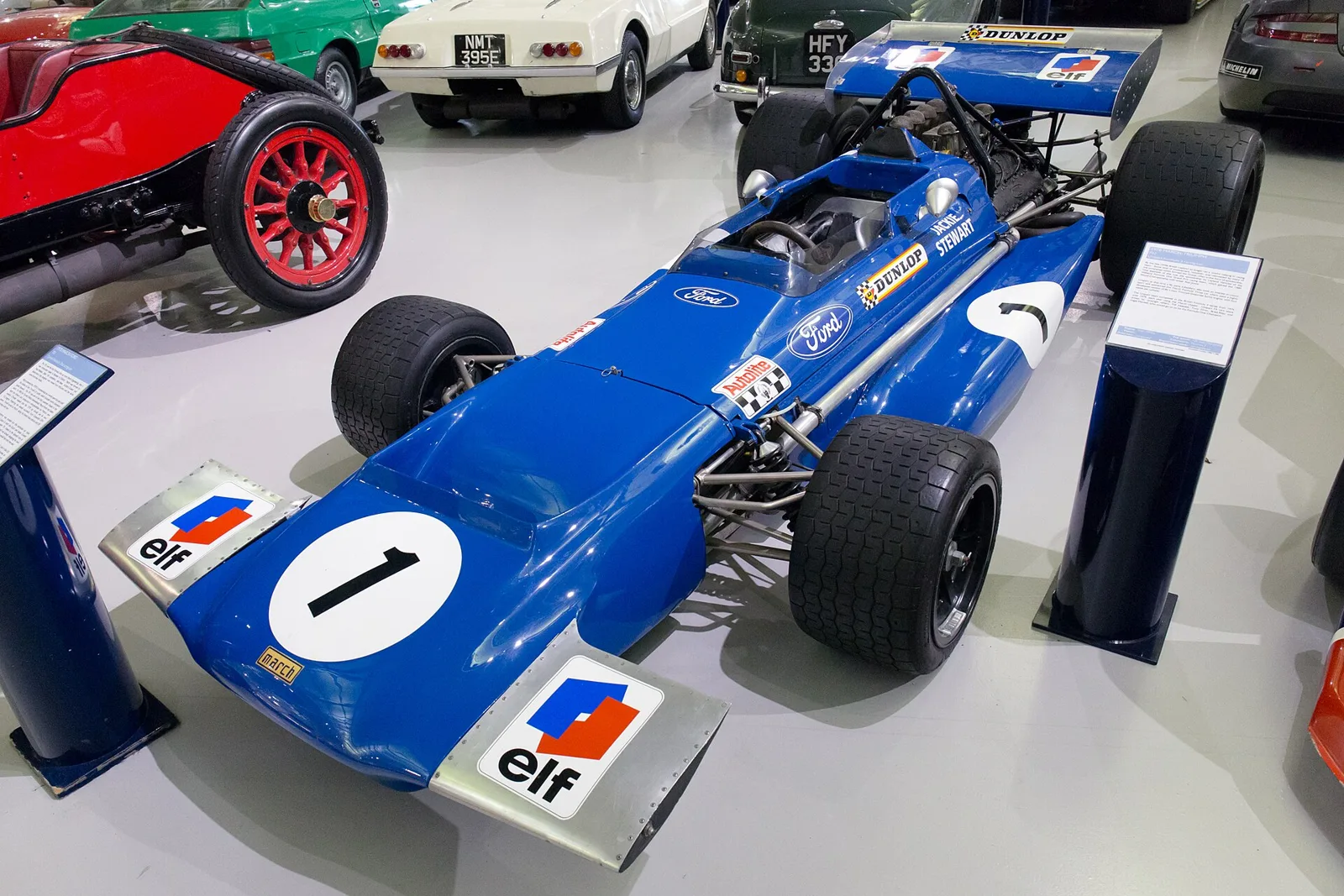
The chassis was a boxy monocoque of aluminium sheet in the L72 alclad grade, fitted with cast magnesium bulkheads, and the engine was a stressed part of the structure. Most cars used 18 swg sheet, although a lightweight car, 701/6, was assembled for the works in 20 swg aluminium and never ran. The Tyrrell chassis 701/4 was also rebuilt in the lighter gauge.
The nose carried a fibreglass shell around a near-rectangular radiator opening, with two small fixed wings either side. A large adjustable rear wing sat on the gearbox, and detachable side fuel tanks with an aerofoil profile sat between the wheels. Together the tanks gave the car a total fuel capacity of 60 gallons, which the team thought was needed for each race.
Engine and transmission followed convention. The Ford-Cosworth DFV was a 2993 cc, 90-degree V8 that originally produced around 430 bhp (320 kW), and it drove through a Hewland DG300 five-speed unit. The rear suspension and ancillaries mounted directly to the engine and gearbox rather than to a subframe.
What were the 701's brakes and wheels like?
Every corner had a Girling disc measuring 10.5 in (26.7 cm). The rear discs were first placed inside the rims, but from the 1970 Spanish round the works cars moved them inboard. Herd estimated that change cut unsprung mass by roughly 25 per cent, and the other cars were converted over the following weeks.
The wheels used March's own single centre-stud design. Herd had wanted 13 in wheels all round, but early in the year the right rear tyres were in short supply in that size, so the rear rims were 15 in until the brake change allowed 13 in at the back as well.
How did the 701 handle on track?
Jackie Stewart described the 701 as the most difficult Formula One car he had driven. Its weight was concentrated at the outer edges, since the heavy radiator sat at the front and the oil tank was placed as far back as possible. The result was a high polar moment of inertia, which made the car reluctant to turn in and then slow to straighten on exit.
The car was at least 50 kg (110 lb) above the limit from the outset, and Ken Tyrrell became increasingly critical of its weight, which ran about 70 kg above the minimum. Herd had prioritised reliability and safety at the urging of Tyrrell and Stewart, which left less room for performance. Stewart and Chris Amon nonetheless extracted good speed from their cars early on, which both drivers credited to their smooth styles.
What were the car's key specifications?
| Item | March 701 (1970) |
|---|---|
| Monocoque | L72 alclad aluminium, cast magnesium bulkheads |
| Engine | Ford-Cosworth DFV, 2993 cc V8 |
| Gearbox | Hewland DG300, five-speed |
| Brakes | 10.5 in Girling discs; inboard at the rear from the Spanish round |
| Fuel capacity | 60 gallons in total |
| Front suspension | Double wishbones, outboard springs and dampers |
| Rear suspension | Twin link and radius arm, outboard coilovers |
| Built | Eleven chassis, three works and eight customer cars |
How did the 701 debut at the 1970 South African Grand Prix?
March introduced the 701 at a Silverstone event on 6 February 1970, where Amon demonstrated the works chassis and Stewart drove the first Tyrrell customer car. The car was designed in only twelve weeks, yet five March 701s appeared at the first race of the season, the 1970 South African Grand Prix. Two were the works cars for Amon and Jo Siffert, and a third, painted in STP colours, was entered by Andy Granatelli for Mario Andretti. The Tyrrell team ran two cars for Stewart and Johnny Servoz-Gavin.
Stewart and Amon qualified first and second. Andretti had damaged his car in a private test the day before and started 11th, while Siffert was ninth and Servoz-Gavin started 17th. Stewart led for many laps, helped by a first-corner incident involving Jochen Rindt, but Brabham and Denny Hulme passed him, and Stewart finished third. Amon and Andretti both suffered overheating after the cooling system's header tanks failed, retiring after two and 11 laps.
How quickly did the 701 win races?
The first win came two weeks later at the Race of Champions at Brands Hatch, a non-championship event. Stewart took pole in 701/2 and turned it into a win, a first for March in only its second Formula One race. Amon's camshaft gave way on lap 10.
A month later four of the South African cars appeared at the 1970 Spanish Grand Prix at Jarama, and Stewart took the first March World Championship win. Brabham had been fastest in qualifying, but Stewart started on the front row and led the race from the start, lapping the entire field. Andretti finished third from 16th on the grid, and Servoz-Gavin drove a second Tyrrell car to fifth.
Amon had his moment at the BRDC International Trophy at Silverstone, where he took pole, won the first heat and set the fastest lap of the race. Stewart won the second heat, but the overall result was decided on aggregate, and Amon took the trophy by ten seconds.
Why did the 701's results decline after Monaco?
Early on the firm had three wins and four pole positions, plus a fastest lap, in its first five starts, which earned real respect. The results flattered the car, though. It handled poorly and carried excess weight from the first race, and March had little money. Its only outside support was 25000 pounds from STP and 27000 pounds from Firestone, and the Porsche backing that put Siffert in the team was the other major source.
Development was limited. March built a lightweight spare, 701/6, but never raced it. After Monaco the team rebuilt Amon's 701/1 around a new monocoque with lighter side tanks, wheels and radiator, which shed about 30 kg. Other teams, including those with the Lotus 72, moved ahead of the 701 as the season went on.
At Belgium Stewart was on pole again, but his engine failed on lap 14. Amon finished second, only 1.1 seconds behind Pedro Rodriguez's BRM, and questions were raised about the size of the BRM engine, though later research found no evidence of a switch. At Zandvoort Rindt won in his Lotus 72, and Stewart finished second 30 seconds back. Engine failures ended the races of Siffert and Cevert, and Amon's clutch failed on the first lap.
In France Amon finished second, less than eight seconds behind Rindt, and Stewart was ninth. In Britain Amon took fifth and Cevert finished seventh, a lap down. Several cars dropped out with suspension failures, including those of Siffert and Andretti.
What happened to March in Germany and Austria?
At Hockenheim touring car driver Hubert Hahne, backed by Axel Springer, had bought 701/9 and entered it in the race. He never came within seven seconds of pole, and he failed to qualify. The qualifiers were Peterson, Cevert, Andretti, Stewart, Amon and Siffert, and Siffert, who had qualified fourth, was classified eighth even though his ignition failed before the start.
Cevert was the highest-placed March in seventh. The other three qualifiers had dropped out with engine or transmission problems, and seventh was not a points position at the time. It was the first race in which March scored nothing for the Constructors' title, eight rounds into its debut year. The Austrian Grand Prix brought no points either, with Amon eighth as the best finisher.
Hahne then took legal action, claiming he had been sold a defective car. German police impounded the works cars and equipment as the team travelled home. Mosley negotiated their release by offering an observed test against the Antique Automobiles car. At Silverstone Peterson began with a decent lap in the yellow car, then changed to Hahne's silver 701/9 and was two seconds quicker. Hahne dropped his action and gave up competing.
How did the 1970 season end for March?
Between Austria and Italy the teams returned to England for the Oulton Park International Gold Cup. Tyrrell, frustrated with the 701, had been building its own 001 in secret, and it unveiled the car to Stewart at the Cheshire event. With the works team absent, no March appeared on the entry for a European round for the first time that year.
At Monza Stewart qualified fourth and finished second, the last race he would drive in a 701. Cevert finished sixth from 11th, with Amon seventh. In Canada the Tyrrell 001 took pole for its World Championship debut. Cevert started fourth, and Amon finished third, trailing the winning Ferrari pair by half a lap. That was the 701's final World Championship podium.
Amon added fifth place in the United States and fourth in Mexico in his well-used chassis, 701/1, but none of the other 701s scored. In total the works and Tyrrell cars took 48 World Championship points, which put March third in the Constructors' Championship in its debut season. Stewart finished fifth in the drivers' table with all 25 of his points scored in a March, while Amon was eighth on 23. Andretti took 4 points for third in Spain and was 16th, and Servoz-Gavin and Cevert finished 22nd and 23rd. Neither Siffert nor Peterson scored a championship point.
At the end of the year the works cars were sold. Tom Wheatcroft bought 701/1, Siffert purchased his own chassis, 701/5, and the lightweight spare went to Frank Williams.
How did the 701 perform in South Africa?
In June 1970 the Rhodesian John Love bought 701/10 for his Team Gunston operation in the South African title series. On its debut, a race at Kumalo on 5 July 1970 known as the Bulawayo 100, Love took the win once series leader Dave Charlton's Lotus 49C had dropped out on lap 23. He added second place in the Rhodesian Grand Prix that September, but the car's handling and reliability let him down for the rest of the year.
In 1971 Love finished second in the Highveld 100 at Kyalami in March and won the Goldfields Autumn Trophy in May. Reliability remained the March's weak point, and he tried an ex-Mike Hailwood Surtees TS9, which was delivered in poor condition. When the TS9 was badly damaged in a crash at the 25th Anniversary Trophy in August, Love returned to 701/10, which he drove to wins in the False Bay 100 and the Rhodesian Grand Prix. He finished third in the championship with 45 points, behind Charlton on 72.
Love replaced the 701 with a Brabham BT33 for the 1972 season, after the older car had shown its age against the new Lotus 72.
Where did the 701 race in 1971?
The works team had moved on to the March 711 by then, and only three Formula One races in 1971 saw 701 entries. Frank Williams entered Henri Pescarolo at the South African Grand Prix, where he finished two laps down, while John Love's gearbox failed on lap 30 in his own car. Williams then kept a 701 for second-string drivers, one of whom, Max Jean, drove it at the French Grand Prix, finishing nine laps adrift. Jean-Pierre Jarier drove Hahne's old car at the Italian Grand Prix, finishing last and unclassified.
Outside the championship there were more 701 entries. Tom Wheatcroft entered Derek Bell in the Argentine Grand Prix, alongside Jo Siffert and Pescarolo. Pescarolo finished second on aggregate, behind Chris Amon's Matra.
Chris Amon's 1971 Tasman campaign had a 701 converted with a 2.5-litre engine. Amon finished third in the opening race at Levin, but the team swapped to a Lotus 70 for the New Zealand Grand Prix. After the series the car went to Skip Barber, who shipped it to America.
Where are the surviving 701s today?
For some years the first car, Amon's works chassis 701/1, was displayed mounted on a wall at the Donington Grand Prix Collection. The Tyrrell chassis 701/4 has been brought back to original specification and, by October 2017, was on show at the British Motor Museum. Many others are in private hands and take part in historic racing around the world.
The 701 is also associated with a tragedy. On 2 September 2017 David Ferrer crashed his 701 at Zandvoort during the Historic Grand Prix, at the Arie Luyendijk corner. He died of his injuries later that week.
What is the March 701's legacy?
The 701 is remembered as a car that did far more than its build time suggested. Designed in a hurry, it gave March its first Formula One wins and a third-place team finish in its first season, which showed that a new constructor could be competitive quickly.
Its limitations are just as instructive. A car that was heavy, hard to handle and short of development could not keep pace with rivals that were moving forward, and the 711 was the attempt to answer that problem in 1971.