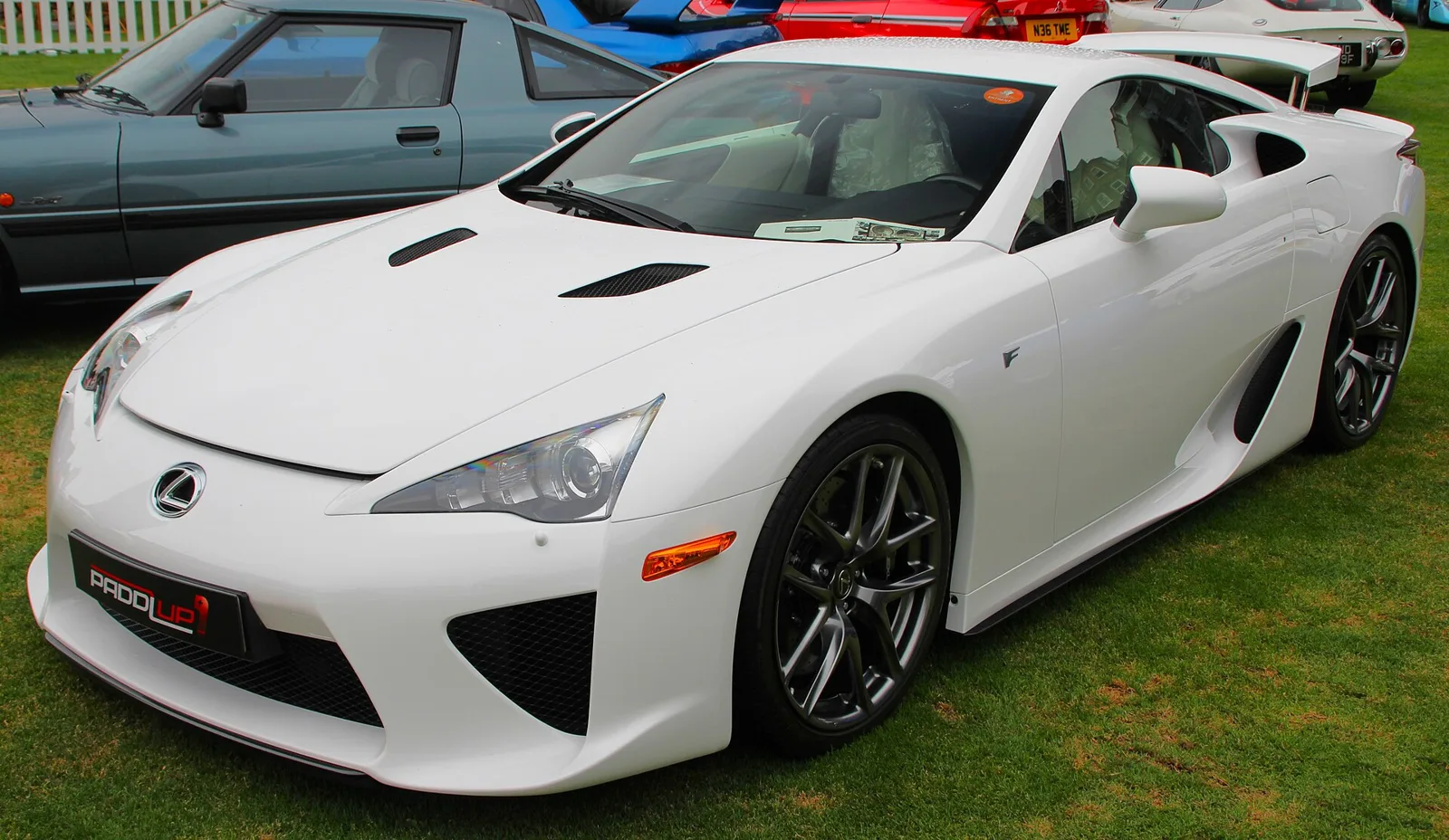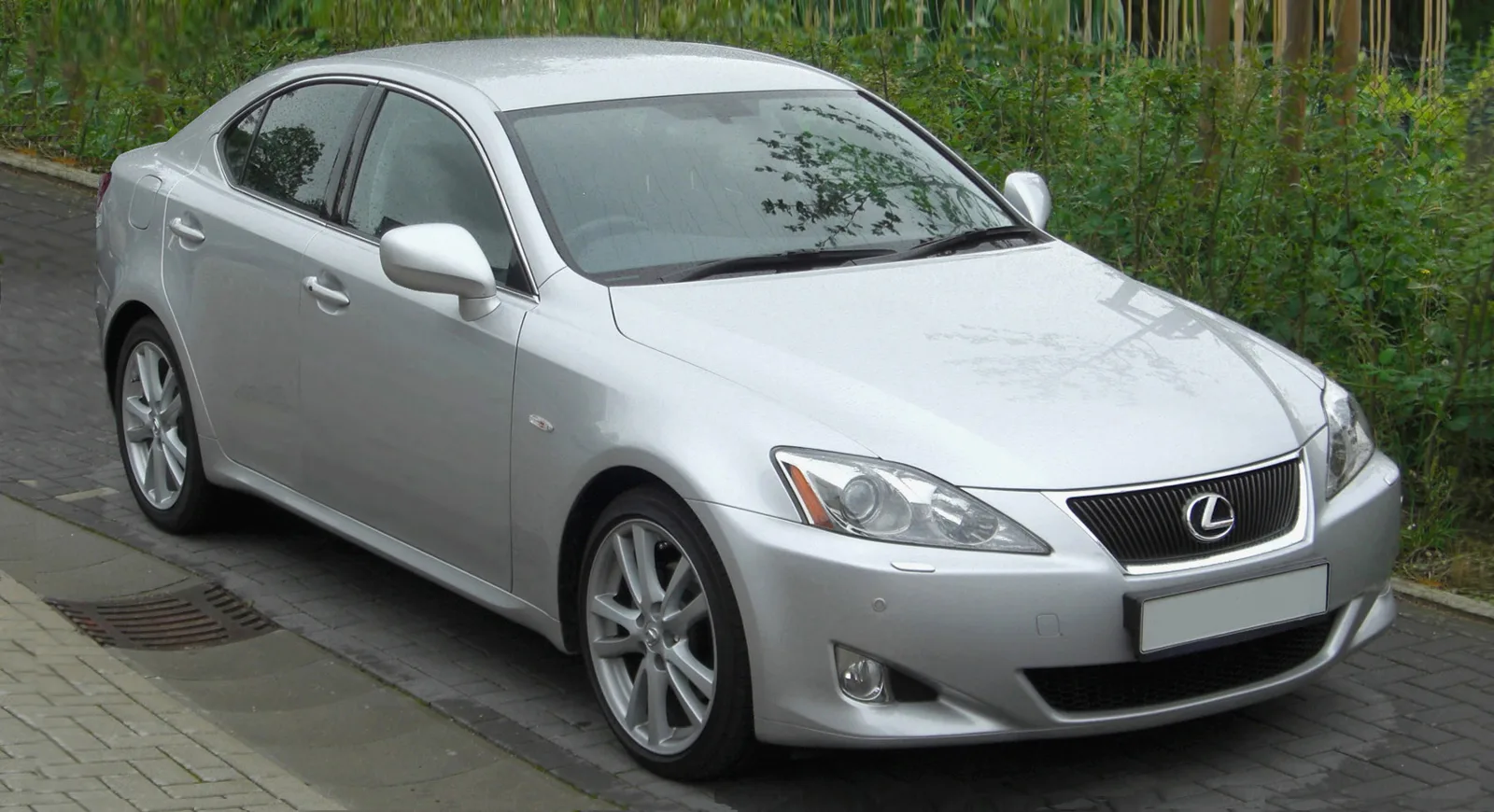
The compact executive car that gave Lexus its entry-level sedan from 2005, its diesel and coupe variants, and the 5.0-litre V8 IS F that became its performance flagship.
The Lexus IS XE20 was the second-generation compact executive sedan from Lexus, built by Toyota from 2005 to 2013. It came as a sedan and a coupe, and the high-performance IS F with its 5.0-litre V8 became its best known variant.
The second-generation Lexus IS was a compact executive car that became the brand's entry point from 2005. It ran in sedan and coupe form, spawned the high-performance IS F, and kept its place until the XE30 arrived in 2013.
What was the Lexus IS XE20?
The XE20 was the second generation of the Lexus IS, a compact executive car that Toyota built under its luxury division from 2005 to 2013. It came as a four-door sedan and a two-door coupe, and the IS F performance version followed.
Toyota built the XE20 at Tahara in Aichi and at the Kyushu factory in Miyawaka, Fukuoka, until 2012. The coupe carried a C in its name, as in IS 250 C, and Lexus rolled the models out in stages.
Lexus's entry-level sedan grew a diesel, a coupe, a convertible and a 5.0-litre V8 performance flagship.
Who designed the second-generation IS?
Suguya Fukusato was chief engineer, and development began in 2001, after US sales of the XE10 had started. Kengo Matsumoto led the primary design, and a pre-production IS debuted at the Geneva International Motor Show in March 2005. The project ran for about four years before the car went on sale.
The final model appeared at the New York International Auto Show in April 2005, and production began in September 2005 at Tahara and Miyawaka. Design work under Matsumoto ran from 2002 into late 2003, when the concept by Hiroyuki Tada was chosen.
Patent filings followed in September 2004 in Japan, then 18 February 2005 in Europe and 25 February 2005 in the US. The design had been frozen only after development wrapped up in early 2005.
What did the second-generation IS look like?
The second-generation IS brought Lexus's L-finesse philosophy to a production car for the second time, following the 2006 GS. It had sleeker, coupe-like contours and a fastback profile, and its front fascia and side windows carried a repeated arrowhead motif.
The new car measured 89 mm more in length than its predecessor (3.5 inches), and 76 mm more in width. Much of that growth came from a 58 mm (2.3 inches) longer wheelbase, and the body reached a 0.28 Cd figure.
The grille was set lower than the headlights, and the forward design recalled the Lexus LF-C coupe concept that had come before.
What was inside the IS?
The second-generation interior offered leather seats, electroluminescent instrument lighting and 10-way power seats for the driver and front passenger. Buyers could also choose faux-metallic trim or Bird's Eye Maple wood made by Yamaha piano craftsmen. Buyers could therefore pick between a plainer or a warmer cabin.
The interior also drew on the Japanese idea of hazushi, in which an object keeps its identity while belonging to a larger whole, as seen in the side air vents.
Options included perforated leather, heated and ventilated front seats, a moonroof, electrochromic mirrors and aluminium scuff plates. A 7-inch touchscreen Gen V navigation system and a 14-speaker Mark Levinson system were also offered.
What safety equipment did the IS have?
Standard equipment included dual front airbags, front-row knee airbags, side curtain airbags and front side torso airbags. The car also introduced a twin-chamber V-shaped passenger airbag, and its Pre-Collision System was a first in the entry-luxury sedan segment.
Stability control differed by model: the IS 250 used Vehicle Stability Control (VSC), while the IS 350 had VDIM, which reacted sooner and intervened more gently.
NHTSA's 2008 crash tests gave the IS five stars for side driver and rollover, and four stars for the frontal and rear side categories. Euro NCAP scored it five stars for adults, four for children and two of four for pedestrians.
The Insurance Institute for Highway Safety rated the sedan Good overall and in most front and side tests, but Poor for small overlap front.
How did the engines and transmissions work?
The IS 250, IS 350 and IS F used D-4S fuel injection, which combines direct and indirect injection. These models were certified ULEV-II in the United States by the California Air Resources Board, and the IS line also used electric power steering in place of the hydraulic pump.
Buyers got rain-sensing wipers, bi-xenon headlamps and radar cruise control, among other features. SmartAccess keyless entry with push-button start came as standard.
What were the first standard models?
Launching in 2005, the IS 250 (GSE20) reached Japan and North America as a rear-wheel-drive car, with the more powerful IS 350 (GSE21) alongside. The IS 250 RWD came standard with a six-speed manual, and other petrol sedans were automatic only.
The IS 350 used larger discs and four-piston front calipers borrowed from a larger Lexus sedan, where the IS 250 had two-piston calipers. Lexus cited independent testing by AMCI in calling the IS 350's acceleration the fastest in its class at launch.
In February 2007, Road & Track's Japanese luxury sports sedan comparison placed the IS 350 first. Reviewers also thought the car compared well with German rivals, though its steering and rear legroom drew complaints.
How did the IS 220d and IS 300 differ?
The IS 220d (ALE20) reached Europe in 2006 as the first diesel Lexus, with a 2.2-litre inline-four producing 175 hp (130 kW). The IS 300 (GSE22) was tuned for China and the Middle East, with a 3.0-litre V6 and 228 hp (170 kW).
The IS 220d was offered only with a manual, and the IS 300 also reached Brunei, Indonesia and the Philippines. The IS 220d was replaced by the IS 200d in 2010, after engine retuning improved its consumption.
What did the IS convertible add?
After three years with only one body style, the IS returned as a coupe convertible. The IS 250 C made its debut in Paris on 2 October 2008, and a more powerful IS 350 C joined it. Its body style marked a return to variety for the range.
The convertible was offered with a six-speed automatic, and the IS 250 C was also offered with a manual and an all-wheel-drive version. Its body had a drag coefficient of Cd=0.29.
What made the IS F different?
The IS F was the performance version, with a 4,969 cc 2UR-GSE V8 producing 310 kW (416 bhp; 421 PS) at 6600 rpm and 371 lb ft (503 N m) of torque at 5200 rpm. It came as a sedan with bucket seats front and rear.
The V8 was derived from the Lexus UR-series engines, and extensive modifications with Yamaha's Formula One engine programme brought a cast-aluminium intake manifold, new cylinder heads and titanium intake valves. The compression ratio was 11.8:1.
An 8-speed Sport Direct Shift automatic handled gear changes in 0.1 seconds, against 0.05 seconds for Formula One cars. Its steering was an all-electric rack and pinion with a 13.6:1 ratio.
Brakes were Brembo cross-drilled rotors, 14.2 inches at the front and 13.6 at the rear, with 19-inch BBS forged alloy wheels. The body was lowered by 1 cm (0.5 inches) compared with the standard IS.
How did the IS F perform on the road?
Road & Track recorded 0-60 mph in 4.4 seconds in its January 2008 issue, and Car and Driver measured 4.2 seconds. Top speed was electronically limited to 170 mph (270 km/h), while the official figure was 168 mph (270 km/h).
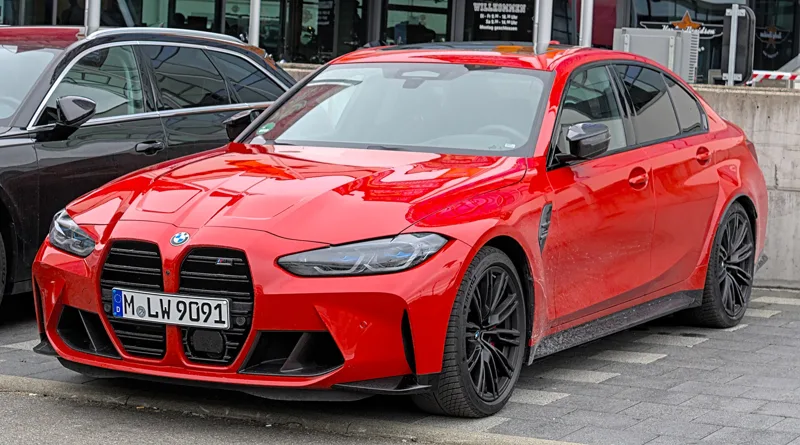
Top Gear pitted the IS F against the BMW M3, with the Lexus taking 1'26.9 to the BMW's 1'25.3 around its test track. Rumours suggested the car could break 200 mph (320 km/h) without the limiter.
Lexus claimed a lap of Fuji Speedway in 2 minutes and 3.4 seconds for the 2011 car.
How many IS F cars were sold?
Lexus sold only about 11,500 IS Fs by 2014. The US took 5,118 of them, against an early target of 500 a year for Japan and 5,000 to 6,000 a year for the US. Those totals were far below the early hopes for the car.
The first 50 IS Fs in the US were a Neiman Marcus special edition, and only 486 units were sold in 2012. The base price in 2008 was US$56,000, and the UK was allocated 150 cars in 2007.
Which motorsport programmes used the IS?
In 2008 an IS 350 raced in Super GT's GT300 class. The No. 19 Team Racing Project Bandoh car, driven by Manabu Orido and Tsubasa Abe, won its first race at Motegi in its fifth outing. Gazoo Racing also showed the car in endurance racing.
The Project Bandoh WedsSport IS 350 went on to win both the driver and team GT300 titles in 2009. Gazoo Racing entered an IS F VLN racer in the SP8 class that year, and it won the DMV Grenzlandrennen on 29 August 2009.
The IS F took third in SP8 at the 2009 24 Hours of Nurburgring and fourth in 2010, behind the Lexus LFA.
Which limited editions were made?
The Elegant White Interior edition had 700 units for Japan, with a two-tone white and grey leather interior. The Red-Edge Black edition for Japan had 500 units with a largely black leather interior and red trim. Most of these limited runs were offered in Japan, where unit numbers were kept small.
The IS 250 X arrived in 2007 with the X-Package, introduced to celebrate the 5000th IS 250 sold in Australia. It came with sport tuned suspension, exclusive alloy wheels, a Mark Levinson stereo and a front lip spoiler, and only 260 were released in 2007.
Prices began at A$64,390 for the six-speed manual and A$66,990 for the semi-automatic. The 2008 IS 250 X added a new Arctic Blue colour and better steering, and 450 units were released that year.
The Neiman Marcus 2008 IS F Special Build was limited to 50 units at US$68,000. The IS 250 SR for the UK in 2008 was limited to 1000 units with a full body kit.
The 2010 IS 350 C F-Sport was limited to 100 units with 19-inch alloy wheels and special blue stitching, and it went on sale in late March 2010 for US$57,500.
Were there concept cars based on the IS?
Lexus built a handful of concept and one-off IS models, and aftermarket tuners such as Wald International and FiveAxis also made one-offs. The IS F Racing Concept appeared at the 2008 Tokyo Auto Salon, built by chief engineer Yukihiko Yaguchi.
Its fenders, wheels and spoilers were larger than standard, a styling approach resembling DTM racing cars. The IS F Circuit Club Sport concept, unveiled at the 2010 Tokyo Auto Salon, used carbon fibre panels and raised output to 428 hp (319 kW).
Lexus IS XE20 specifications
| Specification | Detail |
|---|---|
| Generation | Second generation IS (XE20) |
| Built | 2005 to 2013 at Tahara and Miyawaka |
| Development | From 2001; chief engineer Suguya Fukusato |
| Diesel | IS 220d, 2.2-litre inline-four, 175 hp (130 kW) |
| IS 300 | 3.0-litre V6, 228 hp (170 kW) |
| IS F engine | 4,969 cc (5.0 L) 2UR-GSE V8, 310 kW (416 bhp; 421 PS) at 6600 rpm |
| IS F torque | 371 lb ft (503 N m) at 5200 rpm |
| IS F compression | 11.8:1 |
| IS F transmission | 8-speed Sport Direct Shift automatic |
| IS F 0-60 mph | 4.4 seconds (Road & Track, January 2008) |
| IS F top speed | 170 mph (270 km/h) electronically limited |
| IS F Nurburgring | Third in SP8, 2009; fourth, 2010 |
| IS F production | About 11,500 units by 2014; 486 sold in 2012 |
| Successor | XE30, from April 2013 |