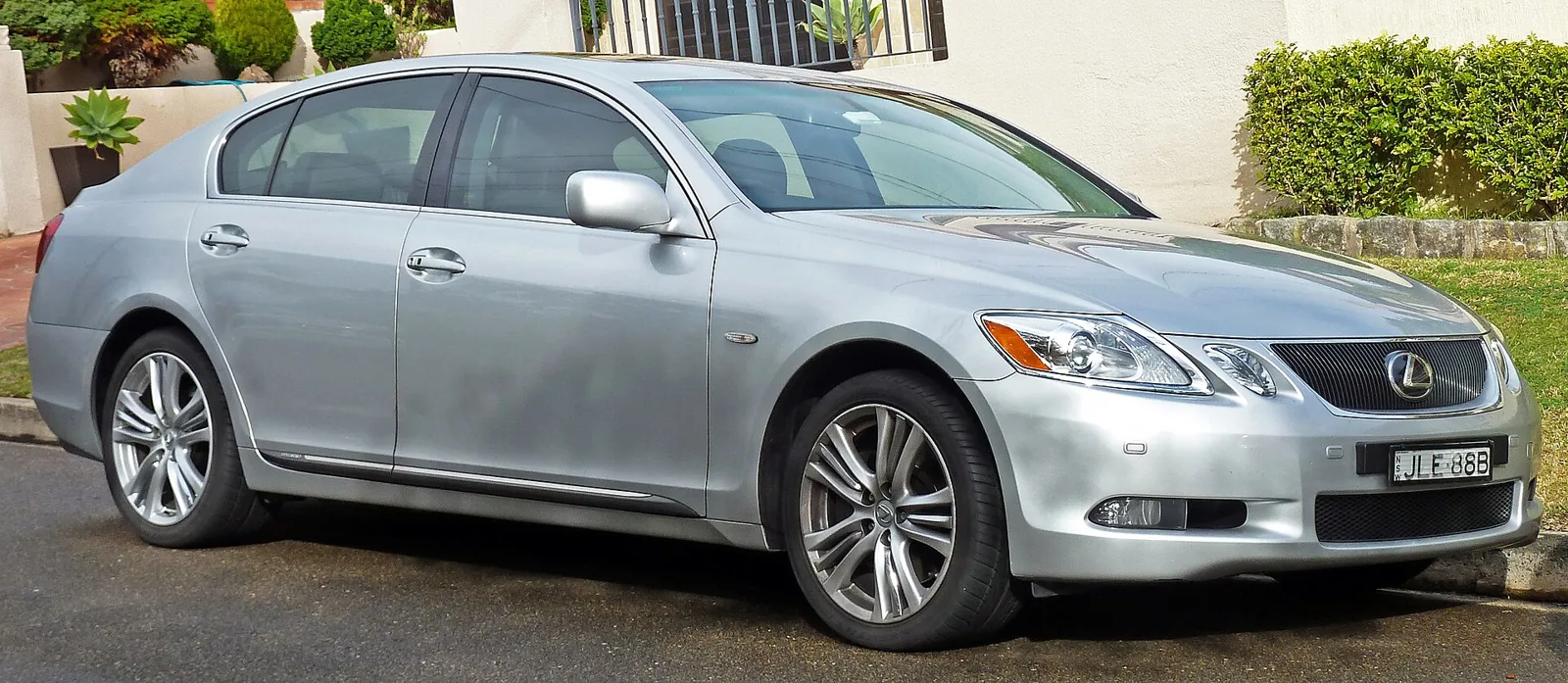
Lexus's third-generation GS, sold from 2005 to 2011, introduced L-finesse styling, added all-wheel drive and launched a rear-drive luxury hybrid.
Sold from 2005 to 2011, the third-generation Lexus GS executive car was built in Tahara, Japan. It introduced L-finesse styling and offered V6 and V8 petrol engines, all-wheel drive and a rear-drive hybrid, the GS 450h. Launch engines were a 3.0-litre V6, a 3.5-litre V6 and a 4.3-litre V8.
The Lexus GS (S190) was the first car to wear L-finesse, the brand's new design philosophy. Built in Tahara, Japan, it went on sale in 2005 with V6 and V8 engines, added a hybrid in 2006 and stayed in the range until 2011.
Two more firsts came with the styling. It was the first Lexus sedan to offer all-wheel drive, and its GS 450h hybrid brought rear-wheel drive to a luxury hybrid built in volume.
Where did the GS S190 come from?
The S190 began as a development project in 1999 under chief engineer Shigetoshi Miyoshi, as the successor to the S160. Lexus previewed the LF-S concept in October 2003, and production started in Tahara, Aichi, on January 24, 2005, and US sales began that March.
The LF-S was a future sedan study with a slingshot cabin, a sleek profile and a fastback deck lid. Most of those ideas reached the production car. Windshield cleaning, a glass roof and side cameras from the concept were dropped.
Styling came from lead designer Yasuhide Hosoda, who worked on the exterior and interior from 2000 to 2002. L-finesse took shape in 2001, and by 2002 the design was settled for a launch the following year.
The new car sat on a mid-size platform that the second-generation IS would also use. Every GS model was built at Tahara, in Aichi.
The first car to wear L-finesse also gave Lexus its first all-wheel drive sedan.
What made the GS look different?
The GS was the introductory Lexus model for L-finesse, with sweeping lines, a sloping fastback silhouette and a more muscular look. Its drag coefficient reached 0.27 Cd, and its slingshot cabin came straight from the LF-S concept. That mix marked a clear break from the second-generation model.
Quad headlamps carried over from the second-generation GS and the SC, but LED tailamps and one-piece bumpers gave the car a more uniform look. The body sides had a stronger tumblehome, and thinner A-pillars with lower beltlines gave the cabin more glass.
What was inside the third-generation GS?
The interior came in three leather and wood combinations: ash leather with black bird's-eye maple, cashmere leather with brown bird's-eye maple, or black leather with walnut. Front seats were 10-way power and heated, and the car used a standard 7-inch touchscreen.
Push-button start came as standard with the latest SmartAccess keyless system, the first time the GS had offered it. A hidden drop-down panel on the driver's side held infrequently used controls, and the three-pod gauge cluster had machined aluminium facings and an electrochromic element that cut glare.
The options list covered a power moonroof, ventilated front seats, a power rear sunshade and rain-sensing wipers. The top audio choice was a 14-speaker Mark Levinson system rated at 330 watts and set up for 5.1 surround sound.
How safe was the GS?
The GS earned Good ratings from the Insurance Institute for Highway Safety in frontal and side impact tests, and it scored Good in 13 of 14 measured categories. Its 2006 to 2011 rollover result was only Acceptable, while Euro NCAP gave the 2005 car five stars for adult occupants.
Standard equipment covered dual front airbags, front knee airbags, side curtain airbags in both rows and front side torso airbags. Rear side torso airbags were an option. The Pre-Collision System with Dynamic Radar Cruise Control was also optional, and it could apply up to 0.3g of braking if the driver failed to respond to a warning.
Euro NCAP's 2005 results gave the car five stars for adults, four for children and two of four for pedestrians. Among executive rivals, the GS beat the three German cars on both adult and pedestrian scores.
Anti-lock brakes and vehicle stability control were standard across the range. The V8 and hybrid versions also received Vehicle Dynamics Integrated Management, which could alter steering ratios when linked to the variable gear ratio system. VDIM came to the 2008 GS 350 as standard equipment, although that version lacked the variable gear ratio system. The GS 450h offered an infrared camera in its steering wheel in some markets, watching for driver attention.
Which engines did the GS use?
At launch the GS used a 3.0-litre V6 in the GS 300, a 3.5-litre V6 in the GS 350 and a 4.3-litre V8 in the GS 430. A hybrid joined in 2006, and the 4.6-litre V8 of the GS 460 arrived for the 2008 model year.
The GS 350 used D4-S direct injection, and the GS 300 used a direct-injection fuel system that made it Toyota's first direct-injected vehicle sold in the United States. The engines were matched to a new six-speed automatic with sequential shift. The GS 300 also offered all-wheel drive, the first Lexus sedan to do so, with the front-to-rear split moving between 50/50 and 30/70 as conditions changed. The 3.0-litre V6 also appeared in the Toyota Mark X, and the GS 300 was never sold in Japan.
Consumer Reports had a rougher time with the first-year all-wheel drive car, which it blamed for pulling down Lexus's overall reliability score in 2007. It cited rattles, body hardware and sound system problems. The same magazine rated the car Recommended for features and overall value, and later all-wheel drive examples were rated average.
Steering and suspension changed as well. Electric power steering replaced the hydraulic pump, and the V8 models added variable gear ratio steering and an electronically controlled brake system, a form of brake-by-wire. In August 2005 the GS 430 became the first Toyota with Adaptive Variable Suspension.
The GS 350 took over from the GS 300 in the US market for 2007. The GS 430's rating fell from 224 kW to 216 kW (300 to 290 hp) after a change in the SAE testing procedures, and the GS 350 produced 226 kW (303 hp), with torque of 274 lb ft (371 N m).
Why was the GS 450h important?
Among volume-built luxury hybrids, the GS 450h was the first with rear-wheel drive. It paired a naturally aspirated 3.5-litre V6 with an electric motor and a CVT, making 253 kW (339 hp) combined, with a SULEV emissions rating.
The hybrid weighed 1,875 kg (4,135 lb) and still reached 60 mph (97 km/h) in 5.2 seconds, a touch quicker than the GS 460's 5.4 seconds. Its US highway rating was 11 km/L (30 mpg-imp; 25 mpg-US), while the city figure was 9.4 km/L (26 mpg-imp; 22 mpg-US), an unusual pattern for a hybrid.
The rear-mounted battery took up trunk space in the early cars. Lexus redesigned that area in 2009, and the boot grew to 300 L (10.6 cu ft), up from 210 L (7.5 cu ft) before that. The same year the hybrid received a new hybrid-only grille and a refresh.
Jeremy Clarkson, a well-known critic of hybrids and of the Toyota Prius, admitted he loved the GS 450h. He drove one up and down Piccadilly and found its styling and quality set it apart from the usual green car. Hybrids were also spared the London congestion charge for a small one-off fee, which made the car a sensible choice for city driving.
What changed with the GS 460?
The GS 460 succeeded the GS 430 and arrived in 2007 as a 2008 model. Its 4.6-litre V8 made 255 kW (342 hp) and 460 N m (339 lb ft) through an eight-speed automatic, and Lexus quoted 5.4 seconds for 0-60 mph.
The 2008 model year also brought a mid-cycle styling refresh across the GS range. A revised front bumper, headlights and grille arrived, along with turn signals in the mirrors and new wheel and colour options. The GS 460 carried the Active Stabilizer Suspension System, which the hybrid and the GS 430 had offered before it.
Inside, the refresh brought a redesigned steering wheel, revised gauges and different trim pieces. The changes were modest, but they gave the range a fresher face in its later years.
Special editions and unusual GS cars
Lexus Japan released a 500-unit Passionate Black edition in 2008 covering the GS 350, the GS 450h and the GS 460, with custom black leather and red piping. A 300-unit Meteor Black edition of the GS 350 followed, with all-black leather upholstery and silver trim.
For 2010 Lexus Japan marked its fifth anniversary with a Sunset edition, designed with the Spanish design duo Stone Designs. It had a multi-tone interior with contrasting leather in orange and saddle tones.
Neiman Marcus also had a special car. The retailer offered 75 GS 450h sedans as its annual holiday catalogue car at US$65,000, and they sold out in under three hours in October 2005.
Other GS cars found their way into unusual roles. Wiltshire Police in England used one as an unmarked car, and a GS 450h took part in the 2007 Targa Newfoundland event.
Did the GS win any awards?
The third-generation GS collected several honours. It won the Paul Pietsch Prize, given for advanced technology, in 2007, from the technical editors of Auto Motor und Sport, and Auto Bild's Auto 1 award for best sedan that same year. Both came in 2007, the car's third year on sale.
Lexus GS S190 specifications
| Specification | Detail |
|---|---|
| Built | Tahara, Aichi, Japan, from January 24, 2005 |
| Launch engines | GS 300 3.0-litre V6; GS 350 3.5-litre V6; GS 430 4.3-litre V8 |
| Hybrid | GS 450h: 3.5-litre V6 with electric motor, 253 kW (339 hp), 1,875 kg (4,135 lb) |
| 2008 V8 | GS 460: 4.6-litre V8, 255 kW (342 hp), 460 N m (339 lb ft) |
| 0-60 mph | GS 450h 5.2 seconds; GS 460 5.4 seconds; GS 350 and GS 430 5.7 seconds |
| Drag coefficient | 0.27 Cd |
| Hybrid boot (2009 on) | 300 L (10.6 cu ft), up from 210 L (7.5 cu ft) |
| Sold | 2005 to 2011 |