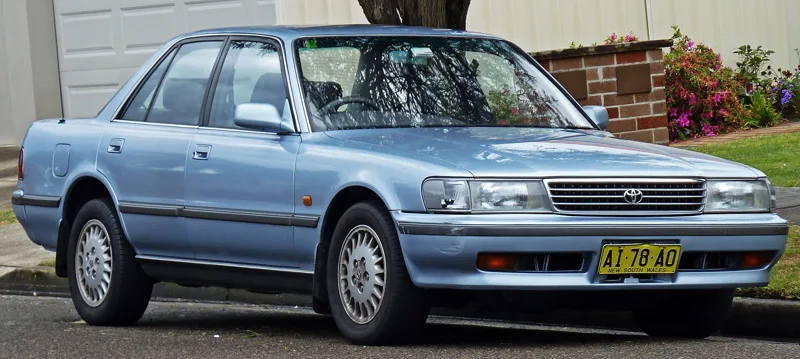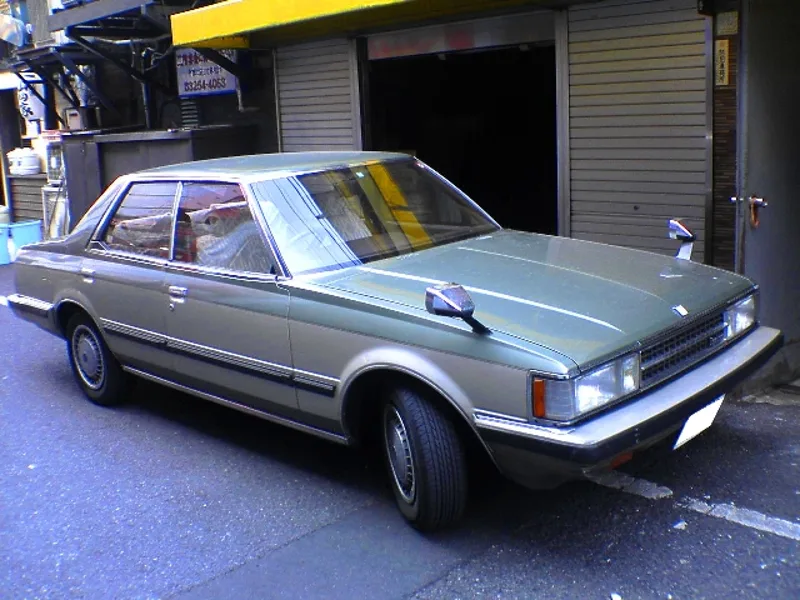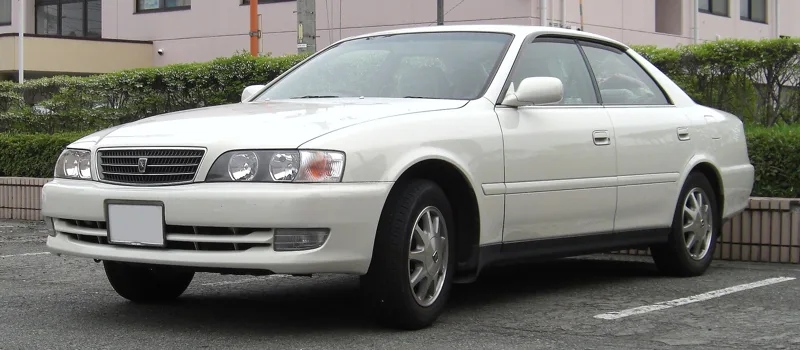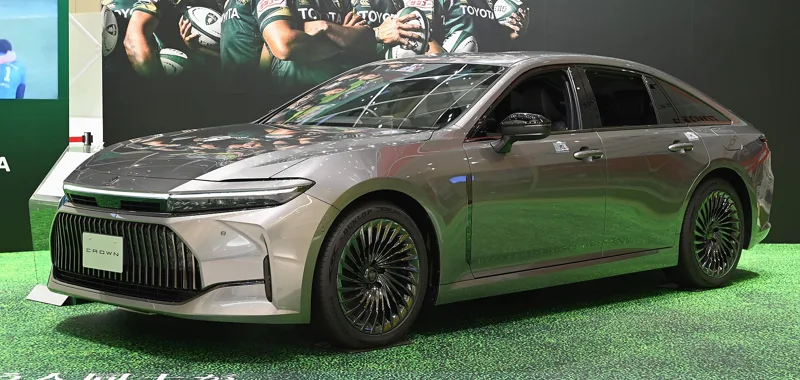
From the 2004 X120 to the 2019 Final Edition: the engines, trims, supercharged specials and GRMN versions of Toyota's last rear-drive Mark.
The Toyota Mark X was a rear-wheel-drive mid-size saloon sold mainly in Japan from 2004 to 2019. It succeeded the Mark II and used V6 engines throughout, from 2.5 to 3.5 litres. Production ended in December 2019 after 6.9 million cars had been built across the lineage.
When the last Mark X left the line in Japan on 23 December 2019, Toyota closed a family tree that had started with the Corona Mark II in 1968 and had produced 6.9 million cars along the way. The Mark X was a rear-drive saloon with V6 power, built to be bought in Japan rather than exported, and it carried its ancestor's name for fifteen years without ever abandoning the layout that made the old car popular.
Where did the Mark X come from?
The story starts in September 1968, when the Corona Mark II went on sale at Toyopet Store dealerships. Toyota was then known as a maker of small economy cars, and the Mark II was pitched as a bigger companion to the Corona while staying smaller than the Crown. It was a deliberate piece of positioning: kept just inside Japanese limits on size and engine capacity, it left the Crown free to grow more lavish. Nissan's Laurel, released that April, was the main rival at home.
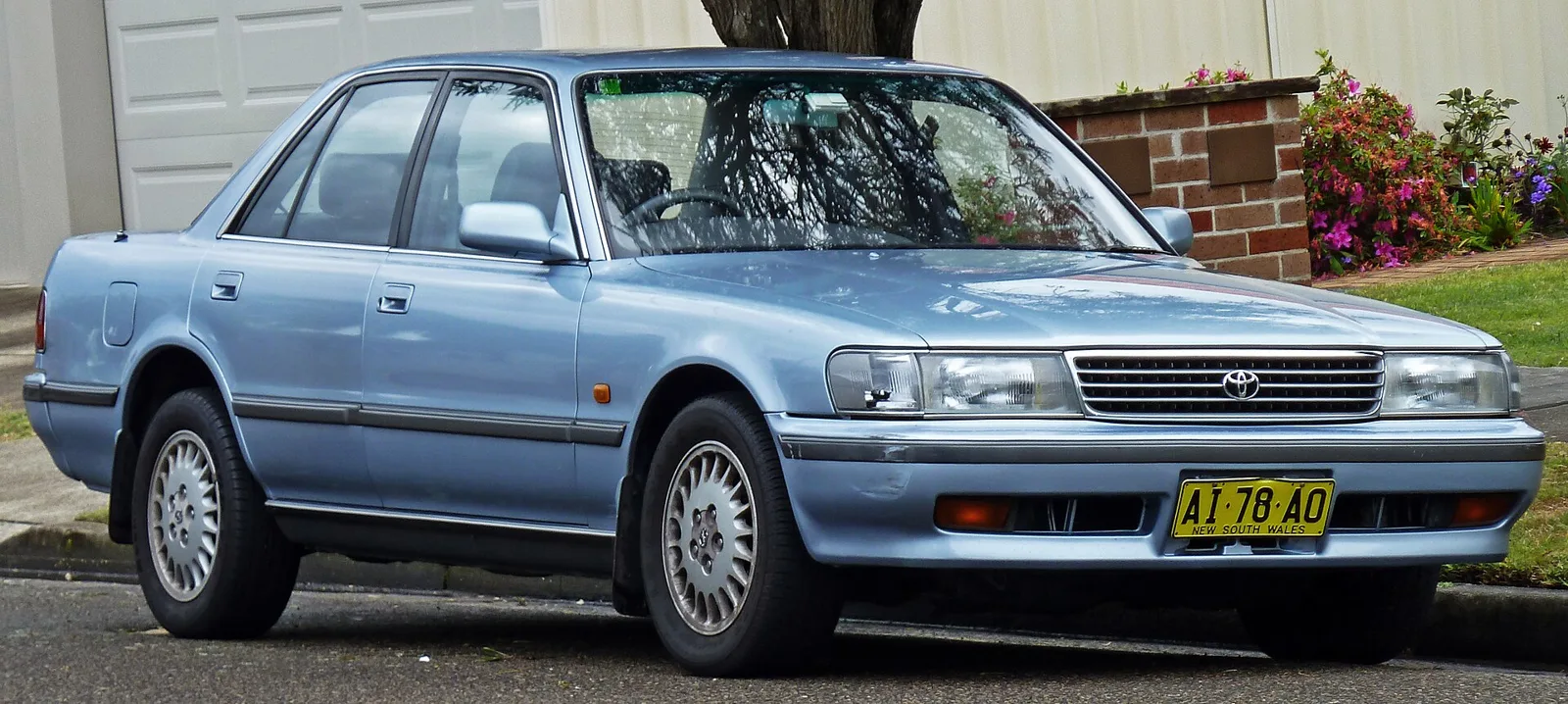
The first series came as a four-door saloon coded T60 and a two-door coupe coded T70, on a wheelbase of 2,510 mm (98.8 in) and an overall length of 4,295 mm (169.1 in). Suspension used double wishbones with coil springs up front and leaf springs behind. Engines were four-cylinder units, among them a 1.9-litre 8R that was unique to the Mark II and a two-litre 18R. This was also the only series sold as a two-door pickup. In 1972 the second generation moved to a new X-series platform and took on what Toyota called Coke bottle styling, a look the company used on this generation alone.
The Mark II's siblings arrived later. The sportier Chaser appeared in 1977 through Toyota Auto Store dealers, and the Cresta followed in 1980 at Toyota Vista Store locations. The 1980s were the high point of the family's popularity, and the Mark II stayed the top product at Toyopet Store until the Celsior arrived in 1989. Then the Japanese recession of the early 1990s hurt sales, the Chaser and Cresta were retired, and their ideas were folded into the short-lived Verossa, which used inline-six engines. In most export markets the car had been sold as the Cressida, which ran until 1992, and in North America the rear-drive Cressida gave way to the front-drive Avalon.
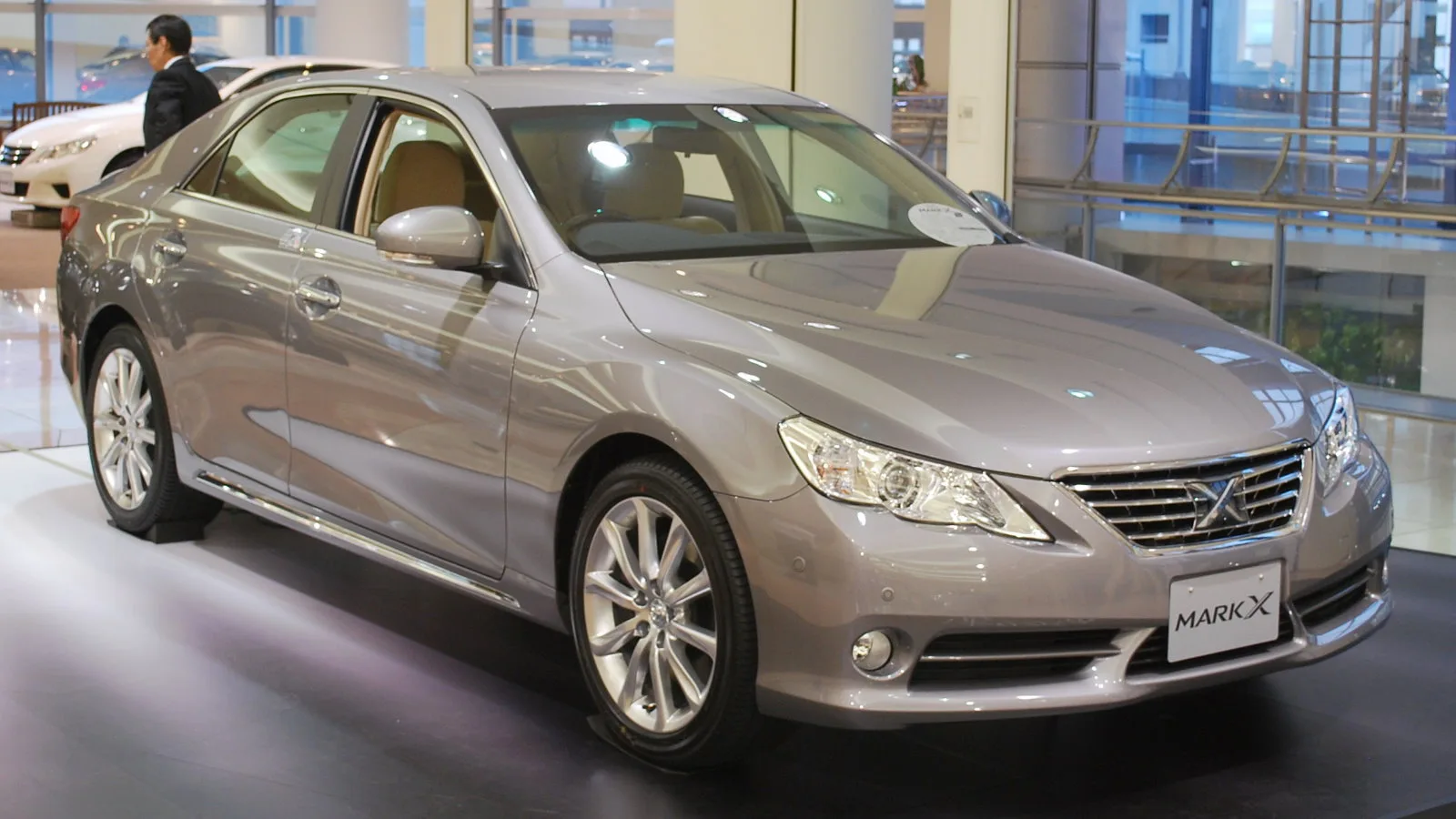
Toyota revealed the Mark X in 2004 to take over from the Mark II. It repeated the Verossa's idea of one car doing the work of three, but with V6 engines in place of the sixes in line. The name is spoken as Mark Ex, not Mark Ten, while the older car remained Mark Two. The name was chosen because this was the tenth generation of the car, and the X also echoed the first dedicated Mark II platform of 1972.
A rear-drive saloon that carried the Mark II name for half a century and ended with a Final Edition in 2019.
Why did Toyota sell it the way it did?
At home the Mark X was positioned as the rear-drive alternative to the front-drive Camry, for buyers who liked that car's size but wanted power sent to the back wheels. The line-up also bent to Japanese tax rules. Several engine sizes were offered so that owners could pick the annual road tax band they wanted to pay, and the larger engines brought longer lists of standard equipment and luxury features.
Both generations were built at the Motomachi plant. Abroad, the car took other shapes. In China it became the Reiz, built by Tianjin FAW Toyota. Indonesia imported a small batch between 2012 and 2013 with the aim of replacing Australian-built Camrys as premium taxis, but the plan was scrapped and the cars already shipped were sold to private buyers instead.
How was the first-generation X120 engineered?
The X120 was not built on a modified Supra A-series chassis. Instead it used the S-series platform that sits under the Crown and the Lexus GS. The bigger change was under the bonnet. The JZ and G inline-sixes of the Verossa were dropped in favour of the new GR family: a 2.5-litre (2,497 cc) 4GR-FSE rated at 158 kW (215 PS; 212 hp) and a 3.0-litre (2,995 cc) 3GR-FSE at 188 kW (256 PS; 252 hp).
Both engines combined Dual VVT-i with D-4 direct injection. Rear-drive cars used a six-speed torque converter automatic, and iFour four-wheel-drive cars made do with a five-speed. There was never a manual option. Toyota restricted sales to Toyopet Store locations, which lifted the car's standing, and the Celsior that had been the range-topper at those stores now wore Lexus LS badges and was sold only through Lexus dealers in Japan.
Small details gave the car character. The rear bumper carried an integrated exhaust outlet, the first in its class, and Toyota later moved the idea to the Lexus LS and the Crown. An LED lighting system ran from front to rear along the headliner, then reached into the footwells, the doors, around the gear lever and the key position, with patterns and brightness that the driver could change for different situations.
What changed in 2006 and 2007?
A minor update in 2006 moved the indicators from the wings to the mirrors, reworked the headlamps and taillamps and gave the grille a new shape. Cars with the black interior lost their wood trim and gained brushed aluminium. The same update formalised the S package, which added a three-spoke steering wheel and altered the lower lip of the bumper. A year later, Japanese cars could be ordered with G-BOOK, a subscription telematics service. Production at the former Kanto Auto Works ran from November 2004 to September 2006.
What were the special first-generation versions?
The Mark X Supercharged took the 3GR-FSE and added a blower, then sent the power through a six-speed automatic. It was rated at 235 kW (315 hp; 320 PS) at 6,200 rpm, with 412 N-m (304 lb-ft) at 3,200 rpm. It was the closest the first generation came to a performance saloon.
The 50th Anniversary Limited Edition wore the Vertiga kit, which supplied chrome ducts and carbon fibre splitters, plus a different suspension tune. In China, the Reiz began production on 24 October 2005 at Tianjin FAW Toyota's plant. It was sold as the 2.5 S, 2.5 V and 3.0 V Premium, with a 2.5-litre 5GR-FE or a 3.0-litre 3GR-FE.
What about the wagon that bridged the gap?
One relative of the Mark X sits awkwardly between eras. The Mark II Blit station wagon went on sale in January 2002, fifteen months after the X110 Mark II saloon, and it brought back the rear-drive layout, with optional all-wheel drive, after the front-drive Mark II Qualis. The name came from the German word for lightning. It sold only through Toyopet Store dealers, apart from a couple of outlets in Tokyo and Osaka, and it kept the inline-six engines that the Mark X would abandon: a 2.0-litre 1G-FE, a 2.5-litre direct-injected 1JZ-FSE, a 2.5-litre 1JZ-GE and a single-turbo 2.5-litre 1JZ-GTE.
Most of these were paired with a four-speed automatic, with the FSE alone getting five speeds. A Torsen limited-slip differential was optional on all but the 2.0-litre rear-drive car. A facelift in December 2004 added LED lamp units, and the turbocharged engine was dropped in May 2006 because of Japan's 2005 emission rules.
The tuner side was busy too. Modellista offered a Fortuna package: an aero front bumper, a new grille, 18-inch alloys and sport springs that dropped the car by 15 mm (1 in). Separately, the 2.5iR-V could be had with a Fortuna Yamaha Power pack. A bigger turbocharger and a stainless steel silencer lifted output to 300 PS (221 kW; 296 hp) and 389 N-m (287 lb-ft). Toyota discontinued the Blit in June 2007, ending the Mark II name after 39 years, and a front-drive minivan took over the job.
What did the second-generation X130 bring?
The X130 was released on 19 October 2009, with the Chinese Reiz following in September 2010. The engine choice narrowed to two V6s: a 2.5-litre 4GR-FSE with 149 kW (200 hp; 203 PS) and a 3.5-litre (3,456 cc) 2GR-FSE with 234 kW (314 hp; 318 PS). Buyers chose between Standard, Premium and Sports models.
Compared with the first generation, the exhaust diffuser disappeared from the rear bumper, All-Trac four-wheel-drive cars received a six-speed automatic, and the boot lid went back to conventional hinges rather than lift supports. Toyota facelifted the car twice, in 2012 and 2016. The second update added spot welds to stiffen the body and made Toyota Safety Sense standard. That package bundled radar cruise control with automatic high beams, a lane departure alert and emergency braking that works without driver input.
How did the Standard, Premium and Sports trims differ?
The Standard was the entry point and took only the 2.5-litre engine. Rear-drive versions were the 250G, the 250G F Package and the Relax Selection, with the 250G Four and a four-wheel-drive F Package completing the list. The interior was ivory and black, with wood-grain panels as an option. The base F Package went without steering-wheel switches and door courtesy lamps and rode on 16-inch steel wheels with covers, while the 250G and Relax Selection moved up to 16-inch alloys, smart entry and push-button start.
The Premium and Premium L Package began as 3.5-litre cars. They set themselves apart with a plated grille, specific side skirts and their own front bumper. Inside, Alcantara seats were standard and leather was an option. The equipment list included millimetre-wave radar cruise control, a pre-crash system that could apply the brakes, super UV-cut glass, a nanoE ventilation system, a retractable rear sunshade and a self-parking system. Seats were a power eight-way for the driver and four-way for the passenger, with heating and cooling, and adaptive variable suspension could be adjusted from inside the cabin. After the facelift, the Premium was offered with the 2.5-litre engine too.
The Sports models were the 250S, 250RDS, 350S and 350RDS, built to replace the Tourer V. A boot spoiler, rear diffuser and new bumpers tidied the airflow, and smoked lamps marked them out. The 350S came with 18x8J aluminium wheels on 235/45R18 tyres, front discs of 334 mm (13.1 in) and four-piston monobloc calipers from ADVICS. Variable gear ratio steering, part of the Vehicle Dynamics Integrated Management system, changed how much the wheels turned for a given input, which eased parking and kept the car calm at speed. Paddle shifters and aluminium pedals were standard, and the tilt-away steering wheel that lifts when the ignition goes off was fitted only to the 3.5-litre cars.
Which limited versions mattered most?
Hong Kong and Macau received the Sports Plus, essentially the Sports with the 2.5-litre engine plus spoilers, fog lamps, paddle shifters, electronically controlled suspension, leather and heated front seats. Japan alone got the Yellow Label in September 2014, based on the 250G, 250G Four or 250G S Package. Its special Awaken Yellow paint sat alongside white, silver and black, and the cabin used black and yellow seats and door trims with stainless scuff plates carrying yellow lettering.
Modellista repeated its earlier trick with the 3.5-litre 2GR-FSE, fitting a supercharger and selling the result as the Mark X +M Super Charger. The supercharged engine gave 265 kW (355 hp; 360 PS) and 498 N-m (367 lb-ft) of torque. The company also built the Vertiga, a version without the blower.
The G's, renamed GR Sport in 2016, was based on the 250S or 350S. It looked different, with a three-piece bodykit, a boot spoiler, clear smoked taillamps and forged 19x8J wheels. Ventilated discs measured 356 mm (14.0 in) at the front and 310 mm (12.2 in) at the back, with four-piston calipers, and the suspension was upgraded. Inside were red-stitched leather, a carbon-style centre console and Alcantara front seats.
What made the GRMN special?
The GRMN was the hot one. Gazoo Racing tuned it with the input of the Meister of the Nurburgring, using the 3.5-litre car as the base, and only 100 were built in 2015 and 350 in 2019. A carbon-fibre roof cut about 10 kg (22 lb), and the car sat on 19-inch BBS wheels with sports seats and steering wheel, piano black trim and ultrasuede upholstery with red stitching.
The 2015 car made 236 kW (321 PS; 316 hp) and came with a six-speed manual and a Torsen limited-slip differential, a gearbox no earlier Mark X had offered. Stiffer suspension, stronger brakes, tuned dampers and electric power steering joined 252 extra spot welds in the chassis. The 2019 re-release was a little different. Output was 234 kW (318 PS; 314 hp) at 6,400 rpm, it shared bumper designs with the GR Sport, and the carbon roof became an option rather than a fixture.
What happened in China and in the MPV spin-off?
The second-generation Reiz launched in September 2010 with a choice of two V6 engines, and it was facelifted in 2013. Production stopped on 27 September 2017, with 528,188 units made since 2004.
Toyota also reused the badge on a very different car. The Mark X ZiO, released on 26 September 2007 to replace the Blit, was a front-drive MPV from the same platform family as the Auris, the RAV4 and the Prius. It was sold only in Japan until 2013. Its name stood for Zones in One, and the cabin could seat from four to seven people in three modes. Power came from a 2.4-litre 2AZ-FE with 120 kW (161 hp; 163 PS) and a CVT, or a 3.5-litre 2GR-FE V6 with 206 kW (276 hp; 280 PS) and a six-speed automatic, and four-wheel drive was offered only on the 2.4. It won a Good Design Award in its first year, and about 51,000 had been built by 2012.
How did the Mark X end?
Demand in Japan had moved towards SUVs and crossovers, and that sealed the saloon's fate. Production stopped on 23 December 2019. Toyota marked the finish with the Mark X 250S Final Edition, which had 18-inch aluminium wheels, dark chrome trim on the front bumper and a red and black cabin finished in Alcantara and leather. It closed the line that had begun 51 years earlier.
Toyota Mark X specifications at a glance
| Feature | First generation (X120, 2004) | Second generation (X130, 2009) |
|---|---|---|
| Engines | 2.5 L 4GR-FSE (158 kW; 215 PS; 212 hp); 3.0 L 3GR-FSE (188 kW; 256 PS; 252 hp) | 2.5 L 4GR-FSE V6 (149 kW; 200 hp; 203 PS); 3.5 L 2GR-FSE V6 (234 kW; 314 hp; 318 PS) |
| Transmission | Six-speed automatic (rear drive); five-speed automatic (iFour); no manual | Six-speed automatic; six-speed manual on the 2015 GRMN |
| Supercharged version | 235 kW (315 hp; 320 PS) 3GR-FSE | 265 kW (355 hp; 360 PS) Modellista +M |
| Drive layout | Rear-wheel drive; iFour four-wheel drive | Rear-wheel drive; All-Trac four-wheel drive |
| Trims | Base and S package (from 2006) | Standard, Premium, Sports; G's (GR Sport from 2016); GRMN |
| Facelifts | 2006 | 2012 and 2016 |
| China | Reiz from 24 October 2005: 5GR-FE 2.5 L, 3GR-FE 3.0 L | Reiz from September 2010; facelift 2013; ended 27 September 2017 |
| Production | November 2004 to September 2006 at Kanto Auto Works | From 19 October 2009; Japan production ended 23 December 2019 |