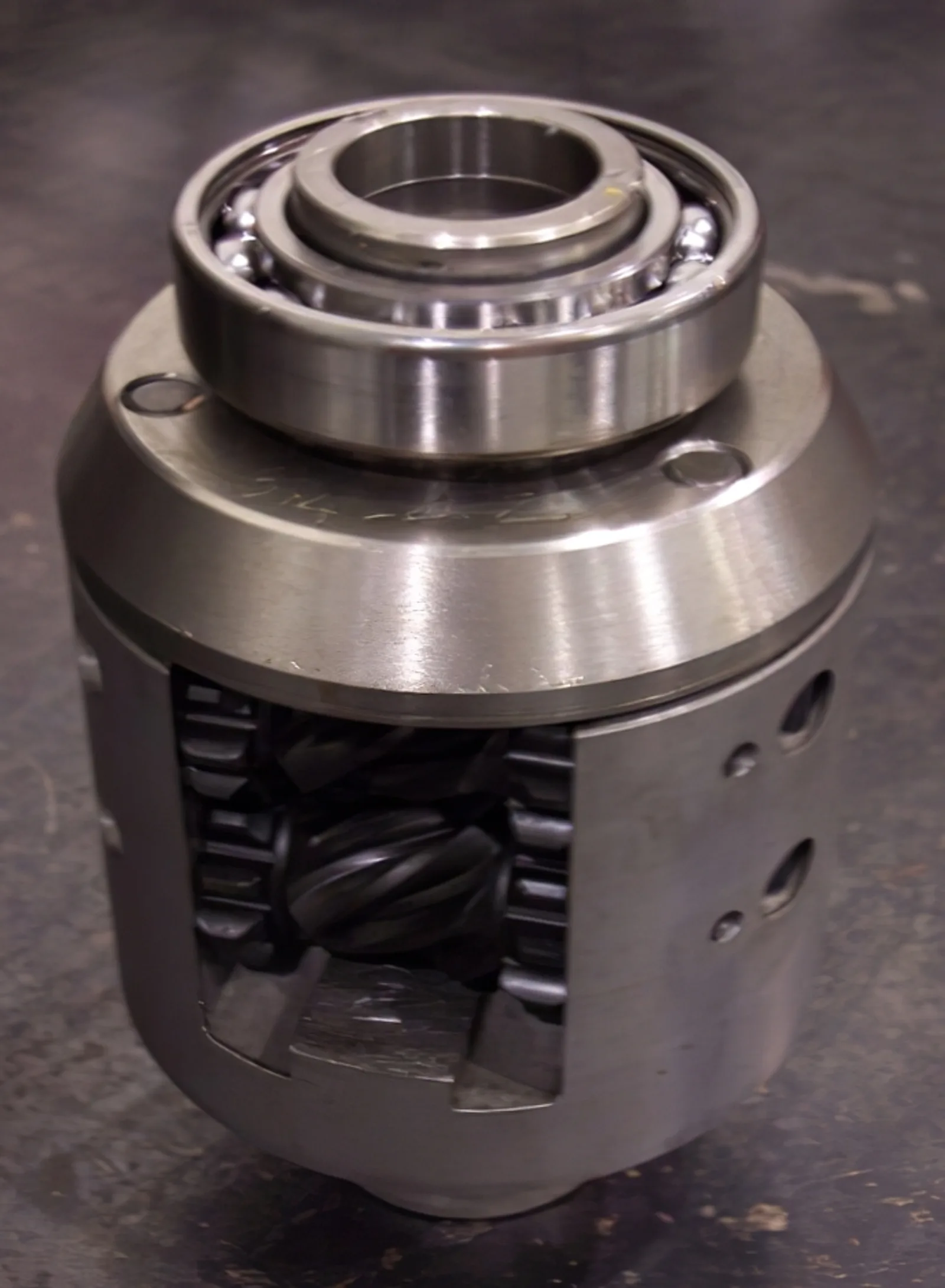
From a 1958 patent to Audi quattro, Toyota Land Cruisers and the Humvee, how the Torsen differential uses gear friction to send more torque to the wheel with grip.
A Torsen differential is a torque-sensing limited-slip differential that uses internal gears to bias torque toward the wheel with grip. Invented by Vernon Gleasman, it appears in Audi quattro cars, Toyota off-roaders and the Humvee, and its T-3 variant is a planetary design.
A Torsen differential is a limited-slip type of differential used in automobiles. It behaves like an ordinary differential most of the time, but it locks up when one wheel loses grip, so that torque flows to the wheel that still has traction. Its name is a portmanteau of Torque-Sensing, and the design has been fitted to all-wheel-drive cars, off-roaders and high-performance models for decades.
Who invented the Torsen differential?
The Torsen was invented by the American engineer Vernon Gleasman and manufactured by the Gleason Corporation. The trademarks are now held by JTEKT Torsen North America, which was formerly known as Zexel Corporation and earlier as Gleason Power Systems. Every Torsen design traces back to the Dual-Drive Differential that Gleasman invented and patented in 1958.
Gleasman's first design solved a problem that open differentials could not handle well. An open differential splits torque evenly, so a wheel that loses grip can spin up while the car stays put. A Torsen solves that by using internal gear friction to bias the torque toward the wheel with traction.
A gear-based differential that reads torque imbalance and hands power to the wheel that still has grip.
Where are Torsen differentials fitted?
A Torsen can be used in three positions on a motor vehicle. A centre unit apportions torque between the front and rear axles of an all-wheel-drive car. A rear unit distributes torque between the left and right rear wheels, in either rear-wheel drive or four-wheel drive. A front unit does the same job for the front wheels in front-wheel or four-wheel-drive layouts. A four-wheel-drive vehicle may use one, two or three Torsens, depending on its design.
What are the different Torsen types?
As of 2008 there were three generations of Torsen differential, labelled by type. The original T-1, known as Type A, uses crossed-axis helical gears to limit the torque split. Type I, the version of the T-1 layout, can be designed for higher torque bias ratios than Type II, but it tends to have more backlash and a greater risk of noise, vibration and harshness, and it needs a precise setup at installation.
The T-2, or Type B, reaches a similar effect with a parallel gear arrangement. A specialist version called the T-2R, or RaceMaster, is the only Torsen with a preload clutch. The most recent design, the T-3 or Type C, is a planetary type, which means its nominal torque split is not 50:50. The twin C unit combines front and centre differentials in a single housing.
| Type | Gear arrangement | Notable feature |
|---|---|---|
| T-1 (Type A) | Crossed-axis helical gears | Original design, limits torque split |
| Type I | Helical gears, a T-1 layout | Higher torque bias possible, more noise risk |
| T-2 (Type B) | Parallel gears | Similar effect to the T-1 with a different layout |
| T-2R RaceMaster | Parallel gears | Only Torsen with a preload clutch |
| T-3 (Type C) | Planetary | Uneven nominal torque split, single or twin |
How does a Torsen behave under load?
A Torsen works like a conventional differential, but it can lock up when a torque imbalance occurs. The largest imbalance it can carry is set by the torque bias ratio, or TBR. With a 3:1 TBR, one side of the differential can handle three quarters of the applied torque while the other side handles one quarter. During acceleration on uneven grip, no relative wheelspin occurs as long as the high-traction side can carry the higher torque.
When the traction difference exceeds the TBR, the slower output receives the tractive torque of the faster wheel multiplied by the bias ratio. Any extra torque beyond that contributes to accelerating the faster side. The bias ratio should not be confused with the uneven torque split of the planetary T-3, which allows a centre differential to share torque unevenly between the front and rear axles in normal driving without winding up the drivetrain.
How does a Torsen help in corners?
In a turn the outer wheel covers more ground than the inner wheel. Friction inside the differential opposes that difference, slowing the faster side and speeding the slower inner side. The torque distribution becomes asymmetric in line with the TBR. Cornering in this way can increase the outer tyre's cornering power, provided the inner wheel is not overpowered.
A Torsen always gives more torque to the slower-moving wheel. That matters when a wheel leaves the ground, because an ordinary Torsen would then act like an open differential and send nothing to the grounded wheel. The parking brake trick can help. If the parking brake applies even drag to each side, the drag on the airborne side is multiplied through the differential, and the grounded side receives the bias ratio times that drag torque, minus the drag itself. That can be enough to restore motion in either direction.
Which vehicles use Torsen differentials?
Torsen differentials appear across many Audi quattro models, although the A3, S3 and TT, which use transversely mounted engines and Haldex four-wheel-drive systems, are exceptions. The T-3 is the centre differential in Audi A6, A7 and Q7 models with a ZF-sourced automatic gearbox, while Audi uses a mechanical crown wheel centre differential on some dual-clutch longitudinal cars.
Other users range widely. The Toyota Supra, Soarer and Altezza, the Mazda MX-5 Miata, the Honda S2000 and the Nissan Silvia S15 all used Torsen units at some point, and the Lancia Delta Integrale and Peugeot 405 T16 had them too. Rover Group preferred Torsens for its turbocharged front-drive models, arguing that a mechanical unit controls wheelspin better than electronic systems that cut engine power. The Humvee uses front and rear Torsens together with a lockable centre differential.
Later examples include the Toyota GT86 and its Subaru BRZ twin, both released in 2012, which used a Torsen limited-slip differential. Ford fitted Torsens to its Ranger FX4 in 2002, to the F-150 SVT Raptor from 2012 and to the Mustang Boss 302. Mercedes-Benz's performance arm AMG offered Torsen differentials as an option from 1988 for older Mercedes models as well.
Which cars use Torsens on the front axle?
Front-axle Torsens appear mainly in performance front-drive cars, where they help the front wheels deliver power through corners. Honda, Ford, Subaru, Nissan, Renault and Peugeot have all used them in hot hatchbacks and sporting models.
Honda's Civic Si has used a front Torsen since 2006, and the Accord Type R and Integra Type R carry the same layout. Subaru fitted one to the Impreza STI from 2005, while the Ford Focus RS, the Renault Megane RS and the Peugeot 208 GTI and 308 GTI by Peugeot Sport all use front units. Earlier, Rover fitted Torsens to its turbocharged front-drive range.
Rear-axle applications are more numerous. Dodge and Ram heavy-duty pickups with the 11.5 AAM rear axle have used one since 2003, and the Mazda Miata offered a rear Torsen as an option on manual models from 1994 to 2005. The Nissan Skyline R34 GTT and later Lexus performance models have also used rear units.
The design changed during production. The Toyota Altezza, sold as the Lexus IS200 and IS300, came with a Torsen on all manual IS300 models and the IS200 Sport, and it was optional with automatic transmission. The Mazda Miata moved from Type I to Type II in late 1995, which shows how the unit evolved over the life of one model.