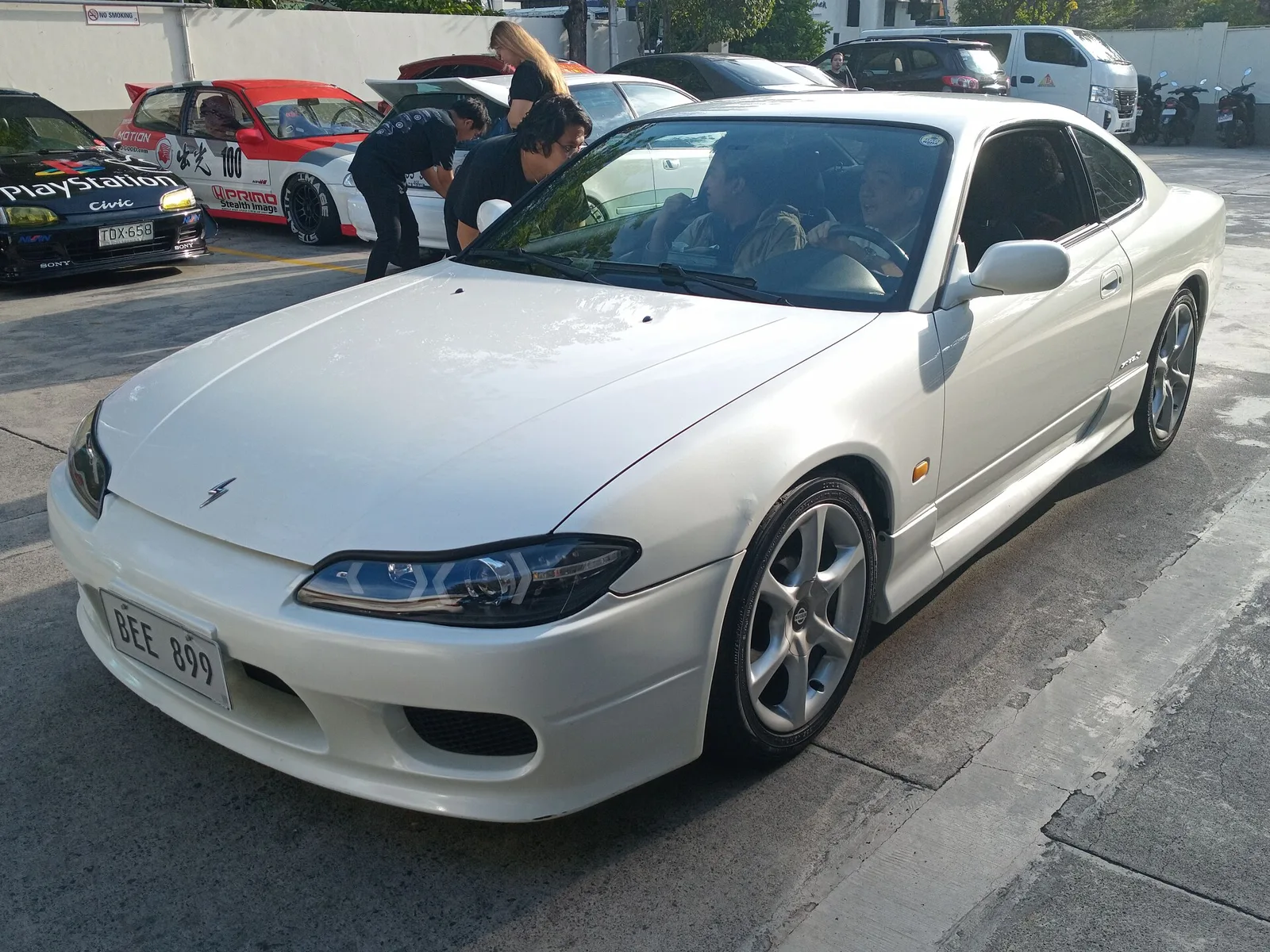
A hand-built 1964 Datsun coupe that became a turbocharged rally, touring and drift icon before the S15 closed the line in 2002.
Sold abroad as the 200SX or 240SX, the Silvia ran from the 1964 CSP311 coupe to the S15 that closed the line in 2002. Its best-known versions include the turbocharged S13 to S15 cars, the 240RS rally car and the Spec-R.
The Nissan Silvia is a family of small sports cars that Nissan built across several generations. Export cars were sold as the 200SX or 240SX, and some markets used the Datsun badge. The name stayed in production until the S15 generation closed the line in 2002.
The Silvia began as a hand-built coupe in 1964, became a mass-produced rear-drive platform in the 1970s and 1980s, and finished as a turbocharged, track-focused car in the late 1990s. Its compact bodies and wide range of engines made it a favourite with tuners, rally crews and drivers who wanted a cheap way into serious performance.
Where did the first Silvia come from?
The first Silvia, the CSP311, was shown at the 1964 Tokyo Motor Show as the Datsun Coupe 1500. It was a hand-built coupe based on the Fairlady platform, and only 554 were produced in total, most of them in 1965 before production stopped in 1968.
Albrecht Goertz, a consultant who had created the BMW 507, saw promise in Japanese sports car makers in 1962. Yamaha already had a working relationship with Nissan, and a joint sports car project was later cancelled. Fragments of that work fed into the Silvia once Goertz's partnership with Nissan ended in 1964.
The CSP311 was powered by a 96 PS 1.6-litre Nissan R series engine with twin SU carburettors. Because nearly every car was made by hand, numbers stayed small. Forty-nine examples went to Australia, ten went to other countries, and four were built with left-hand drive for European shows.
In December 1965 Nissan gave the Tokyo Metropolitan Police two CSP311s for highway patrol. The engines stayed standard, but the car's top speed of 165 km/h (103 mph) and its disc brakes made it the first Japanese high-performance patrol car.
A rear-drive coupe that grew from a hand-built 1964 prototype into a turbo icon of rallying, drifting and tuning.
What made the S10 Silvia different?
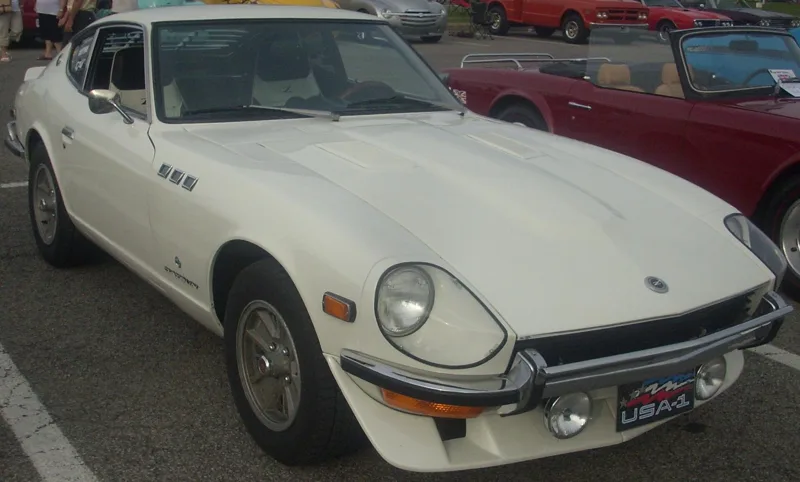
The S10 was the first mass-produced Silvia, built on Nissan's new S platform as a compact, rear-wheel-drive sports car. In Japan it was sold through Nissan Prince Store dealers, and in export markets it appeared as the Datsun 180SX, while the United States received the 200SX name because of its bigger engine.
Its styling was less traditional than rivals such as the Toyota Celica and the Mazda Capella coupe, and it shared a common look with the larger Skyline. The car was based on the Datsun Sunny Coupe. Nissan first intended to fit a Wankel rotary engine, but that plan was dropped after the oil crises of the 1970s.
The Japanese S10, officially the New Silvia, used a 1.8-litre L18S straight four rated at 105 PS (77 kW) at 6,000 rpm. Depending on whether it had a four-speed manual, five-speed manual or three-speed automatic, top speeds ranged from 165 to 175 km/h (103 to 109 mph). The 1976 update brought tighter emissions equipment and the S11 name.
The export 200SX arrived in North America in 1976 with the 2.0-litre L20B engine and the mandated 5 mph (8.0 km/h) bumpers. Its launch price of US$4,399 was cheap for the time, although many buyers chose the Celica instead. Paul Newman built and raced a 1977 car in the 1978 IMSA Class C, where it won 19 of 22 races.
How did the S110 change the Silvia?
The S110 generation had sharper-edged styling that it shared with the new Nissan Leopard. It came as a two-door hardtop coupe and a three-door hatchback, and it was originally designed to use a rotary engine before Nissan switched to conventional Z-series engines of its own design.
In Japan the hatchback was sold as the Gazelle at Nissan Store locations alongside the Fairlady Z, while the coupe stayed with the Skyline at Prince Store dealers. The turbocharged Z18ET was only offered in Japan after a facelift in late May 1981, when the DOHC FJ20 RS model also arrived.
The 135 PS turbo model used the same chassis as the regular cars and had no boost gauge. From 1981 the North American 200SX used the twin-plug Z20 engine, and in 1982 it gained the 2.2-litre Z22E with a sturdier rear axle.
What was the 240RS rally car?
The 240RS, codenamed BS110, was a homologation coupe fitted with a 2.4-litre DOHC FJ24 engine. About 200 road cars were built between 1983 and 1985, and it became Nissan's official World Rally Championship car for those three seasons, but it never won a WRC event.
Around 150 of the road cars were left-hand drive and 50 were right-hand drive. About 30 of the cars went into the WRC and national rally championships. Timo Salonen, Shekhar Mehta and Mike Kirkland drove the car, which achieved few podiums and could not match the Group B machinery of Audi, Lancia, Peugeot and Toyota.
Nissan also homologated a Silvia-based car as the Datsun Violet GTS in 1982. Its best result came at the 1982 Rally New Zealand, where Salonen finished fourth in a car that used the twin-cam LZ20B engine.
How was the S12 Silvia built?
The S12 was produced from August 1983 to 1989, with pop-up headlights and two body styles, a coupe often called a notchback and a hatchback. A mild facelift in 1986 brought revised trim, and the S12 was sold in Japan, North America, Europe and Australia under different badges and with different engines.
In North America the S12 was sold as the 200SX from February 1984, with the 2.0-litre CA20E in the XE coupe and the 1.8-litre turbo CA18ET in the hatchback. For 1987 the SE model took a 3.0-litre VG30E V6 rated at 160 hp, and Nissan scheduled only 5,000 units of each trim and engine option for its final two years in the US.
Japanese cars were badged as Silvia at Prince dealers or Gazelle at Nissan Store locations. The RS-X in Japan used the turbocharged FJ20ET, and the CA18DET replaced the FJ engine in 1987. In Europe the S12 was a hatchback only, and Sweden sold it as the 180ZX.
What changed with the S13 Silvia?
The S13 arrived in May 1988 as a coupe, with the 180SX hatchback as its sister model. It was one of the first Nissans to use a multi-link rear suspension, and it introduced HICAS four-wheel steering. It won the 1988 Car of the Year Japan award in its first year on sale.
Early S13 cars used the CA18DE and the intercooled CA18DET. The J's was the base trim, the Q's added electric features and an available limited-slip differential, and the K's took the turbo engine. Trim names came from the face cards of a deck of playing cards.
From January 1991 the SR20DE and SR20DET engines brought improved power and torque. The Autech convertible built 603 cars in 1988. All 600 publicly sold cars were K's models with the CA18DET turbo and a four-speed automatic, and the price of 3.25 million yen kept demand low.
What did the S14 and S15 generations bring?
The S14 debuted in October 1993 as a lower and wider coupe, and the S15 arrived in January 1999 with a smaller body designed to stay within Japan's compact class. The S14 K's made 220 PS, while the S15 Spec-R made 250 PS from the turbocharged SR20DET with a helical limited-slip differential.
The S14 was sold in North America as the second-generation 240SX from 1995 to 1998, with the non-turbo KA24DE engine. The Nismo 270R was a limited edition built in 1994 to mark ten years of Nismo, and only 50 were made with a vented hood, front-mounted intercooler and Nismo aero kit.
The S15 Spec-S used the naturally aspirated SR20DE with a five-speed manual. The Spec-R added a six-speed manual, larger brake booster and chassis bracing. A retractable hardtop called the Varietta was built by Autech on the Spec-S, and only 1143 were produced.
How did the Silvia perform in motorsport?
Silvia-based cars have competed in rallying, touring car racing, All-Japan GT and drifting. The S14 and S15 each won the GT300 class championship in the All-Japan GT series, in 1997 and 2001 respectively, and the S chassis remains one of the most successful drift platforms.
In rallying the 200SX SE V6 replaced the 240RS from 1986 to 1989. It was chosen because Nissan could sell the 5,000 cars needed for homologation, and its best result was a first place at the 1988 Rallye Cote d'Ivoire. It also finished second at the Safari Rally in 1988 and 1989.
Mark Skaife won the 1987 Australian 2.0 Litre Touring Car Championship in a Nissan Gazelle, and the S12 competed in the Japan Supersports Series throughout the 1980s, where many of the top tuners got their start. The JSS cars were heavily tuned machines from the era.
In drifting, the S chassis is one of the most popular platforms. The S15 has won 11 D1 Grand Prix championships with eight different drivers. Under Suzuki's S15 has also held the Tsukuba lap record, a time quicker than an official JGTC race car.
Is the Silvia coming back?
Nissan has signalled a return. In a September 2024 interview with Australian Drive magazine, Nissan's vice-president of global product strategy, Ivan Espinosa, confirmed a third sports car slotted below the Z and GT-R that would revive the Silvia name.
It is not yet clear whether the new model will be fully electric or use a hybrid system. The project was still in its infancy at the time, and no product had been confirmed, so buyers should treat the revival as a plan rather than a launch date.
What are the Nissan Silvia specifications?
| Generation | Engine | Output | Notes |
|---|---|---|---|
| CSP311 (1964) | 1.6-litre Nissan R series, twin SU carburettors | 96 PS (71 kW) | 554 built, mainly in 1965 |
| S10 and S11 | 1.8-litre L18S inline four | 105 PS (77 kW) at 6,000 rpm | Over 145,000 built until 1979 |
| S10 (US 200SX) | 2.0-litre L20B inline four | Larger engine than Japan | Sold from 1976 at US$4,399 MSRP |
| S12 (1983 to 1989) | CA18DET turbo, CA20E, VG30E V6 in the SE | VG30E 160 hp in the US | Mid-life revision in 1986 |
| S13 (1988 to 1993) | CA18DET, then SR20DET from January 1991 | SR20DET and SR20DE, from January 1991 | HICAS four-wheel steering |
| S14 K's | SR20DET with N-VCT | 220 PS (162 kW; 217 hp) at 6000 rpm | 274 Nm (202 lb ft) at 4800 rpm |
| S15 Spec-R | SR20DET turbo | 250 PS (184 kW; 247 bhp) at 6,400 rpm | 275 Nm (203 lb ft) at 4,800 rpm; 6-speed manual |
| S15 Spec-S | SR20DE naturally aspirated | 165 PS (121 kW) | 5-speed manual |
.jpg)