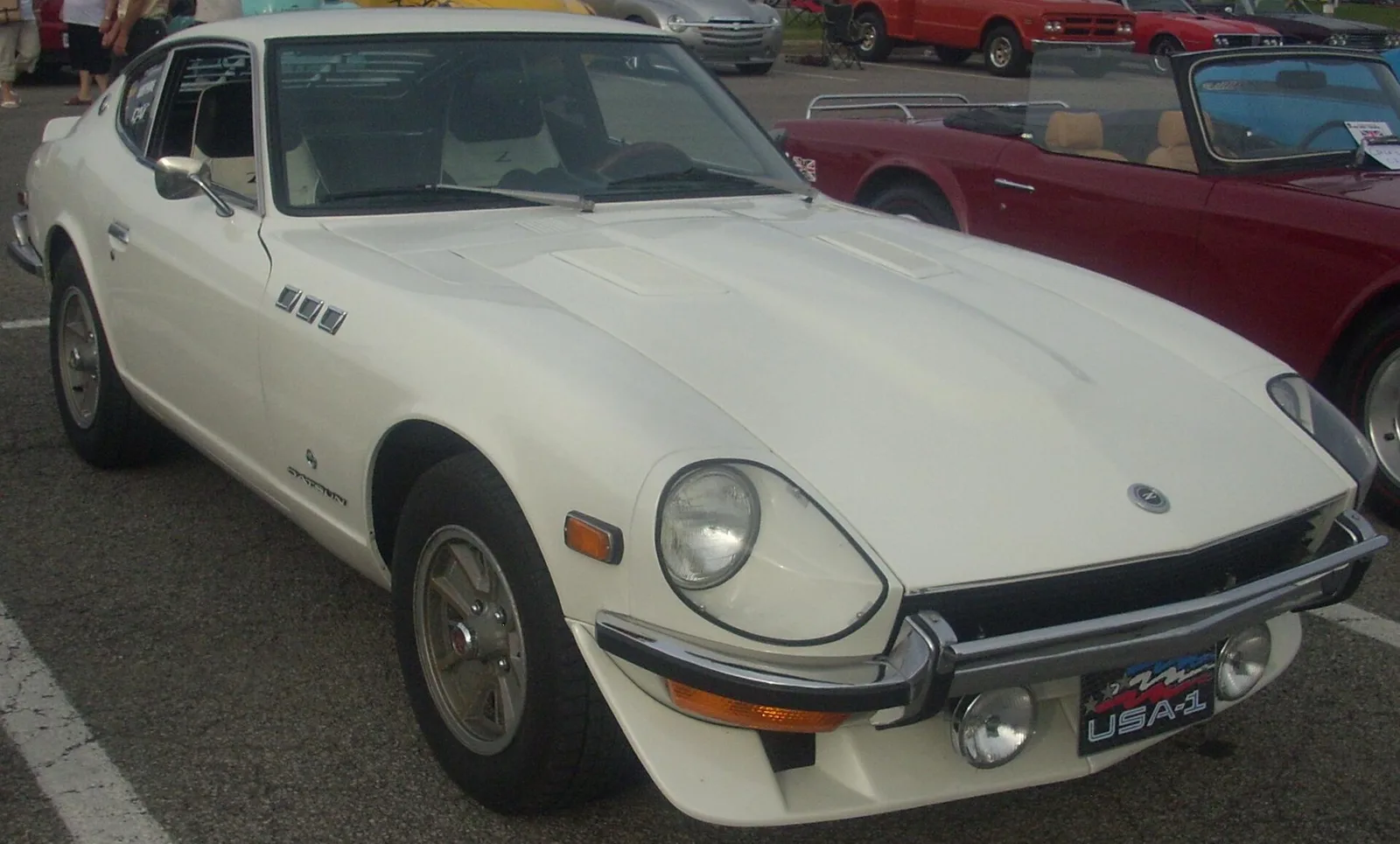
A straight-six, four-wheel independent sports car sold as the Fairlady Z in Japan and the Datsun 240Z abroad, which launched a Z-car family that still runs today.
The Nissan S30 was a sports car built from 1969 to 1978, sold as the Fairlady Z in Japan and the Datsun 240Z abroad. It introduced the Z line, using a straight-six engine and independent suspension at a price well below European rivals.
The Nissan S30 was a two-seat sports car and 2+2 grand tourer that Nissan built from 1969 to 1978. It was sold in Japan as the Fairlady Z and exported as the Datsun 240Z, 260Z and 280Z. It was the first car in the Z series, and it set the template for a sports car family that Nissan still builds.
What was the Nissan S30?
The S30 was a sports car that carried features more usually found on expensive European machines. Its four-wheel independent suspension and overhead camshaft straight-six were the kind of engineering seen on cars such as the Jaguar E-Type and BMW 2800 CS, yet it was priced well below them.
Its styling, engineering and price struck a chord with buyers and the motoring press, and the car quickly generated long waiting lists. It also helped show that Japanese makers could build more than economy cars, a shift that the expanding Datsun dealer network made easier.
A straight-six sports car that sold as Fairlady Z in Japan and Datsun 240Z abroad, and became the template for the Z line.
Who created the S30?
Yutaka Katayama, who ran Nissan's US arm as president, conceived the car. Yoshihiko Matsuo, who led Nissan's sports car styling studio, headed the design team. Katayama, known in the US as Mister K, later introduced the 240Z to the American market.
Matsuo's team led the design work, and the car became the first in Nissan's Z series of sports cars.
How did the S30 compare with rivals?
Rival sports cars such as the Alfa Romeo Spider, MG MGB and Opel GT relied on small four-cylinder units and rear live axles, and they cost a similar amount. The S30 offered six cylinders, independent suspension at all four corners and strong performance at a lower price, which made it stand out.
Early on, the S30 shared showrooms with the smaller four-cylinder Datsun Sports, which left production in 1970. The 240Z is unrelated to the later 240SX, which was sold as the Silvia in Japan.
How did the Fairlady Z start in Japan?
The Fairlady Z arrived in late 1969 as a 1970 model, powered by the L20 2.0-litre single-overhead-camshaft straight-six, rear-wheel drive and a stylish coupe body. Japanese versions made 130 PS JIS (96 kW; 128 hp), and buyers could choose a four- or five-speed manual.
The L20 lost some power in 1973 to meet tighter rules, falling to 125 PS JIS (92 kW; 123 hp). In Japan the Fairlady was sold through Nissan's own dealers, and buyers could also choose the larger L24 engined Fairlady 240Z, although its engine placed it in a higher tax bracket. That car was dropped in 1973 as the fuel crisis hit sales, and the 280Z did not reach the Japanese market until August 1978.
What were the 260Z and 280Z changes?
The export models moved to a larger 2.6-litre engine in 1974, and that left Japanese buyers with only the 2-litre cars. A Fairlady 260Z was planned, but the oil crisis halted it, and the model was sold only in Okinawa, where traffic kept to the right until 1978.
The 280Z reached North America for 1975, with a 2.8-litre engine, a Bosch L-Jetronic fuel injection system and US-specified impact bumpers. Canadian cars were built without the anti-smog kit that the US market required. The S30 series ended in 1978, with the Nissan S130 taking its place for 1979.
How did the engines change across the range?
The S30 grew from a 2.0-litre engine in the early Fairlady to a 2.8-litre fuel-injected unit by 1975. Each step came from a mix of performance demand and tightening emissions rules, which in the US forced lower compression ratios and retuned carburettors.
| Model | Engine | Displacement | Power (SAE gross) | Notes |
|---|---|---|---|---|
| 240Z | L24 straight-six | 2.4 L (2,393 cc) | 113 kW (151 hp) at 5,600 rpm | Four-speed or three-speed automatic |
| 260Z | L26 straight-six | 2.6 L (2,565 cc) | 121 kW (162 hp) at 5,600 rpm | 139 hp SAE net on US cars |
| 280Z | L28 straight-six | 2.8 L (2,753 cc) | 127 kW (170 hp) at 5,600 rpm | Bosch L-Jetronic fuel injection |
What did the 240Z look like on the road?
The 240Z reached the US market in 1970 and used a 2.4-litre L24 with a manual choke. It had a four-speed manual as standard, while a three-speed automatic was offered later. Its top speed was 125 mph (201 km/h), and it took 8.0 seconds to reach 60 mph.
Cars built until mid-1971 wore a chrome badge on the sail pillar, and their rear hatch carried two horizontal vents. From mid-1971 the badge was replaced with a simple Z in a circular emblem, and the hatch vents were removed after complaints that exhaust fumes were drawn into the cabin.
Did the 240Z win rallies?
Yes, though not in the way the factory might have hoped. In 1973 Shekhar Mehta took a 240Z to victory in the 21st East African Safari Rally. The car was also a strong performer in US club racing, where it built much of its reputation.
The Z and the Datsun 510 are credited with helping to kick-start America's performance parts trade for Japanese imports. The company also supported Bob Bondurant's driving school from the outset.
What was the Fairlady ZG?
Japan alone got the Fairlady ZG, model HS30-H, which arrived in October 1971 so that the 240Z could be homologated for Group 4 competition. Changes included a longer fibreglass aero-dyna nose, broader wings bolted onto the body, a rear spoiler, plastic headlamp covers and mirrors mounted on the fenders. Better airflow took its top speed to 210 km/h (130 mph), a margin of 5 km/h over the standard 240Z.
Paint came in red, white or maroon, each carrying the Grand Prix name. It was never sold outside Japan, but Nissan offered the nose as a dealer option in the US so that cars could compete there. Those cars are often referred to as 240ZGs, thanks to the G-nose.
What was the Z432?
The Z432 was a special Japan-only model with the twin-cam 2.0-litre S20 straight-six from the Skyline GT-R. Its name refers to four valves per cylinder, three Mikuni carburettors and two camshafts. Output was 160 PS JIS (118 kW; 158 hp), and the model code was PS30.
Approximately 420 Z432s were built, and some were used by the Japanese police. The lighter Z432R was a homologation special with thinner steel panels, a fibreglass bonnet and acrylic glazing except for the windscreen. It weighed 100 kg (220 lb) less than the Z432 and had no heater, radio or sound deadening.
Only a small number, believed to be below 50, were built, and all were painted orange. An auction in Japan in January 2020 saw a 1970 Z432R change hands for a record A$1.17 million, roughly US$837,000.
How did the Z sell in America?
The 240Z reached American buyers in 1970 with a relatively low price and performance that impressed the press, and its reception made it an important early import.
In 2004 Sports Car International ranked the 240Z second among the 1970s' best sports cars. That recognition has helped keep the early cars in demand among collectors.
What were the special editions of the late 1970s?
In 1977 and 1978 Datsun offered two special editions of the 280Z. The Zap edition, sold in 1977 as a special decor package, came in sunshine yellow with black stripes and chevrons. Around 1,000 Zap Z cars were offered, and the Zap Z led the field as pace car at Long Beach in 1977.
The Black Pearl edition followed in 1978, in pearlescent black with a special appearance package of dual racing mirrors, rear window louvres and red and silver striping. Estimates put the number built at between 750 and 1,500, and the exact figure is not known.
How did the Z win SCCA championships?
The Z won widely in SCCA competition through the 1970s. Bob Sharp Racing of Wilton, Connecticut, fielded cars driven by Bob Sharp, then Elliot Forbes-Robinson, and in time Paul Newman. Brock Racing Enterprises, operating out of the western US, ran John Morton's #46 240Z to the C Production crown in the SCCA in 1970 and again in 1971.
Don Kearney, based in Florida, also had much success with the Z between 1970 and 1978. Nissan went on to celebrate its 97th SCCA national championship in 2013, when Greg Ira won in an orange 240Z. Ira later set several road course records and was awarded the Kimberly Cup in 2008, and he took the 98th national title for Nissan at Daytona on 27 September 2015.
How did Nissan try to bring the Z back?
From 1997 to 2002 Nissan did not sell the Z outside Japan, although the Fairlady Z (Z32) stayed on sale there until 2000. In 1998 the company tried a programme of buying original 240Zs, restoring them to factory specification and selling them through dealers for $24,000. Demand was low at that price, and fewer than fifty cars were restored and sold.
A concept car shown in 1999 signalled a return to the basics that had made the 240Z a success. As of 2022 the car is simply sold as the Z, and its design draws on the cars that came before it.
What changed on the 260Z?
The 260Z kept the S30 layout but added a stiffer chassis, a rear sway bar and a redesigned dashboard, console, seat trim and door panels. Its climate controls were laid out more sensibly, and cars with air conditioning had the system built into the main control panel.
The chassis rails were redesigned to be larger and to run further back than before. The tail lights were also updated, moving the reversing lamps from the main housing into the back panel.
A 2+2 version was added on a wheelbase 300 mm (11.8 in) longer. It had larger quarter panel windows and a slightly notched roofline, a carpeted transmission tunnel instead of quilted vinyl, and push-out rear side windows for ventilation in the back seat.
US bumpers changed during the 260Z's short run. Early 1974 cars had bumpers close to the 240Z's but slightly larger and set further from the body, while late 1974 cars, often called 1974.5 models, carried the heavier 5 mph (8 km/h) bumpers that the 280Z kept for 1975 and 1976. Their front turn signals moved to the outer edges of the grille.
What did the late 280Z add?
From 1977 the 280Z received bumpers with recessed channels that blended into corrugated black rubber trim. A space saver spare replaced the full-size wheel, which allowed a larger fuel tank but left a raised fiberboard rear deck that cut cargo space.
An optional five-speed manual appeared in late 1976 and stayed on offer for most 1977 and 1978 cars, in addition to the four-speed and the three-speed automatic. Cars with it carried a 5-speed badge on the lower edge of the hatch, and the hubcaps were redesigned to resemble alloy wheels.
What is the S30's legacy?
The S30 set the pattern for the Z line: a long-bonnet sports car with a strong straight-six, a focus on the American market and a range of special editions and racing homologation models. Its success in America and Japan showed that a Japanese sports car could compete with European rivals.
Clubs such as the Classic Z Register keep the cars alive, and the S30's rally and racing history remains an important part of the Nissan story. The Z-car family continues to link the 240Z of 1969 with the car sold today.
.jpg)