Mazda's rotary flagship, from the 110S twin-rotor coupe of 1967 to the triple-turbo Eunos Cosmo, with a 2002 retro concept to close the story.
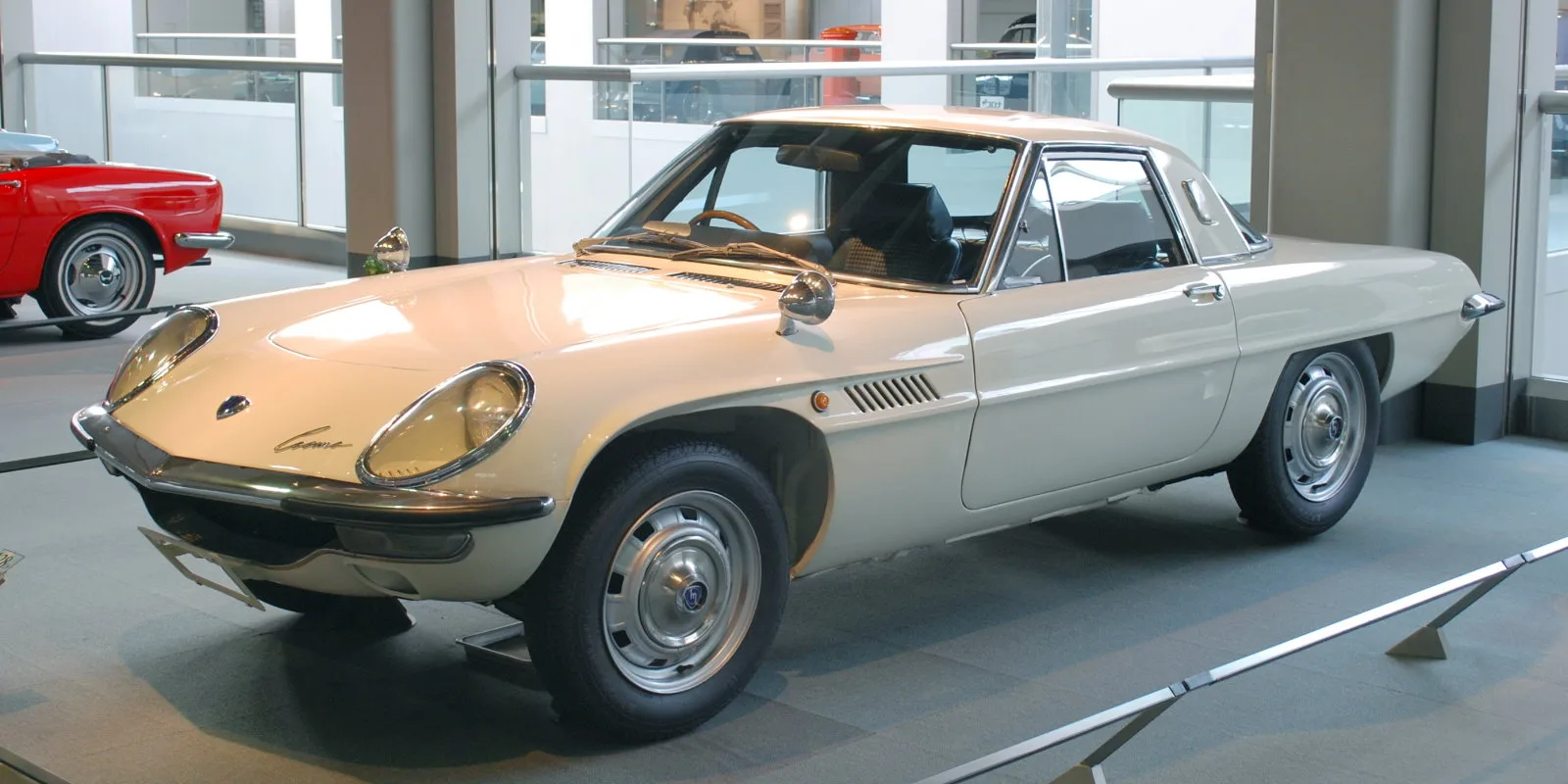
Mazda built the Cosmo from 1967 to 1995 as a showcase for the Wankel engine. The first car was the 110S in export markets, and the 1990 Eunos Cosmo used a triple-rotor engine. The first generation totalled 1,176 cars. Its rotary engines were the core of the car's identity.
The Mazda Cosmo was a coupe that Mazda built from 1967 to 1995 to show off its Wankel rotary engine. Its first car was called the 110S in export markets, while the last generation became Mazda's flagship in Japan under the Eunos Cosmo name, with a triple-rotor engine under the bonnet.
Where did the Mazda Cosmo come from?
Mazda chose the Cosmo name to reflect the fascination with the Space Race that had gripped the world, and the car's new engine was meant to look ahead. The company wanted to present its Wankel engine as forward-looking technology, with an eye on future development.
The first car was one of the first production cars to use a two-rotor Wankel, sharing that honour with the NSU Ro80. A prototype appeared at the 1964 Tokyo Motor Show, a month before the 1964 Summer Olympics.
Through its run the Cosmo acted as a halo vehicle for the brand. The final generation became Mazda's flagship in Japan, sold through the Eunos luxury division.
A rotary halo car that ran for nearly thirty years, from the 110S coupe to the triple-turbo Eunos Cosmo.
What was the first Cosmo?
The first Cosmo, Series L10A and L10B, ran from 1967 to 1972, and it was called the 110S on export models. Full production began in May 1967, and 1,176 cars were built in total, with 343 of them Series I and 833 Series II.
Cosmos were hand-built at roughly one a day. Eighty pre-production cars were made before launch, with 20 going to Mazda's test department and 60 to dealership trials between 1965 and 1966.
The car also appeared in the television show The Return of Ultraman.
Did the Cosmo race?
Yes. In 1968 Mazda entered two mostly stock Cosmos in the Marathon de la Route, an 84-hour race at the Nurburgring in Germany, one of the toughest endurance tests in Europe. The cars faced 58 other entries, and Mazda wanted to prove the reliability of the rotary engine on a demanding circuit.
The 10A engines had a novel intake system, with a butterfly valve that switched from the side port to the peripheral port as revs climbed. Durability was the reason for capping the engines at 130 PS (96 kW).
For most of the race the two cars ran side by side, holding fourth and fifth. One dropped out with axle damage in the 82nd hour, while the other, driven by Belgians, finished fourth overall.
It was the Cosmo's only racing outing. Mazda's next race car was the Familia Rotary, known as the R100.
How did the Series I and II compare?
Series I used a 982 cc two-rotor engine producing about 110 hp, a Hitachi four-barrel carburettor and a four-speed manual. Series II, introduced in July 1968, produced 128 hp (95 kW) with 15-inch wheels and a five-speed manual. Both shared the Wankel concept, so the differences lay mainly in power and equipment.
The Series I car covered the quarter-mile in 16.4 seconds and reached a top speed of 115 mph (185 km/h). Its brakes were 10-inch (254 mm) discs at the front and 7.9-inch (201 mm) drums at the rear, with coil-sprung double wishbones at the front.
Series II stretched its wheelbase by 15 cm, gaining room and ride comfort. It could run over 120 mph (193 km/h) and cover the quarter-mile in 15.8 seconds, with 140 N m (103 lb ft) of torque on tap.
Series I was priced at 1.48 million yen (US$4,100), below the Toyota 2000GT, and Series II cost slightly more in dollar terms at US$4,390.
How many first-generation Cosmos survive?
Only a handful of Series II Cosmos are known to remain. Comedian Jay Leno owned a 1970 example that was featured on a television series in 2006, and a 1970 Series II coupe sold at auction in January 2015 for US$110,000 including premium.
Mazda's US division found another example in a Phoenix-area collection, according to Car and Driver's September 2007 issue, and a further Series II sits in a collection in Alberta, Canada.
Restorers in England were rebuilding a 1970 car in September 2024. The car kept its original 10A Wankel and five-speed gearbox, and its body was stripped to bare metal and refitted with new panels where needed.
What was the CD Cosmo?
The second generation, the CD Cosmo, ran from 1975 to 1981. In Japan it was the Cosmo AP, for anti-pollution, and it sold internationally as the RX-5, while some export markets used the Mazda 121 name for its piston-engined counterpart.
The anti-pollution label came from its ability to meet strict Japanese emissions standards for 1976, thanks to a thermal reactor that kept hydrocarbon levels down.
The CD aimed at the personal luxury market, putting comfort and equipment ahead of outright sportiness. A notchback Landau arrived in early 1977 as the Cosmo L in Japan, with an opera window and a padded vinyl roof.
Japanese buyers responded enthusiastically, with more than 55,000 sold in the first year, a result that helped Mazda recover from serious financial trouble. Rivals included the Toyota Crown, the Nissan Cedric and Gloria, and the Mitsubishi Galant Lambda coupe.
Which engines did the CD Cosmo use?
The CD Cosmo offered 12A and 13B rotary engines and a piston option. The 1800 had a 1769 cc SOHC inline-four whose output was 100 PS (73.5 kW), with 110 lb ft (149 N m) of torque, and a 2000 with 110 PS (81 kW) arrived in March 1977.
The 13B-engined manual could reach 195 km/h (121 mph), which put it at the top of the range, while the piston-engined version sat at the bottom. Mazda saw room for a more powerful piston derivative as rotary sales slowed because of their high fuel use.
The rotary cars kept their engine displacement below 1.5 litres, which mattered for Japan's annual road tax, while still delivering more power than piston engines of the same tax class.
The Cosmo was Mazda's largest rotary-powered coupe, built on the LA series Luce floor pan and mechanics. It was slightly heavier than the Luce, with a five-link rear suspension and rear disc brakes, and the short-lived Roadpacer sedan, powered only by a rotary engine, joined the range.
What was the HB Cosmo?
The third generation HB Cosmo arrived in September 1981 on the HB chassis it shared with the Luce, and it was offered as a coupe, a frameless hardtop sedan and a pillared saloon. Its drag coefficient of 0.32 was the lowest in the world at its launch.
It was the last Cosmo generation to be exported, and some versions were sold overseas as the Mazda 929. It was also one of only two cars in automotive history offered with a choice of gasoline or diesel piston engines alongside rotary units.
A facelift in October 1983 introduced the fuel-injected 13B-SI engine and changed the four-door hardtop to fixed headlights. The non-GT coupes followed in 1984.
The 12A-turbo Cosmo was officially Japan's fastest production car until the R30 Skyline RS overtook it. Because the turbo had durability problems, it never received the six-port intake that its naturally aspirated sibling, the 12A-SPI, carried.
Three rotary engines were offered in the HB series: the 12A-6PI, the 12A-turbo and the 13B-RESI. The 13B-RESI arrived for the second series in 1984, paired only with a JATCO four-speed automatic.
When the RX-7 arrived in 1986 with retractable headlights, the Cosmo kept its place as Mazda's largest rotary personal luxury car, and it borrowed those headlights for itself.
Did Australia get a turbo Cosmo?
Mazda Australia considered importing the rotary-powered 12AT, but it chose the turbocharged FET engine instead. The FET Luxury was sold there from 1986 until May 1987 as a manual-only two-door 929, and the rest of the range stuck with the carburettor and EGI engines.
The FET was a 2.0-litre, 1998 cc fuel-injected turbocharged version of the FE. Output stood at 100 kW (134 hp; 136 PS), and torque reached 237 N m (175 lb ft), and it was a water-cooled, 8-valve SOHC engine with a small turbocharger and no intercooler.
Most other two-door 929 models used other FE variants, either carburettor or EGI engines, with an optional four-speed automatic.
What was the Eunos Cosmo?
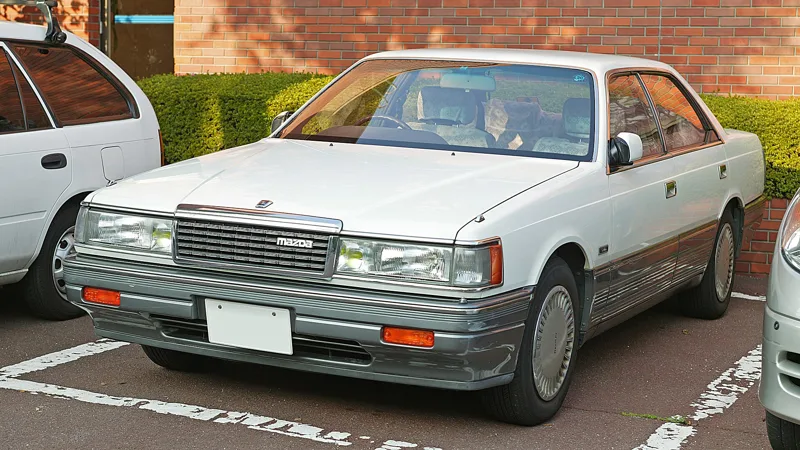
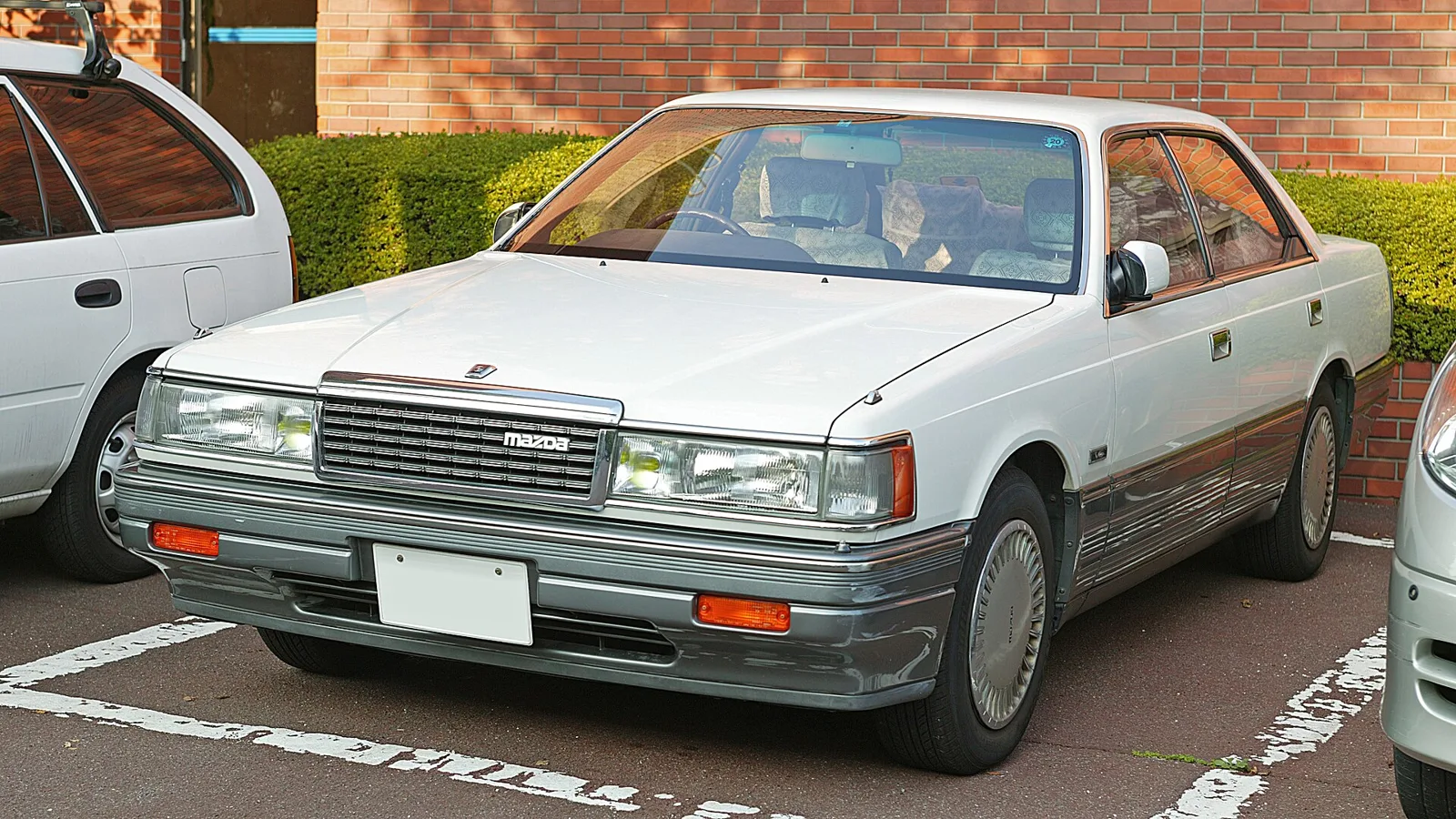
The Eunos Cosmo appeared in 1990 on the new JC platform, loosely based on the 1985 MX-03 concept car. It was the top-line flagship of the Eunos luxury channel and the only Mazda to use a triple-rotor engine, a 1962 cc unit with twin sequential turbochargers.
The 20B-RE delivered 280 PS (206 kW; 276 hp), with torque of 403 N m (297 lb ft) from twin Hitachi turbochargers. The 13B-RE two-rotor engine was the other choice, and the three-rotor was the flagship.
Its only transmission was an electronically controlled 4-speed automatic, which could be placed in a manual shift mode. Two trims were offered: the Type-S, with firmer suspension and cloth inserts in the leather, and the Type-E, with a softer ride and full leather.
The Eunos Cosmo was also a technology flagship. It was the first production car with a built-in GPS navigation system, and its twin sequential turbo systems were the first of their kind on a Japanese series production car.
Production ran from February 1990 to September 1995, with 8,875 cars sold in total. The split between the 13B-REW and 20B-REW versions was about 60/40, which made the triple-rotor the rarer car.
The Cosmo was electronically limited to 180 km/h (111.8 mph) under Japanese rules, although the 20B-REW could reach 255 km/h (158.4 mph) with a free run. Its torque of over 380 N m (280 lb ft) arrived at just 1,800 rpm, giving strong launch performance at the cost of heavy fuel use.
The Cosmo stayed a Japanese market car, but used examples later reached left-hand-drive countries through private import rules.
What was the Cosmo 21 concept?
At the 2002 Tokyo Auto Salon, Mazda showed the Cosmo 21, a retro reinterpretation of the 1967 Cosmo 110S, shown to mark the name's anniversary. It was a deliberate nod to the original car, with a similar silhouette and styling cues.
Based on the NB-generation MX-5, the concept was styled by M'z IF and built by Mazda Sangyo, with an early Renesis rotary engine from the later RX-8 in place of the MX-5 engine.
It arrived alongside other retro designs, such as the Volkswagen reboot of the Beetle and the New Mini. Talk of a small production run spread in Japan, yet the car stayed a concept.
What are the Mazda Cosmo specifications?
| Specification | Detail |
|---|---|
| Built | 1967 to 1995 |
| First car, export name | 110S, two-rotor Wankel |
| Series I output | 982 cc two-rotor, about 110 hp |
| Series II output | 128 hp (95 kW); 140 N m (103 lb ft) of torque |
| First generation total | 1,176 cars, with 343 Series I and 833 Series II |
| Series I performance | 16.4 seconds for the quarter-mile, 115 mph (185 km/h) |
| CD Cosmo 1800 | 1769 cc inline-four, 100 PS (73.5 kW), 110 lb ft (149 N m) |
| CD Cosmo 2000 | 110 PS (81 kW), from March 1977 |
| HB Cosmo drag coefficient | 0.32 |
| FET turbo engine | 2.0-litre, 1998 cc, 100 kW (134 hp; 136 PS), 237 N m (175 lb ft) |
| Eunos Cosmo engine | 20B-RE triple-rotor, 1962 cc, 280 PS (206 kW; 276 hp) |
| Eunos Cosmo torque | 403 N m (297 lb ft) |
| Eunos Cosmo sales | 8,875 cars, February 1990 to September 1995 |
| Speed limit and top speed | 180 km/h (111.8 mph) limited, 255 km/h (158.4 mph) possible |
| Cosmo 21 concept | 2002, based on the MX-5 NB |
The rotary engines are listed separately from the piston versions because the tax and performance figures differ between them.