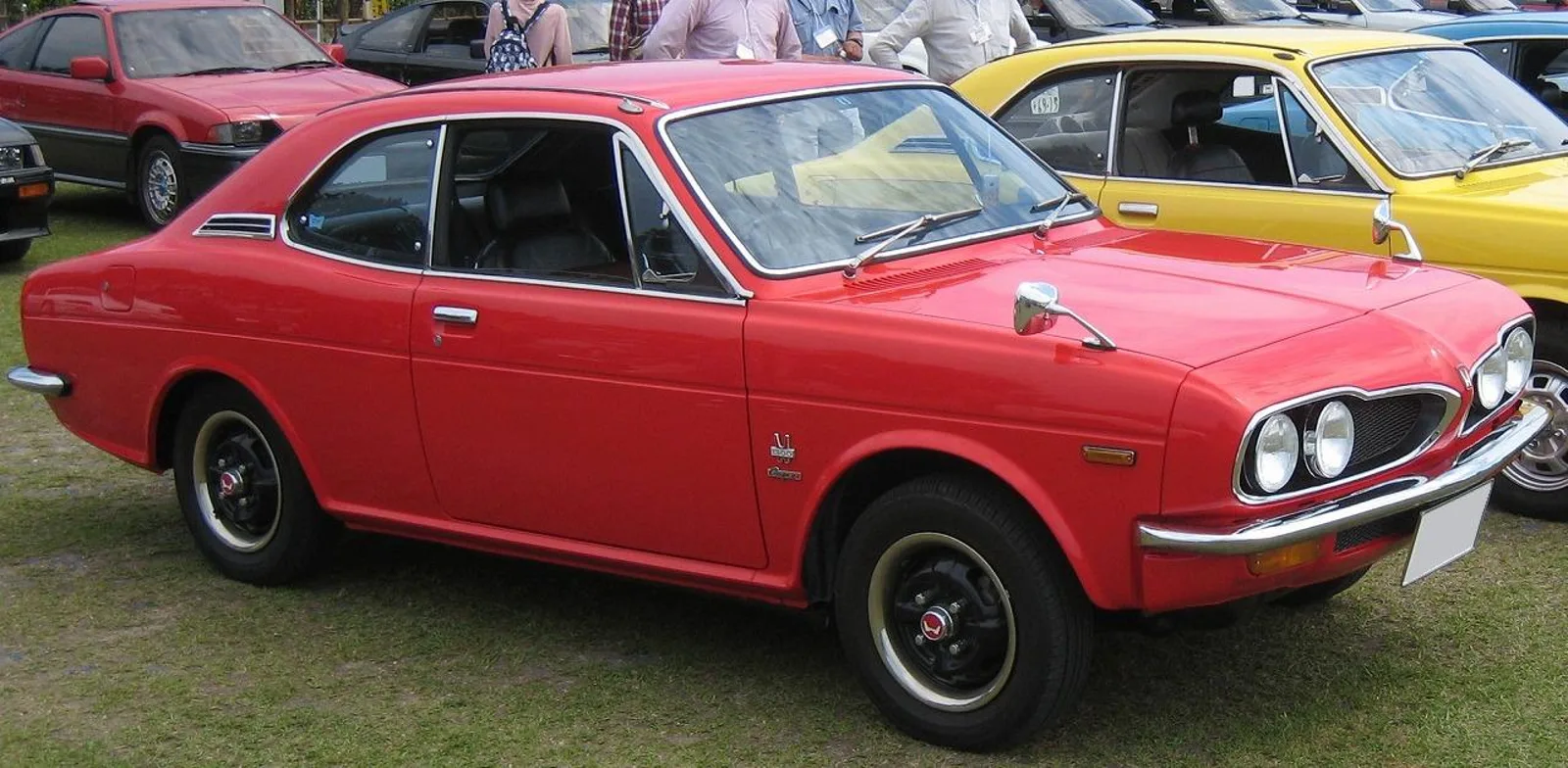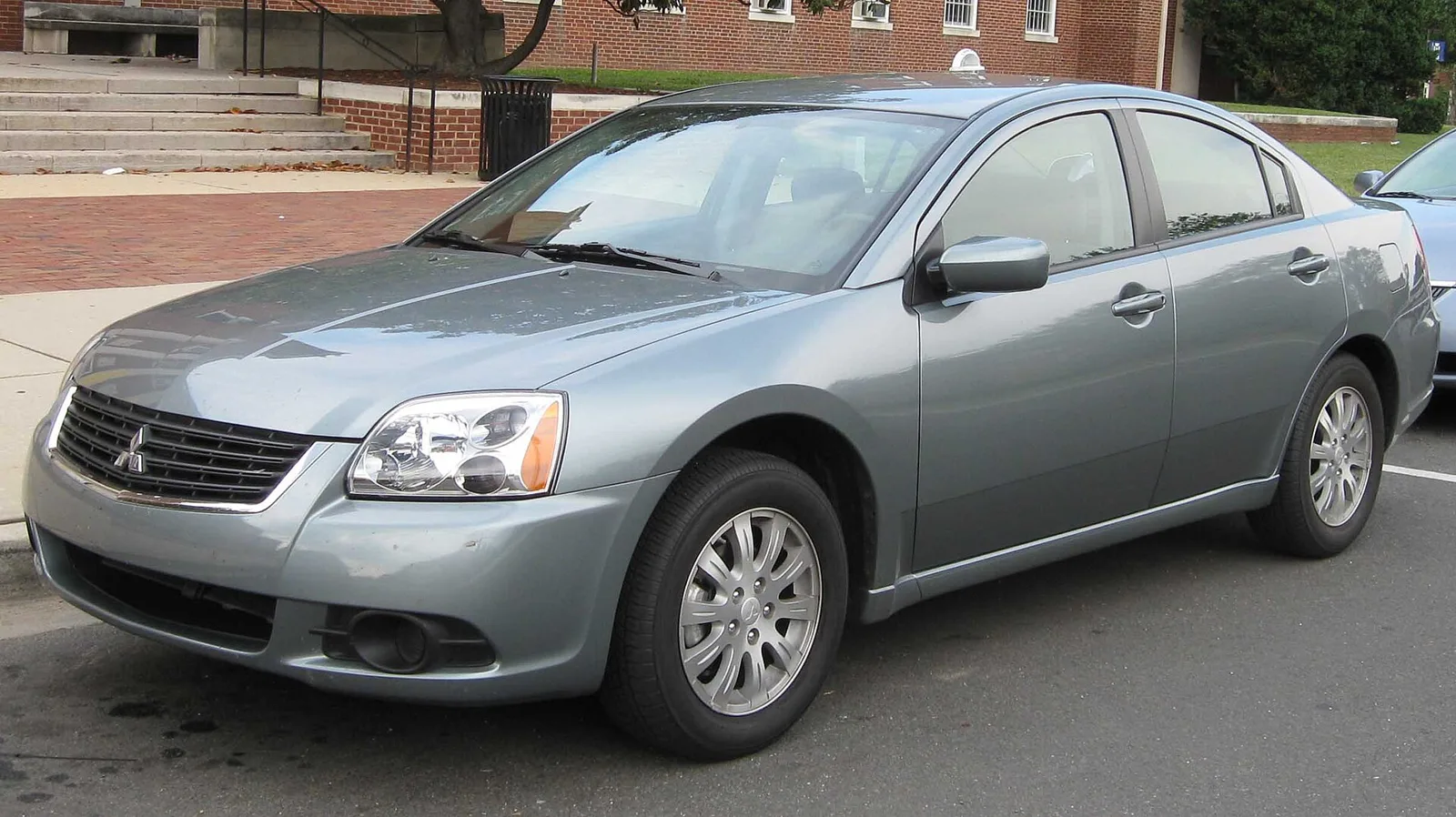
From the 1969 Dynawedge sedan to the 2012 American-built finale, the Galant grew from a compact into a mid-size car and carried the VR-4 rally story.
Mitsubishi built the Galant from 1969 to 2012 across nine generations, passing five million sales along the way. Its body moved from compact to mid-size, and the VR-4 models gave it a rally reputation that outlived many of its rivals.
The Mitsubishi Galant was a Japanese car that Mitsubishi built from 1969 until 2012, across nine generations. It started small and later moved up to a mid-size body, selling more than five million units along the way. This guide covers its origins, engines, the VR-4 turbo story and the markets that built and sold it.
What is the Mitsubishi Galant?
The Mitsubishi Galant was a Japanese car built from 1969 to 2012 over nine generations. Its body style moved from compact to mid-size, and its cumulative sales topped five million units. A French word, galant, which means chivalrous, gave the car its name.
Few family cars covered so much ground in size and purpose. The Galant started with a modest engine range and ended with a mid-size body built on a different continent, which makes it a useful case study for how Mitsubishi adapted its models to changing markets.
Nine generations of a Japanese family car, from a compact sedan in 1969 to a mid-size model built in Illinois.
How did the first-generation Galant launch?
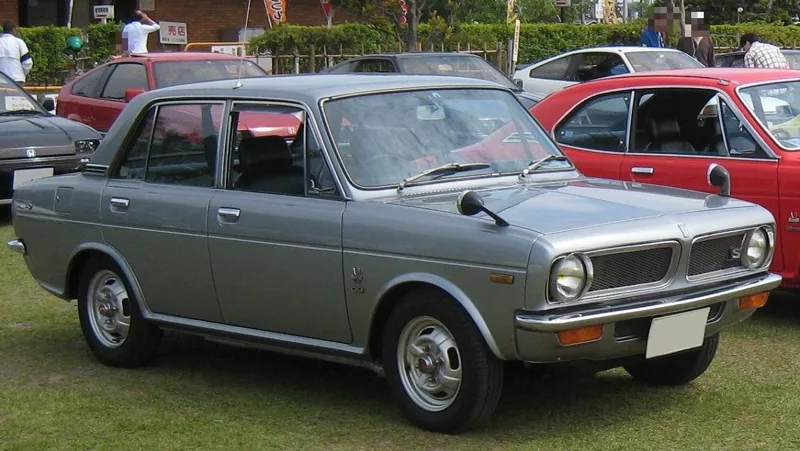
The first Galant was released in December 1969, initially as the Colt Galant, at a new Mitsubishi dealership called Galant Shop. Mitsubishi promoted its styling as Dynawedge, a nod to the way aerodynamics shaped the silhouette. Three initial versions used the Saturn engine family, in 1.3 and 1.5-litre forms.
The 1.4 and 1.6-litre versions replaced them in September 1971, and by early 1973 the top GS offered a 1.7-litre engine rated at 115 PS (85 kW).
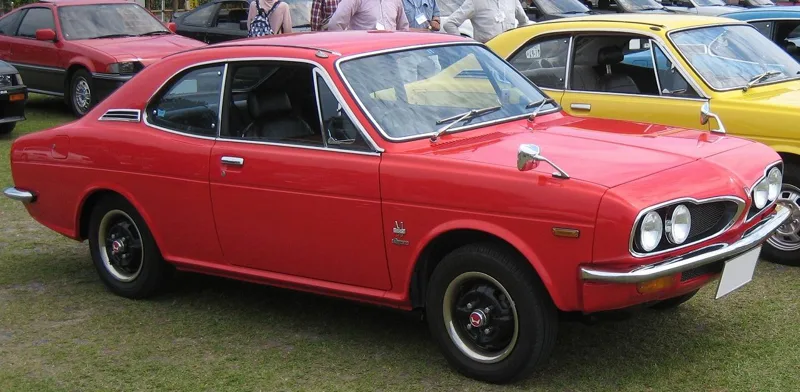
The sedan was joined by a five-door estate and a two-door hardtop. The hardtop was Mitsubishi's first production car to have glass all the way along the sides with no pillars, a detail that gave it an airy look for its time.
Who did the Galant compete with?
Rivals included the Toyota Corona, the Nissan Bluebird, the Honda Accord and the Mazda Capella. It sat in the compact class at first and was aimed at buyers who wanted more style than a basic family sedan offered in those years.
The range also included sportier models that broadened its appeal. Those variants kept the name in the minds of enthusiasts long after the family sedans had settled into routine use.
How did the Galant reach the United States?
Mitsubishi's first sales in the United States came in 1971, when its new partner Chrysler started bringing the car in as the Dodge Colt. The Colt was pitched against American subcompacts of the era, including the Pinto, Vega and Gremlin.
Chrysler also built the car in Australia as the Chrysler Valiant Galant, and in South Africa the A53 hardtop arrived as the Dodge Colt 1600 GS in late 1972. Those partnerships spread the Galant across several continents long before Mitsubishi had a large dealer network of its own.
What did the Galant GTO and FTO add?
The Galant GTO arrived in 1970 as a fastback coupe styled after American muscle cars, and it stayed on sale until 1975. Its engine choices gave it a more aggressive character than the standard sedan. A third and more compact coupe, the Galant FTO, followed in 1971 on a shortened chassis.
It used the 1.4-litre 4G41 engine. The GTO nameplate was regarded highly enough in Japan to return for the 1990 GTO coupe, and the FTO name also returned later as a separate model.
What changed in the second generation?
The second generation, built from 1973, was more curvaceous and was influenced by the coke bottle styling of the period. It was sold in many markets under Chrysler badges, including the Dodge Colt in the United States and the Chrysler Galant in Australia.
Mitsubishi added its Silent Shaft balancing system in some markets, which smoothed the engine, and larger Astron units joined the Saturn range. The estate, sold in Japan as a commercial vehicle, was offered only with the 1600 engine.
What was the third-generation Galant?
The third generation arrived in 1976 as the Galant Sigma, and that name became the car's identity in many export markets. The wagon followed in 1977, and the two-door coupe that replaced the GTO was called the Lambda. In Australia the car was built at Chrysler's Clovelly Park plant and sold as the Chrysler Sigma.
After Mitsubishi bought Chrysler Australia in 1980, it became the Mitsubishi Sigma, and a locally made Astron four became a core part of the range.
The third generation was also named South Africa's Car of the Year in 1977, a result that reflected its strong reception in that market. Sales there ran through the Sigma Motor Corporation, which built the car locally.
What was the fourth-generation Galant like?
The fourth generation, introduced in 1980, brought new work on ergonomics, aerodynamics and safety. Its Sirius engine was offered in turbocharged form, with 145 PS in Japan and 156 PS for export markets where emissions rules were less strict. The Astron 4D55 gave Japanese car buyers their first turbodiesel option, and the 2.3 Turbo D version produced 84 PS.
The diesel had early reliability problems that a redesigned cylinder head addressed in 1982, and it proved popular in the Benelux countries.
New Zealand named the fourth-generation car its Car of the Year in 1981, and the Australian Sigma wagon continued in production until 1987. That run of award wins showed the platform's strength in several markets at once.
Was the fifth generation a major change?
Yes. The fifth generation changed to front-wheel drive in August 1983 with four-door sedan and hardtop bodies, with an average drag coefficient of 0.36. Its boot grew from 272 to 360 litres (9.6 to 12.7 cu ft), and the new Cyclone V6 arrived in October 1986.
The Cyclone V6 was shared with the Debonair limousine. The top Japanese models used a turbocharged, intercooled Sirius Dash unit that alternated between two-valve and three-valve operation per cylinder, rated at 200 PS on paper and later quoted at 170 PS.
Exports began about a year after the launch. The widened Australian version became the Magna, which took Wheels magazine's Car of the Year award in 1985. That car gave Mitsubishi a strong position in the Australian mid-size market.
What did the sixth generation bring?
The sixth generation, launched in October 1987, adopted taller and rounded styling. It won Japan's Car of the Year award that year, and its Dynamic ECS adaptive air suspension was the world's first semi-active electronic suspension system in a passenger car.
The VR-4 variant formed the basis of Mitsubishi's World Rally Championship effort from 1988 to 1992. Its 4G63 turbo engine was later adopted for the Lancer Evolution with little modification, which gave the Galant a lasting engineering legacy.
A special run built on the GTi-16v received AMG tuning in 1989, with a 170 PS (125 kW; 168 hp) engine, a body kit, alloy wheels and a full leather interior. The Japanese V-series cars that followed used VR-4 styling without the full rally specification.
How did the seventh generation change the Galant?
The seventh generation appeared at Tokyo in September 1992. It switched to multi-link suspension at both ends, a first for a front-wheel-drive car, and its front suspension moved from struts to a layout with two lower arms and one upper arm.
In top trim the VR-4 used a twin-turbo 2.0-litre V6, a figure that put 60 mph about 6.5 seconds away and, if derestricted, approached 140 mph (225 km/h). Buyers could pick a manual gearbox with five ratios, or an INVECS automatic with four ratios and fuzzy logic that adapted to the driver.
A five-door liftback followed a month after the sedan in Japan, styled as a crossover. The Eterna XX-4 in Japan used the same engine and drivetrain as the VR-4, while the sport liftback was dropped in November 1995 for lack of demand.
What was the eighth-generation Galant?
The eighth generation, introduced in 1996, kept the seventh generation's design themes but added a wagon, which Japanese buyers knew as the Legnum. It was among the first mass-market cars to use gasoline direct injection, through a GDI version of the 1.8-litre 4G93 four.
The American Galant of this generation moved firmly into the mid-size class. Its front suspension returned to struts, and the larger V6 was standard on the top GTZ model, with the four-cylinder carried over on the other trims.
Mitsubishi enlarged the VR-4 to a 2.5-litre twin-turbo V6 and gave some variants the active yaw control used on the Lancer Evolution. The VR-4 could be bought as a sedan or as a Legnum wagon, and in Japan the sporty look was marketed as Viento.
How did the ninth generation work?
The ninth generation was a sedan-only model on the PS platform, and it went on sale in the United States from October 2003 for the 2004 model year. The four-cylinder rose to 160 hp from the 2.4-litre 4G69, while a 3.8-litre V6 produced 235 hp.
A Ralliart version joined in 2007 with a 258 hp V6, a firmer suspension, a front strut tower bar and larger alloy wheels. The Ralliart was the first Galant to get the updated Mitsubishi infotainment setup, which added GPS navigation.
Mitsubishi CEO Osamu Masuko said the ninth generation would be the last Galant built in North America. The final car left the assembly line in Illinois on 30 August 2012, and a planned Concept-ZT shown in 2007 never became the tenth generation.
Where was the Galant made and sold later?
Production spread across Taiwan, China, Australia and Venezuela, among other places. In Australia the Mitsubishi 380 was built from 2005 to 2008 and became the last Mitsubishi car produced in that country. Taiwanese cars were marketed as the Grunder and sold in China by Soueast.
The Barcelona plant in Venezuela opened in 1991, with the Galant among its first models. Local sales ran until 1994 under four model codes, and the Venezuelan car kept the Galant name until production ended in 2006.
The 380 used a 3.8-litre V6 with 175 kW (235 hp). Twenty limited edition TMR models were built at the Tonsley Park factory in Adelaide, with a supercharged version of the same engine.
Did the Galant have a motorsport career?
Yes, mostly through the VR-4. The Galant VR-4 served as the platform for Mitsubishi's rally entries of the late 1980s and early 1990s, and its turbocharged four-wheel-drive layout later fed into the Lancer Evolution. The 1989 GTi-16v special was tuned by the German firm AMG and carried a 170 PS engine.
Enthusiasts sometimes nicknamed the Japanese V-series car the Evo Zero, although the name was never an official designation.
Galant specifications at a glance
| Specification | Detail |
|---|---|
| Production span | 1969 to 2012, nine generations |
| First generation engines | 1.3 and 1.5-litre Saturn; 1.4 and 1.6-litre from 1971 |
| Top first-generation engine | 1.7-litre, 115 PS (85 kW) |
| Fourth-generation diesel | Astron 4D55 turbo-diesel; 2.3 Turbo D at 84 PS |
| Fifth-generation boot | Boot from 272 litres up to 360 litres (12.7 cu ft) |
| Fifth-generation drag | Average Cd of 0.36 |
| Seventh-generation VR-4 | Twin-turbo 2.0-litre V6; about 6.5 seconds to 60 mph |
| Eighth-generation engine | GDI 1.8-litre 4G93; 2.5-litre twin-turbo V6 on VR-4 |
| Ninth-generation V6 | 3.8-litre, 235 hp; Ralliart 258 hp from 2007 |
| Cumulative sales | Over five million units |
| Final US build | 30 August 2012 at Normal, Illinois |