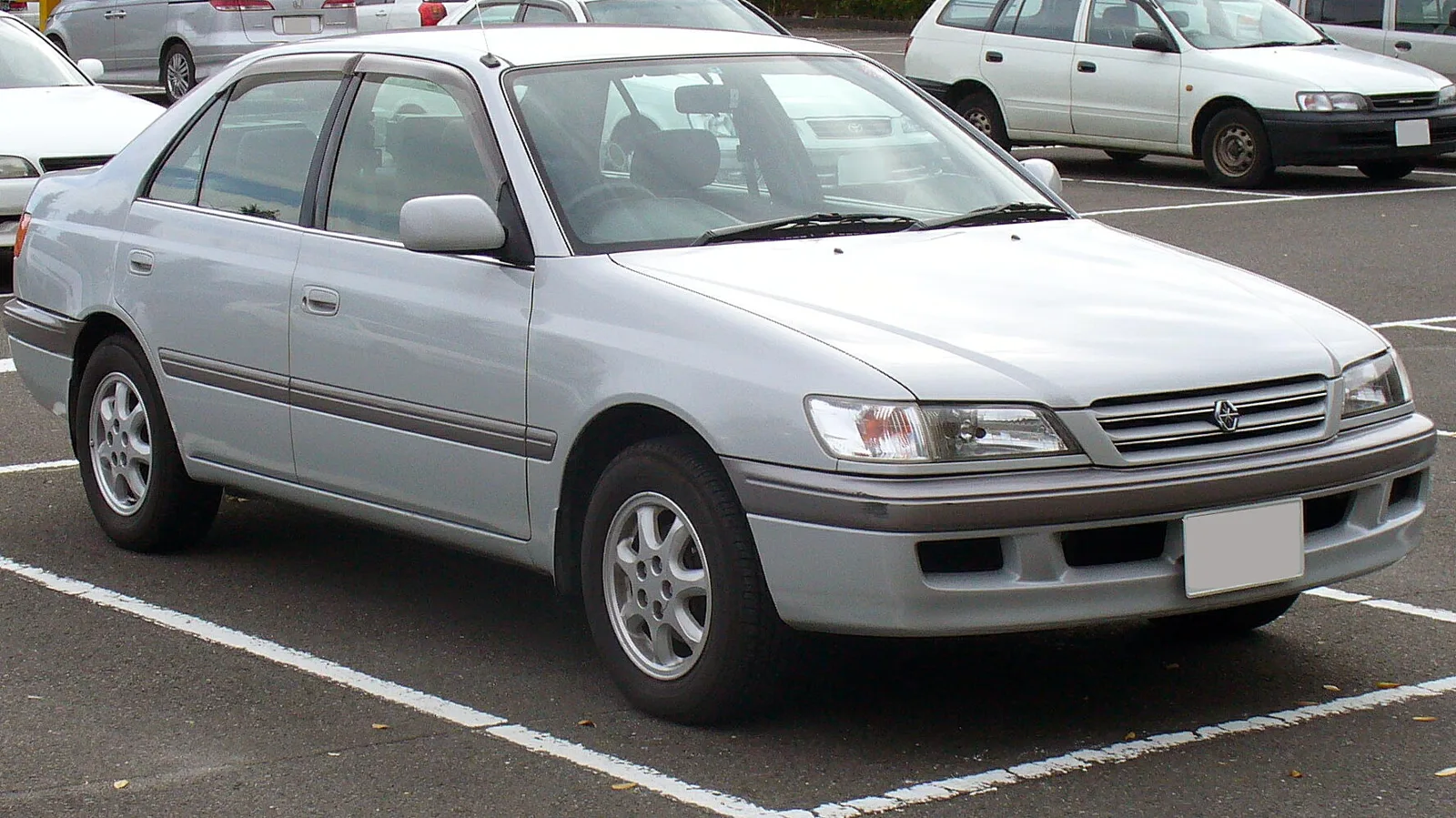
Toyota's Japanese family sedan carried the brand into North America, spawned sister cars worldwide and ran from 1957 to 2001.
Corona was Toyota's family sedan, made in eleven generations from 1957 to 2001. It ranked under the Crown, helped open North American and export markets for the brand, and was succeeded by the Premio in Japan, the Avensis in Europe and the Camry elsewhere.
The Toyota Corona was a Japanese family sedan built by Toyota across eleven generations between 1957 and 2001. It sat just below the Crown in the company's range and was one of the first Toyota models sold abroad, with the smaller Corolla following it into export markets. The name comes from the Latin word for crown.
What set the Corona apart from the Crown?
At launch the Corona was the second-highest product in Toyota's range, sitting just beneath the Crown. Japanese buyers reached it through Toyopet Store dealerships, and it was among the first Toyota models exported to other markets. Its name echoes the flagship, since the Latin word for crown is its origin.
The car was never meant to rival the flagship head on. It offered a smaller alternative inside the Toyota range, and that position shaped how each later generation was judged.
Few cars did more to carry Toyota into the American market than a modest sedan that began life just below the Crown.
How did the first Corona come to market?
The first generation, coded T10, went on sale in 1957 and reused parts from the previous Crown and Master. Its early engine was the old side-valve S unit producing 33 PS (24 kW). A new OHV P series engine arrived in October 1959, lifting output to 45 PS (33 kW).
Body design borrowed heavily from existing Toyota stock. Many panels were cut down from the Master, which had stopped production, while the Crown had been enlarged and restyled at around the same time. The sedan gained a three-door van sibling, the T16V, in October 1958, sold as the Toyopet Coronaline. Its tail lights recalled the 1949 Ford sedan.
Engineering was a notable step for Toyota. With the P engine the sedan reached 105 km/h (65 mph). The car was the first Toyota with a monocoque chassis and an independent front suspension using double wishbones, and that construction let the car weigh less than 1,000 kg (2,200 lb). Taxi rules capped engines at 910 cc (56 cu in), so dealers restricted power on taxi versions.
Second generation: the Tiara and its commercial siblings
The second generation, codes T20 and T30, was sold as the Tiara when exported. Toyota introduced it in March 1960 at a critical time in North America, where the Toyopet Crown had struggled, so the Corona gave buyers a choice alongside the Land Cruiser.
The first version used the 1.0-litre P series motor, rated at 45 PS (33 kW), with a three-speed manual transmission. Top speed was 110 km/h (68 mph). A 1.5-litre R series engine, the same unit used in the Crown, arrived in March 1961, and a 1.9-litre engine followed in 1964. The Tiara body was 180 kg (400 lb) lighter than the Crown, which made the R series feel adequate.
In Australia the Tiara was assembled in Port Melbourne, Victoria, by Australian Motor Industries from 1963. Its American run was small, with only 318 cars sold before it was redesigned and given the Corona label.
How did the Corona grow in the third generation?
The third generation, codes T40 and T50, appeared in September 1964, one month before the 1964 Summer Olympics. It came as a sedan, two-door hardtop, van, station wagon and five-door hatchback. Toyota launched it a year after the Nissan Bluebird debuted, its traditional rival. The Corolla arrived in November 1966 so the Corona could grow larger.
Toyota showed off the new car on the Meishin Expressway, where it was tested over 100,000 kilometres (62,137.1 mi) and sustained 140 km/h (87 mph). The 0-97 km/h (0-60 mph) sprint took 15.1 seconds.
Commercial models used the 1,198 cc 2P engine, which produced 55 PS (40 kW) at 5,000 rpm. Loads were limited to 500 kg (1,102 lb) for two-seaters and 300 kg (661 lb) for five-seaters. Heavier work fell to the Toyota Stout, while the Toyota HiAce, a cab-over van built on Corona engines, arrived in 1967 to carry more payload.
In April 1967 the larger 1.35-litre 3P and 1.5-litre 2R engines replaced the 2P in most markets, producing 77 and 65 PS (57 and 48 kW). The Toyoglide automatic transmission made its debut on this generation, and front disc brakes were introduced. Exports to the United States and Europe grew, and in September 1967 Toyota built 80,000 cars, 30,000 of them Coronas.
The 1600GT and its DOHC engine
In August 1967 Toyota fitted the 1,587 cc DOHC 9R engine to the RT55 1600GT. It was based on the 4R block from the Corona 1600S, topped with a Yamaha-built head derived from the 2.0-litre 3M unit in the 2000GT, which had debuted in May 1967. The result was 110 PS (81 kW).
The 1600GT was a junior version of the more exclusive 2000GT. Only 2,222 examples were built, and the car stayed in production for 13 months. Buyers could choose from colours shared with the larger car, and the body was a two-door hardtop coupe.
Rivals of the day included Isuzu's Bellet GT, Nissan's Bluebird SSS and Prince's Skyline 2000GTB. The sporting coupe lineage carried on for years, reaching a Crown hardtop coupe in 1968, a Celica GT, and a Carina GT in 1970, while the Corolla Levin and Sprinter Trueno followed in 1972. The DOHC engine stayed in Corona GT coupes until 1983.
Did the Corona help Toyota win American buyers?
Yes. Toyota first entered the North American passenger car market in 1957 as Toyopet with little success and withdrew in 1961. It returned in June 1964 under the Toyota name with a third-generation Corona, and US sales of Toyota vehicles rose above 20,000 units in 1966, a threefold increase.
The model also lifted Toyota up the import rankings. The company became the third-best-selling import brand in the United States by 1967. Toyota gave the car prominent advertising, including its first television commercial, and the Corona went on to win the 1969 Road Test Import Car of the Year award.
Car and Driver editors wrote in 2014 that the Corona ranked among the best Toyotas ever built. Their argument was that Toyota could only flourish in America because the car had kept the brand there long enough. The 1970s were the strongest American period, helped by the 1973 and 1979 fuel crises.
Where was the Corona built outside Japan?
The Corona was the first Toyota assembled in New Zealand, beginning in February 1967 at a Christchurch plant run by Steel Brothers. Shinjin Motor in South Korea also built the car between 1966 and 1972, while Australian Motor Industries did so in Melbourne. South African assembly began in 1966.
The Corona Mark II and the fourth generation
In September 1968 Toyota released the Corona Mark II, a larger car with more equipment that shared some features with the Crown and took the top spot at Toyopet Store locations. It measured 4,295 mm (169.1 in) long, against 4,125 mm (162.4 in) for the Corona sedan, and it was 1,610 mm (63.4 in) wide compared with 1,549 mm (61 in). After 1972 it became a separate platform and dropped the Corona name.
The fourth generation, codes T80 and T90, arrived in February 1970 as a complete redesign on its own platform, separate from the Mark II. Body styles were reduced to a two-door hardtop coupe, a four-door sedan and a station wagon. Economy stayed the priority, while the Mark II grew into the more comfortable and powerful car.
Engines were OHV on base cars and SOHC on better-equipped versions. The 1.5-litre produced 77 PS (57 kW), while the 1.6 offered 85 or 100 PS (63 or 74 kW) depending on specification. The 1.7-litre 6R arrived in September 1970, and in January 1971 newer units replaced earlier ones, with a 1.9-litre RT83 joining the range.
A performance model, the Toyota Carina, arrived in 1970 on the Celica platform and sold through Toyota Store dealers, while the Corona stayed with Toyopet Store. The Corona pick-up was dropped once the Hilux arrived in 1969.
What changed with the fifth and sixth generations?
The fifth generation, the T100 series, arrived on 31 August 1973 as sedans, hardtop coupes and wagons. The sixth generation, the T130, followed in September 1978 with a boxier body and a wider range of body styles. Both were rear-wheel-drive cars, and both had to cope with Japan's tightening emissions rules.
The T100 sedan and hardtop used 1.6, 1.8 and 2.0-litre SOHC engines, while North American cars used the 2.2-litre 20R. The high-performance 2000GT was offered only in Japan, with a twin-cam 18R-G, a Yamaha alloy head, a 9.7:1 compression ratio and a Porsche-type five-speed gearbox. Its claimed top speed was 200 km/h (125 mph).
North American models gained longer bumpers to meet 5 mph (8.0 km/h) impact standards, and radial tyres became standard in 1975. Sales kept growing after the 1973 oil crisis. The two-door sedan found buyers in the United States but barely sold in Japan, and it was the last Corona offered in that body style.
The T130 arrived as a four-door sedan, two-door hardtop coupe, four-door wagon and five-door liftback, the last with a 40:60 split-fold rear seat. Its front suspension used MacPherson struts, and the rear used a four-link trailing arm arrangement with a Panhard rod. Front disc brakes were standard across the range.
Markets and engines of the T130 era
In the United States the T130 was the last Corona sold. It came as a sedan, wagon or liftback with Base or LE equipment, and the front-wheel-drive Camry replaced it for the 1983 model year. The original 2.2-litre 20R made way for the 22R in the 1981 facelift, a change that also brought a rearward-sloping front end.
In Australia Toyota used 1.9-litre Holden Starfire engines to meet local content targets of 85 per cent. Reviewers of the day criticised the engine as rough, short on power and thirsty. From November 1979 Toyota imported a five-door liftback with its own 2.0-litre 18R-C, and later the Corona XX received an imported 2.0-litre 21R-C from the Celica.
How did the T140 and T150 generations differ?
The T140 entered production as a rear-wheel-drive sedan, coupe and wagon in January 1982, and it became the longest running Corona series. Its successor, the front-wheel-drive T150, was sold as the Corona FF from January 1983 and gradually became the main part of the range.
The T140 was built in Japan with a 1.5-litre 5K-J, a 1.6-litre 12T-J or a 1.8-litre 1C diesel in the five-door Van. Taxi versions with taller roofs were popular in Hong Kong, Macau and Singapore. European export models used a 2T engine producing 75 PS DIN (55 kW), and an 86 PS (63 kW) 1.8-litre was also offered.
Australian buyers had two models between 1983 and 1987: the ST141 with a 2.0-litre 2S-C, and from 1984 the RT142 with a 2.4-litre fuel-injected 22R-E. Both came as sedans or wagons. A limited Olympic edition in 1984 added a full digital instrument cluster.
The T150 went on sale in January 1983 as the Corona FF, a five-door liftback with a carburetted 1.8-litre rated at 100 PS (74 kW). A four-door sedan followed in October 1983, and a 1.5-litre 3A-LU joined at the bottom of the range. The T150 became the main part of the Corona lineup as the T140 shrank in importance.
In 1983 the T150 became the first Japanese-made car with digital colour liquid crystal gauges. In August 1985 the car gained bigger tail lights, and the new T160 chassis arrived with five-lug wheels. The twin-cam 2.0-litre 3S-GELU, producing 160 PS (118 kW) at 6400 rpm, powered the 2.0 GT and GT-R.
The eighth and ninth generations: EXiV, Carina E and Caldina
The eighth generation, the T170, arrived in December 1987. The Corona and the Carina both grew to the maximum size allowed for a lower Japanese tax bracket, and for several years they were the same size. The four-door hardtop Corona EXiV was added, while the five-door liftback sold as the Corona SF in Japan became the Carina II in Europe.
The EXiV took a low-slung coupe look while adding two more doors. According to Toyota, the name came from EXtra impressiVe. The T180 continued the sporting T160 lineage on the Celica chassis with its own bodywork, and the November 1989 facelift brought densely packed vertical bars to the grille and EFI engines.
The ninth generation, the T190, arrived in March 1992 with a larger, heavier and more rounded shape, while staying within Japanese size rules. In Europe it became the Carina E, built at Toyota's Burnaston plant near Derby in England, with early cars and GT-i models made in Tsutsumi, Japan. Japanese wagons were split off as the Caldina from 1993.
How did the Corona end its run?
The tenth generation ran in Japan from January 1996 to December 2001, and the Corona Premio spun off into a separate model. The 1997 T220 series dropped the Corona name in most markets, where the Avensis took its place. The last Corona was a South American Avensis variant.
The Corona Premio was offered in Base Premio, Premio E and Premio G trims. Its four-cylinder engines were the 1.6-litre 4A-FE, the 1.8-litre lean-burn 7A-FE and the 2.0-litre 3S-FE, with 2.0-litre 2C-T and 2.2-litre 3C-T diesels. The Premio later became an independent model coded ST210, and the Allion followed after 2001.
The 1997 Caldina shared a platform with the T210 Corona and the Carina. The GT-T used a turbocharged 3S-GTE producing 260 PS (191 kW; 256 hp), with all-wheel drive similar to the Celica GT-Four. At 1,470 kg (3,241 lb) it reached 0-100 km/h in 7 seconds, a pace comparable to a Subaru WRX wagon.
In Europe the T220 became the Avensis sedan and liftback, while the taxi-only Corona used diesel engines. Production of the Corona taxi came to an end in April 1998.
Corona chassis codes and specifications at a glance
| Chassis code | Introduced | Standout engine or feature |
|---|---|---|
| T10 | 1957 | 997 cc P series, 45 PS (33 kW) from October 1959 |
| T20 and T30 | 1960 | 1.0-litre P series, 45 PS (33 kW), sold as the Tiara |
| T40 and T50 | 1964 | 1,587 cc 4R, 90 bhp (67 kW; 91 PS) |
| T80 and T90 | 1970 | 1.5-litre, 77 PS (57 kW); 1.6-litre, 85 or 100 PS (63 or 74 kW) |
| T100 series | 1973 | 2000GT twin-cam 18R-G, 9.7:1 compression |
| T130 | 1978 | 2000GT 18R-G, 101 kW (135 hp) at 5800 rpm |
| T140 | 1982 | Rear-wheel drive; 1.5-litre 5K-J in the Van |
| T150 | 1983 | Corona FF; 1.8-litre fuel injected 1S-ELU, 115 PS (85 kW) |
| T160 | 1985 | 3S-GELU 2.0-litre twin-cam, 160 PS (118 kW) at 6400 rpm |
| T170 | 1987 | Corona EXiV and SF liftback; 3S-GELU GT engine |
| T190 | 1992 | Carina E in Europe; Caldina wagon from 1993 |
| T210 | 1996 | Corona Premio; 2.0-litre 3S-FE |
| T220 | 1997 | Avensis in Europe; last Corona in South America |