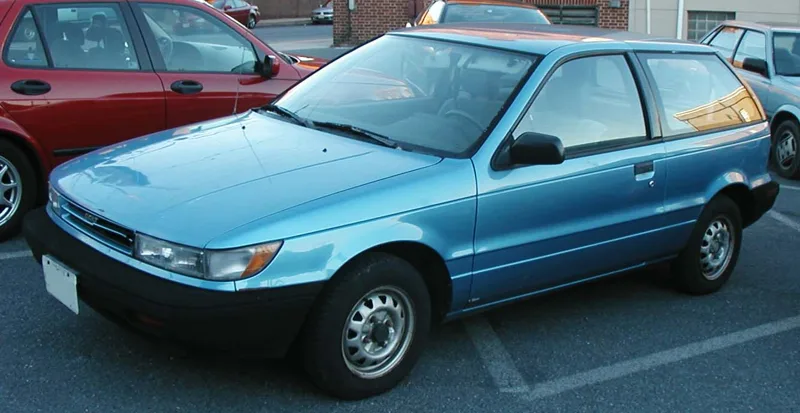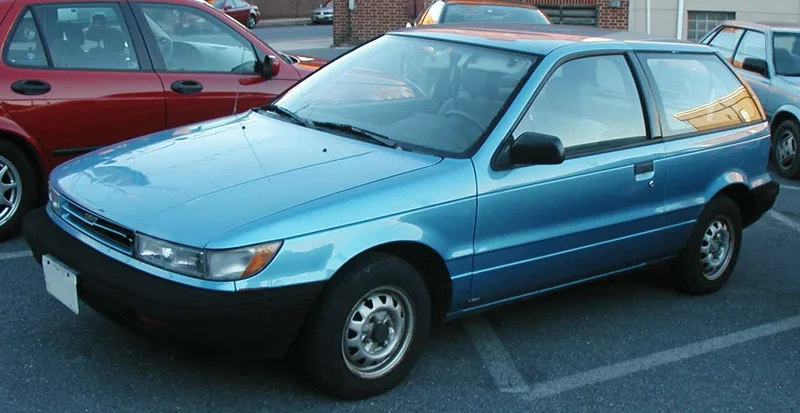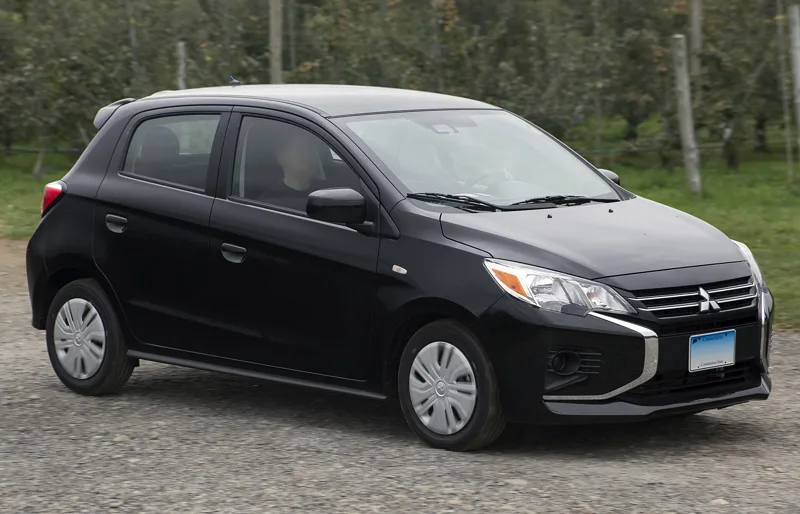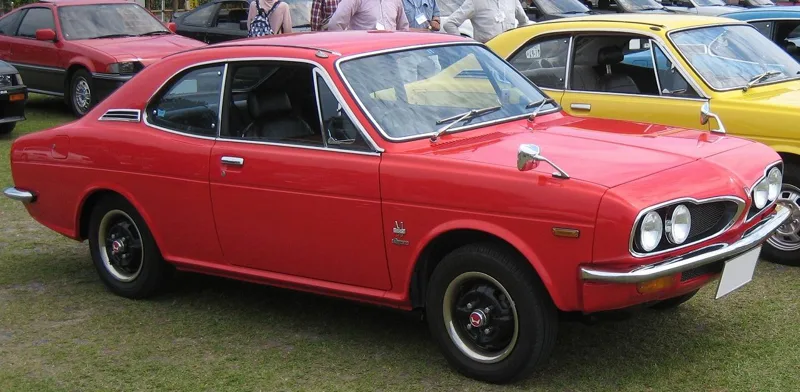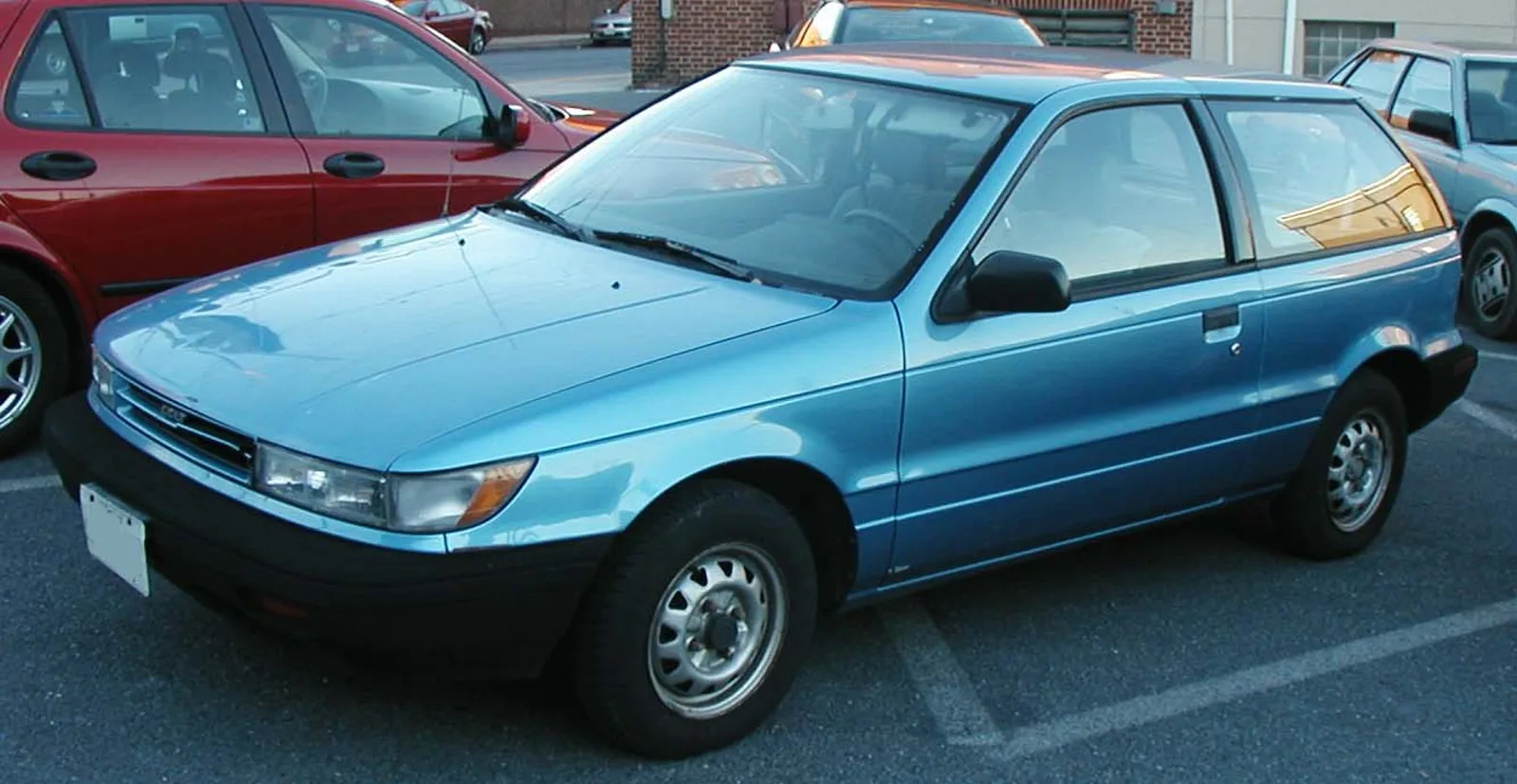
A captive import from Mitsubishi that began life as a rear-wheel-drive compact, switched to front-wheel drive and ran in Dodge showrooms until 1994.
Mitsubishi Motors produced the Dodge Colt, which Dodge sold from 1971 until 1994 as a captive import. The car started as a rebadged Galant and Lancer, switched to front-wheel-drive Mirage underpinnings in 1979, and gave way to the Neon after the 1994 model year.
Dodge sold the Colt for more than two decades as a car that Mitsubishi made, which is why it is described as a captive import. Over seven generations it moved from rear-wheel drive to front-wheel drive, and its rebadged siblings included the Plymouth Champ, the Plymouth Colt and the Eagle Summit.
What was the Dodge Colt?
The Dodge Colt was a subcompact that Mitsubishi Motors built and Dodge marketed from the 1971 model year until 1994. It began as a rebadged variant of the rear-wheel-drive Galant and Lancer families, then shifted to the smaller front-wheel-drive Mitsubishi Mirage in 1979. The Neon took over the Colt's role once the 1994 model year ended.
Chrysler used the Colt as its answer to a group of compact rivals that included the AMC Gremlin, the Ford Pinto and the Chevrolet Vega. Once on sale it competed with imports too, including the Toyota Corolla, the Honda Civic and the Datsun 1200.
Because Mitsubishi supplied the cars, the Colt was a captive import in the same way as other Japanese-built models sold through a North American brand. Plymouth sold its own versions as the Champ and the Colt, so buyers in the two divisions saw very similar cars under different names.
A Mitsubishi-built subcompact that changed drive layout, lost its sporty badges and still outlasted most of its rivals.
How did the first-generation Colt work?
The first-generation car was a federalised version of the Mitsubishi Colt Galant, introduced in 1970 as a 1971 model. It used a front engine and rear-wheel drive, with MacPherson struts at the front, a live rear axle and a 1,597 cc four-cylinder engine. Buyers could pick a pillared coupe, a hardtop coupe, a sedan with four doors or a five-door estate wagon.
The standard gearbox was a four-speed manual, and a three-speed automatic was optional. Power at launch was 100 hp, but the figure fell to 83 hp in 1972 when manufacturers changed how they measured output, moving from gross to SAE net ratings.
For 1973 Dodge added a GT hardtop with rally stripes, sport wheels and a centre console. The first Colt therefore offered a sporty option within a simple, mechanically conventional package, and it used the same basic architecture as the Galant it came from.
What changed in the second generation?
The second generation arrived as the 1974 model, with a rounder body carried over from the Galant coupes and sedans. Single headlights replaced the double units of the earlier car, and the wagon kept the older body with a facelifted front end. The base engine stayed the same, while a larger 2-litre G52B Astron became optional.
The 2-litre produced 96 hp at 5500 rpm, with the California version making two fewer horsepower. Published ratings for the two engines varied between sources, with figures between 79 and 83 hp for the smaller unit and between 89 and 96 hp for the larger one.
Transmissions also changed. The original Borg-Warner automatic gave way to Chrysler's own TorqueFlite unit in the 2-litre version, and that automatic later replaced the old Borg-Warner unit entirely. A five-speed manual arrived for 1977, standard on the GT and Carousel coupes.
The Carousel, introduced in 1975 with larger bumpers, was the more luxurious version and wore special blue and white paint. Elsewhere the second-generation car had its own life: it was sold as the Dodge Colt 1600 GS in South Africa, but only as a two-door hardtop coupe.
How was the Colt sold in Canada?
In Canada the second-generation car was rebadged as the Plymouth Cricket for the 1974 and 1975 model years, and it wore the grille from the 1974 to 1977 Colt wagons. The Canadian Crickets reached all the body styles of the Colt, and the sporty GT equivalent was sold as the Cricket Formula S.
These Canada-only Crickets were then renamed Plymouth Colts for 1976. The name confusion did not end there, because a separate Hillman Avenger-based Cricket had been sold across North America between 1971 and 1973 without much success.
Why did the third generation split into two lines?
The third generation split into two lines because the coupes and sedans came from a smaller Lancer-based series, while the station wagons were based on the Mitsubishi Galant Sigma. Coupes and sedans arrived for the 1977 model year as the Colt Mileage Maker, and the wagon had its own separate development path.
The smaller cars were slightly shorter in wheelbase than the second generation, and their overall length fell from 171.1 in to 162.6 in (4,346 mm to 4,130 mm). The engine was the 4G32 from Mitsubishi's Saturn family, a 1,597 cc unit rated at 83 hp at 5,500 rpm. Second-generation coupes and wagons remained on sale alongside the new cars for 1977.
A Silent Shaft version of the engine and a five-speed manual formed part of a Freeway Cruise package, which also included a maroon and white paint scheme. For 1978 power fell to 77 hp with the introduction of the MCA-Jet high-swirl system. The third-generation sedans and coupes were replaced for the 1980 model year.
What was the 1978 Colt Wagon?
The 1978 Colt Wagon was a rebadged version of the larger Mitsubishi Galant Sigma, not a Lancer-based car. The 1.6-litre MCA-Jet four was standard, and the 2.6-litre Astron, producing 105 hp (78 kW), was optional with a five-speed manual.
The wagon continued alongside the front-wheel-drive models until 1981, when it was effectively replaced by the domestic Dodge Aries K wagon. Chrysler also sold the larger Mitsubishi Galant Lambda coupe as the Dodge Colt Challenger from 1978, sharing the wagon's chassis and engine options before the Colt name was dropped.
Why did the fourth generation switch to front-wheel drive?
The fourth generation came in late 1978 for the 1979 model year as a North American captive import based on the front-wheel-drive Mitsubishi Mirage. Dodge sold it as the Colt and Plymouth as the Champ, and in 1982 the Plymouth version became the Plymouth Colt. The cars were three-door hatchbacks in Deluxe and Custom equipment.
The first engine was a 70 hp (52 kW) 1.4-litre overhead-cam four from Mitsubishi's Orion family, which earned the highest US fuel economy rating in its debut year. The 1.6-litre 4G32 Saturn engine arrived at the end of 1979 with 80 hp (60 kW), and a decontented version appeared for 1981.
Gearboxes were varied. Buyers could take a KM110 four-speed manual, a Twin Stick version giving eight forward gears and two in reverse through a two-speed transfer case, a KM119 five-speed or a TorqueFlite three-speed automatic. An RS package added firmer suspension, extra gauges and a larger fuel tank for the sportier buyer.
For 1982 a five-door hatchback joined the range, and the equipment levels were renamed E and DL. The 1.6-litre was offered only with the automatic that year. In August 1983 the GTS Turbo arrived for the 1984 model year, powered by the fuel-injected 4G32T, which made 102 hp (76 kW) at 5500 rpm. Turbocharged Colts sold elsewhere used a 1.4-litre engine, so the North American GTS was a distinct car. Both GTS models had a 13.2 US gal (50 L) tank, against 10.6 US gal (40 L) in the E and DL.
What did the fifth-generation Colt offer?
The fifth generation, sold from the 1985 model year, came as a three-door hatchback, a four-door sedan and a five-door minivan marketed as the Colt Vista. The Vista was a rebadged Mitsubishi Chariot. The base engine was a twin-barrel carburettor 1468 cc four rated at 68 hp (51 kW), and the turbocharged 1.6-litre was optional on the Premier sedan and standard on the GTS Turbo hatchback.
The sedan was the first three-box four-door body offered on a front-wheel-drive Colt. The five-door hatchback was sold in the US only for 1985, in base E trim, because Chrysler feared it would take sales from its own Omni and Horizon. The E sedan replaced it for 1986.
The 1987 model year brought a facelift, presented in late September 1986, and the turbo became an option on the DL hatchback in place of the GTS. Power for the turbo versions rose to 105 hp (78 kW) for 1988. The wagon arrived in 1988 with a fuel-injected 1.5-litre rated at 75 hp (56 kW) at 5500 rpm, and it was front-wheel drive at first.
From January 1988 Chrysler Canada sourced Colts from Thailand, assembled from Japanese parts, with a plan to bring in 8,000 cars a year. The Thai-built cars reached Canada until 1994, and from 1988 to 1991 the Colt and Mirage were sold in Canada as the Eagle Vista.
For 1989 the wagon gained a 1,755 cc four-wheel-drive version with 87 hp (65 kW), offered only in DL trim and without an automatic option. The final US year of the fifth generation brought a fully body-coloured look that Plymouth called the dipped look.
How did the sixth generation and the Eagle Summit work?
The sixth generation was sold for 1989 as the Dodge and Plymouth Colt in Canada, while Eagle sold its Summit in the United States as another rebadged Mitsubishi Mirage. Sales of the Summit began in August 1988. In Canada the new model was badged Colt 200, and the earlier generation continued as the Colt 100.
The Colt was the only subcompact left in the Dodge and Plymouth lineups after the Omni and Horizon ended in 1990. The Colt sedan was not sold in the US for this generation, because Dodge and Plymouth used the Shadow and Sundance liftbacks for that role. The sedan bodywork did reach American buyers as the Eagle Summit.
The 1.5 and 1.6-litre inline fours of the Colt, Summit and Mirage used multi-point fuel injection in the 1.5-litre case, which produced up to 82 hp. A turbocharged 1.6-litre 4G61T made 135 hp (101 kW) and appeared in the Mirage and the Colt GT Turbo for 1989 only. Rumoured production of that special edition is around 1,500 cars.
The turbo car had power seats, power windows and locks, and a 150 mph gauge cluster marked to 9000 rpm. Car and Driver named the turbo Colt and Mirage to its Ten Best list for 1989. A naturally aspirated version of the engine powered later Colt GT cars with 113 hp. The 1.5-litre car had a top speed of 160 km/h (99 mph).
What happened in the seventh generation?
The seventh generation was the same car as the Plymouth version and the Eagle Summit, all badge-engineered from the Mitsubishi Mirage and Lancer. It had no hatchback, and it came in base and GL trim at first, with a sportier ES added later.
The engines were 1.5-litre and 1.8-litre fours, with the larger unit at first limited to the four-door body. For 1994 the two-door ES took the more powerful sixteen-valve SOHC 1.8. The smaller engine produced 92 hp (69 kW) and the larger 113 hp (84 kW). Production of the Dodge and Plymouth Colts ended with the 1994 model year, when the Neon arrived.
Which related models shared the Colt name?
Several rebadged cars used Colt-related names. The Plymouth Cricket name appeared on Galants sold in Canada between mid-1973 and 1975, after Chrysler had stopped using it for a Hillman Avenger-based model from the United Kingdom. The Plymouth Arrow sold from 1976 to 1980 was a rebadged Mitsubishi Lancer Celeste, not the Mitsubishi truck that also used the Arrow name from 1979.
The Colt Wagon's successor was the Mitsubishi RVR-based wagon of 1991, which continued until the 1996 model year. The fifth-generation Colt Vista had previously been the minivan-style variant.
Dodge Colt specifications
| Specification | Detail |
|---|---|
| Built by | Mitsubishi Motors, sold by Dodge as a captive import |
| Model years | 1971 to 1994 in North America |
| First generation engine | 1,597 cc four-cylinder; 100 hp at launch, 83 hp from 1972 |
| First generation drive | Rear-wheel drive with a live rear axle |
| Second generation engine | 2-litre Astron, 96 hp at 5500 rpm (optional) |
| Third generation engine | 4G32 1,597 cc, 83 hp at 5,500 rpm; 77 hp from 1978 |
| Fourth generation | Front-wheel drive; 1.4-litre 70 hp and 1.6-litre 80 hp |
| GTS Turbo (1984) | 4G32T 1.6-litre, 102 hp (76 kW) at 5500 rpm |
| Fifth generation base engine | 1468 cc twin-barrel four, 68 hp (51 kW) |
| Fifth generation turbo | Up to 105 hp (78 kW) by 1988 |
| Sixth generation turbo | 4G61T 1.6-litre, 135 hp (101 kW), 1989 only |
| Seventh generation engines | 1.5-litre 92 hp (69 kW); 1.8-litre 113 hp (84 kW) |
| Successor | Neon, after the 1994 model year |