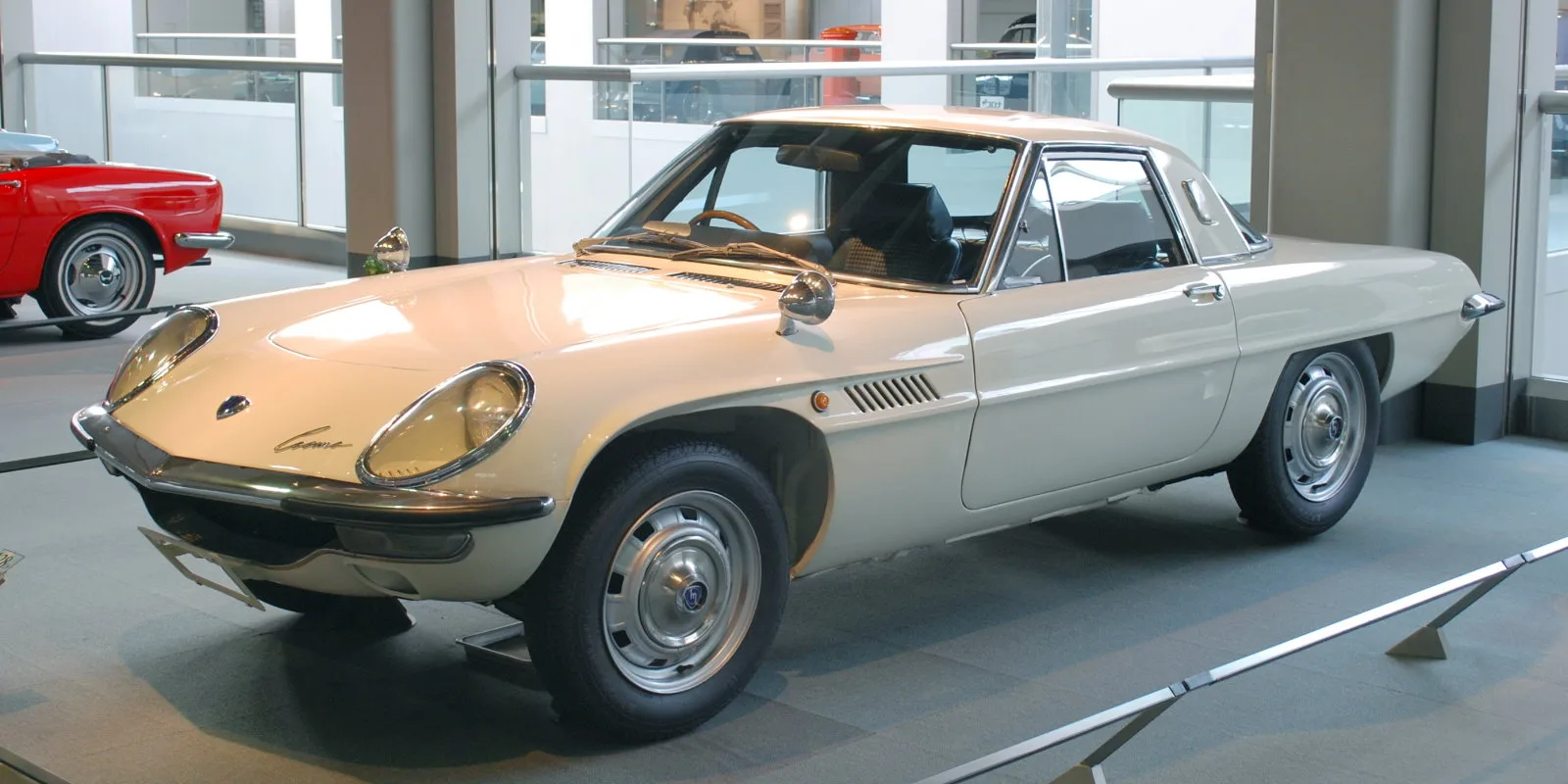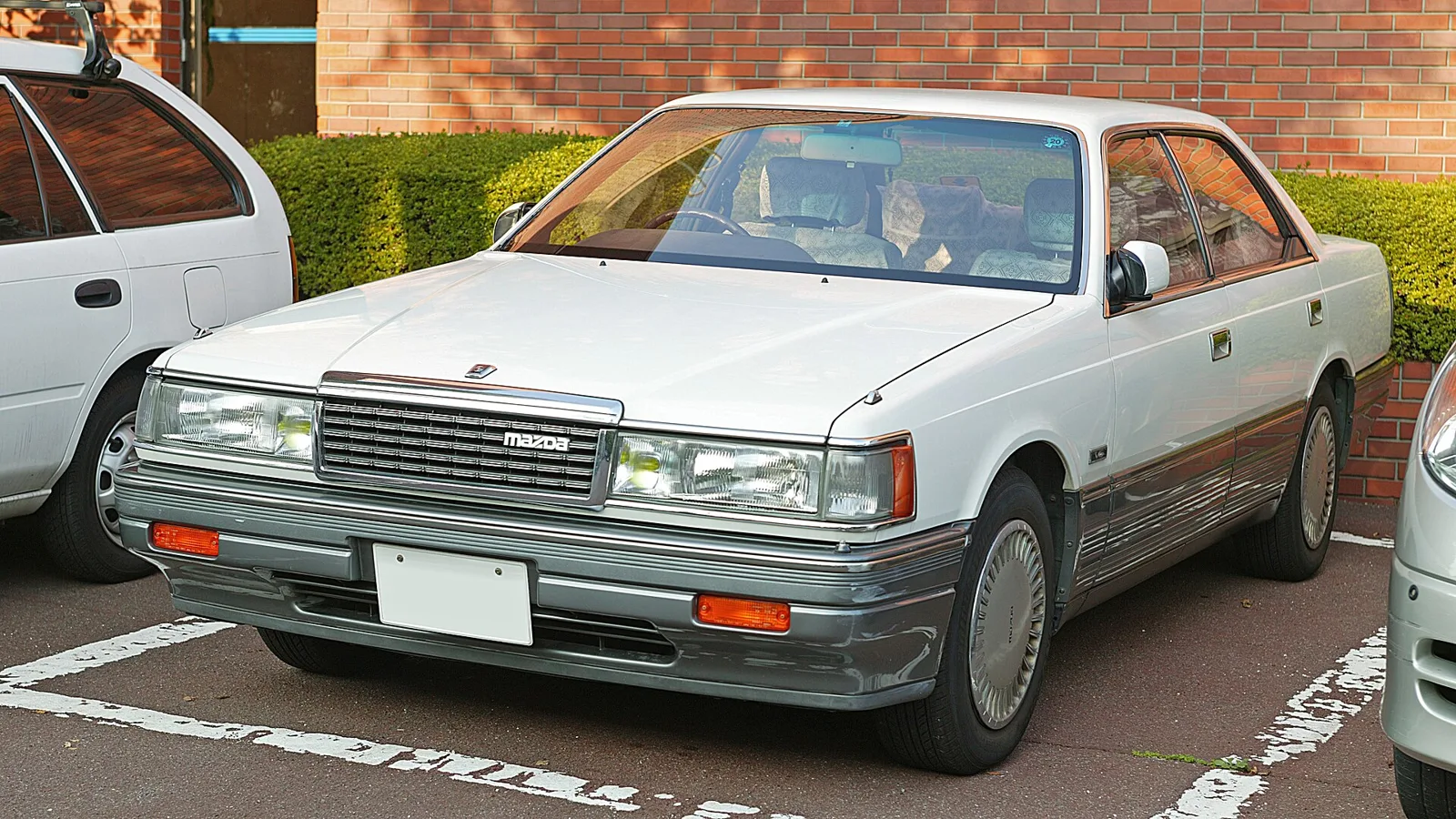
Mazda's largest sedan from 1966 to 1991, a car that wore the 1800 badge, rotary power and the 929 export name.
The Mazda Luce was an executive car built by Mazda in Japan from 1966 to 1991. Exported as the 929 from 1973, it used piston and rotary engines, and it gave way to the Sentia in 1991. Its later generations gained luxury trim as the flagship.
The Mazda Luce was an executive car that Mazda built in Japan from 1966 until 1991. Exported as the Mazda 929 for most of that span, it was Mazda's largest sedan, and it was offered with both piston and rotary engines.
What was the Mazda Luce?
Mazda's executive Luce was made in Japan between 1966 and 1991. From 1973 to 1991 it reached many export markets as the Mazda 929, and it grew into Mazda's largest sedan, with later generations gaining luxury trim and interiors as the Luce became the flagship.
The name was taken from the Italian word for light. Its successor in 1991 was the Sentia, which was also exported under the 929 nameplate.
Mazda's largest sedan for a quarter century, sold abroad as the 929 and built with piston and rotary power.
Where did the Luce's design come from?
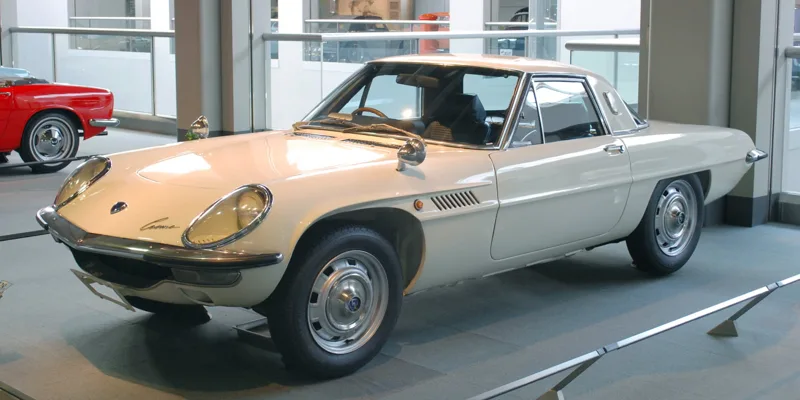
The 1965 Luce 1500 show car was designed by Giorgetto Giugiaro of Italy, following an agreement with Bertone signed in April 1962. It was low and sharp, and it looked more like a BMW Bavaria than the smaller Mazda Familia or the kei car Carol.
The production version, known as the SUA, started production in July 1966 and was launched in August. It had a higher roofline but kept the BMW-like look, and it was a front-engine, rear-wheel-drive four-door sedan with a square 1490 cc SOHC engine.
That engine made 78 PS (57 kW) at 5,500 rpm, with 114.6 Nm (84.5 lb ft) of torque. The car sold poorly at 695,000 yen.
An estate version followed in April 1967, with the same engine as the sedan. Unlike most commercial vehicles of the time, it could also be fitted with a three-speed automatic transmission.
How did the 1500 SS and 1800 engines compare?
The 1500 SS arrived in June 1967 with twin carburettors, producing 86 PS (63 kW) at 5,500 rpm. A stroked 1.8-litre (1796 cc) 1800 engine followed in December 1968, giving the Luce 1800 its name. The 1500 SS was a sportier version of the basic sedan.
The Luce 1800 produced 104 PS (76 kW) at 5,500 rpm and 152 Nm (112 lb ft) at 2,500 rpm. To clear the taller engine, the bonnet had a slight bump in the middle with an air inlet on the leading edge.
The Mark I was sold in Australia and most other export markets as the Mazda 1500 and Mazda 1800. South Africa was considered as a site for Luce assembly, and 50 examples went there for evaluation and company use in 1967. Mazda then concentrated on the 1200 Familia and compact pickups.
How did the Luce fare in the United States?
Mazda entered the United States market in 1970 with the small R100 and expanded to a full line in 1971, which included the full-size 1800. The American-market 1800 offered 98 hp (99 PS; 73 kW) and 146 Nm (108 lb ft), and its price was US$2,280, but it was a sales disappointment.
With the three-speed automatic, performance was sluggish, with a 0 to 60 mph time of 17.5 seconds and a 20.5-second quarter-mile reaching 105 km/h (65 mph). Unlike the rotary cars, the 1800 was a flop in that market.
Road and Track called the car solidly built but overly heavy, with pleasant handling and weak performance. The 1800 was gone from the American market for 1972.
In Europe the same engine was rated at 104 PS (76 kW) at 5,500 rpm, and its torque peaked at 148 Nm (109 lb ft) at 3,000 rpm, giving 60 mph in 13.4 seconds. The gap was probably down to fuel, since US petrol then had an octane index of only 85 RON, while European petrol was 95 RON.
The four-speed manual used in Europe also contributed to better performance than the three-speed automatic common in the US. The 1800 with a manual also sold in small numbers in Australia.
US imports of the 1800 show the trend clearly:
- 1970: 1,058 sedans and 937 wagons
- 1971: 1,020 sedans and 1,639 wagons
- 1972: 100 sedans and no wagons
The 1800 four-door sedan, model SVA, was built from October 1968 to March 1973, with a reported 39,401 units made. A 1800 station wagon, model SVAV, was added in 1968 and lasted until 1970.
What was the rotary R130 Luce?
The rotary-powered Luce arrived in 1969 as the R130, which was built from October 1969 to 1972. It used a 1.3-litre 13A engine producing 126 PS (93 kW; 124 hp), and quarter-mile performance over 400 metres was 16.9 seconds. It was the first rotary Luce.
Giorgetto Giugiaro, then working for Bertone, styled the R130 as a front-wheel-drive two-door coupe with front disc brakes. It was similar in concept to the NSU Ro 80, and it was Mazda's only front-wheel-drive rotary until the MX-30 R-EV.
The R130 is now a collector's item and very rare, and fewer than 1,000 were built.
How did the LA2 Luce become the RX-4?
Mazda released a second-generation LA2 series Luce in November 1972. This was a rotary-powered model that would later be exported as the Mazda RX-4. The conventionally engined Luce sedan, the LA2VS, did not reach Japan until April 1973, after starting production in March.
The range was available as a hardtop coupe, a formal sedan, a custom sedan and a station wagon, which was also sold as a van in Japan. The hardtop and custom sedan had a longer, more aggressive front end, while the formal sedan and wagon had a shorter one that was also used on export 929s.
The LA2VV wagon entered production in September 1973 and lasted until 1979, when it was replaced by the LA4 wagon. The facelifted LA3 from 1976 used a single, squarer front design for all models.
The Luce was large and luxuriously equipped, yet it still met Japanese dimension rules and was not the largest sedan Mazda sold in Japan. That title went to the short-lived Mazda Roadpacer, which was based on the Holden Premier from GM Australia.
What was the RX-4?
In most export markets the rotary Luce was sold as the Mazda RX-4 from October 1972 until October 1977. It was larger than the rotary RX-2, which was based on the Capella, and the RX-3, which was based on the Grand Familia. It used the Luce chassis.
Mazda marketed the RX-4 as a sporty yet luxurious personal luxury car. Japanese rotary models also paid less annual road tax than their in-line equivalents while offering more performance, which helped the brand's standing with the Wankel engine.
The RX-4 began as a hardtop coupe and sedan, with a station wagon launched in 1973 to replace the Savanna Wagon. The early 12A engine made 130 or 120 PS (96 or 88 kW), with the higher output reserved for the five-speed GR-II and GS-II models.
In December 1973 the 13B replaced it, producing 135 PS (99 kW) in Japan and 125 PS (92 kW) for export. The 13B was Mazda's new anti-pollution, or AP, engine, with better emissions and fuel economy but somewhat worse cold starting.
The RX-4 used a strut-type independent suspension at the front and a live axle at the rear, with discs at the front and drums at the back. Its curb weight was 1,188 kg (2,620 lb), and the wheelbase was 2,510 mm (99 in). The body was freshened in 1976.
How did the RX-4 sell in the United States?
The RX-4 ran in the United States from 1974 until the RX-7 arrived in 1978. The 13B produced 110 hp (82 kW) and 159 Nm (117 lb ft) in US emissions form, and the base price was US$4,295, with automatic transmission and air conditioning the only costly options.
Road and Track was impressed by the car's better fuel economy and price compared with the RX-3, at a time when the Wankel engine had a reputation as a gas-guzzler.
In a 1974 comparison test of six wagons, the RX-4 managed 11.7 seconds to 97 km/h (60 mph) and 18 seconds over the quarter-mile. The magazine also observed that the wagon's brakes had to work harder with an extra 136 kg (300 lb) compared with the coupe.
The RX-4 also appeared on Road and Track's Ten Best list for Best Sports Sedan in the US$3,500 to US$6,500 class in 1975.
What was the Mazda 929 and how was it named?
The first Mazda 929 arrived in 1973 as an export name for the piston-engined second-generation Luce. Earlier export names, Mazda 1500 and Mazda 1800, were dropped because engines of different displacement were coming into use across the range, which would soon have made the naming confusing.
The 929 was a large coupe, sedan and station wagon by Japanese standards. It was powered by a 1769 cc Mazda VB engine that produced 94 PS (69 kW) and 137 Nm (101 lb ft).
In 1975 the Luce and 929 gained an optional 1970 cc engine, producing 103 PS (76 kW) and 167 Nm (123 lb ft) from a two-barrel carburettor.
What was the LA4 Luce Legato?
The Luce Legato arrived in October 1977 as the LA4 series, a big, luxurious sedan with piston or rotary power. It was also offered as a four-door pillarless hardtop, which looked like a huge, square coupe, and as a wagon with a more utilitarian role.
The coupe was replaced by the Mazda Cosmo (CD). The Luce 1800 (LA4VS) and 2000 (LA4MS) sedans went on sale in October 1977, ending in July 1981 and September 1981 respectively for the Japanese market. The rotary LA42S with the 12A ran from September 1977 to April 1978, and the larger LA43S with the 13B lasted until October 1981.
The sedan was not sold in North America. It was originally called the Luce Legato, but Japanese industry authorities would not allow the change of name, so it was officially sold as the Luce. The Legato suffix survived in export, where the car was sold as the 929L. Legato is a musical term meaning a smooth transition from one note to the next.
A rotary-engined version was exported to general-issue countries and sold as the RX-9. Most RX-9s were sold with the smaller 12A engine.
The second-generation 929 arrived in 1978 for export markets, often called the 929L. In Europe a more efficient 2.0-litre inline-four producing 90 PS (66 kW) replaced the earlier engines. The 2.2-litre diesel, rated at 66 PS (49 kW) and 141 Nm (104 lb ft), was offered from 1980 to 1981.
How did the HB generation change the Luce?
The next generation was built on the HB platform, with production starting in October 1981. Exports again took the 929 name, and the Luce shared its platform with the Mazda Cosmo, which was also sold as a coupe. Japanese buyers could choose either model.
Japanese customers could buy the Luce or the rebadged Cosmo at the Mazda Auto Store network, which was renamed Eunos in 1991. From 1989 an LPG-powered 2.0-litre Luce sedan, the Mazda Custom Cab, was built for taxis and other fleets until December 1995.
The HB Luce was known in China as the Haima HMC6470L and was produced from 1992 to 2002, with a 2.0 or 2.2-litre engine and a five-speed manual gearbox.
The HB platform gave Luces and Cosmos different front ends. Export 929 sedans had the staidest design, while 929 coupes had the sportier flip-up headlamp look of the Cosmo. The 929 was introduced in 1982 in most export markets and built until 1986.
What did the HC Luce of 1986 bring?
The 1986 Luce used the HC platform and was large and luxurious, with a turbo 13B rotary among many engine options. It was still exported as the 929, and it introduced Mazda's first V6, the Mazda J engine, in 2.0, 2.0 turbo and 3.0-litre forms.
The Royal Classic, with the Limited below it, cost more than its 929 counterpart. It was factory fitted with a turbo 13B rotary or a V6, plus electric leather seats, a digital speedometer, a cool box, electronically adjustable suspension and power options throughout.
To suit Japanese size and displacement rules, the car came in two bodies. The 3.0-litre V6 went into the longer, wider hardtop, while the smaller engines, including the rotary, went into the shorter, narrower sedan. Rotary owners paid less annual road tax.
The HC generation was built alongside the Eunos Cosmo, and the HD platform gave rise to the Sentia, which was exported as the 929. 1991 was the last year of the Luce nameplate, and it was also the last year for a four-door rotary-powered sedan before the RX-8.
In the 1990s Mazda sold the body stampings to Kia, which built the HC series as the Kia Potentia between 1992 and 2001. It was sold only in South Korea, and the Potentia remained in production until May 2002.
How was the 929 sold in North America?
The 929 began US and Canadian sales in 1987. From the 1988 model year it was sold as a sedan only, with no hardtop and no rotary engine. Most cars were 3.0-litre V6 models, although a rare few 2.2-litre four-cylinder cars reached the market.
The actor James Garner was the spokesman who first presented the 929 to North American buyers. The Canadian car came with a Winter Package, which included heated seats, a higher-grade alternator, winter tyres and non-recessed windscreen wipers.
A five-speed manual was optional, but most North American 929s had two-mode electronic four-speed automatics. Top speed was 195 km/h (121 mph). A 0 to 97 km/h (60 mph) time of 9.2 seconds was recorded with the manual, while the automatics were slower at 10 seconds.
The first 3.0-litre V6 in the 1986 to 1989 929 had a single overhead cam with 18 valves. The higher-spec 929S for 1990 and 1991 upgraded it to a double overhead cam with 24 valves, and it added anti-lock brakes and ventilated rear discs.
What were the Mazda Luce specifications?
| Specification | Detail |
|---|---|
| Production span | 1966 to 1991 in Japan |
| Export name | Mazda 929, 1973 to 1991 |
| Launch engine | Square 1490 cc SOHC, 78 PS (57 kW) at 5,500 rpm |
| 1800 engine (1968) | 1796 cc, 104 PS (76 kW) at 5,500 rpm, 152 Nm (112 lb ft) |
| Rotary R130 (1969) | 1.3-litre 13A, 126 PS (93 kW; 124 hp) |
| RX-4 13B (1973) | 135 PS (99 kW) in Japan, 125 PS (92 kW) for export |
| 929 VB engine | 1769 cc, 94 PS (69 kW) |
| 1800 four-door sedan | 39,401 units built |
| R130 output | Fewer than 1,000 built |
| Final V6 engine | 3.0-litre JE, 190 PS (140 kW; 187 hp) |
| Successor | Sentia, 1991 |
| Kia Potentia | Built in South Korea, 1992 to 2002 |