From the 1963 van to the Protege and the 323 hatchbacks, the Familia carried Mazda through rotary racing, Kia production and front-wheel drive.
Built by Mazda between 1963 and 2003, the Familia was a compact family car that became the 323 in Europe and the Protege in North America. Its best-known variants included the rotary R100, the Mazdaspeed editions and the Kia-built Brisa.
Mazda built the Familia from 1963 until 2003, and it reached buyers under several names, most famously the 323 and the Protege. It grew through nine generations, its engines ran from a 782 cc four to a 2.0-litre unit, and it gave Mazda an early rotary racing record. The model was also assembled abroad and rebadged by other manufacturers for decades.
What is the Mazda Familia?
The Mazda Familia was a small family car made by Mazda from 1963 to 2003. The name is Japanese for family, and the line was replaced by the Mazda3 for 2004. Over nine generations, the car was sold in many markets under export names that changed from place to place.
Mazda's Hiroshima Plant built the cars, while knock-down kits were assembled in Taiwan, Indonesia, Malaysia, South Africa, Zimbabwe, Colombia and New Zealand. Some of those overseas plants kept making the Familia long after it had stopped at home.
A small family car that became nine generations, several brands and a rally and racing name.
What names did the Familia sell under?
Outside Japan, early models carried nameplates such as 800, 1000, 1200 and 1300. In North America the 1200 was replaced by the GLC, and later models became the 323 and the Protege. In Europe, every Familia sold after 1977 used the 323 name.
The car was also rebadged by other makers. It appeared as the Ford Laser and Ford Meteor across Asia, Oceania, Southern Africa and parts of Latin America, and from 1991 it was the Ford Escort and Mercury Tracer in North America.
How did the first Familia begin?
The first production Familia appeared in October 1963, styled by a young Giorgetto Giugiaro while he worked at Carrozzeria Bertone. Mazda had started with the R360 kei car in 1960, and a larger Mazda 700 prototype shown at the eighth Tokyo Motor Show in 1961 formed the basis of the Familia.
Mazda released the car in stages. It arrived first as a two-door commercial van, then a plusher wagon came in April 1964, followed by a four-door saloon in October and a two-door saloon in November. Private car versions added foglights and more chrome, and the Familia reached Japan in time for the 1964 Summer Olympics.
The earliest cars used a 782 cc aluminium four-cylinder nicknamed the white engine. A 985 cc overhead-cam unit arrived in the 1965 coupe, and a 987 cc pushrod engine followed in 1967 for the one-litre saloons and vans.
Around 400,000 first-generation Familias were built, and 130,473 of them were saloons and coupes. About 10,000 were exported, mainly to Australia and Oceania.
What changed in the second generation?
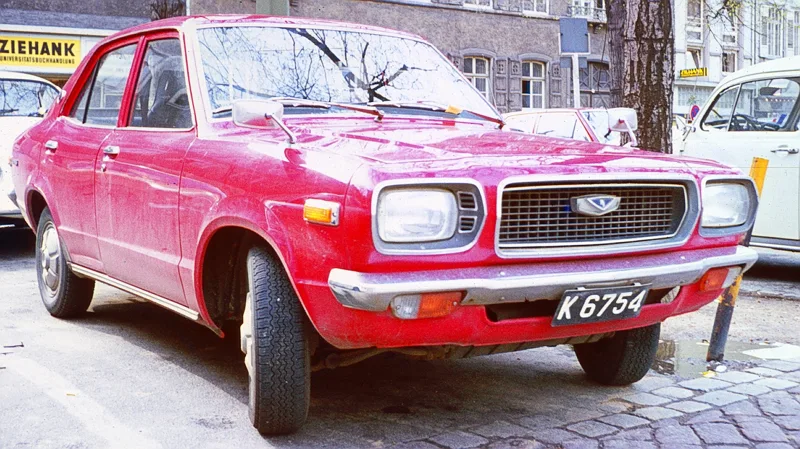
The second generation, known as FA2, appeared in November 1967 with the same pushrod 987 cc engine as the saloon it followed. In July 1968 Mazda added the rotary-engined R100, a coupe with a 982 cc Wankel powered by a 10A engine.
A larger 1169 cc straight-four arrived in February 1968 as the Mazda 1200 for export, and the car was first shown in Europe at the 1968 Paris Motor Show. After an April 1970 facelift, overhead-cam versions were offered, and their Japanese outputs were 62 and 75 PS (46 and 55 kW).
Why was the rotary R100 significant?
The R100 gave Japanese buyers a more powerful car without moving into the higher one-litre tax bracket. Its rotary engine was rated at 100 PS (74 kW), and the name came from the small carburettor that held that figure down.
The rotary was dropped in late 1973, when Mazda moved the engine to a single-distributor design and discontinued the 10A. Upgrading to the 12A would have cost the car its tax advantage in Japan, so the rotary Familia ended even though the body continued in production.
The R100 was among the earliest Mazda imports to the US, arriving through the newly formed Mazda Motors of America in 1971 and 1972. Round headlights were fitted for US rules, and sales started in a few Northwestern states before spreading.
Did the Familia Rotary succeed in motorsport?
Yes, and the early results were strong. The Familia Rotary coupe won its first outing at the Grand Prix of Singapore in April 1969, and Mazda followed up at Spa, Nurburgring and Suzuka.
At the 1969 Spa 24 Hours, two Familia Rotary coupes finished fifth and sixth behind four Porsche 911s. Mazda's Familia also took fifth at the 1969 Marathon de la Route, and at Suzuka it won the All-Japan Grand Cup easily.
In 1970 the car placed eighth at the RAC Tourist Trophy in June and fourth at the West German Touring Car race in July. Mazda also turned to Le Mans that year with rotary-powered prototypes, and the company finally won the race 21 years later with the 787B.
Did Kia build the Familia?
Yes. Kia Motors built the second-generation Familia at its Sohari Plant in Gwangmyeong, South Korea, under the Brisa name. Production began in 1973 with the B-1000 pickup, and the passenger model followed in October 1974.
Brisa is a Spanish and Portuguese word meaning breeze. Passenger production stopped in 1981, after the military government forced industry consolidation and Kia had to leave the car business to concentrate on light trucks. In total 31,017 Brisa passenger cars were built, and 75,987 including pickups.
Kia's first exports began in 1975 with 31 pickups sent to Qatar, and 1,526 Brisas were exported in all. The Brisa also appeared in the 2017 South Korean film A Taxi Driver, which dramatised the 1980 Gwangju Uprising.
What was the Grand Familia?
The Grand Familia arrived in September 1971 as a larger car aimed at the Toyota Corolla and Nissan Sunny in North America. It was intended to replace the smaller Familia, but it sold under export names including 808, 818 and RX-3.
The 1970s energy crisis then lifted Familia sales thanks to better fuel economy, so the small car stayed in production in Japan and Europe. Mazda kept the Grand Familia and Savanna as larger performance alternatives, and Kia built a version from October 1975 as the Brisa II and later the K303.
What was the third-generation Presto?
The third generation of the Presto was unveiled in September 1973, a month ahead of the oil crisis. It was about 60 mm wider than before, and Mazda marketed it as the Widebody in Japan while vans and pickups kept their narrower bodywork.
Japanese power outputs were 62 PS (46 kW; 61 hp) and 87 PS (64 kW; 86 hp), with export figures lower on the DIN basis. A lean-burn emissions update in February 1976 produced the 1300AP with 72 PS (53 kW; 71 hp), and production of the generation ended in January 1977.
What did the fourth generation bring?
The fourth generation, sold as the Familia AP and as the 323 in most markets, debuted in January 1977 as a rear-wheel drive subcompact. It replaced both the Grand Familia and the earlier Familia, and in North America it became the GLC, short for Great Little Car.
Its sales were strong, with around 890,000 examples sold in three full years of production. The car found favour with a new kind of buyer, Japanese youth, but the rear-drive layout limited interior space and left a narrow track compared with the body.
A 1979 facelift swapped the round headlights for rectangular units. In South Africa the 323 GLC sold well, and a locally built Mitsubishi Saturn 1.6-litre engine providing 77 PS (57 kW) was used to satisfy local content rules, although period testers felt it added little.
In the United States the GLC was offered with one engine at a time, and its advertising campaign set the Great Little Car words to the tune of Spanish Flea. The 1979 base three-door weighed 1,995 lb (905 kg) and measured 154.3 in (3,920 mm) long.
How was the Familia sold in Indonesia?
In Indonesia, Indomobil sold the 323 as a hatchback from 1977 to 1980, then offered a low-cost MR90 hatchback between December 1990 and 1993. The name stood for Mobil Rakyat 90, a people's car for the 1990s, and the project was overtaken by the Timor 515 plan.
The MR90 was a lightly modernised car with a 70 PS (51 kW) 1.4-litre and a five-speed transmission. A coachbuilder also produced around 50 replica Porsche 911 (964) bodies on MR90 hatchbacks, a venture that was dropped once its build quality fell below VW Group's standard.
What was the fifth-generation BD?
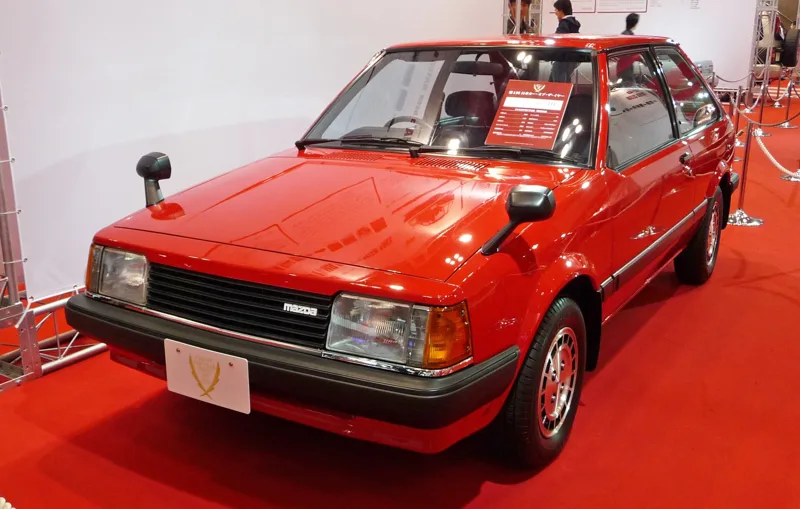
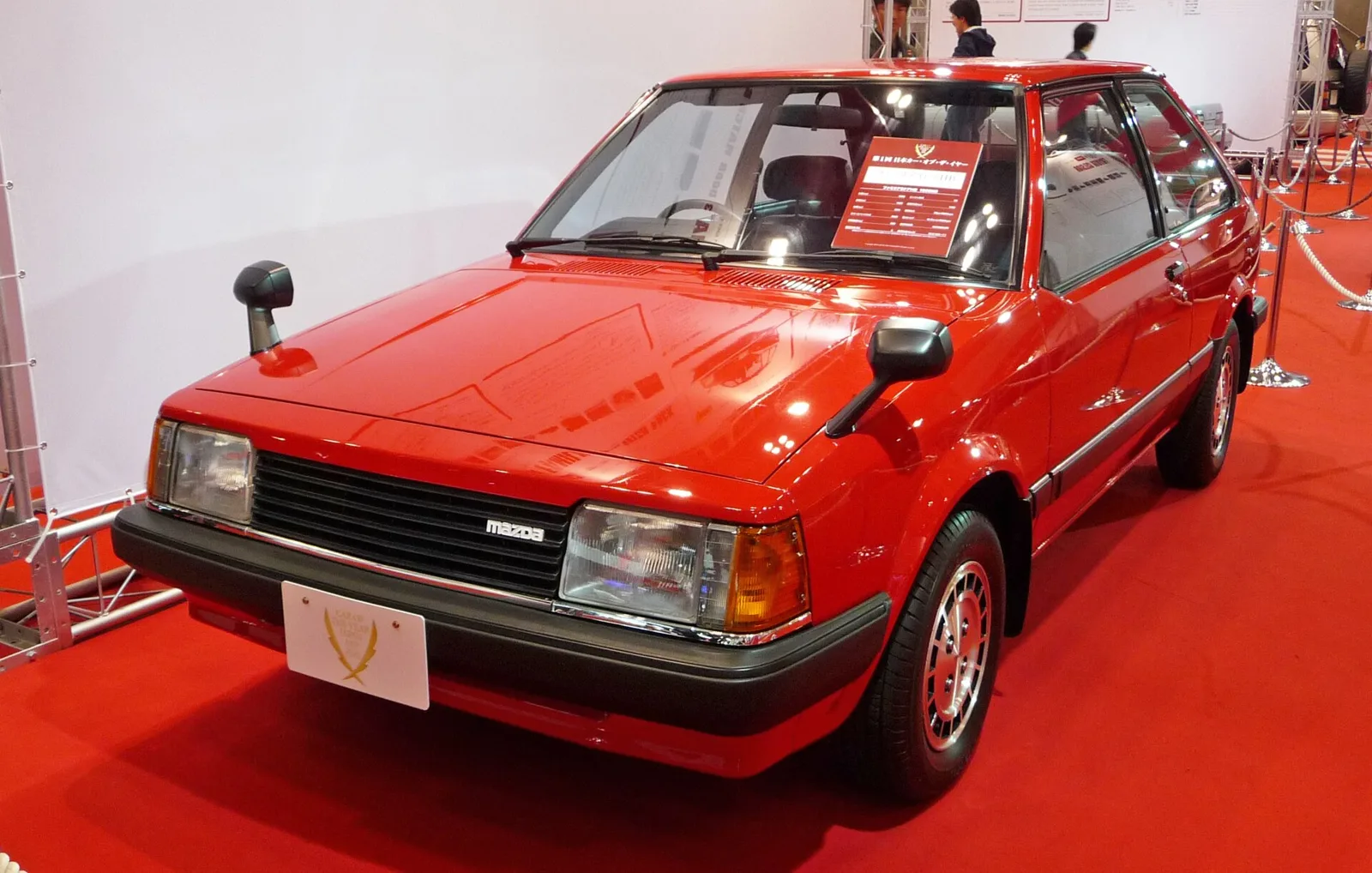
The fifth generation, the BD, was first shown on 2 June 1980 as Mazda's first front-engine, front-wheel drive subcompact. Ford had taken a stake in Mazda in 1979, and its input shaped the car, which was sold as a hatchback and saloon with a twin called the Ford Laser.
The BD won the first Car of the Year Japan Award in 1980 and was also Wheels magazine's car of the year. It was the first front-engine, front-wheel drive Mazda since the R130, and it outsold the Toyota Corolla on several occasions in Japan.
The new E-series engines came in 1.1, 1.3 and 1.5-litre sizes. Outputs ran from 55 PS (40 kW; 54 hp) in the 1.1 to 88 PS (65 kW; 87 hp) in the 1.5 E5S, and the most powerful version was sold as the 323 GT in Europe, where the car arrived in September 1980.
The turbocharged XGI Turbo arrived in Japan in June 1983 with 115 PS (85 kW), Mazda's first turbocharged piston engine. It had a small turbocharger for better low-end response, and commentators praised its smooth delivery. Japanese figures are JIS rather than DIN, and period sources suggest subtracting ten percent to compare them.
How did the sixth-generation BF sell?
The sixth-generation BF arrived in January 1985 as a full renewal. By November 1986 Familia production had reached five million units, when Mazda was building about 40,000 cars a month. Wagons and a convertible followed in November 1985 and March 1986.
Turbocharged DOHC models with front- or four-wheel drive produced 140 PS (103 kW). The 4WD version introduced in October 1985 had some success in the Group A rally class, and the GT-Ae homologation special followed in May 1988 with an extra ten horsepower.
A 1.7-litre naturally aspirated diesel with indirect injection arrived in July 1985, producing 58 PS (43 kW) at 4300 rpm and 112 N-m (83 lb-ft) at 2800 rpm. The Etude coupe was added in January 1987, and a February 1987 facelift replaced the E engines with the B series, though some markets kept the E engine.
What was the Sao Penza?
The Sao Penza was a rebadged, South African-built 323 sold in the United Kingdom between 1991 and 1993. It was priced at just over 7,500 pounds and struggled against cheap South Korean and Eastern European rivals, so only about 1,000 were sold.
The car used the 1.3-litre B3 engine, rated at 65 hp (48 kW) at 5500 rpm, with a top speed of 150 km/h (93 mph). Its prices were cut in early 1992 but not enough to revive sales, and it was withdrawn in 1993.
How did the seventh-generation BG perform?
The seventh generation BG arrived in 1989 as a three-door hatchback, a five-door liftback and a four-door saloon, and all-wheel drive versions followed in August 1989. The turbocharged GT-X, developed for World Rally Championship Group A homologation, produced 185 PS (136 kW; 182 hp).
The Familia Infini was a Japan-only special for Mazda's 70th anniversary in February 1990, with a 1.8-litre DOHC engine. Around 1,000 were made. The GT-R followed in 1992 with 210 PS (154 kW; 207 hp), and around 5,000 units were produced.
In North America the 323 saloon became the Protege, and the LX version used a 1.8-litre DOHC 16-valve engine producing 125 hp (93 kW; 127 PS). Production of the BG mostly ended on 24 May 1994, though the BG saloon continued in some markets for longer.
What was the eighth-generation BH?
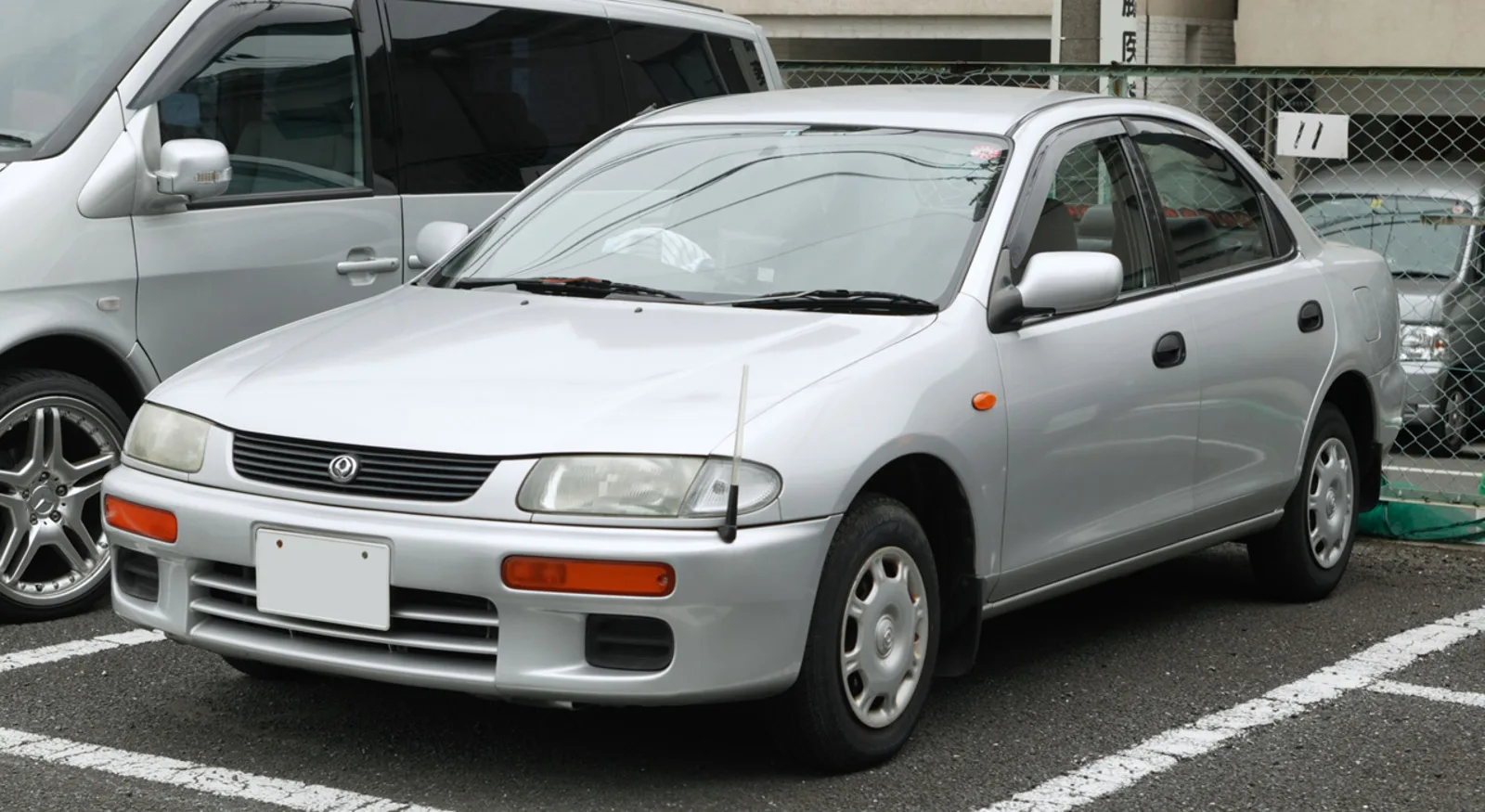
The eighth generation went on sale in Japan in June 1994 as a front-wheel drive car. Its four-door saloon was sold as the Protege in North America, and its wheelbase was only 5 mm short of the 626, a mid-size car.
A lean-burn GS-L arrived with a 94 PS (69 kW) engine that improved fuel economy by ten to fifteen percent. Isuzu supplied a 1.7-litre turbo-diesel from October 1994, and Mazdaspeed accessories were offered in Japan and the Philippines.
The Familia Neo coupe, sold as the 323C in Europe, had a divided-glass rear hatch that echoed the Honda CR-X.
The eighth generation was facelifted in October 1996, and it was discontinued in most markets in 1998. The three-door hatchback stayed on sale in Europe until October 2000.
How did the ninth-generation BJ end the story?
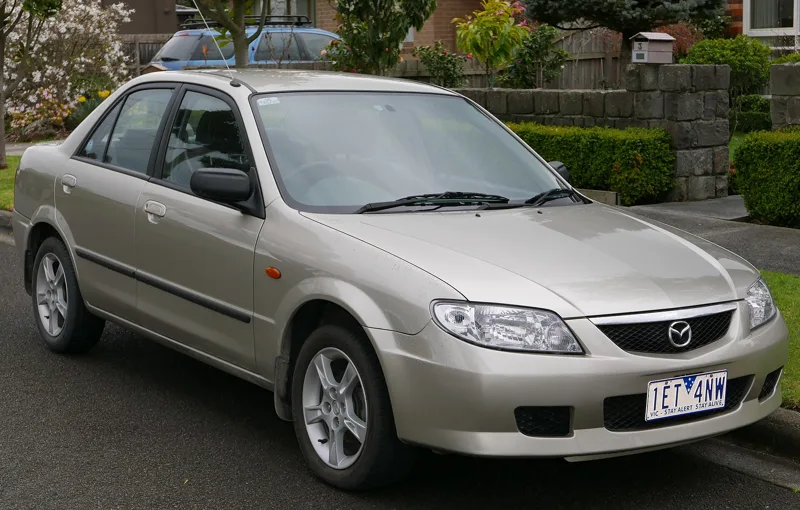
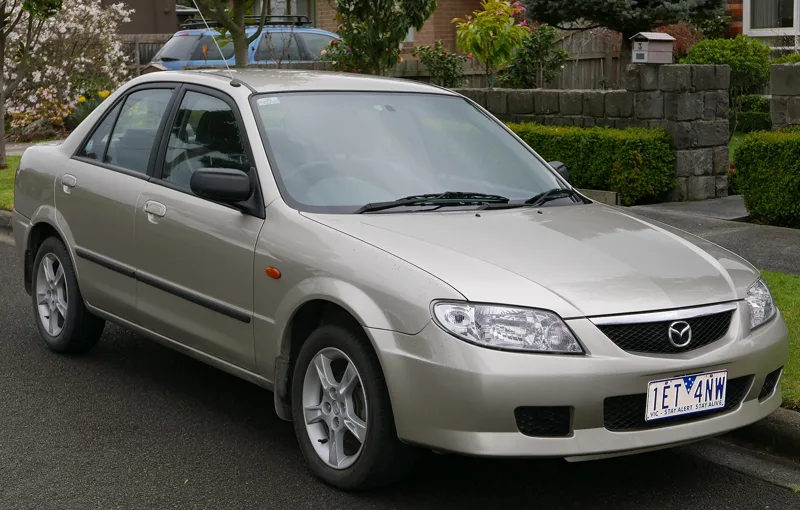
The ninth generation BJ was introduced on 9 June 1998 and went on sale on 29 September 1998 as a 1999 model. The five-door S-Wagon became the Protege5 for North American buyers, while Europe knew it as the 323F.
The Mazdaspeed Familia of May 2001 had 174 hp (130 kW; 176 PS) and was built in 200 units finished in Starry Blue Mica. The Mazdaspeed Protege of 2003 had 170 hp (127 kW; 172 PS), and 4,500 were produced in total across its versions.
Production ended on 2 October 2003, and the Mazda3 replaced the whole Familia line in the same month. The name lived on in other places, from Taiwan to South America, where the Mazda Allegro carried the family's styling for a time.
What are the main generations at a glance?
| Generation | Introduced | Notable model | Top engine |
|---|---|---|---|
| First | October 1963 | Familia coupe | 985 cc PC |
| Second | November 1967 | Familia Rotary R100 | 982 cc 10A rotary, 100 PS (74 kW) |
| Third | September 1973 | Familia Presto Widebody | 1300AP, 72 PS (53 kW; 71 hp) |
| Fourth | January 1977 | 323 and GLC | 1.4 UC, 83 PS (61 kW) in Japan |
| Fifth | 2 June 1980 | 323 GT | 1.5 E5S, 88 PS (65 kW; 87 hp) |
| Sixth | January 1985 | 323 4WD turbo | 1.6 B6T, 140 PS (103 kW; 138 hp) |
| Seventh | 1989 | 323 GT-R | 1.8 BPD turbo, 210 PS (154 kW; 207 hp) |
| Eighth | June 1994 | Protege | 1.8 BP-ZE, 114 to 140 PS (84 to 103 kW) |
| Ninth | 9 June 1998 | Protege5 and Mazdaspeed | 2.0 FS, 130 hp (97 kW; 132 PS) |
How is the Familia remembered today?
The Familia is remembered as the car that carried Mazda through its early growth, from the rotary R100 to the front-wheel drive 323 that won Japanese awards. It also gave the Protege name to North America, and the Mazdaspeed models of 2001 and 2003 stand out as its performance highlights.
The name travelled widely, through Mazda's Hiroshima plant, Kia's Gwangmyeong factory, Ford badges in Asia and the Americas, and Haima in China.