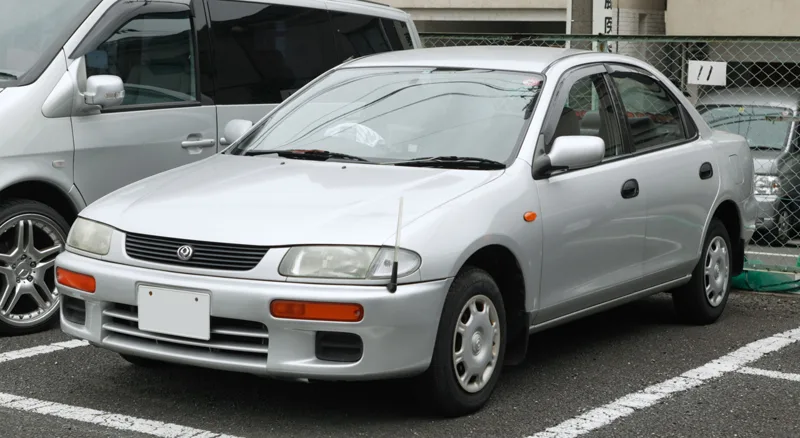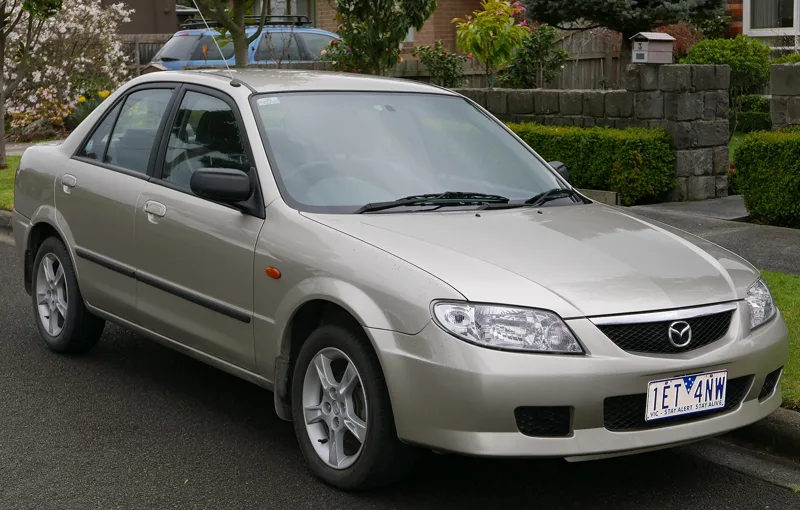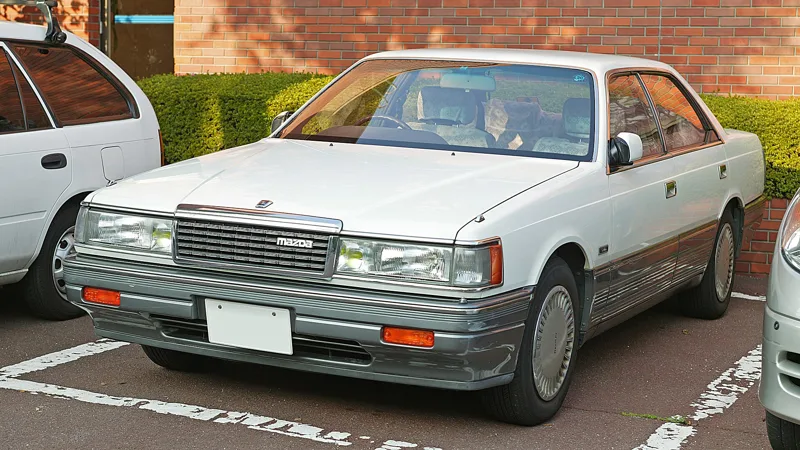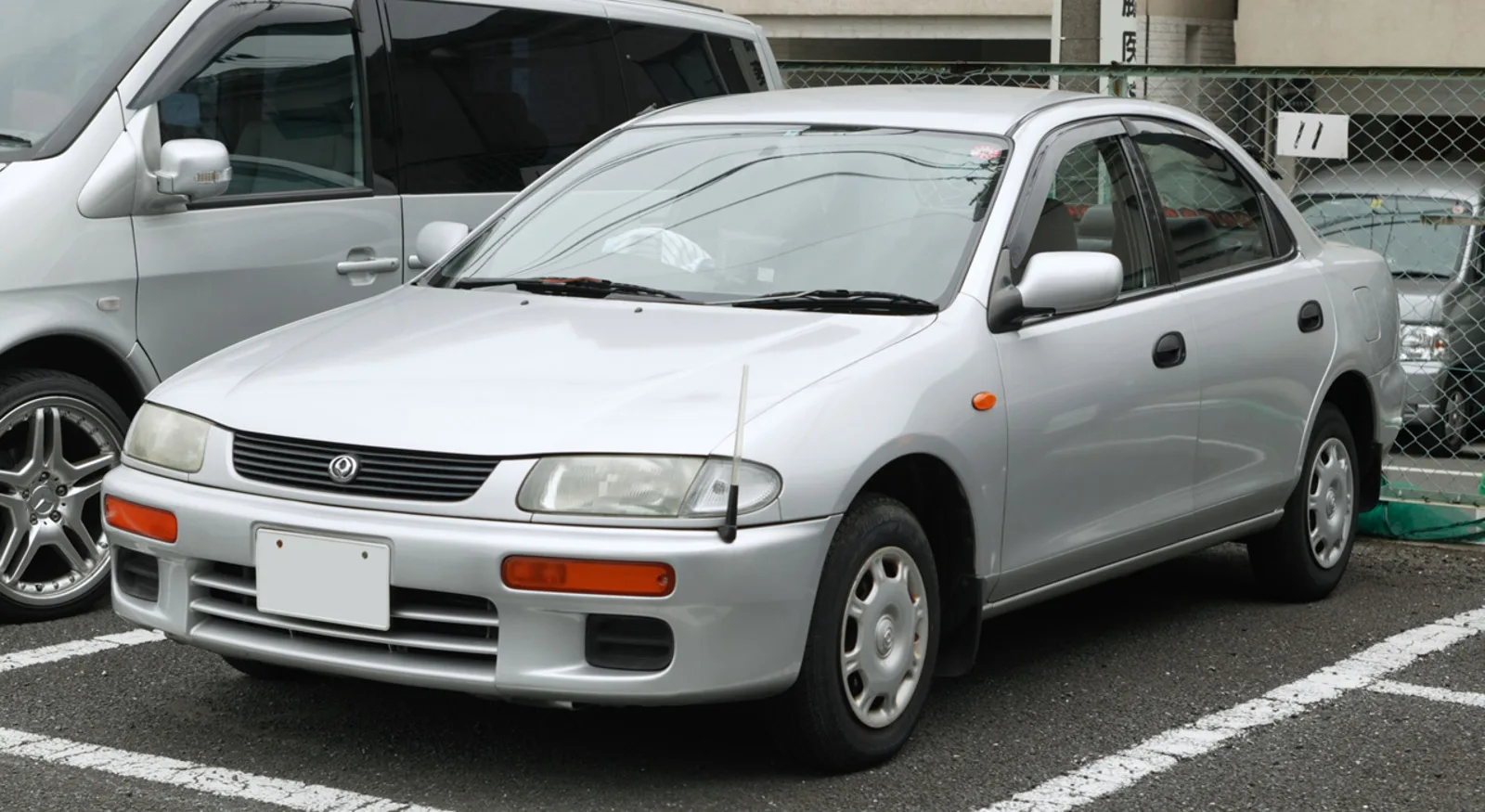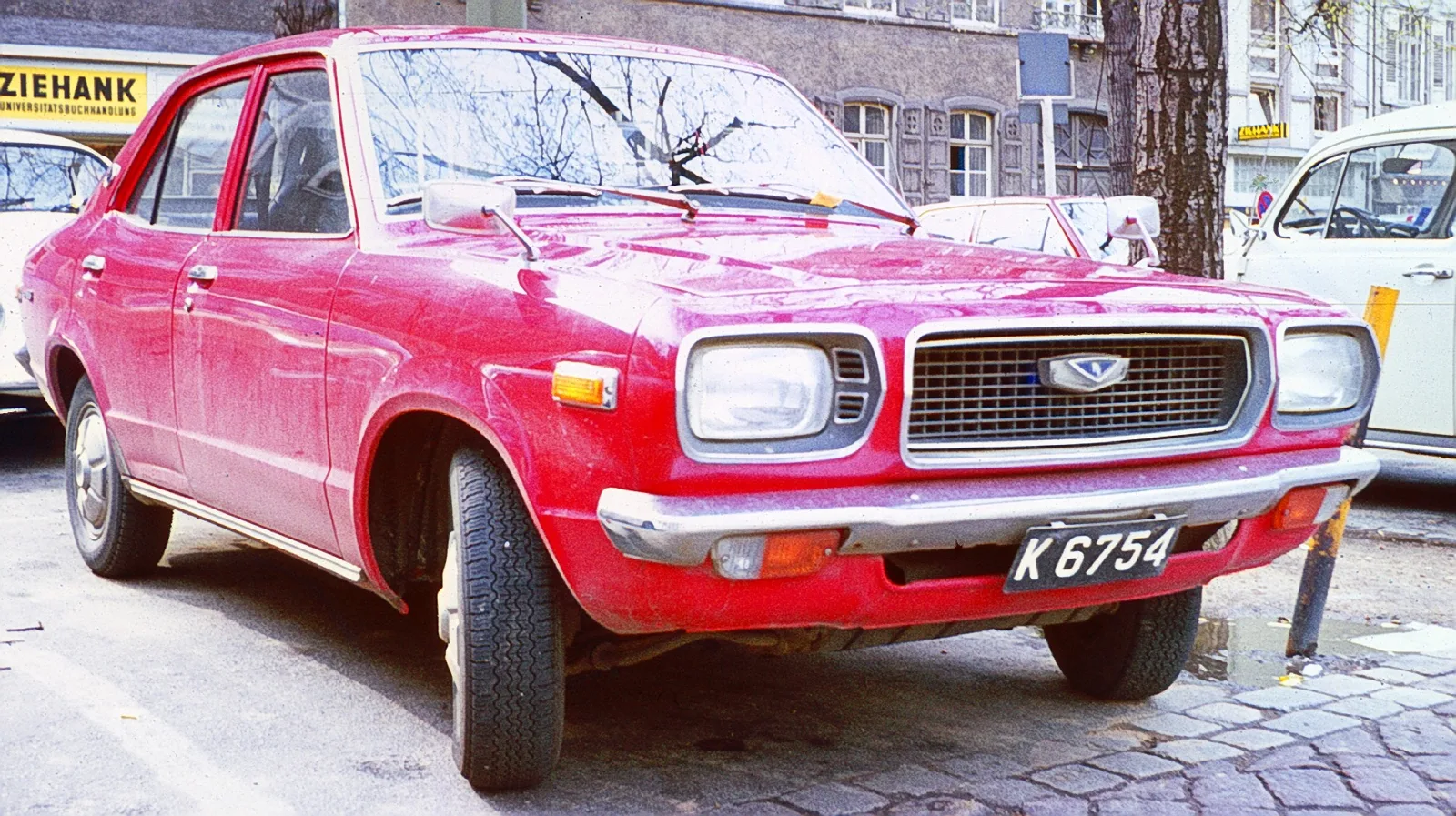
Mazda's 1971 to 1978 family car, sold as the 808 and 818 abroad, and the platform that carried the rotary Savanna and RX-3 to racing success.
The Mazda Grand Familia was a larger family car built by Mazda in Japan from 1971 to 1978. It used inline four-cylinder engines and was sold abroad as the 808 or the 818. Its rotary-powered sibling, the Savanna, was called the RX-3 overseas and became the most popular of Mazda's pre-RX-7 rotary cars.
The Mazda Grand Familia was a larger, more upscale family car that Mazda built in Japan from 1971 to 1978. It came as a two-door coupe, a four-door sedan and a five-door station wagon, and it always used an inline four-cylinder engine. The same body underpinned the rotary-powered Savanna, which was sold overseas as the Mazda RX-3.
Where did the Grand Familia come from?
Mazda designed the Grand Familia to replace the smaller Familia and to challenge the Toyota Corolla, Nissan Sunny and Mitsubishi Colt. Fuel economy then favoured the smaller Familia, but the larger car was sold worldwide as a more upscale choice.
Mazda had already developed the Grand Familia and Savanna before the energy crisis changed buyer priorities. That meant the company could sell the car worldwide as a larger, more upscale alternative to the Familia, the 1000 and the 1300.
In North America the Grand Familia was Mazda's smallest offering. Its 808 export was the only version sold there in the early years, and it was priced some $200 above the Honda Civic and Toyota Corolla.
A plain family car that carried Mazda's rotary story, sold under several names and raced in many countries.
Why did the Grand Familia have two export names?
Peugeot held trademarks on three-digit model numbers that contained a middle zero in many markets. Mazda therefore sold the car as the 808 in Asia, Australia and New Zealand, and as the 818 in many other countries, including the European markets where distributors used that name.
The US market had its own version of the story. The 808 was sold there from 1972 through 1977, and the name applied only to the 1.6-litre car. The coupe was the first body style offered, while the four-door sedan and five-door wagon were added for 1975 as the range was widened.
What engines did the Grand Familia use?
Every Grand Familia used an inline four-cylinder engine. In Japan the range began with a 1,272 cc unit and a 1,490 cc option, which Japanese buyers knew as the Grand Familia S. The 1.6-litre engine replaced the 1.5 in November 1973, although it had already been used in some export markets for more than two years.
The Japanese line-up covered a wide range of trim levels. Buyers could choose from the basic 1300 Standard up to the luxurious 1500 GL II, with the coupe carrying the GF II designation at the top of the range. A four-speed manual was the only transmission at first.
Later desmogged versions were sold as the Grand Familia AP, where AP stood for Anti Pollution. Their power outputs were considerably lower than those of the earlier cars.
- September 1971 to February 1976: 1,272 cc inline four with a two-barrel carburettor, delivering 87 PS (64 kW; 86 hp) at 6,000 rpm, 108 Nm (80 lb ft) at 3,500 rpm
- From February 1976 until October 1978 the 1300 AP made 72 PS (53 kW) at 5,700 rpm and 103 Nm (76 lb ft)
- February 1972 to October 1973: 1,490 cc inline four, 92 PS (68 kW; 91 hp) at 5,800 rpm
- October 1973 to September 1975: 1,586 cc inline four, 100 PS (74 kW; 99 hp), 137 Nm
- September 1975 to October 1978: 1500 AP, rated 90 PS (66 kW; 89 hp) at 6,000 rpm, with peak torque of 127 Nm (94 lb ft) reached at 3,500 rpm
How did the export engines differ from the Japanese ones?
The first European cars carried the 1.6-litre unit, rated 75 PS (55 kW; 74 hp). For 1976 the 1.3-litre engine became standard across Europe, with 60 PS (44 kW; 59 hp), although the 1.6 stayed on sale in several markets until later years. Sales in those markets increasingly came down to price.
Between 1972 and 1974 the US 1.6-litre engine gave 70 hp (52 kW), with 82 lb ft (111 Nm) of torque. From 1975 to 1977 it fell to 64 hp (48 kW) at 5,000 rpm. For 1976 and 1977 a 1.3-litre version was sold as the Mazda Mizer, with 48 hp (36 kW) across all three body styles.
What was the rotary Savanna and RX-3?
The Savanna was the rotary-powered version of the Grand Familia body, sold in Japan as a coupe, sedan and station wagon from September 1971 through 1978. Export markets called it the Mazda RX-3. It was smaller and sportier than the Capella Rotary, which was known overseas as the RX-2, and it was largely identical to its inline-four donor car.
The Super Deluxe coupe was heavier at 884 kg, compared with 864 kg for the other body. It carried an optional body stripe, clock, rear defogger, a centre console with a high armrest and a collapsible steering column.
Japanese buyers also gained a financial advantage from the rotary engine. Because the displacement stayed below 1.5 litres, owners avoided the tax bracket above that figure while still getting more power than a conventional inline engine.
Which rotary engines powered the Savanna?
The first Savanna used a 10A rotary engine, the same unit that powered the Familia Rotary Coupe and the R100. The 10A totals 982 cc. US cars received the larger 12A from the RX-2, which measures 1,146 cc.
The smaller-engined version carried the internal model code S102A, and the 12A version was known as the S124A. The 12A eventually replaced the 10A in most markets, although the S102A remained on sale in Japan into early 1974 alongside the revised models.
In 1972 Mazda introduced a new Transplant Coating Process for the die-cast rotor housings. It sprayed steel onto the housing and then added a chrome coating, which greatly increased engine life.
How quick was the first Savanna RX-3?
The 10A car produced 105 PS (77 kW) and 135 Nm (100 lb ft) and reached 60 mph (97 km/h) in 10.8 seconds. Its quarter mile took 17.6 seconds, compared with 16.3 seconds for the RX-2 with the 12A engine.
In September 1972 Mazda launched the Savanna GT, sold only in Japan. It used the larger 12A with 125 PS (92 kW) and a five-speed gearbox, along with lowered suspension, wider 5.5-inch rims and a unique dashboard, console and leather-look seats with GT embossed on the headrests.
What changed in the Series II and Series III cars?
The Series II Savanna arrived in mid-1973 with revised front-end sheet metal and new tail lights with twin brake lights. Its 12A used a single distributor and produced 130 PS (96 kW) and 156 Nm (115 lb ft). The model reached Australia in March 1974 with that engine.
The Series II was slower off the mark than the 10A Series I, despite its greater capacity and about 15 percent more power. The Rotary Engine Anti Pollution System hurt torque, and a weight increase of 44 kg pushed the quarter mile out to 17.7 seconds. Its top speed was better, though.
The Series III arrived in 1976 for Japan and the US, while exports to Australia and New Zealand ended. The nose gained a lower spoiler-style lip, and the rotor badge gave way to a Mazda corporate badge on the grille. Those changes made the cars much plainer, and they lost some of the model's charm.
Did the Grand Familia and RX-3 win races?
The Savanna and RX-3 were Mazda's next racing entries after the Cosmo and the Familia Rotary. The Savanna debuted with a win at the September 1971 Fuji 500. In 1972 the cars took the touring car category at the Japanese Grand Prix, where they battled Nissan's Skyline, and that result stopped the GT-R from winning 50 consecutive races.
The cars went on to claim more than 100 victories in Japan by 1976, and a special V100 edition was released to commemorate the milestone. Many of them still compete in club racing today.
In Australia the RX-3 won on and off the track. At the 1975 Bathurst 1000, one RX-3 finished fifth outright and first in its class, following a class win in 1974. The RX-3 took four of the top five places in Class C that year.
In New Zealand the car was a rally force. Local driver Rod Millen finished fifth in the 1977 Rally New Zealand, where 17 of the 100 starting cars were RX-3s. Millen won the first three New Zealand Rally Championships, in 1975, 1976 and 1977.
Internationally the car scored World Rally Championship points in 1977 and 1979, and it was the only Mazda to do so between 1977 and 1982. Earlier, a piston-engined Mazda 818 had placed eighth in the 1976 Rallye de Portugal. In North America the RX-3 had success in SCCA and IMSA competition.
How many rotary cars did Mazda build before the RX-7?
Mazda built 930,000 rotary-powered cars before the RX-7 arrived. The RX-3 was by far the most popular of them, and the coupe alone made up more than 50 percent of its total sales. Those figures shaped the design profile of the RX-7 that followed.
The Savanna and RX-3 production run ended in 1978 to make room for the new RX-7.
Who built the Grand Familia in South Korea?
Kia Motors built the Grand Familia in South Korea from October 1975, with a 1,272 cc engine rated at 72 PS (53 kW) and four-door bodywork. Locally it carried the Brisa II name, sitting beside a smaller Brisa derived from the Familia Presto. Production ended in 1981.
The early Kia cars had rectangular lights. In December 1976 an updated version with single round headlights appeared as the Kia K303, and a taxi version running on LPG was also offered. A station wagon joined the range in 1978, and production stopped in 1981 when the licence expired.
Kia was then excluded from building passenger cars until 1986. Today the Brisa II and K303 are exceedingly rare, and as of 2019 only a single example was registered in South Korea.
What are the Grand Familia specifications?
| Specification | Detail |
|---|---|
| Production | Japan, 1971 to 1978 |
| Body styles | Two-door coupe, four-door sedan, five-door station wagon |
| Engines (Japan) | Inline four, 1,272 cc to 1,586 cc |
| Top Japanese output | 100 PS (74 kW; 99 hp), 1,586 cc |
| Export names | Mazda 808 and Mazda 818 |
| US 808 price | $2,997 |
| US 1.6-litre output | 70 hp (52 kW) 1972 to 1974; 64 hp (48 kW) 1975 to 1977 |
| Rotary sibling | Savanna (Japan), RX-3 (export) |
| Rotary displacement | 982 cc (10A) and 1,146 cc (12A) |
| Savanna GT | 125 PS (92 kW) from the 12A, five-speed gearbox |
| Rotary cars built before the RX-7 | 930,000 |