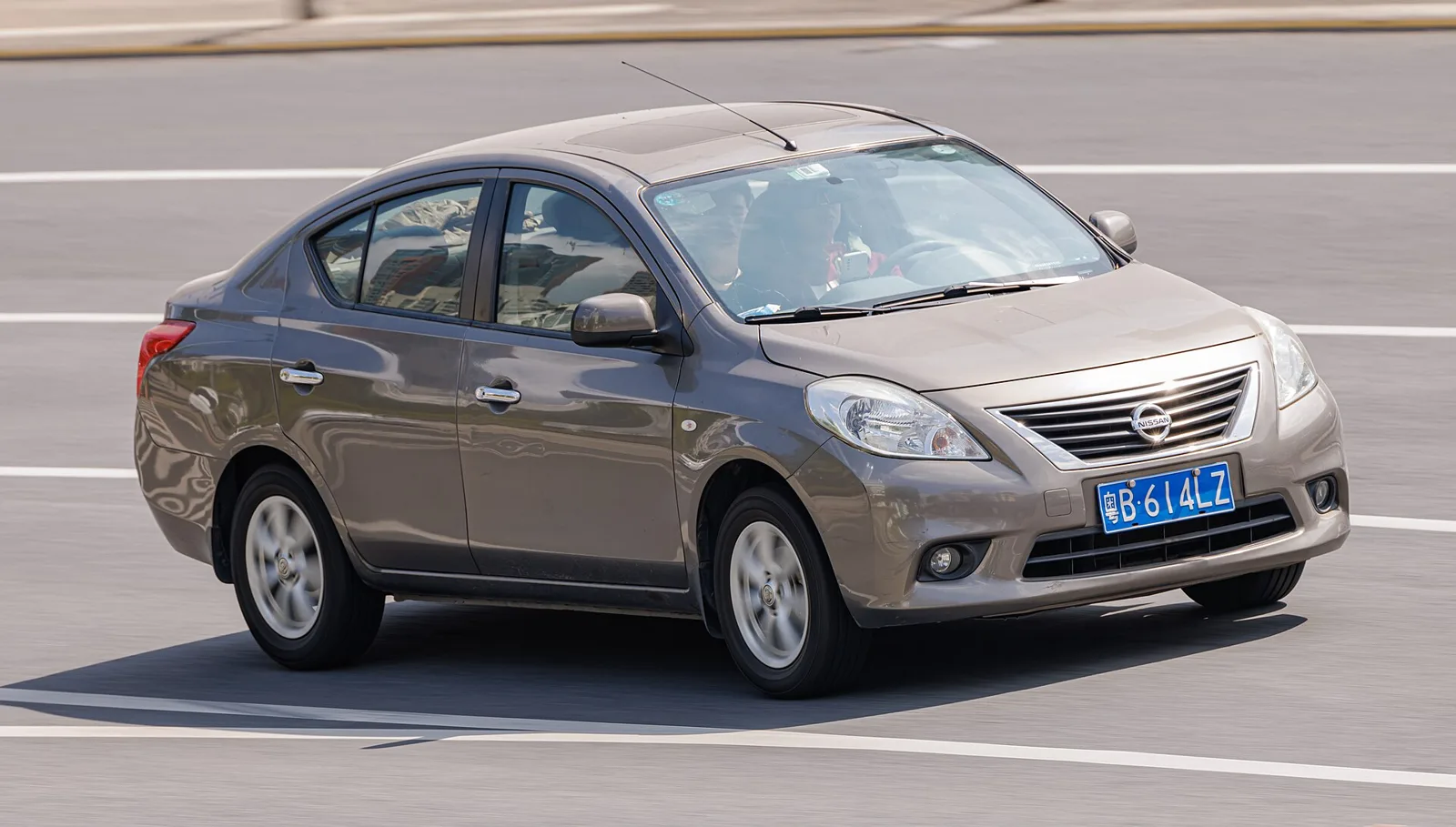
From the 1966 B10 that started as the Datsun 1000 to the B15 that closed the nameplate in Japan, the Sunny was Nissan's everyday small car for decades.
The Nissan Sunny was a small car built by Nissan from 1966 to 2004 that competed with the Toyota Corolla. It began as the B10, became front-wheel drive with the B11 in 1981 and ended in Japan with the B15, after which the nameplate lived on abroad.
The Nissan Sunny was a small family car that Nissan built from 1966 until 2004. It began life as the Datsun 1000 in export markets and was designed to take on the Toyota Corolla. Over its long life it moved from rear-wheel drive to front-wheel drive, from subcompact to compact, and from Datsun badges to Nissan ones.
Where did the Sunny come from?
The Sunny launched in September 1966 as the B10, a two-door sedan with a matching VB10 van. It was built on a dedicated platform called the B series, which came with the newly acquired Aichi Manufacturing company. The car was designed to compete directly with the Toyota Corolla.
The name itself was chosen in a public contest, and Nissan founder Yoshisuke Ayukawa announced the result. Nissan's mail-in campaign drew over eight million submissions, and the name Sunny was suggested 3,105 times before it was announced on 19 February 1966.
The first engine was a 988 cc inline-four, the A10. In Japan the car was sold through the Nissan Satio Store channel, a dealer network set up for the Sunny alone.
The coupe came in February 1968. Japanese buyers knew it as the Sunny Coupe, and it was offered in a wide range of trim levels and factory options that by then were extensive.
A small Nissan built to beat the Corolla, which went on to outlive the Datsun brand and carry the Sentra name abroad.
How did the second generation take on the Corolla?
The second-generation Sunny, the B110, launched in January 1970 and was sold abroad as the Datsun 1200. It was slightly larger in every dimension than its predecessor, which matched the growth of its main rival.
Its MacPherson strut front suspension came with optional disc brakes, and the car used an enlarged version of the A10 engine. A five-door station wagon joined the three-door wagon, and a GX trim with a twin-carburettor engine was added in April 1970 for the Japanese market.
Toyota had given the Corolla 1,100 cc and Nissan answered with 1,200 cc, so the two cars were locked in a contest over capacity. The B110 made its racing debut at the Fuji 200-mile race in November 1970, where it finished as the class winner for works driver Makoto Suzuki. In Australia and New Zealand the Datsun 1200 was prized as a rally car, and a Datsun 1200 won Class A at the 1970 Bathurst 500.
The car also sold well outside Japan. In Britain the Datsun 1200 became the company's best seller, with sales rising from about 6,000 in 1971 to over 30,000 in 1972. In South Africa the B110 was sold until 1976, and more than 275,000 were sold there in total.
What did the third generation bring?
The third generation, the B210, was first shown on 1 May 1973. It was exported as the Datsun 120Y and, in North America, as the Datsun B210. Its launch during the 1973 oil crisis helped it sell in large numbers.
The B210 wagon was sold in Japan as a commercial van, with the lowest-powered 1.2-litre engine. The B210 came in six body styles, including the four-door sedan, the two-door sedan, the two-door fastback and several wagon and van versions. The fastback coupe retained its styling, but it gained a full hatchback door in place of the earlier small boot lid.
A minor facelift in February 1976 brought a changed grille, new wing mirrors and hubcaps. The most important change was under the bonnet, where the engines were upgraded to meet Japan's 1976 emissions standards.
In North America the B210 was the fuel-economy leader. Its US five-speed version was rated 50 mpg-US (4.7 L/100 km; 60 mpg-imp) on the highway, and the B210 started at US$2,849 in 1975. Road and Track was impressed by its 27 mpg-US (8.7 L/100 km; 32 mpg-imp) economy, even while it criticised the modest performance.
Why is the fourth generation the last rear-drive Sunny?
The fourth generation, the B310, went on sale in November 1977. It was the last Sunny to use a front engine and rear-wheel drive, and it was the final Sunny sold under the Datsun brand in Japan.
The B310 was known for its high equipment levels and build quality. It kept the leaf-spring rear on the vans, but the passenger models moved to a coil-spring four-link rear suspension with coilover struts at the front. The fuel tank was relocated beneath the boot floor in the sedans, which freed up luggage space.
Production of the B310 in Japan ended in December 1995, but the design lived on in other markets. In Taiwan Yue Loong continued building the series until the 1990s as a lower-priced alternative, and the North American version was sold as the Datsun 210.
The Datsun 210 was offered as a two-door or four-door sedan, a five-door wagon and a three-door hatchback coupe. The 1981 MPG model reached 40 mpg-US (5.9 L/100 km; 48 mpg-imp), and the 210 remained on sale until April 1982, when the Sentra replaced it.
What made the B11 a turning point?
The fifth generation, the B11, debuted at the late 1981 Tokyo Motor Show. It was the first front-wheel-drive Sunny, arriving about a year and a half ahead of the Corolla's switch to the same layout, and it was sold in North America as the Nissan Sentra from 1982.
The B11 was the first Sunny to be offered with a diesel, a 1.7-litre CD17 producing 61 PS (45 kW). A turbocharged 1.5-litre fuel-injected version arrived in Japan in September 1982 as the Sunny Turbo Leprix, a model sold in the United Kingdom as the Sunny Maxima Coupe.
The B11 was marketed as the Nissan Tsuru in Mexico and became the most sold car in Chile in 1989 and 1990. The Sunny California wagon in Japan was a fuel-injected turbo model from October 1983, and the MPV-style Prairie was introduced in Japan in 1982 on the same platform.
The B11 was regarded as one of Nissan's most modern ranges at the time, and it was the first Sunny to abandon the Datsun name formally, although a small Datsun badge still appeared on the boot lids for two years.
How did the sixth and seventh generations look?
The sixth generation, the B12, was introduced in September 1985. Its squared-off styling was unfashionable by the mid-1980s, and the angular look was insisted upon by Nissan's design chief at the time. Sales suffered as a result.
A four-wheel-drive version appeared during the B12's run. The sporting RZ-1 coupe was introduced in February 1986 and replaced the Turbo Leprix. Its name stood for Runabout Zenith-1, since Nissan was already using the Z name for the Fairlady Z.
The seventh generation, the B13, arrived in 1990 and kept much of the B12's design language in a more rounded body. In the United States the sporting two-door Sentra SE-R was marketed as a rival to the BMW 2002, and in Mexico the car became the Tsuru.
In Mexico the Tsuru was the best-selling car in its category until 2017. It was discontinued in May 2017 after new safety rules, and a special Buen Camino edition marked its end there.
How did the final generations end the line?
The eighth generation, the B14, appeared in December 1993 and was built until 1998. It came with four-wheel-drive variants and was produced in Karachi through a joint venture with Ghandhara Nissan until 2001 for local and export markets.
The luxury Presea remained in Japan as a Sunny companion to the Laurel, and the Wingroad spun off from the Sunny California wagon as a highly specified estate for Japanese buyers.
The ninth generation, the B15, was built from October 1998 to the end of 2004. It had 1.3, 1.5, 1.6 and 1.8-litre petrol engines and a 2.2-litre diesel in Japan. The B15 was the last Sunny, and in 2004 the Tiida and Bluebird Sylphy replaced it in Japan.
The Sunny name did not end with the B15. It continued on rebadged Pulsar and Sylphy models in other markets, including the N17 sold in China and parts of the Middle East.
How did the Sunny truck line develop?
The truck range began with the Datsun Sunny truck, the B20, which debuted in February 1967 on the VB10 van chassis. The B120 followed in February 1971 on the B110 chassis, and the range became a commercial mainstay.
In South Africa the pick-up was sold for 37 years, and in 1977 it was the most sold commercial vehicle of any type there. Japanese vans were also sold with the 1.2-litre engine, which kept their running costs low for commercial users. The truck line was also one of the longest-running parts of the Sunny family, and it outlasted several of the passenger models.
How did the Sunny perform in North America?
The Datsun 1200 sold more than 133,000 units across three American model years. Coupe sales reached 89,541, and two-door sedan sales reached 43,761. In 1973 the EPA's rating put the Datsun 1200 at the top of the fuel-economy table, with 28.7 mpg-US (8.2 L/100 km; 34.5 mpg-imp).
The B210 continued as the fuel-economy leader, and the Datsun 210 followed it. In 1981 the special 210 MPG model used a small-port 1.4-litre A14 with five-speed overdrive to reach 40 mpg-US.
The Sentra then became the mainstream C-segment Nissan in North America, and the B12 Sentra stayed in the line-up until the early 1990s. The Sunny's US story therefore moved from Datsun economy cars to a Nissan compact line.
Sunny specification by generation
| Generation | Years | Drive | Notable detail |
|---|---|---|---|
| B10 | 1966 to 1970 | Rear-wheel drive | Launched as the Datsun 1000 abroad |
| B110 | 1970 to 1973 | Rear-wheel drive | Sold abroad as the Datsun 1200 |
| B210 | 1973 to 1978 | Rear-wheel drive | Datsun 120Y and B210 in export markets |
| B310 | 1977 to 1981 | Rear-wheel drive | Last rear-drive Sunny |
| B11 | 1981 to 1985 | Front-wheel drive | First front-drive Sunny; Sentra in North America |
| B12 | 1985 to 1990 | Front-wheel drive | RZ-1 coupe from February 1986 |
| B13 | 1990 to 1993 | Front-wheel drive | Tsuru in Mexico |
| B14 | 1993 to 1998 | Front-wheel drive | Four-wheel-drive variants |
| B15 | 1998 to 2004 | Front-wheel drive | Last Sunny in Japan |
_China_(10).jpg)