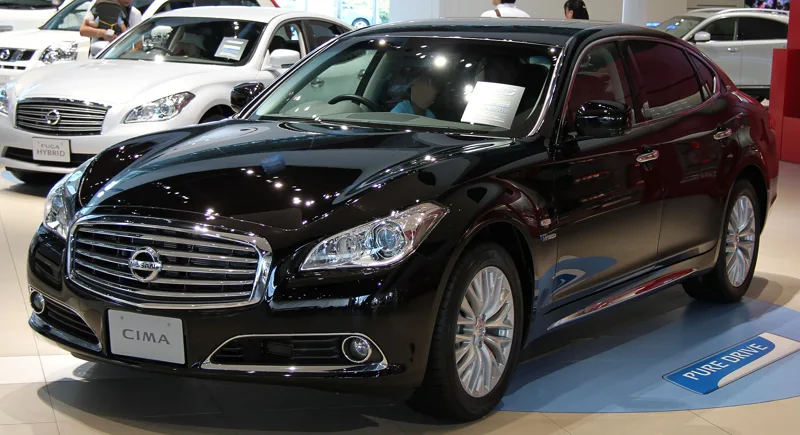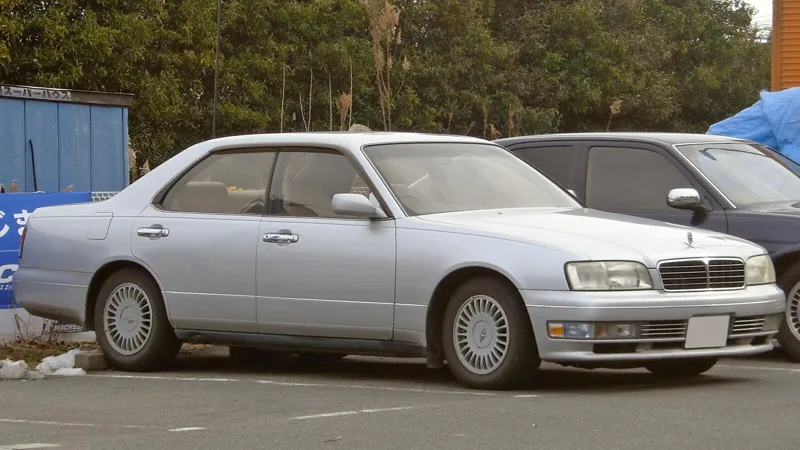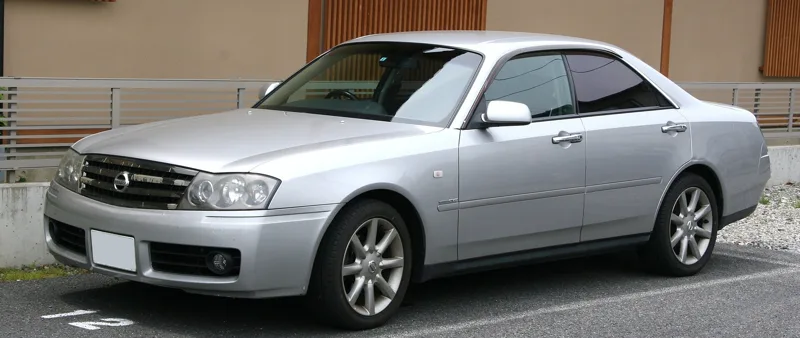
Nissan's top Japanese sedan for 45 years, from the hand-built H150 with its 4.0-litre V8 to the 2003 fourth generation.
The Nissan President was a Japanese flagship luxury sedan built from 1965 to 2010. It began as a hand-built executive limousine with a V8 option and was later built on an assembly line, with four generations in total. The V8 stayed in the range until production ended in 2010.
The Nissan President was Nissan's flagship luxury sedan in Japan from 1965 until 2010. It was built first as an executive limousine, and over four generations it moved from hand-built cars to an assembly-line model with a V8 at its heart.
What was the Nissan President?
The Nissan President was a Japanese luxury sedan that Nissan made and sold from 1965 until 2010 as the top of its range. It was available only through Nissan Store dealerships, which later became Nissan Blue Stage outlets, and at first it was marketed in Japan as an executive limousine.
Exports reached a handful of countries, among them Singapore and Hong Kong, but overseas sales stayed small. When the President arrived in 1965 it carried the Nissan badge, while most other Nissan products of the time were sold under the Datsun brand.
Nissan's hand-built flagship for executives and officials, which moved to an assembly line and a V8 that outlived its rivals.
Why was the first-generation President built?
The first generation, designated H150, was introduced in October 1965. It replaced the Cedric Special as Nissan's top-of-the-range model and was sold only through Nissan Store dealers. Its external dimensions and engine displacement put it in the top road tax bracket, which made ownership expensive.
The President appeared after the Toyota Crown Eight debuted in 1963. Nissan developed it as a possible limousine for the Imperial Household Agency of Japan, and as a corporate car it faced the Mitsubishi Debonair, which was mainly used by Mitsubishi's own executives.
Each President was fully hand-built.Its look was close to that of the smaller and more popular Nissan Bluebird, introduced in 1964, and like the Bluebird it was built at Nissan's Oppama plant in Yokosuka, Kanagawa.
Left-hand drive versions, designated HL150, numbered under 200. They went abroad, chiefly to Japan's overseas diplomatic posts and to Japanese firms working overseas.
What engines did the first-generation President have?
The President came with either the 4.0-litre Y40 V8, developed specially for the model and rated at 180 PS (132 kW), or the 3.0-litre H30 straight-six. The V8 can be identified by its twin exhaust, while the six has a single pipe on the left side.
The front wheels used double wishbone suspension, while the rear used a live axle on leaf springs.
The car was lavishly appointed for its time. It served as the official car of Prime Minister Eisaku Sato, while the Emperor rode in one of four Prince Royals built by Prince Motor Company. Every car was tested individually and run in before handover.
A V8 was regarded as an extravagant feature, because urban two-way streets in Japan are usually zoned at 40 km/h (25 mph) or less.
What did the 1971 President offer?
In 1971 Nissan offered the Electro Anti-lock System, known as EAL, as an option on the President. It became Japan's first electronic anti-lock braking system, and most buyers chose the fully loaded Spec-D with the Full Power Equipment specification. It was therefore a notable first for Japanese braking technology.
The Spec-D added power seats, power windows, twin air-conditioning units, central door locks, plenty of interior lights and a remote-controlled auto-tuning radio. Every trim came with a split rear bench that could be power-reclined opposite the driver.
The Spec-C was close to the Spec-D, minus the power extras. The Spec-B ran the 130 PS (96 kW) H30 six, taken from the Cedric Special 50, and the base Spec-A also used the H30 but with a three-speed column-shift manual, the only manual version in the range.
The Spec-C trim was dropped after 1971, and all V8 models were then sold only as Spec-D. In October 1971 the outside mirrors moved closer to the front, the wipers were repositioned to sweep more glass, and the automatic changed from Borg-Warner to a Nissan unit, announced by a Nissan Matic badge at the rear.
What changed with the second-generation President?
The second generation, designated 250 and H250 for the V8 versions, arrived in August 1973 with a thorough facelift. The chassis was essentially unchanged, but the front and rear ends were redesigned, which lengthened the car by 235 mm (9.3 in), mainly through a longer rear overhang.
The Y40 V8 was replaced by the 4.4-litre Y44, and the H30 six remained available until 1974 or 1975. The original lineup had two six-cylinder models, type A with a three-speed manual and type B with an automatic, plus the eight-cylinder type D, which was automatic only.
The President was a very expensive car in Japan. Annual car tax on the V8 was 54,000 yen in 1973, while the average annual salary for a recent university graduate was 57,000 yen at that time.
How did the V8 become the only engine?
In April 1975 all trim levels except the type D were dropped, which removed the H30 engine and the manual transmission. From then on every President had a V8 and an automatic. The V8 also gained electronic fuel injection, becoming the Y44E to meet stricter emissions standards.
The type D came in nine sub-models, from D-1 through D-9. Top versions came with power features throughout, satin weave nylon seats, early anti-lock brakes, automatic climate control and a digital clock, which made it the first Nissan with one.
Emissions updates followed. In July 1976 the engine was modified for the 1976 rules and the model code changed to C-H251. The luxurious Sovereign trim arrived in August 1977 with the E-H252 code and a redesigned grille, and the type C trim returned in 1978.
In November 1982 the President received better suspension, a bigger fuel tank, a revised cluster and dashboard, a new grille, and square halogen headlamps replacing the round units. The Sovereign VIP, with an air-sprung rear seat and other comforts, followed in January 1985.
How many second-generation Presidents were built?
The 250 series remained in production until October 1990, and a total of 33,128 units were registered in Japan. Ratings were quoted in gross horsepower until January 1990, after which the industry-standard net figures applied. That total covers cars registered in Japan only.
The change lowered the claimed output from 200 PS to 165 PS (147 to 121 kW) net, although the car's actual output and performance did not change. Smaller updates in the period included an AM/FM cassette stereo with a slave clock in March 1980, and a shift lock in March 1989.
What was the third-generation JHG50?
The third-generation President, designated JHG50, debuted at the Tokyo Motor Show in October 1989, with sales beginning a year later. Unlike the earlier hand-made cars, it was the first President built on an assembly line. Its styling marked a clear break from the earlier cars.
Its styling took cues from Europe, and its front resembled the contemporary Jaguar XJ. A short-wheelbase version on the PHG50 chassis went to the United States as the Infiniti Q45, and it had no grille, which set it apart from the Lexus LS and the Acura Legend.
Project 901 gave the President a renewed role as a senior corporate limousine with high standard equipment. The standard upholstery was Connolly leather or a wool and silk blend, and extras included a diamond inlay on the key, a gold-plated hood ornament and rear badging, and ultrasound massage in the rear seats.
Buyers could choose Full-Active Suspension on the JHG50 or PHG50, or conventional coil suspension on the JG50 or PG50. A multi-link layout was used at all four wheels, similar to the Nissan Laurel. The hood ornament was a stylised military headdress for ceremonial duties, called a feather bonnet or busby.
What technology did the 1990s President bring?
The new model introduced a world first in 1993, an SRS airbag for the left-hand, curbside rear seat passenger. The President and the Q45 shared the new 4.5-litre VH45DE V8, which was tuned down by ten horsepower to 270 PS (199 kW) to avoid an overly sporting sound.
A short-wheelbase President JS arrived in 1993 for personal owners, positioned as an alternative to the Cima, Cedric and Gloria. The President JS and the Infiniti Q45, both exclusive to Nissan Prince Store locations, were discontinued in October 1997.
Autech, Nissan's special vehicles subsidiary, built a Royal Limousine with a split passenger compartment for 1993. It was created as a possible replacement for the four 1966 Prince Royals used at the 12 November 1990 coronation of Emperor Akihito, but it was not accepted for the role.
How did the third generation develop up to 2002?
In 1994 a minor facelift came with the revived Sovereign trim for the long-wheelbase model. A further facelift in 1998 brought the PHG50 update, and the previous Infiniti Q45 was replaced by the Nissan Cima, which was fitted with Japan's rear passenger airbag option.
In 1996 Autech introduced the Relax Seat, which let the front passenger seat fold flat and slide forward, which gave rear passengers extra legroom and a seat they could extend and recline. The rear passenger airbag was dropped in favour of side curtain airbags on both sides.
The 1999 model year brought a revised front grille, integrated fog lamps, xenon headlights and an upgraded audio-visual system with a navigation system called Compass Link. A rear monitor was hidden behind a flip-down door on top of the front centre console. The PHG50 remained in production until 2002, when the F50 chassis arrived.
What was the fourth-generation President?
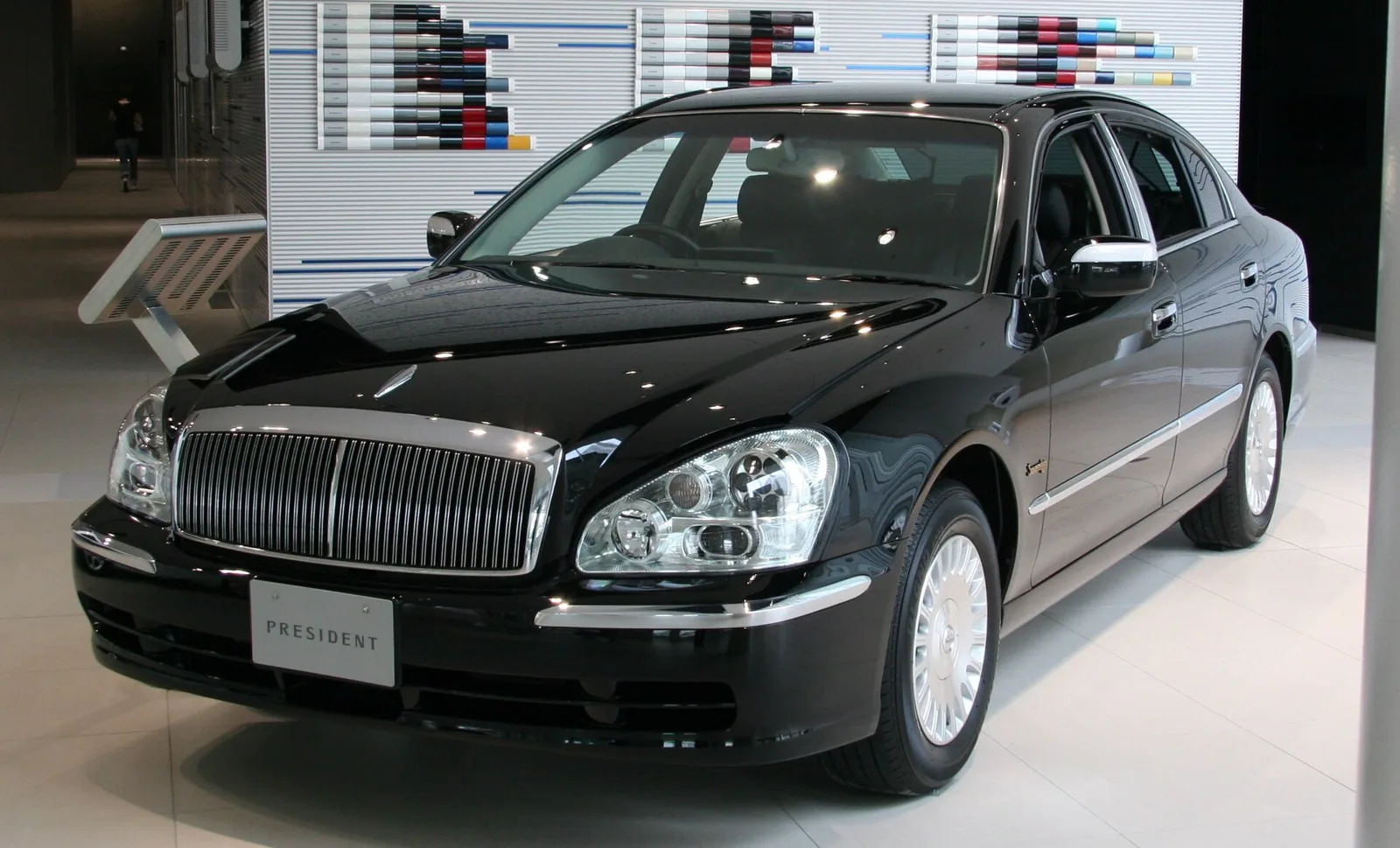
The fourth generation arrived in October 2003 and was based on the F50 Nissan Cima, which had debuted in 2001. It used the same 4.5-litre VK45DE V8 and kept its place as the flagship at the reorganised Nissan Blue Stage dealerships.
Two versions were offered, both badged Sovereign, with five-passenger or four-passenger seating. The front suspension changed to MacPherson struts, while the multi-link rear suspension remained, and the Relax Seat feature carried on.
The four-seat package also offered a Rear Seat VIP version with a rear seat monitor that folded down from the ceiling, a rear DVD player, a Bose 8-speaker sound system, and a rear seat that could be extended and reclined with an integrated ultrasonic massage and heat function.
The fourth generation competed for three years with the all-new Mitsubishi Dignity, which Mitsubishi built with front-wheel drive. It remained Nissan's traditional rival to the Toyota Century and Toyota Celsior. The President earned a ULEV emissions certification in April 2005, and the Compass Link system was upgraded to CarWings in February 2008.
In 2009 the hood ornament changed from a raised type to an embedded one, near the end of production.
Why did production end in 2010?
In August 2010 Nissan announced that it had stopped production of both the Cima and the President, which shared the same chassis. The two models needed safety upgrades to meet the latest regulations, but weak sales meant the company could not recoup the costs.
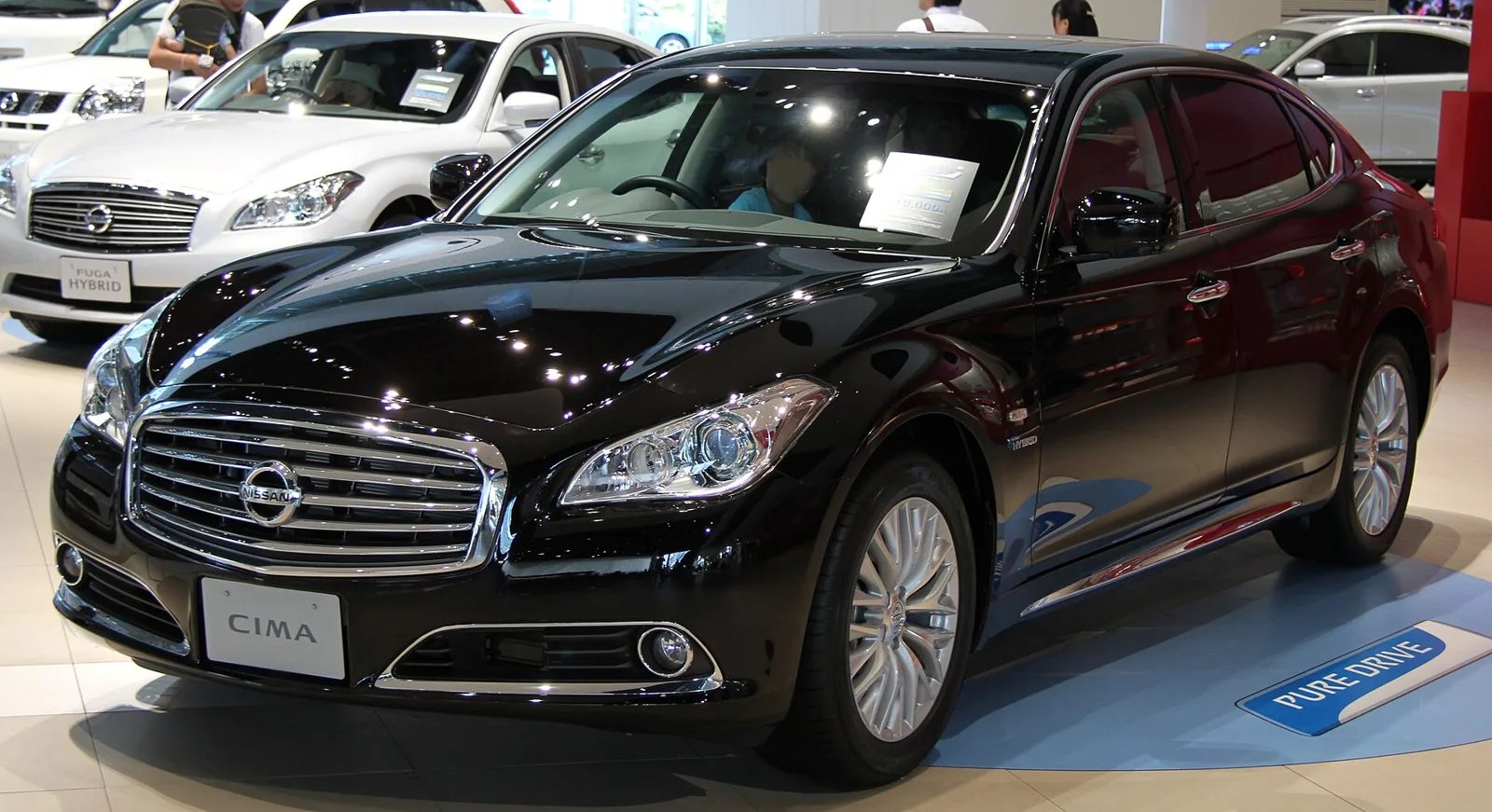
There was no platform successor, so the Nissan Fuga became the flagship, and the V8 ended for Japanese luxury sedans, although it continued overseas. Starting in 2012 the Cima name was revived as a stretched Fuga, taking on the segment once held by the President.
The President was also indirectly affected by the Nissan Revival Plan, given its exclusivity and niche positioning for senior Japanese executives. After only 63 units were sold in fiscal year 2009, production was ended.
What were the Nissan President specifications?
| Specification | Detail |
|---|---|
| Production span | 1965 to 2010 |
| First generation | H150, October 1965, replacing the Cedric Special |
| First-generation V8 | 4.0-litre Y40, 180 PS (132 kW) |
| First-generation six | 3.0-litre H30, 130 PS (96 kW) in Spec-B |
| Second generation | 250 series (H250 for V8), August 1973 |
| Second-generation V8 | 4.4-litre Y44, electronic fuel injection from April 1975 |
| Third generation | JHG50, Tokyo Motor Show, October 1989 |
| Third-generation V8 | 4.5-litre VH45DE, 270 PS (199 kW) |
| Fourth generation | October 2003, 4.5-litre VK45DE V8 |
| Left-hand drive export | HL150, fewer than 200 built |
| Registered in Japan (250 series) | 33,128 units |
| Total sold since 1965 | 56,000 units |