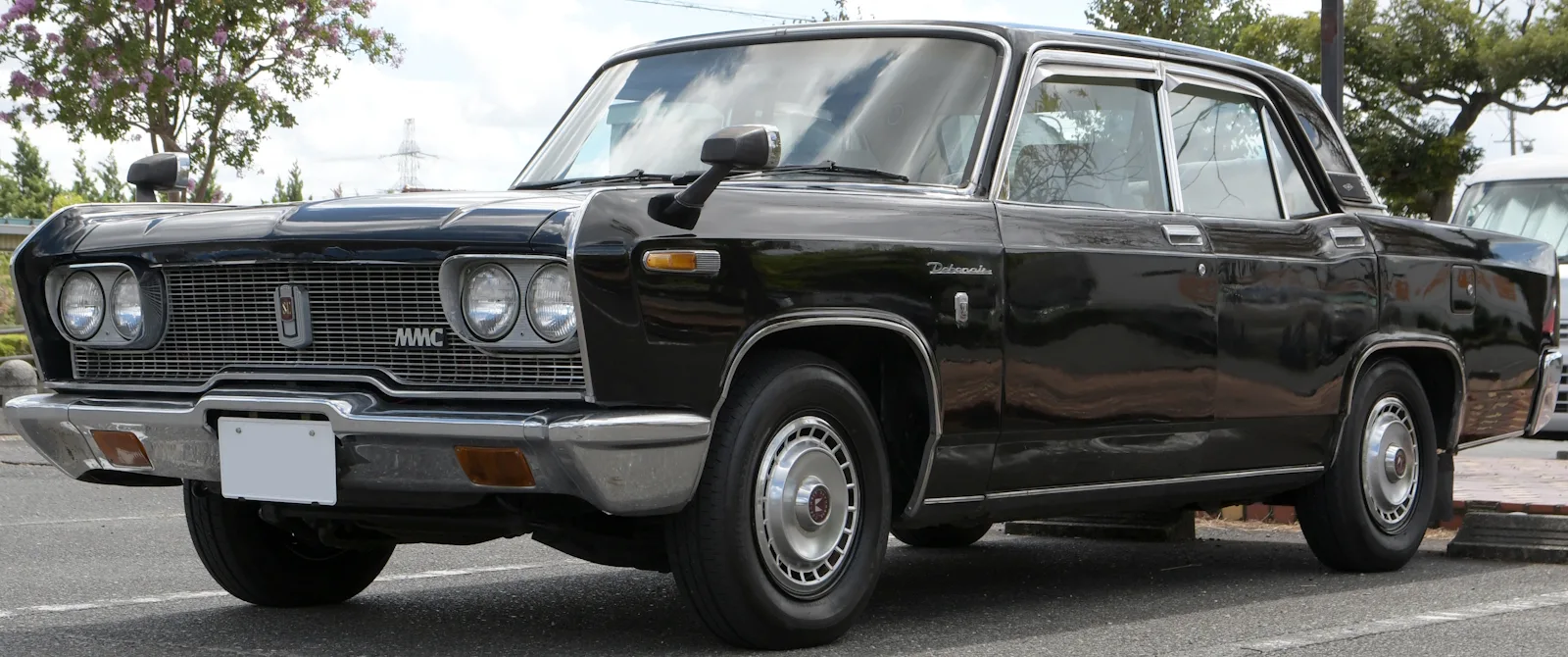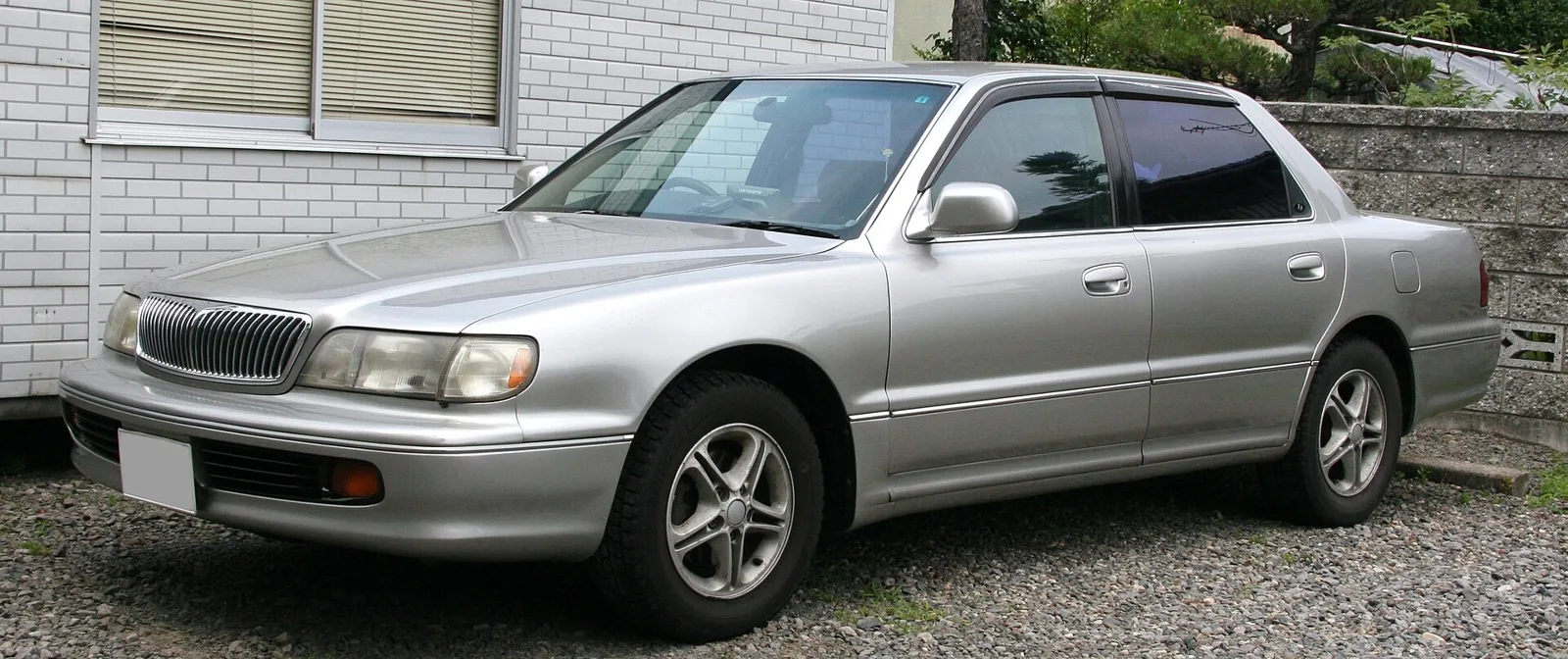
A flagship built for Mitsubishi's senior executives, updated under the bonnet far more often than in its bodywork.
The Mitsubishi Debonair was a four-door executive saloon that Mitsubishi Motors built for the Japanese market from 1964 to 1999. It arrived in three generations, and its engines and running gear changed far more often than its styling did. It served as the company's flagship passenger car throughout.
The Mitsubishi Debonair was the flagship passenger car of Mitsubishi Motors in Japan, a four-door saloon launched in 1964 and built until November 1999. Its styling stayed close to the original for two decades, while its mechanicals kept changing. Across three generations it offered a dignified look, a roomy cabin and the latest technology the company could fit.
What was the Mitsubishi Debonair?
Mitsubishi created the Debonair as its top passenger car for Japan. The name means gentle, courteous and suave. Most early buyers were senior managers in the Mitsubishi Group, so in practice it was a company car for the group's most senior staff, not a mass-market model.
Mitsubishi had built its name on small, economical sedans and left the larger, dearer end of the market to other manufacturers. The Debonair was a clear break from that. At its launch it was the largest sedan the company had built, and it was first shown at the 10th All Japan Motor Show in October 1963, an event later renamed the Tokyo Motor Show.
Its exterior dimensions sat just under the Japanese government limits for compact vehicles, yet the cabin was spacious. Production began in October 1964, in time for the Tokyo Summer Olympics. From 1969, when the Galant arrived, the Debonair was also sold through a dealer chain called the Galant Shop.
The name is a good guide to the car's intent. Debonair suggests a courteous, relaxed manner, and the car was seen as a special-purpose vehicle rather than a product for the general motoring public. Mitsubishi did not market it widely, and few private buyers were expected.
A senior executive's saloon that changed its engines far more often than its looks.
How did the first generation develop?
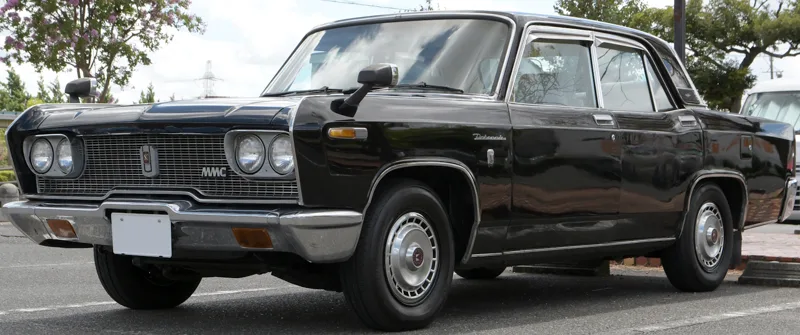
The first generation, codes A30 to A33, ran from 1964 until early 1986 with its look largely unchanged. Four updates were recorded using Roman numerals I to IV, and the engines ranged from a 1,991 cc six to a 2,555 cc four. In total 21,703 were built in just over 22 years.
The first-generation styling is credited to former General Motors designer Hans S. Bretzner. The look drew on the 1961 Lincoln Continental by Elwood Engel, showing in the slab-sided panels, squared wheel arches, wraparound front indicators and tapered rear fins. The chassis used double wishbones at the front and leaf springs with a differential at the rear.
The first engine was the KE64, a 1,991 cc six with twin carburettors, dual exhausts and overhead valves. Peak output was 105 PS (77 kW; 104 hp), reached at 5,000 rpm, and the top speed was 155 km/h (96 mph). In September 1970 the 1,994 cc Saturn 6 arrived, with 130 PS (96 kW; 128 hp) on offer and a maximum of 180 km/h (112 mph).
The changes kept coming. A facelift in October 1973 brought rectangular taillights and smaller front indicators. The manual gearbox was dropped in 1976, leaving a three-speed Borg-Warner automatic, and the 2,555 cc Astron four arrived that June. Anti-lock brakes followed in 1979, and a de-smogged model in April 1978 took the A33 code to meet tighter emissions rules.
Why did the second generation switch to front-wheel drive?
The second generation, introduced in July 1986, switched to front-wheel drive because it gave more passenger space without a costly new executive platform. Mitsubishi shared the layout with the E11 Galant. Sales in Japan jumped from 205 in 1985 to 6,230 in 1987.
Mitsubishi had decided the old design was too rare to drive sales or image. The new car was also badge engineered as the Hyundai Grandeur for Asian luxury buyers, a move that gave Hyundai a luxury sedan for visiting officials during the 1988 Seoul Olympics.
This generation brought Mitsubishi's first V6 engines: a 2.0-litre 6G71 and a 3.0-litre 6G72, sold under the Cyclone name and later shared with the Galant. Cars with the smaller engine used a shorter, narrower body with smaller bumpers to meet Japanese dimension rules. The only transmission was a four-speed automatic, with MacPherson struts at the front and a three-link torsion axle at the rear.
A supercharged 2.0-litre producing 150 PS (110 kW; 148 hp) joined in February 1987, using a needle roller rocker arm assembly that the company called a world first. The 3.0-litre V6 with 150 PS could reach 195 km/h (121 mph), but a mandatory 180 km/h (110 mph) limiter applied to Japanese cars. V6 models carried a V badge on the boot and a V hood ornament.
The trunk was designed to carry two sets of golf clubs, and the front-wheel-drive layout released more room for passengers. A full stretch limousine was also offered for a short time from 1987, largely built by hand by the Aichi dealership chain.
What did the third generation add?
The third generation, launched in late 1992, was longer and wider than its predecessors and carried much of the company's technology. At the top of the range sat a DOHC V6 of 3,496 cc producing 260 PS (191 kW; 256 hp). Features included four-wheel steering, four-wheel anti-lock brakes and electronically controlled suspension.
The list continued with GPS-guided navigation, self-closing doors and a rear-focused camera. The gearbox was an INVECS 5-speed automatic with traction control. A Japan-only lidar system gave distance warnings for vehicles ahead, but it had no say over throttle, brakes or gear selection, so it warned rather than controlled.
In July 1993 a long-wheelbase Debonair 150, 150 mm (5.9 in) longer, joined the range with the 3.5-litre V6 and the top Executive III grade. The Debonair 150 left the range in September 1994, as the line-up was reshuffled, the rear suspension became multilink and the body that met Japanese dimension rules was no longer offered.
Much of the third generation's technology was shared with the GTO and 3000GT sports cars.
Which engines and specifications did the Debonair use?
The Debonair's engines grew from a 1,991 cc six making 105 PS (77 kW; 104 hp) to a 3,496 cc V6 making 260 PS (191 kW; 256 hp). Early cars were held to 2.0 litres to limit the annual road tax bill, and the table below sets out the main figures for each generation.
| Specification | Detail |
|---|---|
| Generations | Three: 1964, 1986 and late 1992 |
| First-generation engine | 1,991 cc KE64 six, rated at 5,000 rpm for 105 PS (77 kW; 104 hp) |
| Later first-generation engine | 1,994 cc Saturn 6 from September 1970, 130 PS (96 kW; 128 hp) |
| Second-generation V6 | 3.0-litre 6G72, 150 PS (110 kW; 148 hp) |
| Twin-cam 24-valve V6 | From the third quarter of 1989, 200 PS (147 kW; 197 hp) |
| Third-generation top engine | 3,496 cc DOHC V6, 260 PS (191 kW; 256 hp) |
| Top speed, first generation | 155 km/h (96 mph) with 105 PS; 180 km/h (112 mph) with 130 PS |
| Transmission | Three-speed automatic (1976), four-speed automatic (second generation), INVECS 5-speed automatic (third generation) |
| Production ended | November 1999 |
The 24-valve twin-cam 3.0-litre, introduced in the third quarter of 1989, lifted the rating from 155 PS (114 kW; 153 hp) on to 200 PS (147 kW; 197 hp) and became the only engine for the AMG version. A 1991 facelift raised the 24-valve unit to 210 PS (154 kW; 207 hp) and brought passive safety updates.
Variants, AMG tuning and the Debonair 150
German tuner AMG was brought in for a version of the second generation, and its work was mostly on exterior body treatments. Two versions were built: a standard-length car and the Debonair V 150 AMG, whose wheelbase was stretched by 150 mm (5.9 in). The 150 limousine, with the 3.0-litre engine only, was first shown in October 1990.
A Debonair AMG appeared in the Japanese crime drama Gorilla. British apparel maker Aquascutum was then commissioned to design an exclusive interior package, shortly after the brand was bought by the Japanese textile group Renown. The supercharger could be fitted with that trim.
Trim names began with Executive I, II and III, then moved to Exceed, Exceed Contega and the Type A, B and C grades. Each model year reshuffled the names to suit the market, so a single trim label does not always describe the same car from one year to the next.
Reception, the Diamante and the search for a modern flagship
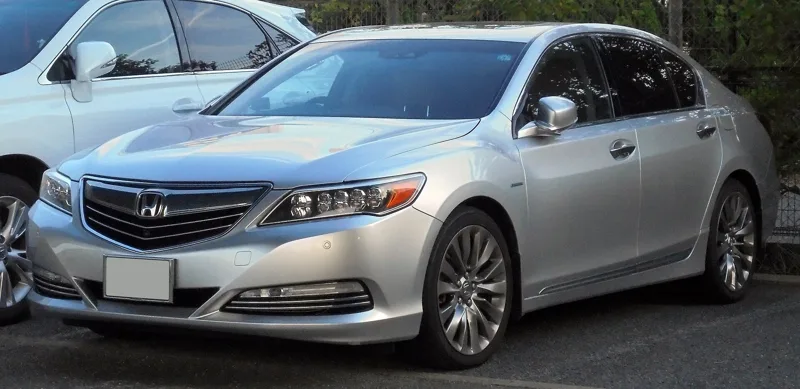
Mitsubishi wanted the Debonair to remain a senior executive car, so its look changed little while the engineering moved on. By 1990 that look seemed dated, which is why the company introduced the Diamante, also sold as the Sigma. It was a sportier executive saloon aimed at rivals such as the Honda Legend.
The Diamante's arrival also came during what became known as Japan's asset price bubble, which took hold after the 1985 Plaza Accord. Mitsubishi was keen to keep up with newer Japanese luxury saloons, and the Debonair's own role was to remain the flagship of the range rather than a sales leader.
How many Debonairs were sold?
Mitsubishi built 21,703 first-generation Debonairs over just over 22 years, and the car sold largely in Japan. Only 205 units were sold in 1985, the final full year of the first generation. Sales rose to 6,230 in 1987 after the second generation launched.
By the mid-1980s the first generation had become so rare that it no longer drove sales or image for the brand, which is what prompted the redesign. Export was a minor affair. Aside from a small push in the 1960s, the car remained a domestic product, though the later two generations did well under South Korean licence production.
What replaced the Debonair?
The Debonair ended in November 1999 and was directly succeeded by the Proudia, a model meant to keep a top-level luxury saloon in the Mitsubishi line. Mitsubishi's first V8 engine was developed for the Dignity limousine around the same period, and that car became the company's domestic flagship.
The Debonair had run for 35 years across three generations, and the Proudia was designed to carry on the top-level luxury role that the older car had held. The V8 developed for the Dignity limousine then took over as the company's most prestigious domestic model.