From a Mitsubishi-derived executive car in 1986 to a hybrid seventh generation in 2022, the Grandeur carried Hyundai's luxury ambitions in South Korea.
The Grandeur is a Hyundai executive sedan that began in 1986 as a Mitsubishi-derived car and has now reached seven generations. The hybrid seventh generation went on sale in 2022, and the Azera name covered the car in North America until 2017.
The Hyundai Grandeur is an executive sedan that Hyundai has built since 1986, across seven generations. It sits below the Dynasty and the Equus in the company's range and was sold as the Azera in North America and parts of the Middle East. Its story runs from a car rebadged from Mitsubishi to a hybrid flagship in the 2020s.
Where did the Grandeur fit in Hyundai's range?
The Grandeur was Hyundai's flagship mainstream sedan. Above it sat the Dynasty, a more premium car introduced in 1996, and the Equus, a luxury flagship first sold in 1999. Abroad the car was known as the Azera in North America and the Middle East.
Since 2017 the Azera has no longer been sold in the United States and Canada, where it was overshadowed by the Genesis G80. It remains on sale in South Korea and the Middle East.
A Mitsubishi-derived sedan that became Korea's flagship, a North American Azera, and a hybrid seventh generation.
How did the first-generation Grandeur come about?
The first Grandeur was in effect a rebadged Mitsubishi Debonair. Before the 1988 Seoul Olympics, South Korea's luxury market was led by Daewoo and its Royale series. Hyundai's previous flagship had been the locally built Ford Granada Mark II, which the Royale outsold.
Rather than design a luxury car from scratch, Hyundai obtained the platform, technology and internal layout from Mitsubishi Motors. Mitsubishi was itself seeking to replace its ageing Debonair, which had not been redesigned since 1964, so the two companies shared the platform and, above all, an engine.
Hyundai launched the car in July 1986 and used it as an official sponsor of the Seoul Olympics to entertain executives and dignitaries. The design was Hyundai's, and the internal configuration was Mitsubishi's. It was the second front-wheel-drive model built in Korea, after the Hyundai Excel.
Why did the first Grandeur sell so well?
The first car began with a four-cylinder 2.0-litre engine from Mitsubishi and a manual gearbox. A 2.4-litre SOHC engine followed in 1987, a 3.0-litre V6 arrived in 1991 to take on the Daewoo Imperial, and automatic transmission became available as well.
Its Mitsubishi roots and strong reputation made it a hit at home, where it outsold every other large car by a wide margin. The Debonair V found little traction in Japan, a market already crowded with the Toyota Crown, Nissan Cedric and Gloria, Mazda Luce and Honda Legend.
A taillight redesign arrived in 1989, and ABS was offered from 1991. Production ended in September 1992, by which time 122,074 cars had left the line.
In 2021 Hyundai revealed a restomodded first-generation car as an electric concept, the Grandeur Heritage. The concept borrowed the Parametric Pixel styling of the Ioniq range, celebrated the car's 35th year and debuted at Hyundai Motorstudio Goyang on 12 November 2021.
What did the second generation bring?
The second generation, codenamed LX, was built jointly with Mitsubishi between 1992 and 1998. Mitsubishi supplied the powertrain, while Hyundai handled the body and trim. Production began in September 1992.
Every car in the range used a V6, in 2.0, 2.5, 3.0 and 3.5-litre sizes. The larger engines came from Mitsubishi, because Hyundai could not yet make engines of that size on its own. The sedan was a huge success in Korea, where it became a status symbol that politicians and wealthy executives favoured.
The partnership produced related cars as well: the Hyundai Equus and Mitsubishi Dignity premium flagships, and the smaller Hyundai Dynasty and Mitsubishi Proudia. Once the Equus arrived, Hyundai began developing its engines in-house, which led to the 4.6-litre Tau engine later fitted to the Genesis.
Why did the third generation matter?
The third-generation Grandeur, codenamed XG, arrived in 1998 and was developed entirely by Hyundai. Drawing on what it had learned from the first two generations, the team built a car that could be exported without legal complications. In North America and Japan it was sold as the Hyundai XG.
The Kia Opirus, called the Amanti in North America, shared a modified version of the Grandeur and XG platform. In Korea the XG name was later used on the Hyundai Trajet, which shared the same underpinnings.
What were the XG250, XG300 and XG350?
The XG250 appeared in 1999 with a 2.5-litre Delta V6 and remained in production until 2005. Some markets called it the XG25, while South Korea had a two-litre XG20 instead. Its output was 165 bhp (123 kW), and it took 10.6 seconds to reach 60 mph, with a top speed of 204 km/h (127 mph).
The XG300 arrived in 1999 with a 3.0-litre Sigma V6 and was built from 2001 to 2003, sold as the XG30 in Europe and parts of Asia. Its 181 bhp (135 kW) gave a 0-60 mph time of 9.8 seconds and a top speed of 214 km/h (133 mph). In the United States the XG300 was offered only for the 2001 model year, with an L trim that added heated front seats and a rear reading lamp.
From 2002 the XG350 used a larger 3.5-litre Sigma V6 with 194 hp (145 kW) and 216 lb-ft (293 N-m) of torque, up from the previous engine. The 2004 model year brought larger front brakes, which in turn required a full-size spare tyre as standard. The 2005 model year was the last for the XG350, and the 2006 Azera replaced it at the top of the range.
What did the fourth generation become?
The fourth generation, codenamed TG, arrived for the 2006 model year as a redesigned XG350. It shares its platform with the Sonata and is sold as the Azera in North America, China and several other markets. Buyers in Europe apart from France, along with those in Australia, New Zealand and Japan, knew it simply as the Grandeur.
The Azera used Hyundai's new 3.8-litre Lambda V6, which made 265 hp (198 kW). Power reached the front wheels through an automatic with five or six ratios and a manual shift mode. Hyundai quoted 6.0 seconds to 60 mph, with 249 km/h (155 mph) as the limit. The 2.2-litre VGT CRDI diesel from the Santa Fe was also offered.
The car won the Best New Family Car award over CAN$35,000 at the 2006 Canadian Car of the Year awards, and J.D. Power named it the Most Appealing Large Car that year. For 2011 the V6s received dual variable valve timing, and the automatic gained a sixth ratio.
Hyundai took legal action in November 2010 against Avera Motors, a Florida start-up, arguing that the Avera name resembled Azera. The company became Rivian Automotive in March 2011.
What changed in the fifth generation?
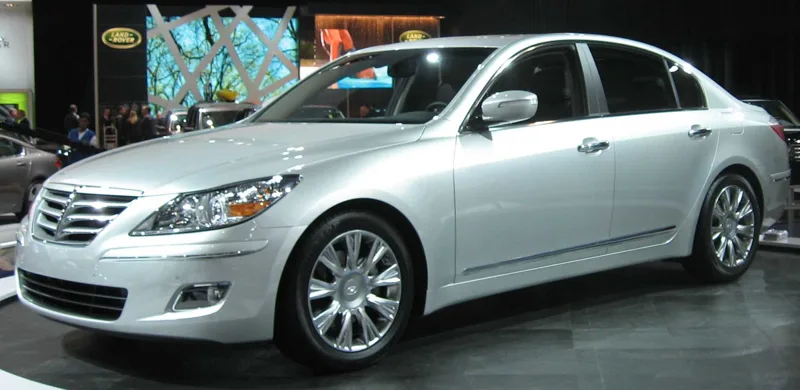
Hyundai revealed the fifth-generation HG at the 2011 Los Angeles show, where it was pitched as a 2012 model. Engineers spent three and a half years on it, at a cost of 450 million dollars. Measured against its siblings, it sat in the space between the Sonata and the Genesis, and the Grandeur badge was used at home while most export markets knew it as the Azera.
Opponents ranged from the Ford Taurus, Dodge Charger and Chevrolet Impala to near-luxury cars like the Chrysler 300, Toyota Avalon, Nissan Maxima and Buick LaCrosse. The design followed Hyundai's fluidic sculpture language, which the company dubbed the Grand Glide concept.
The Korean hybrid went on sale on 17 December 2013. It paired a 2.4-litre Theta II engine with a small electric motor, and it came with LED tail lights, Nappa leather and an optional panoramic sunroof. Every model used a six-speed automatic, which was the only gearbox offered.
For the 2014 model year Hyundai cut the US starting price by $1,250 to $31,000. The update also brought an electroluminescent gauge cluster, an 8-inch navigation system on the Limited and power-folding mirrors.
Why was the sixth generation not sold in North America?
Hyundai unveiled the sixth-generation IG on 27 October 2016. It was not sold in North America, because sales of the previous generation had been slow. Apart from the new Genesis luxury division, the Sonata had become the largest and most expensive Hyundai sedan sold in the US.
A hybrid joined the range in March 2017, and the 2.2-litre diesel was dropped in 2018. Some 132,000 Grandeurs were sold in 2017, followed by about 110,000 in 2018. In South Korea the model led its category in sales.
The November 2019 facelift lengthened the car by 60 mm (2.4 in), widened it by 10 mm (0.4 in) and stretched the wheelbase by 40 mm (1.6 in). A 12.3-inch widescreen display became an option, shift-by-wire buttons took the place of the gear lever, and the 8-speed Smartstream G2.5 succeeded the 2.4-litre Theta II.
What is the seventh-generation Grandeur like?
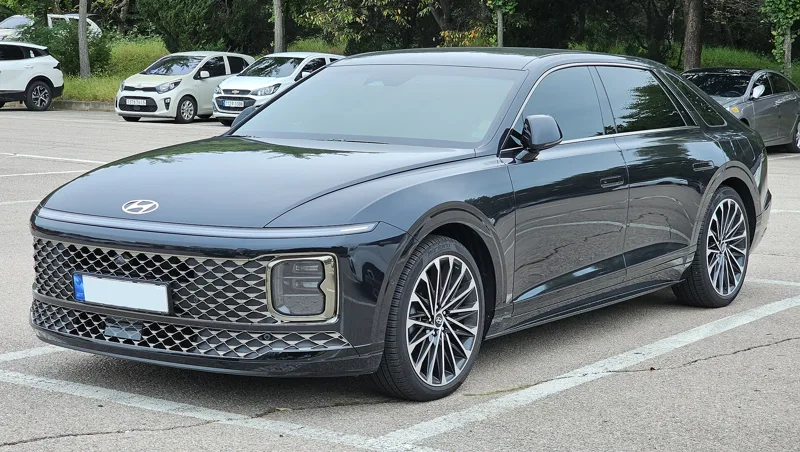
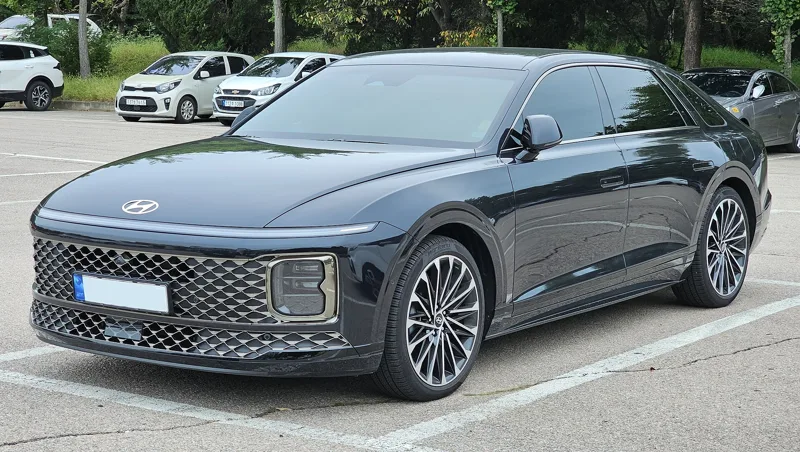
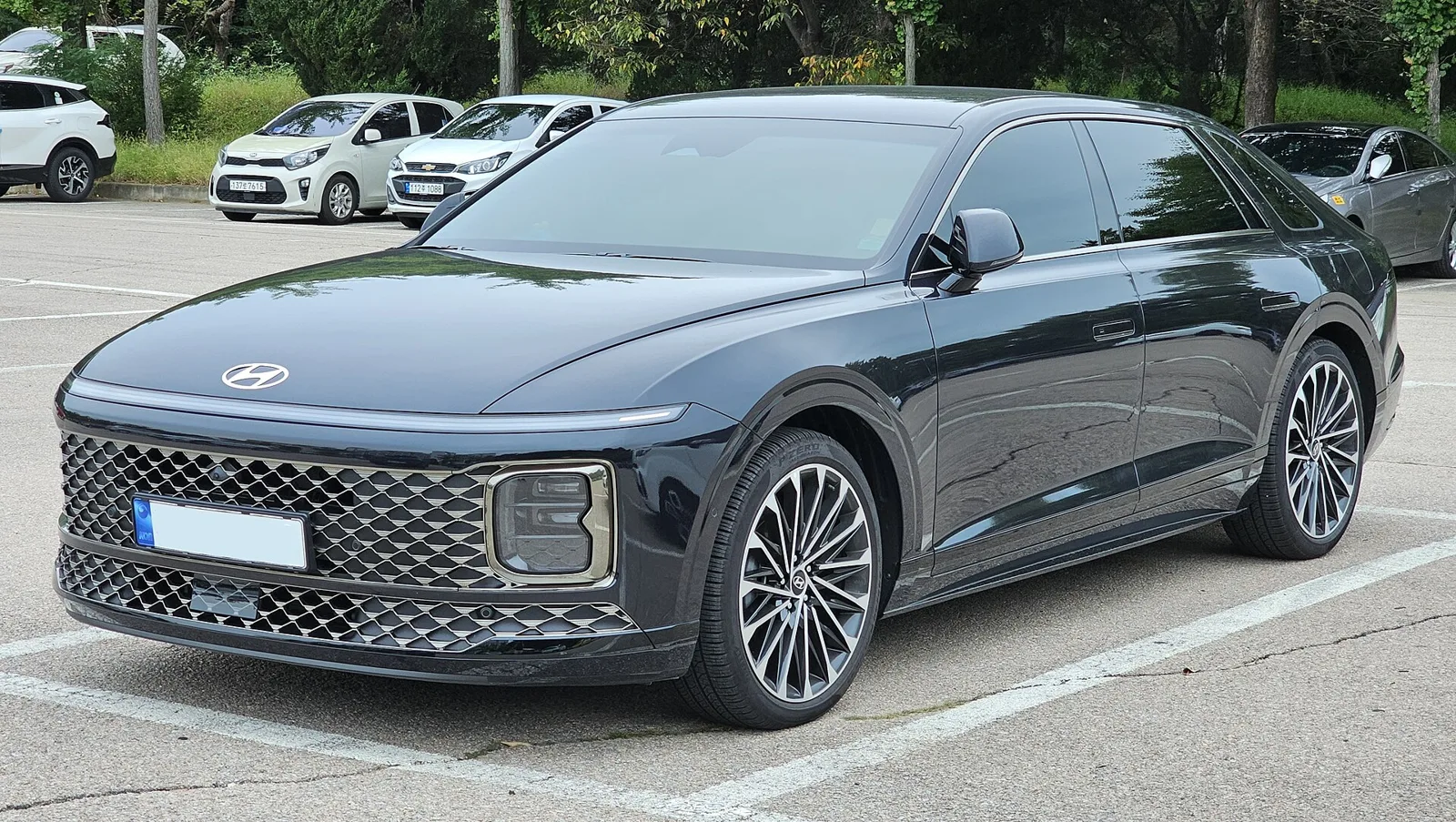
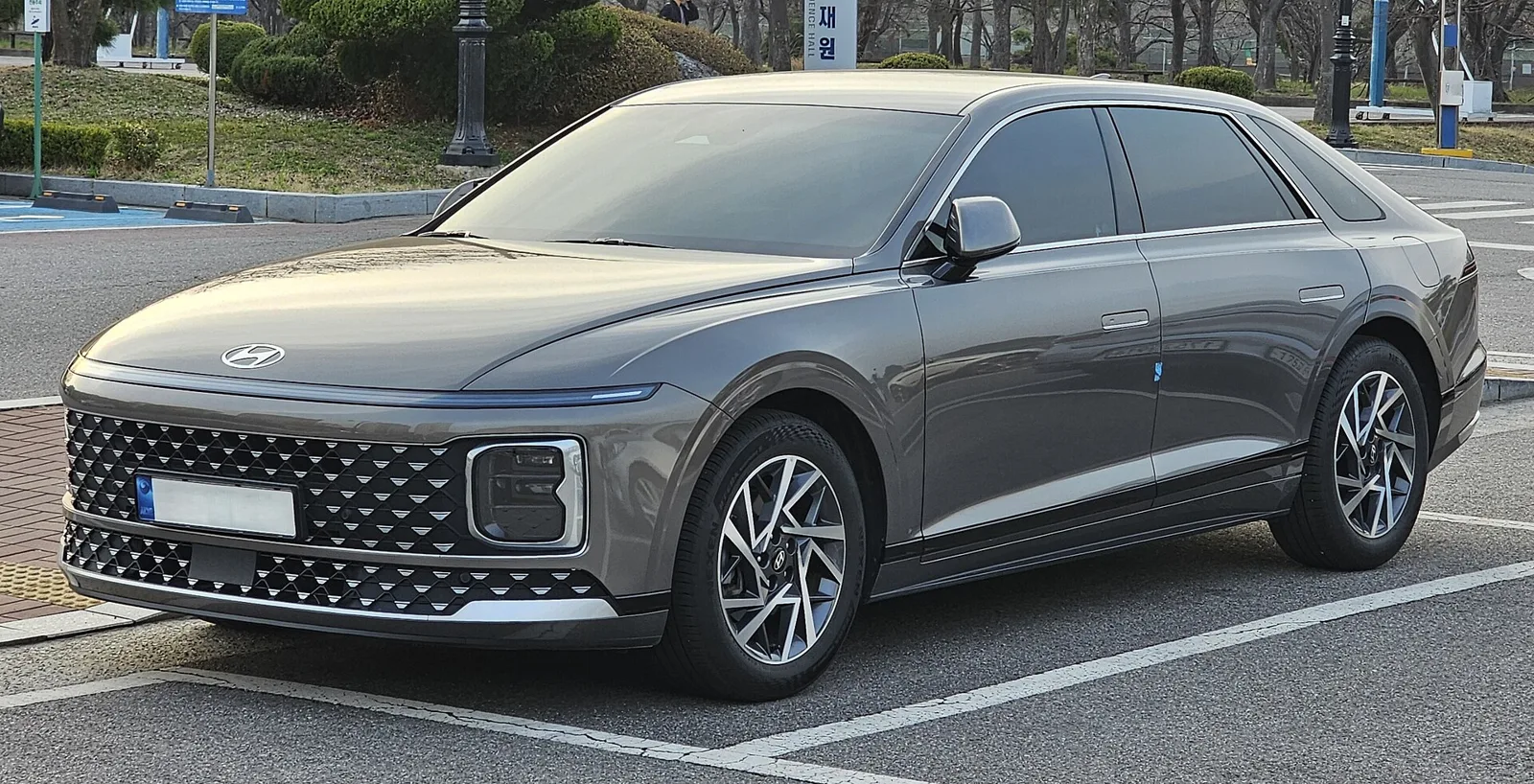
The seventh generation GN7 went on sale in South Korea on 14 November 2022, six years after its predecessor. The new body measures 5,035 mm (198.2 in), growing the car by 45 mm (1.8 in), while its wheelbase and rear overhang expanded by 10 mm and 50 mm respectively.
Outside, a full-width strip of lights joins the daytime running lamps and turn signals. Inside, the dashboard wraps around the occupants under soft ambient lighting. Standard kit covers the ccNC infotainment system, a pair of cameras, twin digital keys and electric door curtains. The hybrid variant adds E-motion drive, which relies on a drive motor to improve performance.
The GN7 shares its platform with the Kia K8, using the Hyundai-Kia mid-size architecture known as N3. The April 2026 facelift refined the hybrid, shrank the digital instrument cluster and enlarged the infotainment screen, which now runs Hyundai's Android-based Pleos software.
How did sales develop in North America?
In the United States the XG and Azera were consistent sellers from their introduction in late 2000 until late 2008, when sales fell sharply. The Genesis sedan arrived in the US that year, and it may have taken sales from the Azera. Auto journalists saw the Genesis as a rival to the full-size and near-luxury cars the 2012 Azera was positioned against.
Hyundai Grandeur specifications at a glance
| Feature | First generation (1986) | Fourth generation (2006) | Seventh generation (2022) |
|---|---|---|---|
| Basis | Rebadged Mitsubishi Debonair | Shares its platform with the Sonata | Shares its platform with the Kia K8 |
| Engines | 2.0 L SOHC, later 2.4 L and 3.0 L V6 | 3.8 L Lambda V6, 265 hp (198 kW); 2.2 L VGT CRDI diesel | Not given |
| 0-60 mph | Not given | 6.0 seconds claimed | Not given |
| Top speed | Not given | 155 mph (249 km/h) | Not given |
| Length | Not given | Not given | 5,035 mm (198.2 in) |
| Production | 1986 to September 1992; 122,074 built | From the 2006 model year | Released 14 November 2022 in South Korea |