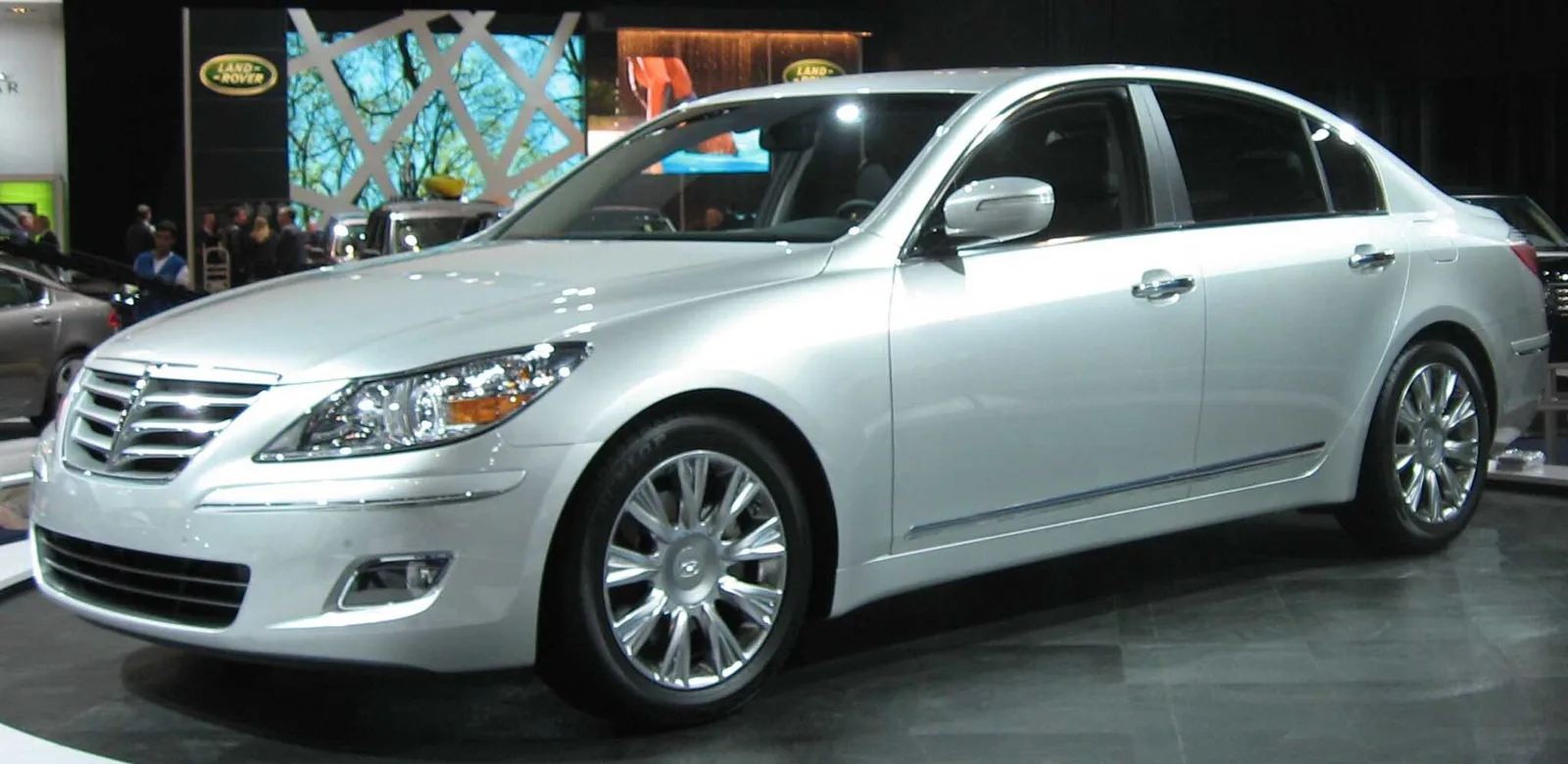
A rear-drive executive sedan with V8 and V6 engines, a BMW 5 Series benchmark, a Korean price row and a long list of awards before the nameplate moved to its own brand.
The Hyundai Genesis was an executive sedan sold in two generations from 2008 to 2016. It offered rear- or all-wheel drive, V8 and V6 engines and a string of awards, and it was renamed the G80 in 2017 when the Genesis brand became separate.
The Hyundai Genesis was a five-passenger, four-door executive sedan that Hyundai sold in two generations from 2008 until 2016, and from 2017 as the G80 after the nameplate moved to a separate luxury division. Buyers could choose rear-wheel or all-wheel drive, and the engine line-up covered a V8 and two V6 units depending on the market. It was the largest and most powerful car Hyundai had marketed in North America before the Equus arrived.
This guide follows the car from its concept showing in 2007 through the first generation, its engines and the model-year updates, the second generation that replaced it, the South Korean price row, the sales record, the awards and the rename. It closes with the specification figures and answers to common questions.
Where did the Hyundai Genesis come from?
The Genesis was an executive sedan that Hyundai built from 2008 to 2016 in two generations. Hyundai conceived the idea in 2003, showed a concept in March 2007 and started full production for South Korea on 8 January 2008, before the car reached North America later that year.
The concept was introduced at the 2007 New York International Auto Show under the Concept Genesis name. The production car carried the internal designation BH, and the first generation was marketed as a premium sports sedan. Hyundai sold it worldwide except in Europe, where the company did not launch the car at first.
The second generation, coded DH, arrived in November 2013. It was unveiled in Seoul, Korea, and later shown at the 2014 North American International Auto Show and the 2014 Toronto Auto Show. In 2015 the company announced that the Genesis name and its luxury model would move to a new division called Genesis Motor.
A rear-drive executive sedan with no front badge, V8 power and a BMW 5 Series benchmark, built until 2016.
How was the Genesis developed and designed?
Hyundai described the Genesis as a progressive interpretation of the rear-wheel drive sports sedan, and it benchmarked the BMW 5 Series (E60) during development. The company said the body in white was 14% stronger in torsional rigidity than the BMW, and reliability testing covered 800,000 miles.
The body design took three years, while the development period lasted 23 months. An earlier expectation had put the cost of developing the car at $533 million, and the total programme cost was $500 million.
Hyundai marketed the car as offering the performance of a 5 Series, the interior packaging of a 7 Series and the price of a 3 Series. The production model received five stars in every crash category from the National Highway Traffic Safety Administration.
Automotive journalist Dan Neil, reviewing the Genesis 4.6 at its US introduction, said that leaving brand emblems off the front of the car subverted the grammar of luxury.
Which engines did the first-generation Genesis use?
The first-generation car used three engines that varied by market: a Tau 4.6 L V8 and two Lambda V6 units, one of 3.8 L and one of 3.3 L. Power ranged from 264 hp (197 kW) in the smaller V6 to 375 hp (280 kW) in the early V8, and the V8 was the flagship of the range.
The Tau V8 was Hyundai's first domestic V8. In the 2008 and 2009 model years the 4.6 L unit made 375 hp (280 kW) at 6,500 rpm, plus 333 lb-ft (451 Nm) at 3,500 rpm. Hyundai reported 0-60 mph (97 km/h) times of under six seconds for the V8, while Car and Driver recorded 5.3 seconds and Motor Trend recorded 5.5 seconds in its October 2008 issue.
The V8 was uprated mid-way through the 2010 model year to 385 hp (287 kW) at 6,500 rpm, with torque staying at 333 lb-ft (451 Nm) at 3,500 rpm. The V8 was designed to run on premium fuel for maximum output, although it would also run on regular unleaded. On regular fuel the 2010-11 model produced 378 hp (282 kW) and 324 lb-ft.
The Lambda 3.8 L V6 was offered in Korean and North American models. In Korean specification it produced 306 hp (228 kW). In US specification it made 290 hp (216 kW) at 6,200 rpm, rising to 333 hp in the direct-injection GDi form, and 264 lb-ft (358 Nm) at 4,500 rpm. Motor Trend recorded 5.9 seconds to 60 mph with the V6. The Lambda 3.3 L V6 produced 264 hp (197 kW) and was offered in some markets only.
Across the range the chassis used speed-sensitive rack-and-pinion steering, four-wheel disc brakes, a multi-link front suspension and a five-link rear. Weight distribution was 53% front and 47% rear for the V8, and 52% front and 48% rear for the V6 cars.
What changed in the Genesis model-year updates?
Between 2010 and 2014 Hyundai revised the first-generation car several times. The V8 was uprated in mid-2010, the 5.0 R-Spec arrived with a direct-injection Tau V8 in 2011, and the 2012 update brought an eight-speed automatic to the range. The 2014 model year added connectivity and colour changes before the second generation replaced the car.
The 2010 model year offered only one trim, with all packages made standard, including the Technology package. The Premium Navigation Package replaced the earlier Premium Plus Package, although the 18-inch alloy wheels stayed part of the new package. For 2011 the V8 gained the features of the earlier Tech Package as standard equipment.
Those standard features included the Lexicon 7.1 surround-sound audio system with 17 speakers, an 8-inch navigation screen, smart cruise control, an electronic parking brake, a cooled driver seat, adaptive front lighting with HID headlights, and parking assistance with front and rear sensors plus a rearview camera.
For 2012 the transmission changed to an eight-speed automatic with SHIFTRONIC manual mode. Hyundai revised the shock and spring rates and the rear stabiliser, and the standard 5.0-litre model was dropped so that the direct-injection V8 became exclusive to the 5.0 R-Spec. The 3.8-litre V6 was offered in three equipment configurations, and an enhanced multi-media controller came with the revised optional 8-inch touchscreen.
The 2014 changes included greater connectivity through the Blue Link interface, a new Santiago Silver body colour in place of Platinum Metallic, and 18-inch wheels as standard on the base model. Assurance Connected Care telematics came standard for three years on 2014 sedans fitted with Blue Link.
What changed in the second-generation Genesis?
The second-generation DH car was previewed by the HCD-14 Genesis concept at NAIAS 2013 and unveiled in Seoul in November 2013. Its launch engines were the Lambda 3.0 GDi, Lambda 3.3 GDi, Lambda 3.8 GDi and Tau 5.0 GDi, with rear or all-wheel drive, and every model had an eight-speed automatic with manual shift mode.
The second generation then went on show at the 2014 Toronto Auto Show, following its North American International Auto Show debut. The second generation also carried a five-star safety rating.
Australia was the first country in the Oceania region to receive the sedan, with arrivals in November 2014. The car was also sold in several Latin American markets, including Costa Rica, the Dominican Republic, Colombia, Chile and Peru, where the versions carried 3.3 L and 3.8 L engines. Brazil took only the 3.8 L engine.
Why did the Genesis cost more in South Korea?
The Genesis was priced far higher in South Korea than in the United States, with a reported 58.3 million won (US$57,000) at home against $32,000 in the US. The gap drew criticism from Korean consumers, led to dumping allegations and created a grey market in cars re-imported by dealers.
Korean regulators looked into whether Hyundai had abused its domestic market share, which stood at 75%. Hyundai cars sold in South Korea come with a wider range of options, and that may explain part of the mark-up, but the price gap remained a sore point for buyers in the home market.
The Korean market Genesis also looked different from the US car. It carried only the Genesis emblem and no Hyundai badge, which set it apart from the US car.
How did the Genesis sell in the US and beyond?
The Genesis sold slowly at first in the United States, with 6,167 units in its first five months and 21,889 across sedan and coupe in 2009. Hyundai had not marketed the car in Europe at launch, and it reached Australia in November 2014, the first Oceania market to get the sedan.
US sales began in August 2008. The company recorded 1,297 units in the first full sales month, and it had expected to move around 8,000 units from US showrooms by the end of 2008.
Hyundai had discussed creating a separate brand for the Genesis and the Equus in North America. Prohibitive costs and possible delays kept both cars under the Hyundai name until 2016, when the Genesis brand became separate in the United States.
The European case was different. A September 2007 trade report described Hyundai sedans as having a poor image and weak durability compared with rival luxury brands, and the company was trying to shake off a reputation built on generous warranties and low prices. The latest Genesis was to be sold in Europe at about 65,000 euros in Germany.
What awards did the Genesis win?
The Genesis won the 2009 North American Car of the Year title, the first such honour for Hyundai, and it ranked top in the JD Power Vehicle Launch Index. It also took Consumer Reports' Top-Rated Upscale Sedan label and the 2009 Canadian Car of the Year award in the luxury class under $50,000.
The awards list was long. Among the honours the sedan collected were a top-five luxury sedan ranking from the National Automobile Dealers Association in 2008, the Best Luxury Sedan title in MotorWeek's 2009 Driver's Choice Awards, and the Car of the Year prize from China's Autoworld magazine in 2009.
- Top five luxury sedan, National Automobile Dealers Association, 2008
- Top-Rated Upscale Sedan, Consumer Reports, 2009
- No. 1 midsize premium car in the JD Power 2009 APEAL study, ahead of the BMW 5 Series and Jaguar XF
- Cars.com New Car of the Year, 2009
- Highest residual value in the 2009 Automotive Lease Guide
- Car of the Year, Autoworld, China, 2009
Edmunds.com gave the car 9.5 out of 10 points in 2009. It praised a cabin comparable to a top-of-the-line Lexus but pointed to a lack of brand cachet as the main drawback. Motor Trend said the Genesis came close to winning its 2009 Car of the Year title, and the Tau V8 won the 2009 Ward's 10 Best Engines award.
What variants did the Genesis have?
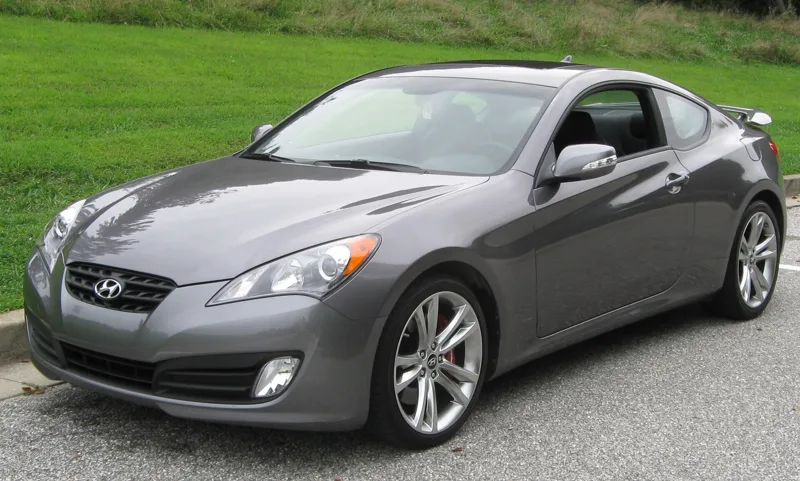
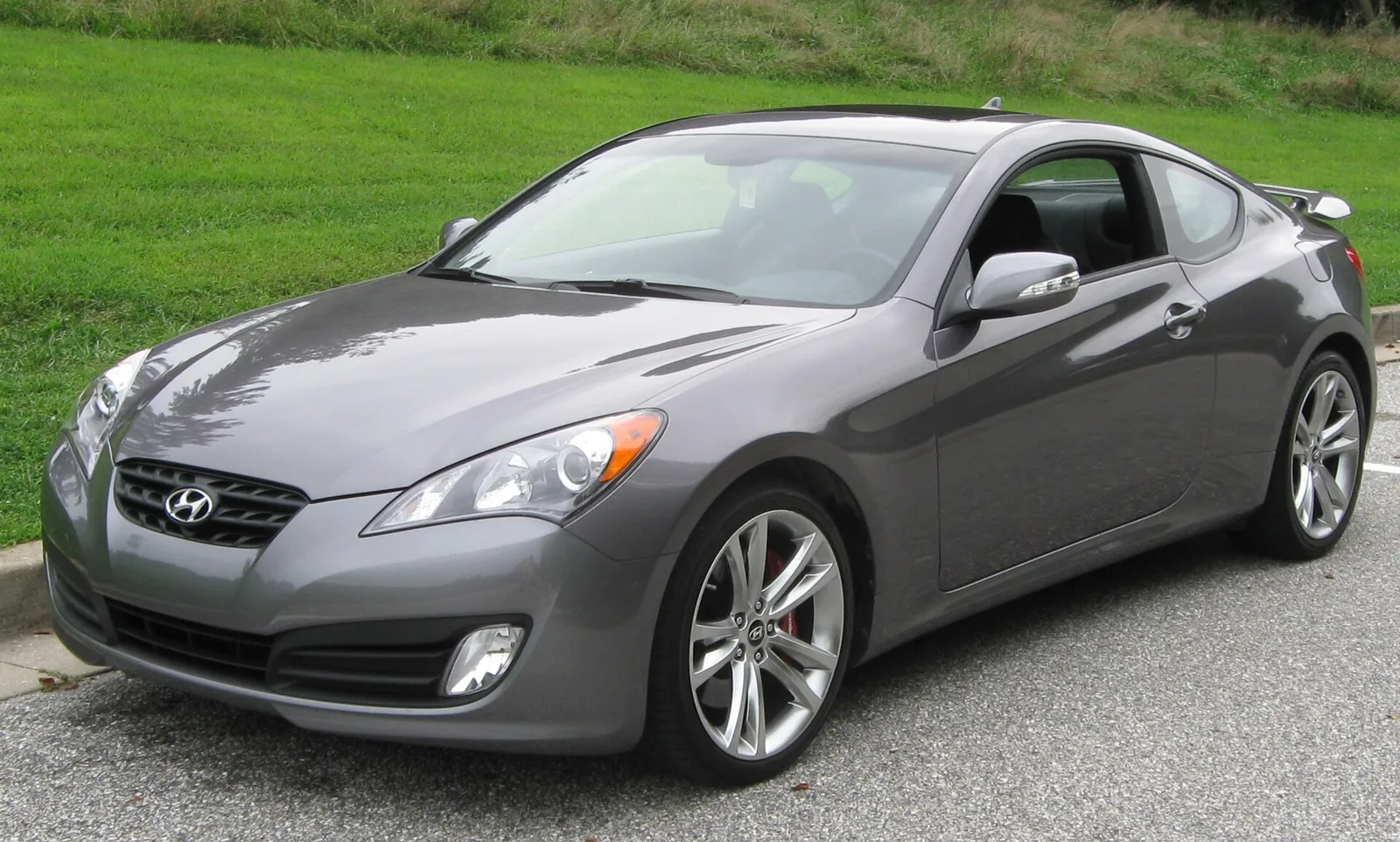
The main variants were the Genesis Coupe, shown at the 2008 New York International Auto Show, and the 5.0 R-Spec, which ran from 2011 to 2014 with the Tau 5.0 GDi V8. The Coupe was a rear-wheel drive sports car that shared the sedan's platform and name.
The 5.0 R-Spec carried the Tau 5.0 GDi engine, a choice of three exterior colours and a black interior. It came with 19-inch Premium Machined Finish alloy wheels fitted with P235/45R19 tyres, unique headlamps with dark chrome inserts and R-Spec badging on the rear deck lid. The car was unveiled in Seoul, and all models included the eight-speed automatic.
Why did the Genesis become the G80?
The Genesis name and Hyundai's second-generation luxury model moved to a separate division, Genesis Motor, after the announcement on 4 November 2015. The second-generation Hyundai Genesis was renamed the G80 in 2017, and in late 2016 the Genesis brand became separate from Hyundai in the United States.
Hyundai tied the move to the car's success in the luxury market and to buyers' acceptance of the Genesis nameplate. The change gave the luxury models an identity of their own under a separate name.
What are the Hyundai Genesis specifications?
| Specification | Detail |
|---|---|
| Body | Five-passenger, four-door sedan |
| Drive | Rear or all-wheel drive |
| Generations | BH (2008) and DH (2013); renamed G80 in 2017 |
| V8 engine (2008-09) | Tau 4.6 L, 375 hp (280 kW) at 6,500 rpm |
| V8 engine (from 2010) | Tau 4.6 L, 385 hp (287 kW) at 6,500 rpm |
| V8 torque | 333 lb-ft (451 Nm) at 3,500 rpm |
| V6 engine (US) | Lambda 3.8 L, 290 hp (216 kW) at 6,200 rpm; up to 333 hp in GDi form |
| V6 torque | 264 lb-ft (358 Nm) at 4,500 rpm |
| Smaller V6 | Lambda 3.3 L, 264 hp (197 kW) |
| Transmission | Six-speed ZF (V8) or Aisin (V6); eight-speed from 2012 |
| 0-60 mph (97 km/h) | 5.3 seconds (Car and Driver); 5.5 seconds (Motor Trend) |
| Weight distribution | 53% front, 47% rear (V8); 52% front, 48% rear (V6) |
| Standard safety | Dual front airbags, side and side-curtain airbags, ABS, traction and stability control |
| Development | $500 million over 23 months; body design took three years |