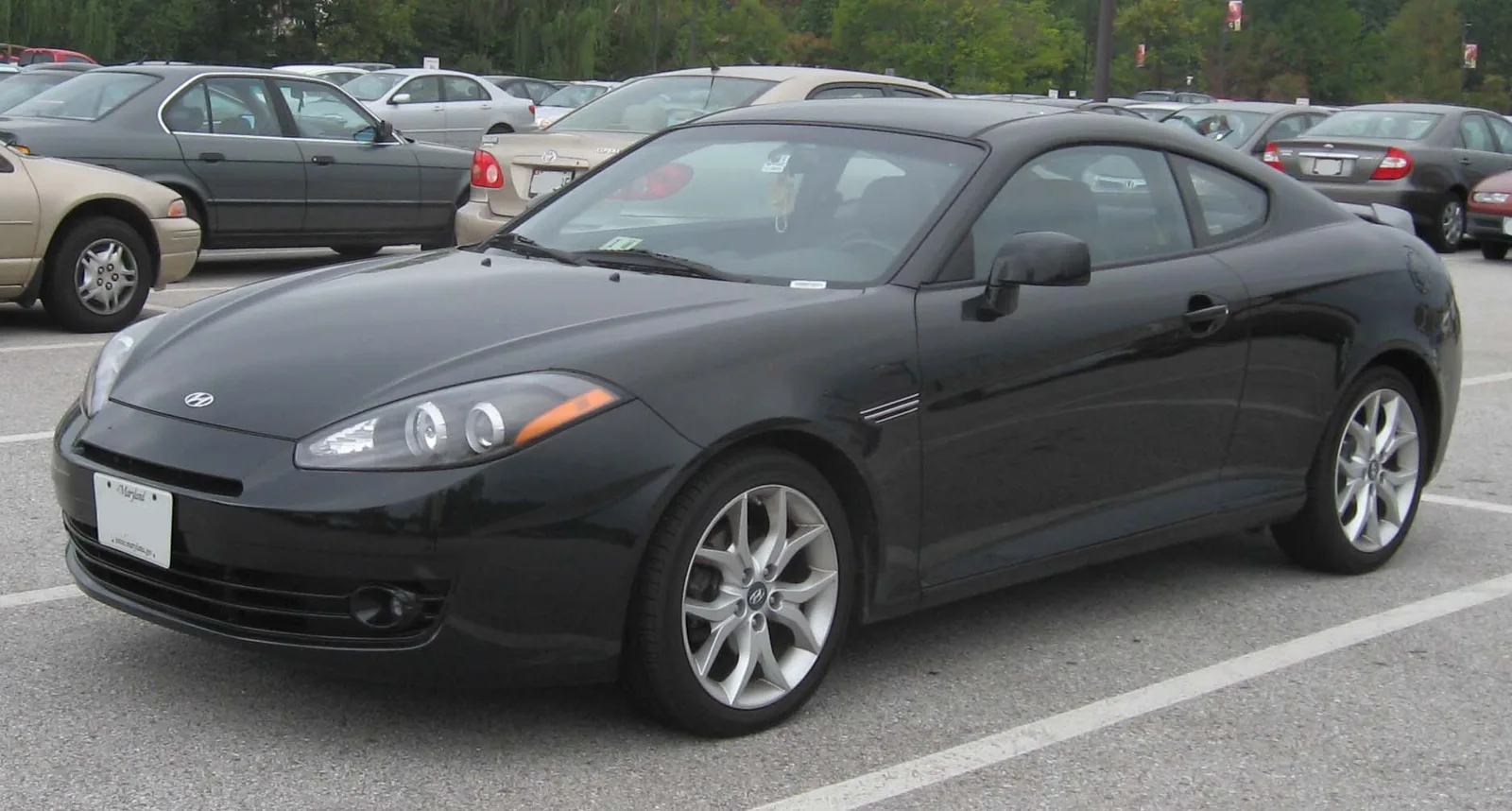
A front-wheel-drive sports coupe from Hyundai, sold as the Coupe in Europe and the Tiburon in North America, with a limited UK F2 story along the way.
Built by Hyundai from 1996 to 2008, the Tiburon was a front-wheel-drive coupe that went on sale as the Hyundai Coupe in Europe and Indonesia. Its RD and GK generations were followed by the Veloster.
The Hyundai Tiburon was a front-wheel-drive sports coupe that Hyundai built from 1996 to 2008. It went by one name in North America and another in Europe, where it was sold as the Hyundai Coupe. Across two generations and a run of facelifts, it also produced several limited editions, the most notable being the UK F2 and F2 Evolution.
Where did the Tiburon come from?
Production began in late 1996, with the car sold as a 1997 model. Its design borrowed several cues from the HCD-II Epoch concept, which had been shown at the 1993 Detroit Auto Show. The aim was a sporty coupe with a stronger identity than Hyundai's family cars.
The name is a slight variation of tiburon, the Spanish word for shark. In South Korea the same car was sold as the Turbulence and the Tuscani, so the model carried a different identity in each part of the world.
The first generation, known as RD, ran until 2001. The second, GK, debuted in 2002 with a 2003 model-year badge, and its production finished in 2008. The GK was then succeeded by the Hyundai Veloster, which was a different kind of car.
A sporty coupe with a shark name and several badges, built from 1996 to 2008 and sold across three continents.
What was the Tiburon called around the world?
In most markets the car was the Tiburon, but in Europe and Indonesia the name was Hyundai Coupe. In South Korea it wore the Turbulence and Tuscani names, and the Tiburon name was used in North America and a number of other countries.
The naming variations reflected how Hyundai handled each market separately. The same car could carry three or four names depending on where it was sold, which makes the model harder to follow than its production span suggests.
The Tuscani name also turned up outside Korea. Canada received a Tiburon special edition sold as the Tuscani edition, and many owners elsewhere fitted Tuscani emblems to their own cars.
How did the RD generation look?
The RD's styling revived coke-bottle lines, a look that had been popular in the 1960s and 1970s. Its curved, sculpted body set it apart from the more conventional coupes of its day.
Equipment varied by version. Buyers could choose with or without anti-lock brakes, with two airbags, leather trim or a sunroof, so the car could be ordered as a simple sporty coupe or a more comfortable one.
The MacPherson strut front suspension was co-developed with Porsche. That detail gave the chassis a more serious pedigree than the car's price suggested, and it sat alongside the front-wheel-drive layout in shaping how the car handled.
What engines did the RD use?
The RD was offered with a 1.6-litre engine, a 1.8-litre unit and a 2.0-litre four-cylinder. The 2.0-litre became the main choice and produced 140 hp (104 kW; 142 PS) at 6,000 rpm, along with 180 Nm (133 lb-ft) of torque at 4,800 rpm.
In the United States the 1.8-litre engine was used in base models from 1997, while the upscale FX received the 2.0-litre. The weaker 1.8 was dropped in 1998, so both models were given the larger engine.
A five-speed manual was standard with the engine, while a four-speed automatic with overdrive was available as an option until 1999. The RD's weight of around 2,550 lb (1,150 kg) gave it a better power-to-weight ratio than the later GK 2.0-litre.
How quick was the RD Tiburon?
The 2.0-litre RD reached 0-60 mph in about 8.3 seconds, with a quarter-mile time of around 16 seconds. The 1.8-litre managed 0-60 mph in 9.0 seconds and topped out at 126 mph (203 km/h), while the 1.6-litre needed 10.8 seconds for the same sprint.
Top speed depended on the gearbox. The 1.6-litre was rated at 115 mph (185 km/h) with the automatic, and the 2.0-litre managed 131 mph (211 km/h) with the manual rather than the automatic.
The figures were brisk for a small coupe of its era, and they explain why the early car found a following among drivers who wanted more than the badge suggested.
What was the UK F2 special edition?
Hyundai's entry into the Formula 2 World Rally Championship produced the F2 and F2 Evolution in the UK in 1998 and 1999. The F2 was released in July 1998, and it was sold only in the UK, where the car was called the Hyundai Coupe.
About 1100 F2 cars were sold in total during 1998 and 1999. It was an enhanced version of the UK 2.0 SE, offered in black, Bright Silver and Racing Blue. Racing Blue was unique to the F2, and no other Hyundai model was ever sold in that colour.
The F2 wore 16-inch DTM-style alloy wheels with carbon-fibre effect centre caps bearing the F2 logo. Its wheels were lighter than most OEM alloys, weighing 17.6 lb (8.0 kg) per corner, and it was fitted with Pirelli P7000 tyres.
The F2 also had a deeper front spoiler with an oval chrome mesh grille, F2 badging, a leather-and-aluminium gear lever and an uprated stereo. The on-the-road price was 17,999 pounds as of July 1998.
The first five-hundred buyers received extras. One was an aluminium-bound art book, signed inside by rally driver Kenneth Eriksson, who drove for Hyundai in the F2 World Rally Championship. The other was a key fob with an LED light.
What made the F2 Evolution different?
The F2 Evolution arrived on 14 June 1999, almost a year after the F2. It replaced the original F2 in the range and came in Silver or Cobalt Blue. It was planned as a limited edition of 1500 units, and 1513 were eventually made.
The design was led by Peter Stevens, who had worked on the McLaren F1, in conjunction with Motor Sport Developments, the support company of Hyundai's World Rally Team. Standard 2.0 SE coupes went to MSD for modification, which included a bigger front bumper, a larger rear spoiler and a high-lift camshaft.
The Evolution's wheels were 16-inch five-spoke TSW alloys, and it carried a Magnex exhaust. A Thatcham-approved alarm and immobiliser were fitted, and the cabin gained cream dials, a stitched leather armrest and an uprated stereo.
Those camshaft and exhaust changes took output up to 154 hp (115 kW), with 140 lb-ft (190 N-m) of torque. The brake pads were co-developed with AP Racing for better bite and fade resistance. It listed at 19,299 pounds on the road in June 1999.
What did the RD2 update change?
The RD2 was an update on the original RD platform, released for sale in 1999. It received a facelift that reworked the front and rear bumpers and refreshed the dashboard. In South Korea the RD2 was marketed as the Tiburon Turbulence.
Its headlights had separate enclosures for high and low beams, giving a four-headlight look. The rear bumper was reshaped with larger taillights, and the 140 hp engine carried over unchanged.
A package bundled anti-lock brakes, leather upholstery and a sunroof, so buyers wanting all three ordered them together.
What changed with the GK generation?
After five years on sale, the RD was dropped in 2001. The revised Tiburon launched in 2002 for the 2003 model year, with fresh styling, bigger dimensions and a V6 option. Its wheelbase and overall length grew slightly, and the car gained about 200 lb (91 kg) in weight.
Base models kept a 138 hp (103 kW) 2.0-litre four-cylinder. The GT V6 received a new 2.7-litre V6 with 172 hp (128 kW), a unit shared with Hyundai's Sonata and Santa Fe. The five-speed manual was standard across the range, with a four-speed automatic as an option.
A six-speed manual was also optional on the GT V6, and leather upholstery came standard in that model. Four-wheel disc brakes were fitted as standard on the new car.
Some automotive journalists compared the GK's design with the Ferrari 456, and its look was a clear step up from the RD. The new body set the tone for the rest of the car's life.
How were the GK trims and special editions arranged?
In 2004 every GT V6 got larger wheels, and a special edition joined the range. It had a Special Edition decal, sport cloth seats, a Kenwood stereo and red front brake calipers, and the choices were Jet Black, Rally Red and Sunburst Yellow.
The 2005 update reworked the line-up into GS, GT and SE models, with a facelift on top. The SE became a separate trim, the GS took the four-cylinder, and the other two kept the V6. Only the SE was given a six-speed manual as standard.
By 2006 anti-lock brakes were standard on every Tiburon. In the UK the car was offered as the 1.6S, the 2.0SE and the V6, with the six-speed gearbox standard on the V6.
Which limited editions were sold in Australia?
In October 2005 Australia received a limited edition TS. It was finished in a tiger orange that no other model used, and it had an extra-high rear spoiler, firmer suspension and a thicker rear sway bar. The name stood for Tiger Shark, a nod to the orange colour and to the shark link in the Tiburon name.
Only 80 of the 2005 TS cars were built. Each had an individually numbered ID plate in the driver's door frame, and the first car was a manual while the last had an automatic.
A 2006 TS followed in vivid blue, and 62 were released. Its plaque did not list the build number, unlike the 2005 cars. The TS came with the 2.7-litre V6 and a six-speed manual.
What was the Greek S145 model?
In Greece a 1.6-litre turbocharged version was offered for some years, because high taxation fell on larger engines. The S145 made 145 PS (107 kW) and 190 Nm of torque, and it weighed 1233 kg.
It could reach 100 km/h (62 mph) from rest in 9.3 seconds and its top speed reached 210 km/h (131 mph). Economy was 36.8 mpg, a sensible figure for that market.
How did the later facelifts change the car?
Hyundai gave the GK a light update in September 2004, ahead of the 2005 model year, with smoked headlights, redesigned tail lights and a more aggressive front air dam. In 2006 the GT Limited arrived, with an upgraded tan leather interior, automatic climate control and an Infinity stereo with a 10-inch subwoofer.
A fuller facelift arrived in November 2006, badged as the 2007 model. In the UK it was called the Coupe SIII, and it altered the look enough to be treated as the GK F/L2. The headlights grew thinner and angled more sharply, and the fenders lost their tall gill fins.
The radio antenna moved into the rear hatch glass, and the gauges received a blue backlight. The UK TSIII was the last model made, with quad exhaust pipes and an anthracite finish on its alloy wheels.
What equipment did the Tiburon offer?
The specification depended on the model and the market, but the range included anti-lock brakes with brake force distribution, front and side airbags, side impact protection bars and traction control. Electronic stability control arrived in 2007.
Comfort items covered electric windows and a sunroof, heated front seats, a trip computer and climate control. Buyers could choose leather, half-leather or cloth upholstery, and the car came with sports seats and alloy wheels.
Optional gauges covered torque, live fuel use and battery voltage. Models from 2004 to 2007 earned a four-out-of-five-star verdict from the US National Highway Traffic Safety Administration.
How fast was the GK Tiburon in road tests?
Motor Trend recorded 7.0 seconds for 0-60 mph in its test of the six-speed 2.7-litre car, while Car and Driver and MotorWeek were close behind. Road and Track's testing showed the car reaching a top speed of 137 mph (220 km/h) in 2007 and 2003.
Quarter-mile times clustered near 15.4 seconds, which put the GK in the same bracket as other sporty coupes of its time. The car's performance was strongest in the six-speed form that the magazines tested most often.
How was the Tuscani name used?
In South Korea the Tuscani wore a circular badge with horizontal bars and a gold and silver T. Hyundai offered the car in several markets as the Tuscani, and owners elsewhere fitted Tuscani emblems to their Tiburon and Coupe models.
An unconfirmed rumour said Hyundai had weighed making Tuscani a separate sub-brand for more exclusive models. The plan was never confirmed, although the name stayed in use on some models.
Secondary badges such as GS, GT, SE and FX denoted engine size and trim, and the 1.6-litre always used one exhaust outlet on the right, whichever market it was sold in. Those details help owners and buyers identify a car's version.
What are the Hyundai Tiburon specifications?
| Specification | Detail |
|---|---|
| Type | Front-wheel-drive sports coupe |
| Years | 1996 to 2008 |
| RD engine range | 1.6L, 1.8L and 2.0L four-cylinder |
| RD 2.0-litre output | 140 hp (104 kW; 142 PS) |
| GK base engine | 2.0-litre, 138 hp (103 kW) |
| GK V6 | 2.7-litre, 172 hp (128 kW) |
| F2 Evolution output | 154 hp (115 kW), 140 lb-ft (190 N-m) |
| Base weight (RD) | 2,550 lb (1,150 kg) |
| 0-60 mph, RD 2.0 | About 8.3 seconds |
| Top speed, GK 2.7 six-speed | 137 mph (220 km/h), Road and Track 2007 |
| Greek S145 | 1.6L turbo, 145 PS (107 kW), 1233 kg |
| Successor | Hyundai Veloster |