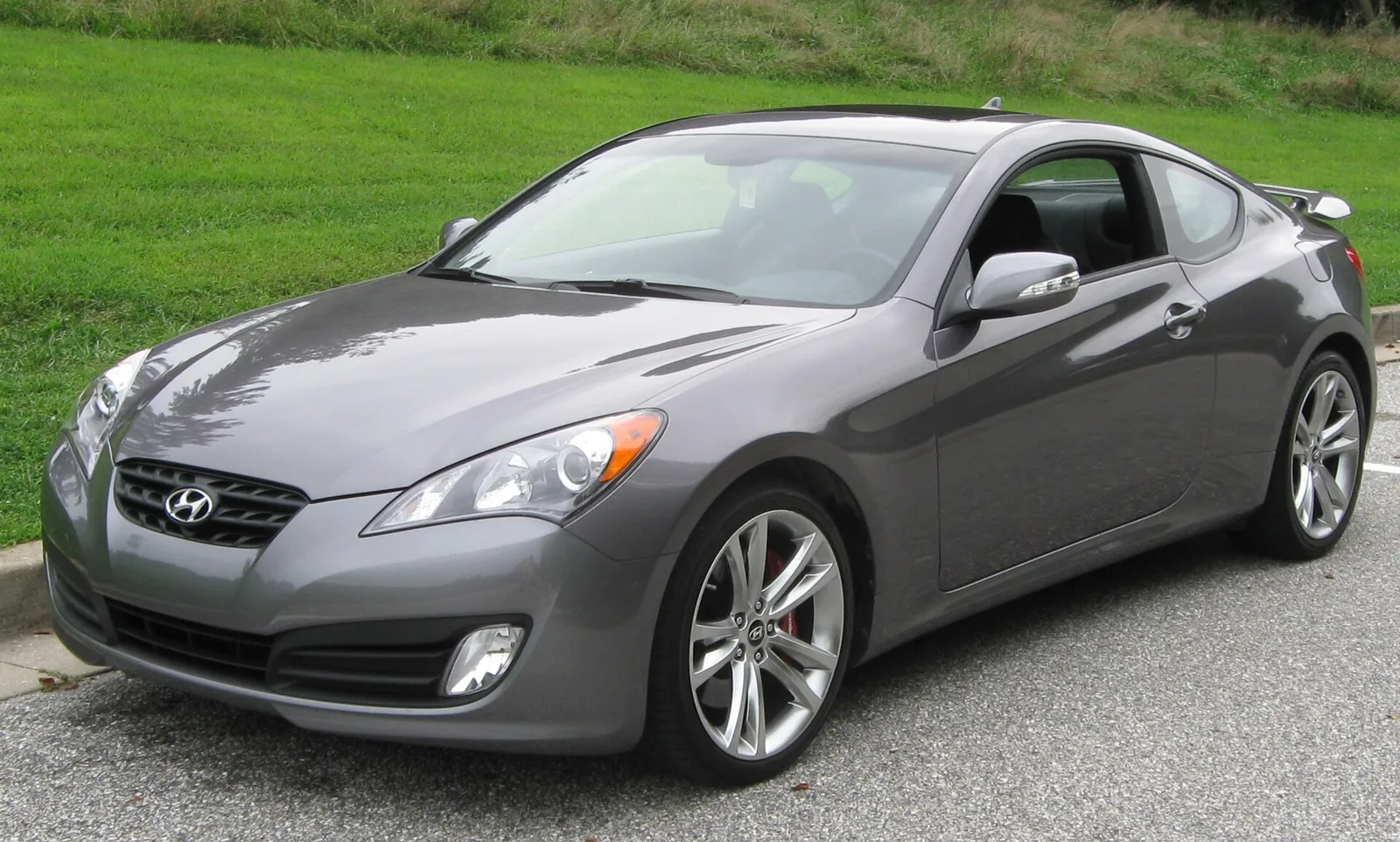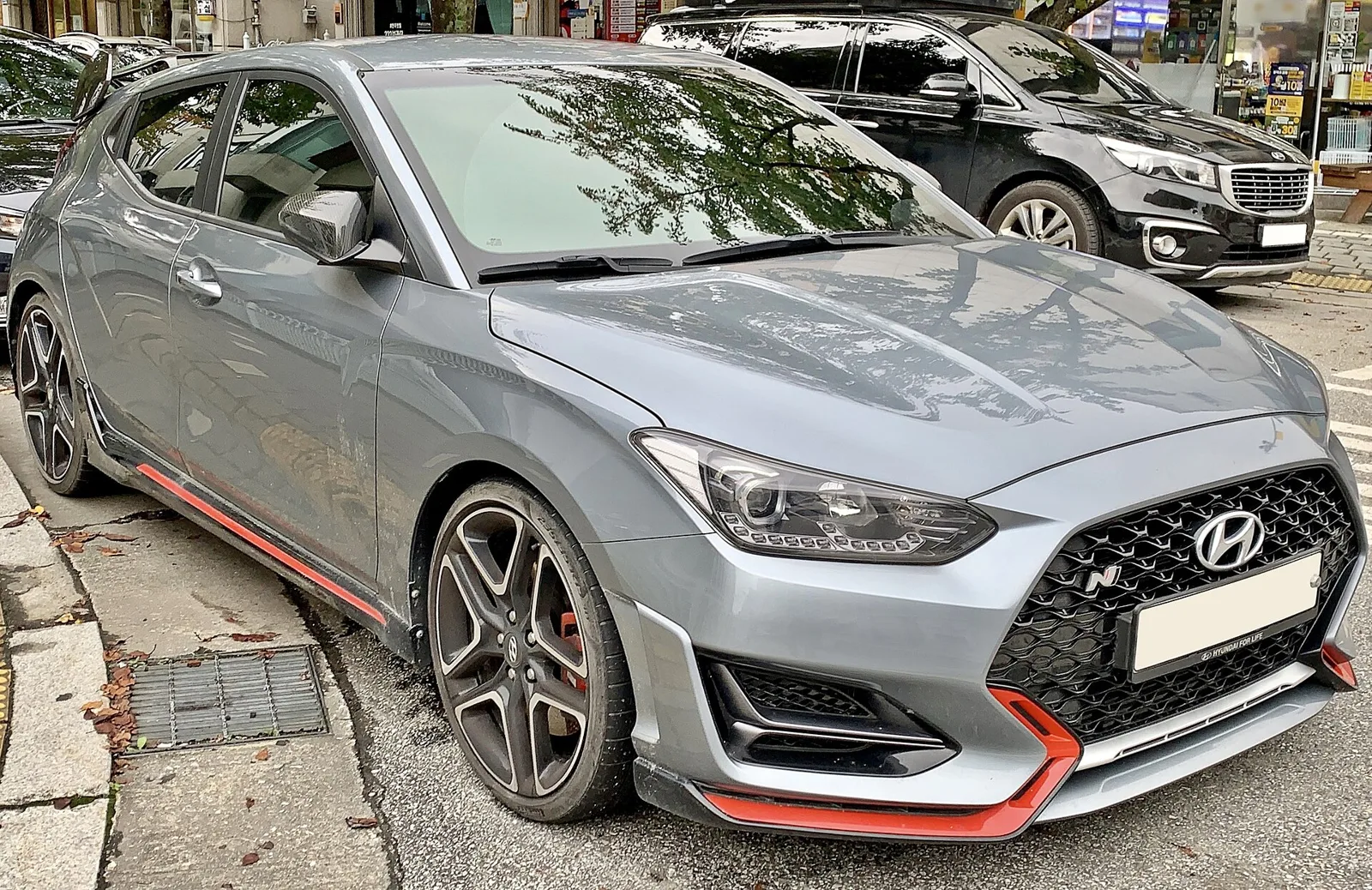
A compact three-door hatch with one large door on the driver's side, built in two generations with Turbo, special editions and N versions.
A compact hatch built by Hyundai from 2011 to 2022, the Veloster is known for its uneven door pattern. It came as two generations, with Turbo, limited editions, racing offshoots and an N model, all sharing that unusual door layout.
The Hyundai Veloster is a compact three-door hatchback that Hyundai built from 2011 until 2022 across two generations. Its defining feature is an asymmetrical door arrangement, with one large door on the driver's side and two smaller doors on the passenger side. Turbo and N versions added the car's performance credentials.
What is the Hyundai Veloster?
The Veloster is a compact car that Hyundai produced from 2011 to 2022 in two generations. It differs from most hatchbacks in its door layout, and the N performance version, released in 2019, was the first N model sold in North America.
Across its life the car offered a standard engine and a turbocharged one, and it was sold as the Veloster Coupe and Veloster Coupe Sport in Europe. The sport model added a panoramic sunroof, 18-inch wheels and full leather trim to the base car.
A car insurance comparison service studied 2.5 million insurance applications from 2021 and found that 15.43% of Veloster owners had speeding violations. That rate was 32% higher than the national average, and sixth highest for any car in the database.
A compact hatch whose one large door on the driver's side became its signature across two generations.
Why does the Veloster have an asymmetrical door layout?
Only one door sits on the driver's side, and the other two are on the passenger side. The Mini Clubman, by contrast, has a pair of side doors on the right, while the Veloster keeps its large door on the driver's side whichever way the car is built.
That layout is more usual on commercial vehicles and minivans than on sporty hatchbacks. The second generation kept the same 2+1 door configuration, so the arrangement outlasted the first design.
Where did the Veloster come from?
The Veloster grew out of the HND-3 concept, the third sport compact concept styled at Hyundai's Design Center. That concept was unveiled at the 2007 Seoul Motor Show, and the production car was developed under the codename FS.
The production model was built on a modified version of the Cee'd front-wheel-drive platform and unveiled at the Detroit Auto Show on January 10, 2011. Sales began in South Korea on March 10, 2011, and in Canada and the United States later that year.
The car was positioned to fill the gap left when Hyundai discontinued the Tiburon after the 2008 model year. North American cars also carried Blue Link, a telematics system comparable to OnStar, which provided automatic crash notification and remote control of vehicle features.
What engine did the first-generation Veloster use?
The standard car used a direct-injected 1.6-litre four-cylinder producing 138 hp (103 kW) and 123 lb ft (167 Nm) of torque at 4,850 rpm. A six-speed manual was standard, and a seven-speed dual-clutch gearbox with paddle shifters was optional.
That dual-clutch unit was Hyundai's first. Official EPA figures for the manual are 27 mpg-US city, 37 highway and 31 combined, while the dual-clutch car returns 28 mpg-US city, 37 highway and 31 combined.
Some markets received a different car. For the Middle East, Chile and Brazil the Veloster was offered without GDI, which made 128 hp.
How did the Veloster Turbo differ?
The Turbo used a 1.6-litre T-GDi Gamma engine, rated in North America at 150 kW (204 PS; 201 hp) at 6,000 rpm. It produced 27 kg m (265 Nm; 195 lbf ft) of torque between 1,750 and 4,500 rpm, while European cars were tuned to 186 PS (137 kW; 183 hp).
European Turbo torque peaked earlier in the rev range, at 1,500 rpm. The Turbo also gained LED lights, twin exhausts, side skirts and a larger grille, and its three-door body gave it a shooting brake shape that was a novelty.
North American Turbos went on sale in summer 2012 as 2013 models, with a six-speed manual or a six-speed automatic with Shiftronic. European Turbos were manual only.
Which special editions did the Veloster get?
Three limited versions stand out. RE:MIX was unveiled at the 2012 SEMA show, the RE:FLEX Edition of 2014 was limited to 3,000 units, and the 2016 Rally Edition was limited to 1,200 units and based on the Turbo.
The RE:FLEX Edition used a six-speed EcoShift dual-clutch transmission. It was unveiled at the 2014 Chicago Auto Show, and its US price was $21,650 before freight.
The Rally Edition came with matte blue paint, RAYS wheels that were 5 lb lighter each, and a full-metal roof in place of the panoramic sunroof. RE:MIX reached US dealers in December 2012.
What concept cars were built from the Veloster?
Outside builders produced several concept versions of the car. The 2011 ARK Performance Veloster had an estimated 210 hp from a twin-scroll turbocharger, while the 2011 PM Lifestyle car was estimated at 163 hp. The ARK Alpine Edition reached 232 hp (173 kW) and 240 lb ft (325 Nm).
The Veloster C3 Roll Top concept was unveiled at the 2012 LA Auto Show. The Zombie Survival Machine was built by Galpin Auto Sports for The Walking Dead Chop Shop, and it was unveiled at the 2013 San Diego Comic-Con.
Did the Veloster race?
Yes. Rhys Millen drove a rallycross Veloster with a 2-litre engine making 500 hp (373 kW), and torque of 600 lb ft (813 Nm). The car debuted at the Summer X Games during the 2011 US Rallycross Championship.
The rallycross car used a six-speed sequential gearbox and all-wheel drive. Rhys Millen Racing and Hyundai continued the partnership into the 2012 Global RallyCross season, and race cars went on sale from January 1, 2013, after Hyundai left North American motorsport.
Hyundai later built an electric racer. The Veloster N ETCR debuted at IAA in Germany in September 2019 as a battery electric rear-wheel-drive racing car, and it was the first electric racing car the company built.
The ETCR was campaigned from the inaugural FIA ETCR season in 2021 and assembled in Alzenau, Germany. Jean-Karl Vernay finished second in the 2021 PURE ETCR series, and Hyundai finished third of three in the manufacturer standings.
Did Hyundai face a legal challenge in Brazil?
Yes, a consumer controversy. Hyundai advertised GDi injection, but the MPI DUAL engine was the one sold in Brazil. Buyers who cancelled forfeited a 10% reservation deposit, and the Brazilian Public Ministry began investigating Hyundai.
The case shows how the same model could be sold with different engines in different markets. Buyers who had pre-ordered were left to accept the non-GDi car or walk away from their deposit.
Were there recalls on the Veloster?
Yes. Hyundai recalled 2012 Veloster cars fitted with panoramic sunroofs, because the sunroof could be weakened during installation at the factory. A separate recall covered manual 2012 cars whose parking brake components could bind from moisture and road grime.
Both recalls concerned 2012 model-year cars rather than the whole production run.
What changed in the second generation?
The second-generation Veloster was revealed at the 2018 North American International Auto Show. It kept the asymmetric 2+1 door layout and made forward-collision warning with automated emergency braking standard.
Multi-link suspension and Torque Vectoring Control arrived with the new generation. The base and Premium cars used a new 2.0-litre four rated at 147 hp (110 kW; 149 PS), with torque of 132 lb ft (179 Nm).
Why did Hyundai stop selling the Veloster?
Hyundai dropped all Veloster models except the N in Canada in August 2020. In July 2021 it announced that US Veloster models would end for 2022, again except the N, citing slow sales. The company said it would focus on more popular models such as the Kona.
The N therefore carried the nameplate in both markets during the final years of the car.
What is the Veloster N?
Hyundai's N badge arrived on the Veloster in 2019, with a turbocharged four-cylinder that initially made 250 PS (184 kW; 247 hp) as standard. The optional Performance Package raised output to 275 PS (202 kW; 271 hp).
The car launched with a six-speed manual only. An eight-speed wet dual-clutch transmission was added in 2020, and Hyundai claimed 0 to 100 km/h in 5.6 seconds with it. The Performance Package became standard in 2021.
What are the Veloster specifications?
| Specification | Detail |
|---|---|
| Production | 2011 to 2022, two generations |
| First-generation engine | 1.6-litre direct-injection four, 138 hp (103 kW); 123 lb ft (167 Nm) at 4,850 rpm |
| Turbo, North America | 150 kW (204 PS; 201 hp) at 6,000 rpm; 27 kg m (265 Nm; 195 lbf ft) from 1,750 to 4,500 rpm |
| Turbo, Europe | 186 PS (137 kW; 183 hp) at 5,500 rpm; torque peaks at 1,500 rpm |
| Manual EPA | 27 mpg-US city, 37 highway, 31 combined |
| DCT EPA | 28 mpg-US city, 37 highway, 31 combined |
| Second-generation engine | 2.0 L I4, 147 hp (110 kW; 149 PS); 132 lb ft (179 Nm) |
| Veloster N | 250 PS (184 kW; 247 hp) standard; 275 PS (202 kW; 271 hp) with Performance Package |
| Veloster N 0 to 100 km/h | 5.6 seconds with the 8-speed wet dual-clutch |
| Veloster N ETCR | Battery electric, rear-wheel drive, built in Alzenau, Germany |