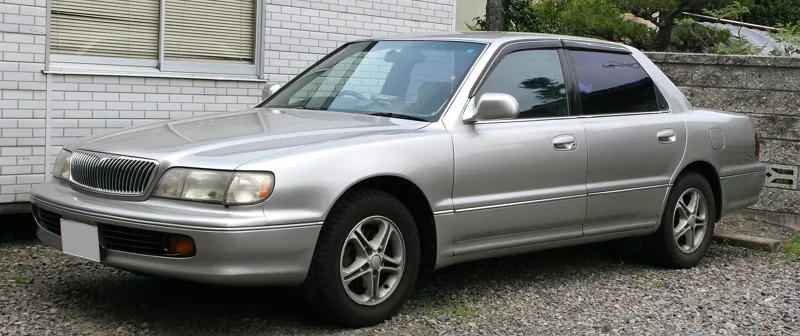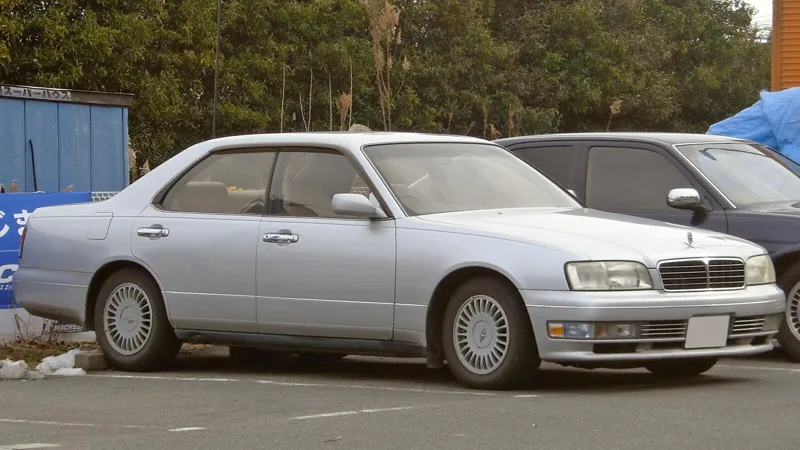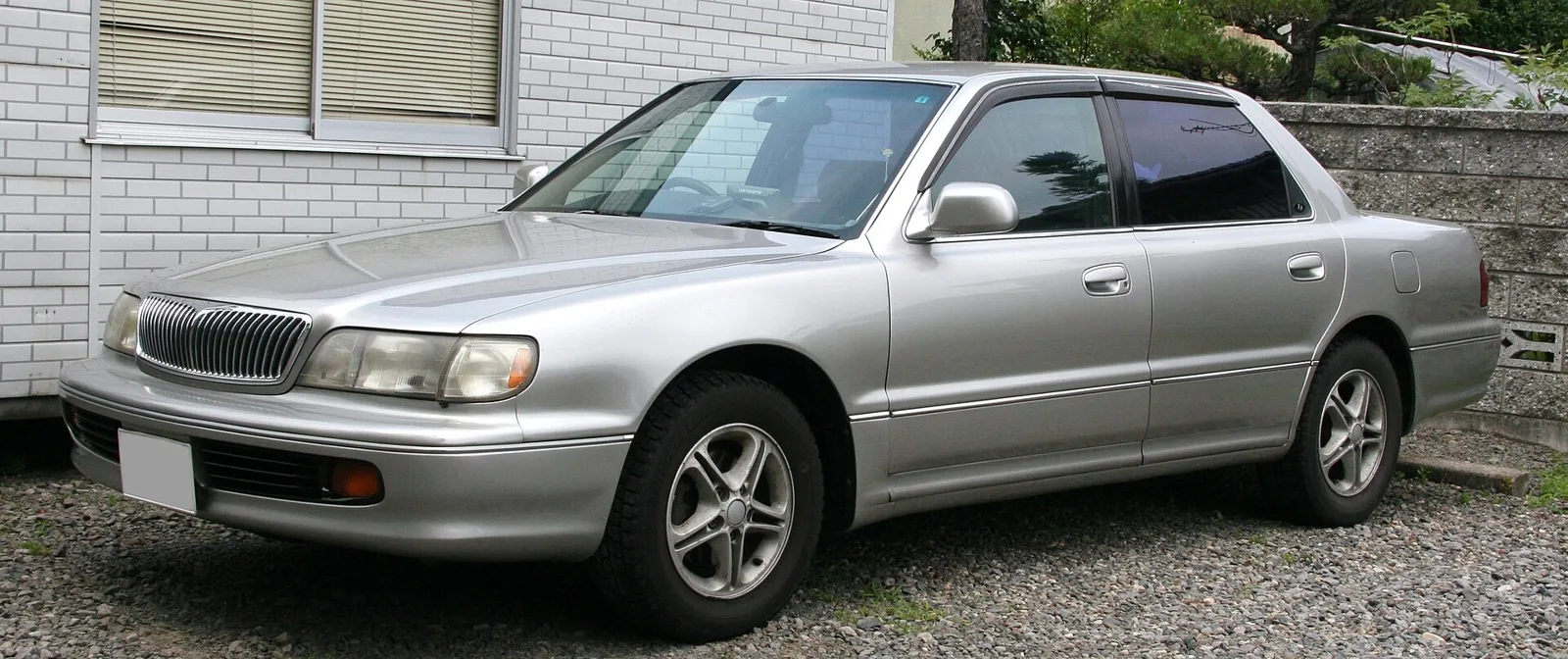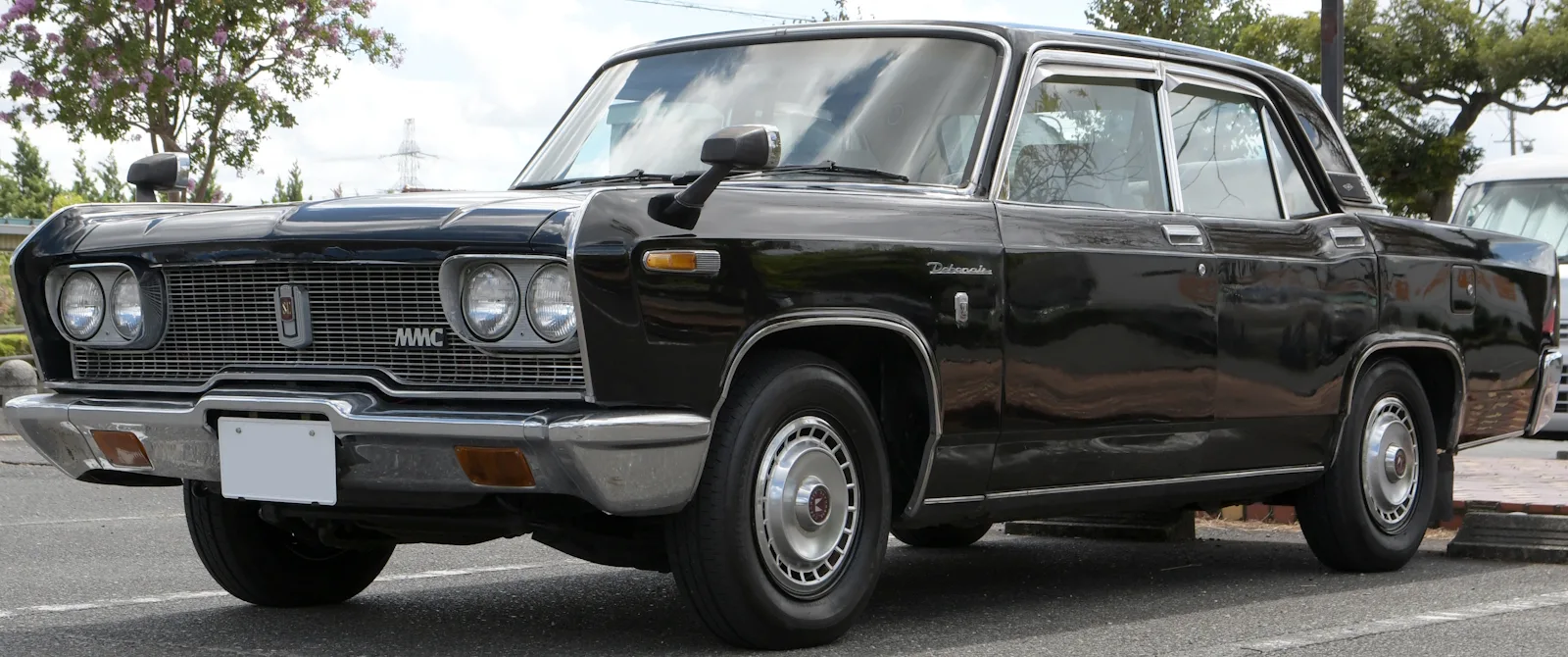
Mitsubishi's senior executive car kept one shape for 22 years, while Nissan's Cedric kept changing and grew into a range that reached above two litres.
The Mitsubishi Debonair was a senior executive sedan from 1964 to 1999, while the Nissan Cedric dates from 1960 and ran until 2015. They were direct rivals in the Japanese market, and the Cedric was the main competitor to the Toyota Crown.
The Mitsubishi Debonair and the Nissan Cedric were two of the Japanese executive sedans that competed for the same senior buyers. The Debonair was introduced in 1964 as Mitsubishi's flagship, while the Cedric dated back to 1960 and became one of Nissan's main upscale models.
The two cars were built with the same market in mind, the company car of the Japanese executive. They took very different routes, from the Debonair's long-lived shape to the Cedric's steady run of generations that lasted until 2015.
Were the Debonair and Cedric rivals?
They were direct competitors. The Debonair was Mitsubishi's rival to the Nissan Cedric, the Prince Gloria, the Isuzu Bellel and the Toyota Crown. Throughout its life the Cedric was considered the prime competitor to the Toyota Crown, which kept the two Japanese brands in the same showrooms.
The Debonair was an executive car in the strictest sense. Its first and second generations were used mainly by senior executives of the Mitsubishi Group and affiliated companies, which set it apart from the more widely sold Cedric.
One Japanese executive sedan kept the same look for 22 years, while its Nissan rival kept changing shape and engine.
When were the two cars on sale?
The car debuted in October 1963 at the 10th All Japan Motor Show, which later became the Tokyo show. Production began in time for the Tokyo Summer Olympics in October 1964, and the car remained in production for 35 years until 1999.
The Cedric began as the 30 series in March 1960, and the nameplate ran until 2015. Its P130 generation of 1965 to 1971 was the one that overlapped most closely with the first Debonair.
Specifications side by side
| Specification | Mitsubishi Debonair (first generation) | Nissan Cedric (P130, 1965) |
|---|---|---|
| Introduction | Shown October 1963; production for the 1964 Olympics | 1965 to 1971 generation |
| Body styles | Four-door executive sedan | Sedan, five-door wagon and five-door van |
| Starting engine | 1,991 cc six-cylinder, 105 PS (77 kW; 104 hp) at 5,000 rpm | H20 2.0 L, 92 PS (68 kW) |
| Top engine | 1,994 cc Saturn 6 from September 1970, 130 PS (96 kW; 128 hp) | L20 OHC twin-carburettor six, 130 PS (96 kW) |
| Top speed | 155 km/h (96 mph) with the original engine; 180 km/h (112 mph) with the Saturn 6 | No figure given |
| Diesel | No figure given | 2.2 L SD20 diesel, 70 PS (51 kW) |
| Suspension | Double wishbone at the front, leaf springs and a differential at the rear | No figure given |
| Styling | Continental-inspired panels, squared wheel wells and tapered rear fins | Pininfarina bodywork on a new dedicated platform |
| Engine size policy | Held to 2.0 L to limit annual road tax | Versions above two litres no longer regarded as compact |
| Production | 21,703 first-generation cars built in just over 22 years | No figure given |
| Export | A very minor export push in the 1960s | Sold abroad as the Datsun 2000, 2300 and 2400 |
Why did the Debonair keep the same shape for so long?
The Debonair's appearance remained largely unchanged from 1964 to 1986. It went through several minor redesigns, denoted I through IV, and stayed in production for 22 years without major changes to its look. Those redesigns were small enough that the shape stayed recognisable across two decades.
The reason was its role. Because the Debonair was seen as a senior executive vehicle, the exterior received little attention, while its mechanicals were updated regularly with the latest advances.
How was the Debonair styled?
Former General Motors designer Hans S. Bretzner was largely responsible for the Debonair, and its look drew heavily on the 1961 Lincoln Continental designed by Elwood Engel. Slab-sided body panels, squared wheel wells, extended front protrusions and tapered rear fins gave it a Continental-like appearance.
Its 1973 facelift made the front turn signals smaller and moved them up onto the fenders, deleted the front ventilation windows and replaced the L-shaped taillights with rectangular units. The model code did not change with the facelift.
How did the Cedric's first generation look?
The first Cedric, the 30 series, was introduced in March 1960 and produced through 1962. It was sold only through Nissan's Cedric Store dealers, and it was the first product labelled as a Nissan, although its mechanicals were shared with Datsun products.
The 30 series had a first monocoque body and a wrap-around windshield, with two stacked headlights on either side of a large grille. The stacked headlight approach was a novel way to suggest size and luxury, and the Isuzu Bellel of 1961 used it too.
How did the Cedric's second generation change?
The P130 Cedric ran from 1965 to 1971 with bodywork by Pininfarina, a fresh platform and a range of new engines. Its L20 was the first OHC engine Nissan made, and its modernised look followed the sleek, angular sedans of the period.
Buyers could choose a four-door sedan, a five-door station wagon or a five-door van. In 1967 there were 68 model variations of the Cedric, and Nissan built a police car with the Y40 V8, the only time it installed a V8 in the Cedric.
What engines did the P130 Cedric offer?
The P130 line started with the 2.0-litre H20 OHV four at 92 PS (68 kW) and the 2.0-litre J20 six at 100 PS (74 kW). The L20 OHC twin-carburettor six developed 130 PS (96 kW), and it was used in the Special Six and Super Six.
A 2.2-litre SD20 diesel four produced 70 PS (51 kW) and was offered from 1965 to 1971. The P130 was the first Cedric available in versions no longer regarded as compact sedans, because the engine displacement exceeded two litres.
How did the Debonair's second generation change?
In July 1986 Mitsubishi changed the Debonair's look and layout, because the old car was seen as rare and not a sales leader. The second generation adopted front-wheel drive, a cost-effective way to add interior space without heavy engineering spend, shared with the E11 Galant, and it brought Mitsubishi's first V6 engines.
The Debonair took advantage of front-wheel drive to add passenger space, and its trunk was designed so that two sets of golf clubs could fit. Sales in its first full year, 1987, reached 6,230 cars in Japan, compared with 205 for its predecessor in 1985.
What was the second-generation Debonair's V6 like?
The car used the 6G71 2.0-litre and 6G72 3.0-litre V6, marketed as the Cyclone. The 3.0 produced 150 PS (110 kW; 148 hp) and could reach 195 km/h (121 mph), but a 180 km/h (110 mph) limiter applied to Japanese cars.
In the third quarter of 1989 a twin-cam 3.0-litre V6 with four valves per cylinder arrived, lifting output from 155 PS (114 kW; 153 hp) to 200 PS (147 kW; 197 hp). Its top speed was 215 km/h (134 mph) according to period sources.
Did the Debonair have a special luxury version?
German tuner AMG worked on a version of the Debonair that consisted mostly of exterior body treatments. AMG offered two versions of the car: one at standard length, and a longer one, the Debonair V 150 AMG, stretched by 150 mm (5.9 in).
A full stretch limousine was also available briefly from 1987, largely handbuilt by Mitsubishi's Aichi dealership chain. It was stretched 600 mm (24 in) between the doors, for an overall length of 5,465 mm (215 in).
How did the Debonair's third generation differ?
The third-generation Debonair arrived in late 1992, longer and wider than its predecessors. Its engine range was topped by a 260 PS (191 kW; 256 hp) 3,496 cc 6G74 DOHC V6, and as Mitsubishi's domestic flagship it carried much of the company's technology.
Its features included four-wheel steering, four-wheel anti-lock braking, electronically controlled suspension, GPS navigation, a rear-focused camera and self-closing doors. A lidar-based distance warning system was offered on Japanese cars, but it only warned the driver of vehicles ahead.
How did Nissan keep the Cedric in production?
Nissan's Cedric was developed to provide upscale transport, and it faced the Prince Skyline and Gloria, which later joined the Nissan family. Its Cedric/Gloria series was known in Japan as CedGlo, and that series ended in October 2004, when it was replaced by the Nissan Fuga.
The Cedric name survived on the Y31 fleet vehicle used as a taxi, which competed with the Toyota Comfort. The name itself came from the character in Frances Hodgson Burnett's novel Little Lord Fauntleroy, as chosen by Nissan's CEO Katsuji Kawamata.
How did the Cedric's 230 series change?
The 230 series, released in 1971 and produced through 1975, was built at the Tochigi factory. It had a coke-bottle appearance, a two-door coupe and a four-door hardtop added in August 1972 with no B-pillar between the front and rear side windows.
The 2.4-litre engine gave way to a 2.6-litre L26 of 140 PS (103 kW) to meet emission regulations from April 1973, and in many European markets the car was offered only with the diesel, aimed at taxi use.
What did the Cedric's 330 series bring?
The 330 Cedric was produced from 1975 to 1979, and like the 230 it came as a sedan, wagon and van, a coupe and a rarer pillarless hardtop sedan. In Japan it was also sold as the Gloria, while export models were badged as the 200C, 220C, 260C and 280C from 1978.
The diesel returned, mainly for taxi use, and a version of the H20 four ran on LPG. Trim levels ran from the Deluxe and Custom Deluxe up through the SGL, where the initials stood for Senior Grade Level, and the E suffix marked fuel injection. The top-of-the-line Brougham version first appeared in June 1977.
What did Japanese buyers pay for larger Cedrics?
Japanese buyers of the larger-engined Cedric models were liable for higher annual road tax, which added to their exclusivity. That tax burden kept the largest Cedric engines with a smaller group of owners, and the Debonair was held to 2.0 litres for the same reason.
The 2.8-litre Cedric Special of 1963 to 1965 carried the same tax penalty, and it was made more exclusive by it. Its K-series straight-six was an H engine with two extra cylinders, producing 118 hp (88 kW).
Which buyer suits each car?
The Debonair suits a buyer who wants a senior executive sedan with a long-running shape, a 2.0-litre tax position in its early years and, later, a V6 with the latest technology. The Cedric suits a buyer who wants an upscale Nissan with a choice of diesel, four-cylinder and six-cylinder power across many generations.
Practicality is only partly covered. The Debonair's golf-club trunk and the Cedric's wagon and van bodies are noted, but no seating or running cost figures are compared for the two cars.
How did the two marques sell?
The first Debonair generation was sold in small numbers, with only 205 units sold in Japan in its last full year, 1985, and 21,703 built across 22 years. The second generation's 6,230 cars in 1987 marked a clear recovery, which came just before the Diamante arrived in 1990.
The second and third Debonair generations found considerable success in South Korean licence production. The Cedric's sales figures are not given in this comparison. For the Cedric, the Toyota Crown was the benchmark it always had to measure against.