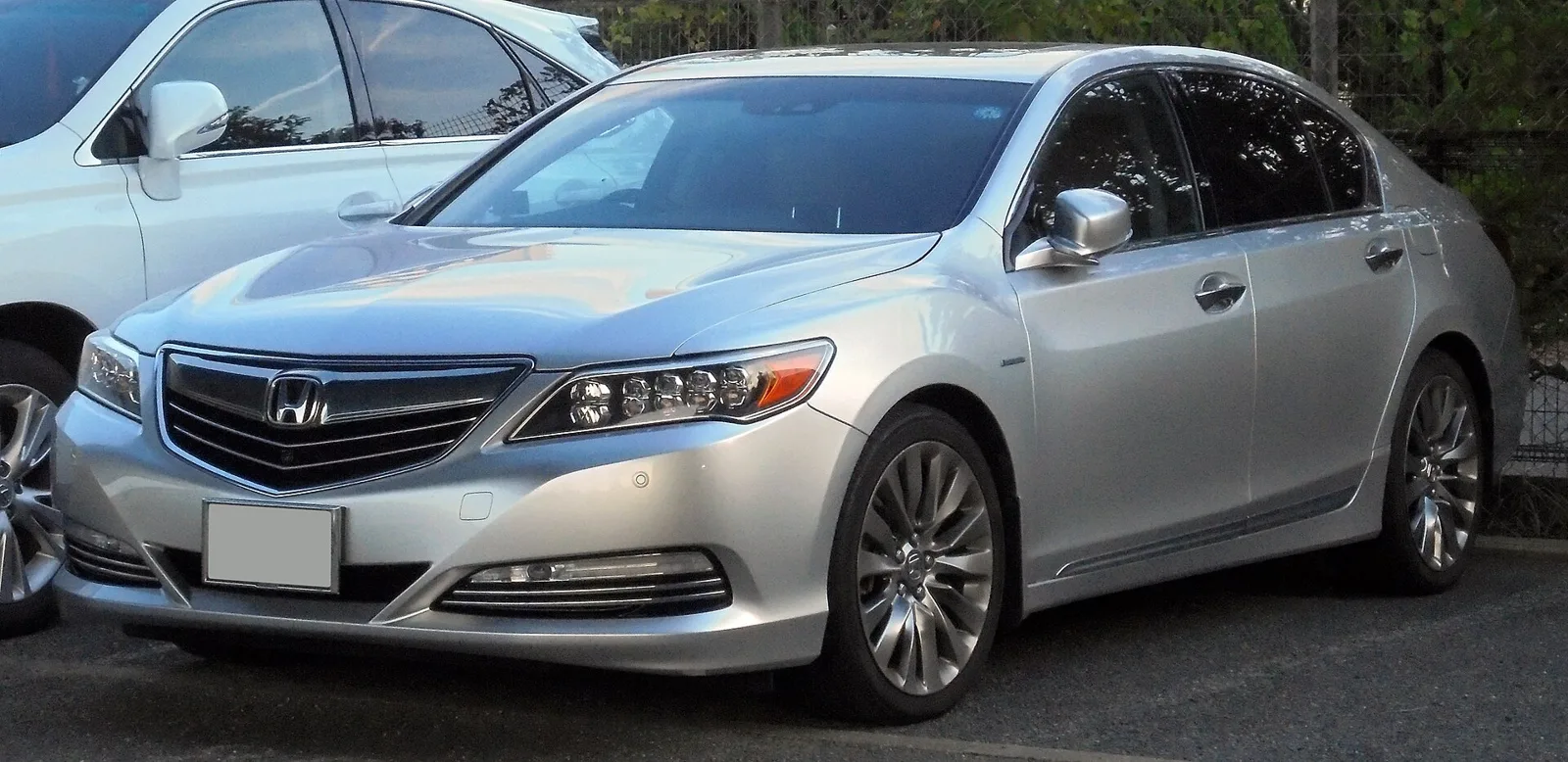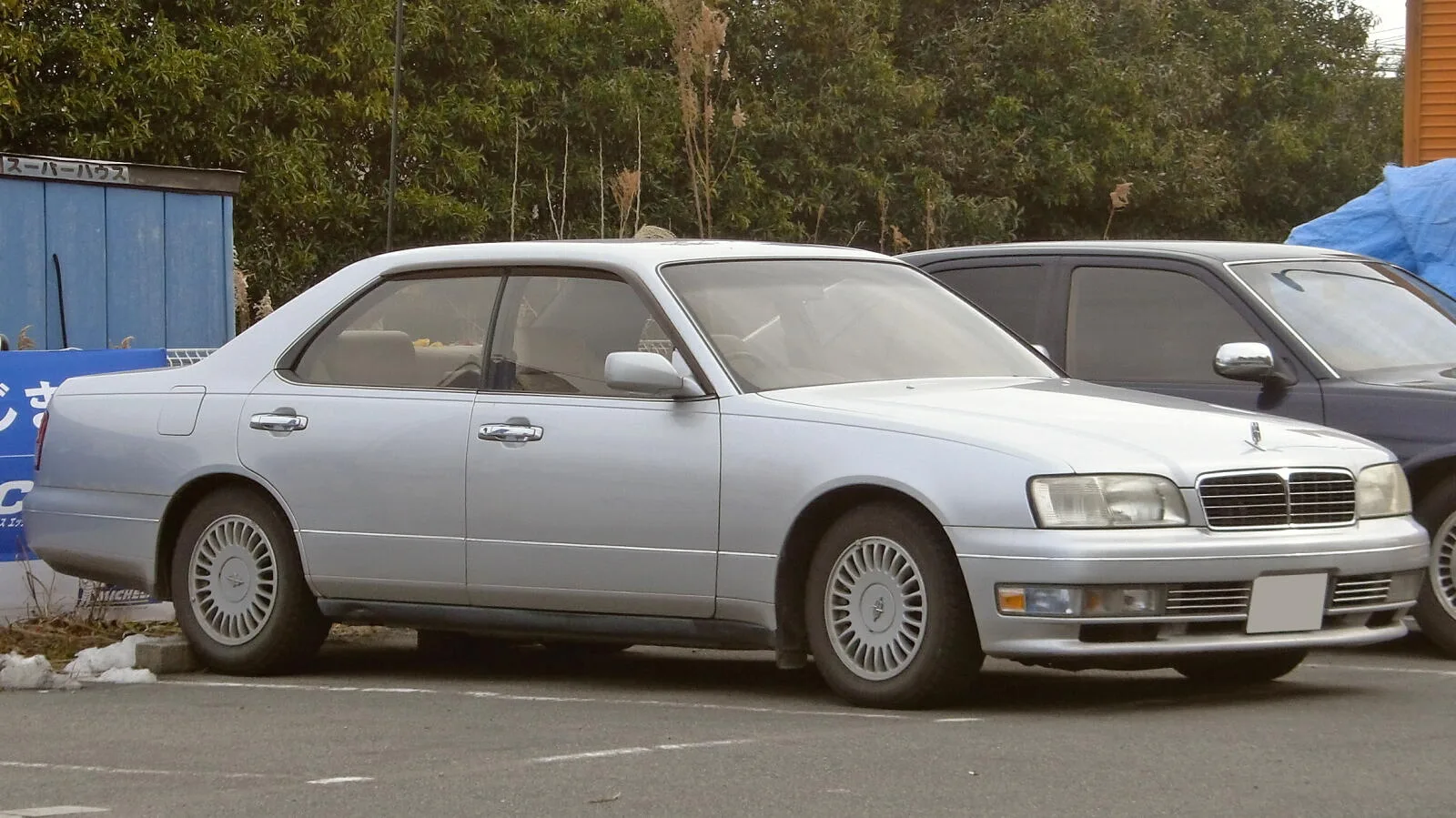
Two long-running Japanese executive saloons that fought for the same chauffeur, taxi and company-car buyers, from the 1960s to the 1970s and beyond.
The Nissan Cedric was built from 1960 to 2015 as Nissan's upscale saloon, while the Toyota Crown began in 1955 as Toyota's mainstream flagship. The two were each other's main rivals in Japan, and the Crown's US exports from 1958 gave it the wider overseas reach.
The Nissan Cedric and the Toyota Crown were the two big executive saloons of Japan for much of the 20th century, and each was the other's main target for most of its life. The Cedric came from Nissan's upscale line, while the Crown was Toyota's mainstream flagship that had started life in 1955. Both sold to taxi operators and company fleets, which made them unusually close rivals.
Why were the Cedric and Crown rivals?
The Cedric was designed to give Nissan an upscale car to compete with the Prince Skyline and Gloria, which later merged into the Nissan family. Later the Skyline was positioned as a sports sedan and coupe, while the Gloria became a sportier version of the Cedric with a different grille and light clusters.
Throughout the many versions of the Cedric, the Toyota Crown was its principal competitor. That made the rivalry a daily one for showroom sales, and for the taxi and company car markets where both cars were regular fixtures.
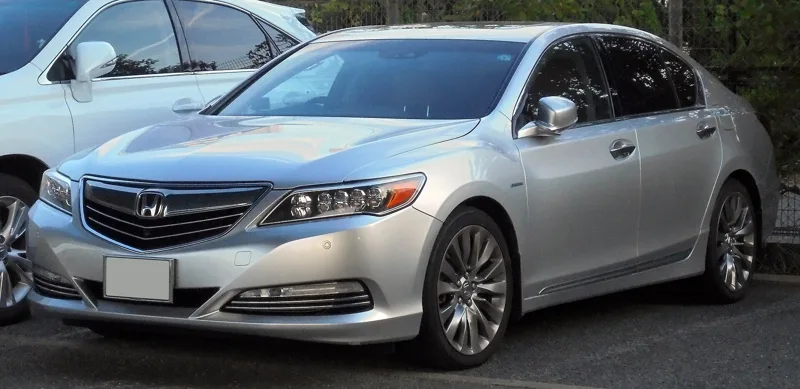
The Crown was introduced in January 1955 for private buyers, while a commercial Master version served as a taxi. The Crown's main Japanese rivals later included the Nissan Cedric, Gloria and Fuga, the Honda Legend, the Mazda Luce, the Isuzu Bellel and the Mitsubishi Debonair.
Two Japanese executive saloons that fought for the same chauffeur, taxi and fleet buyers across half a century.
Where did each car first compete?
In Japan the two cars competed in the same dealer networks, which kept the rivalry close on home ground. The first Cedric was sold only through Nissan's Cedric Store outlets, and the Crown was originally sold at Toyota Store dealers.
Toyota took the Crown abroad first. The first export to the United States was 30 Crown Deluxes shipped in June 1958, after Toyota Motor Sales USA was set up in the previous October. The car was built for muddy Japanese roads, however, and it struggled on American freeways, so Toyota suspended passenger car exports in 1960.
The Cedric followed a different path. In North America it was sold as a Nissan rather than a Datsun, around 1963 and 1965, but it did not sell well and only a handful are known to exist there. From 1967 the P130 Cedric was exported as the Datsun 2000, 2300 and 2400 in various markets.
How did the designs evolve?
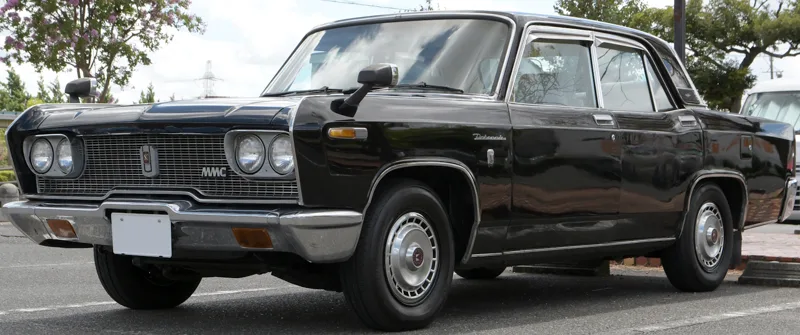
The first Cedric, the 30 series, arrived in March 1960 and was the first car labelled as a Nissan, although it shared mechanicals with Datsun products of the time. It introduced Nissan's first monocoque body and a wrap-around windscreen, and its twin-stacked headlights on either side of a large grille gave it a suggestion of size.
The Crown's early design used suicide doors at the rear, a feature shared with the Toyota AA, Toyota's first car. Its coil and double wishbone front suspension was a departure from the leaf-sprung beam axles of most earlier Toyotas, and in 1958 it gained a ball joint suspension.
The Cedric's second generation, the P130 of 1965 to 1971, had Pininfarina bodywork on a dedicated platform. Its look was influenced by other Japanese luxury saloons of the period, including the 1962 Toyota Crown and the 1964 Mitsubishi Debonair, with squared and angular lines in place of the earlier curves.
The 230 series of 1971 to 1975 introduced a coke-bottle appearance, a style that had begun appearing internationally in the 1960s. In August 1972 a four-door hardtop with no B-pillar between the front and rear side windows was added to the options list.
What engines did the two cars use?
The Cedric 30 used a 1.5-litre G-series four making 71 PS (52 kW) in the Standard car, while the 1.9-litre H-series with 88 PS (65 kW) was optional. Toyota's Crown began with the 1.5-litre Type R engine, and the larger 1.9-litre 3R arrived in October 1960 for the RS30.
The Cedric's sixes were more important as the range grew. The Cedric Special of 1963 to 1965 used a 2.8-litre K-series straight-six at 118 hp (88 kW), with a long-wheelbase body lengthened by 145 mm (5.7 in). The P130 brought Nissan's first overhead-cam engine, the L20, which the Cedric used in a twin-carburettor form at 130 PS (96 kW).
The Cedric's diesel was the SD20, which made 70 PS (51 kW) on the P130 and was aimed at the taxi trade. The Crown had its own diesel history, starting with Japan's first diesel-engined passenger car in October 1959, which produced just 40 PS (29 kW).
The Cedric's V8 was an oddity. Nissan fitted a Y40 V8 to a police-spec P130, the only time a V8 appeared in the Cedric line.
Specifications side by side
| Feature | Nissan Cedric | Toyota Crown |
|---|---|---|
| First model year | 1960 (30 series) | 1955 (Toyopet Crown) |
| Production span | 1960 to 2015 | Continuous from 1955; 16th generation in 2022 |
| Entry engine | 1.5-litre G-series four, 71 PS (52 kW) | 1.5-litre Type R engine |
| Step-up engine | 1.9-litre H-series, 88 PS (65 kW) | 1.9-litre 3R, from October 1960 |
| Six-cylinder | 2.8-litre K-series, 118 hp (88 kW), Cedric Special | No figure |
| Overhead-cam engine | L20 six in P130, 130 PS (96 kW) twin-carb | No figure |
| Diesel | SD20 2.0-litre, 70 PS (51 kW) | Diesel of 40 PS (29 kW), 1959 |
| Body styles | Sedan, wagon and van; coupe and hardtop in later generations | Sedan, wagon and Masterline commercial versions |
| Early wagon | Eight-seat wagon from April 1962 | Wagon body added for 1960 in the US |
| Export name | Datsun 2000, 2300, 2400 from 1967 | Crown in North America and Europe |
| US sales | Sold poorly in the US in the 1960s | 287 (1958); 967 (1959); 659 (1960) |
| Flagship successor | Fuga replaced the Cedric and Gloria series in October 2004 | Lexus LS took the overseas flagship role in 1989 |
What did the 230 and 330 series bring?
The 230 series arrived in 1971 and was built at Nissan's Tochigi factory. It kept the suspension layout of the P130 but added front disc brakes to some versions, and a two-door coupe joined the sedan and wagon. The coupe was a personal luxury car, a response to the Toyota Crown's hardtop coupe of 1970.
The 2.4-litre engine was swapped for a 2.6-litre six to meet emissions rules enacted in April 1973, and fuel-injected models carried a NAPS badge on the boot lid. South African buyers got the Datsun 260C, with a 96 kW (131 PS; 129 hp) L26. From late 1975 the output rose to 110 kW (150 PS; 148 hp) and the car was renamed the Datsun 300C.
The 330 series ran from 1975 to 1979 with sedan, wagon, coupe and a rare pillarless hardtop. In Japan it was also sold as the Gloria, and a four-cylinder petrol engine ran on LPG for taxi use. The Brougham, the top-of-the-line version, arrived in June 1977, with trim names such as Custom Deluxe, GL and SGL forming the rest of the range.
How practical were the two cars?
The Cedric was built in several forms. The 30 series offered a six-seat saloon, a Van with six seats and a Wagon for eight people from April 1962. The P130 added five-door wagons and vans, and by 1967 there were 68 model variations.
The Crown's commercial side was equally important. Masterline utilities, wagons and vans carried the name in Japan, and Crown taxis were common. The Crown's Airport Limousine, a six-door wagon shown as a concept at the 1961 Tokyo Motor Show, never reached production.
The Cedric's transmissions evolved too. A four-speed manual was standard on the 30 series, while a three-speed automatic from Borg-Warner appeared in July 1964. Toyota's Crown offered the two-speed Toyoglide automatic with the 1.9-litre engine.
Why did the Crown struggle on American roads?
The Crown had been designed for the slow, unpaved roads of Japan, and it could not keep up with traffic on American interstates. Stability, noise and vibration were also concerns, and the car was heavy and rigid for its size at around 2,700 pounds.
Motor Trend tested it and recorded 23.5 mpg combined over 407 miles, yet the overstressed parts kept breaking. Toyota answered in July 1960 with the RS22L and RS32L Crowns, which carried the larger 3R engine and other changes for high-speed driving.
How did the cars sell and export?
The Crown's US record was modest. Toyota's first US shipment of 30 Crown Deluxes went on sale in June 1958, and US sales were 287 that year, 967 in 1959 and 659 in 1960. The car then slipped to 225 units in 1961, 74 in 1962 and 28 in 1963.
In total, the Crown RS series sold 2,240 units in the United States. By the end of 1960 Toyota Motor Sales USA had lost 1.42 million dollars on the car, and the company's decision to refocus on the Land Cruiser followed.
The Crown's wider export reach came later. It went to Canada from 1964 to 1972 and Mexico from 1959 to 1964, reached Europe in 1964 with a first car to Finland, and was assembled in Australia from the mid-1960s to the late 1980s.
The Cedric's export story is one of renaming. It became the Datsun 200C, 220C, 240C and 260C in the 230 series, and the 330 series took the 200C, 220C, 260C and 280C names. In Japan the family was known as CedGlo, the Cedric and Gloria pairing.
How did the Cedric and Crown finish their runs?
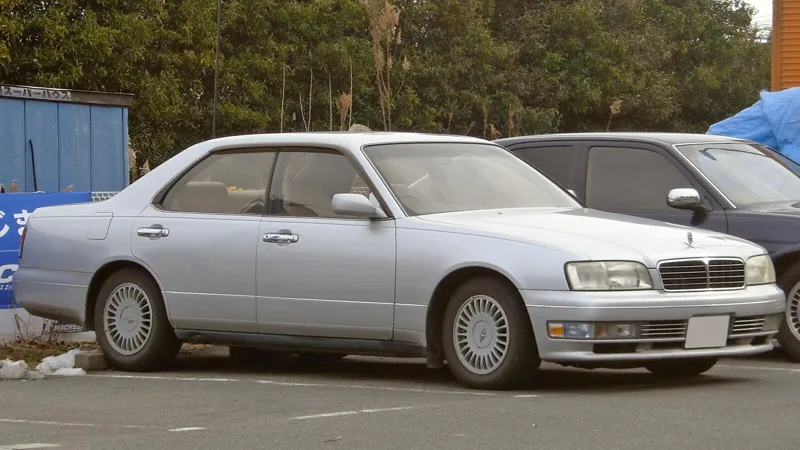
The Cedric and Gloria series finally ended in Japan in October 2004, replaced by the Nissan Fuga. The Cedric name lived on in a fleet vehicle, the Y31, used as a taxi and still in production, where it competed with the Toyota Comfort.
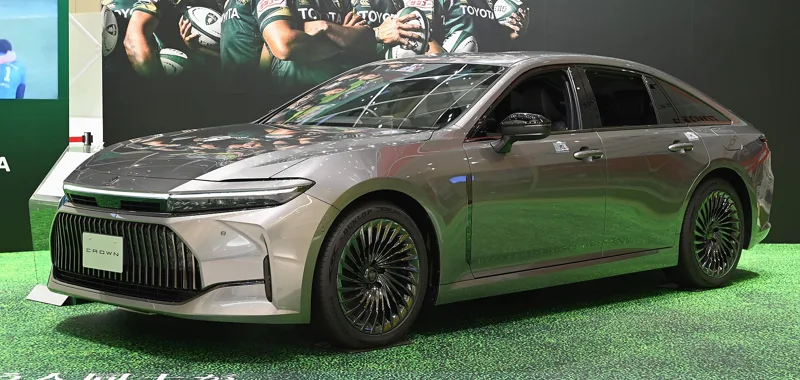
The Crown kept going through many generations. It is Toyota's second longest-running nameplate in Japan, after the Land Cruiser, and the nameplate returned to North America in 2022 with the sixteenth generation, which is exported to about 40 countries.
The Crown's longevity makes it the more durable name. The Cedric did not survive into the 2010s as a private car, while the Crown's name and the Lexus GS that partly succeeded it kept the line alive.
Which buyer should choose which?
A buyer who wanted a Japanese executive saloon with a long-running name, a wide export history and a strong showing in government and taxi use would look at the Crown. The Crown's status as the mainstream Toyota sedan made it a common sight in fleets. Its use as a police car and as transport for government officials in Japan added to that reputation, and the Comfort arrived in 1995 as a cheaper alternative for taxi buyers.
A buyer who wanted Nissan's upscale saloon, an overhead-cam six or the Cedric Special's straight-six would find the Cedric more appealing. Later Cedrics also gave buyers a wider choice of body styles, from coupes to vans.
On the facts, the Crown was the more successful export car, while the Cedric was the more varied in body and engine choice. Neither car has a clear overall winner, because each served the market that its maker had chosen for it.