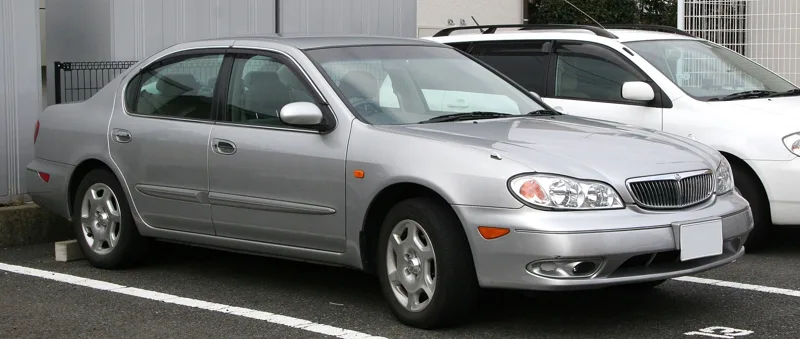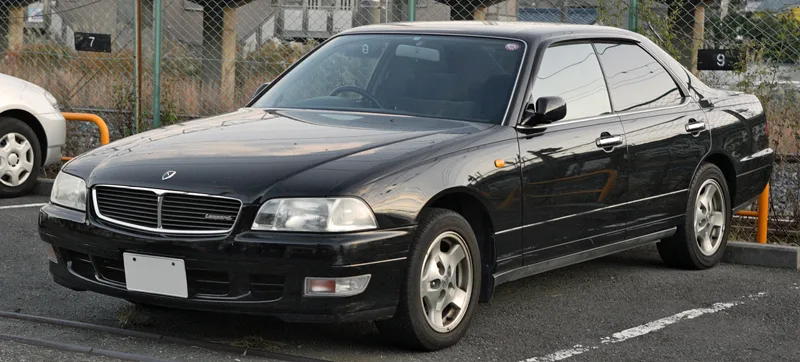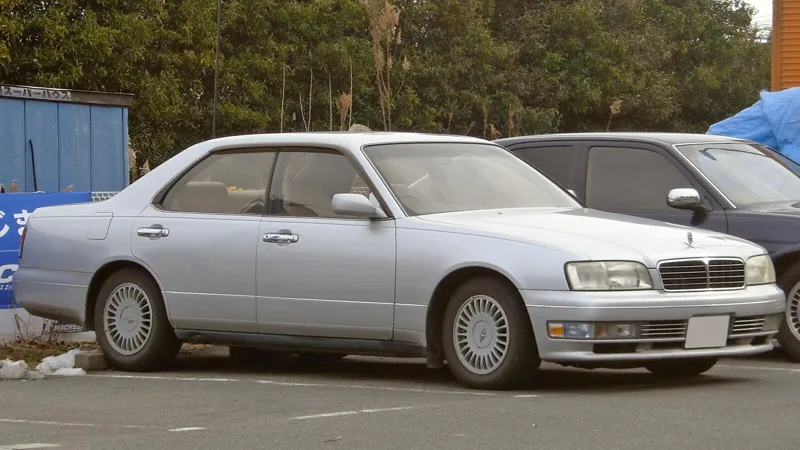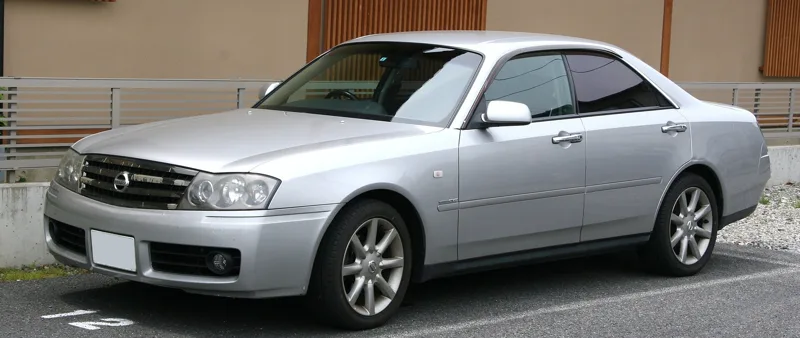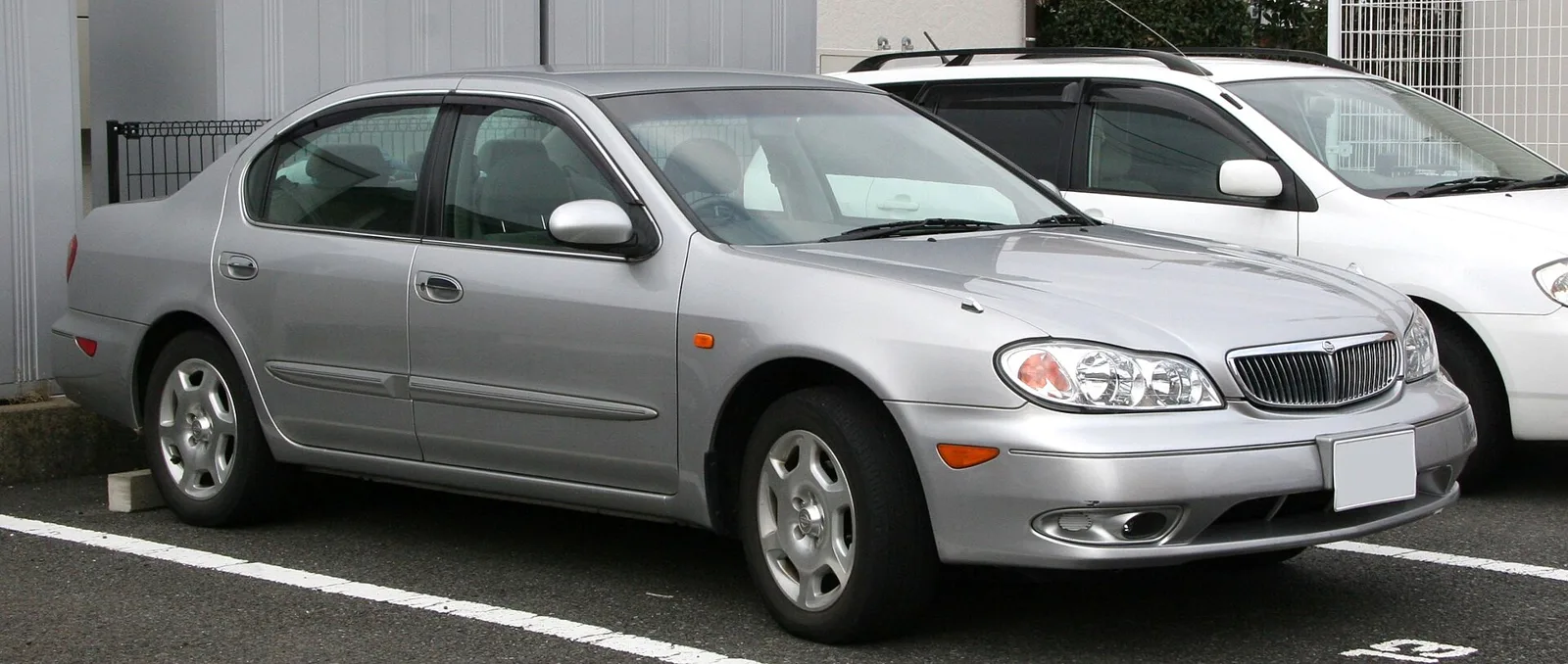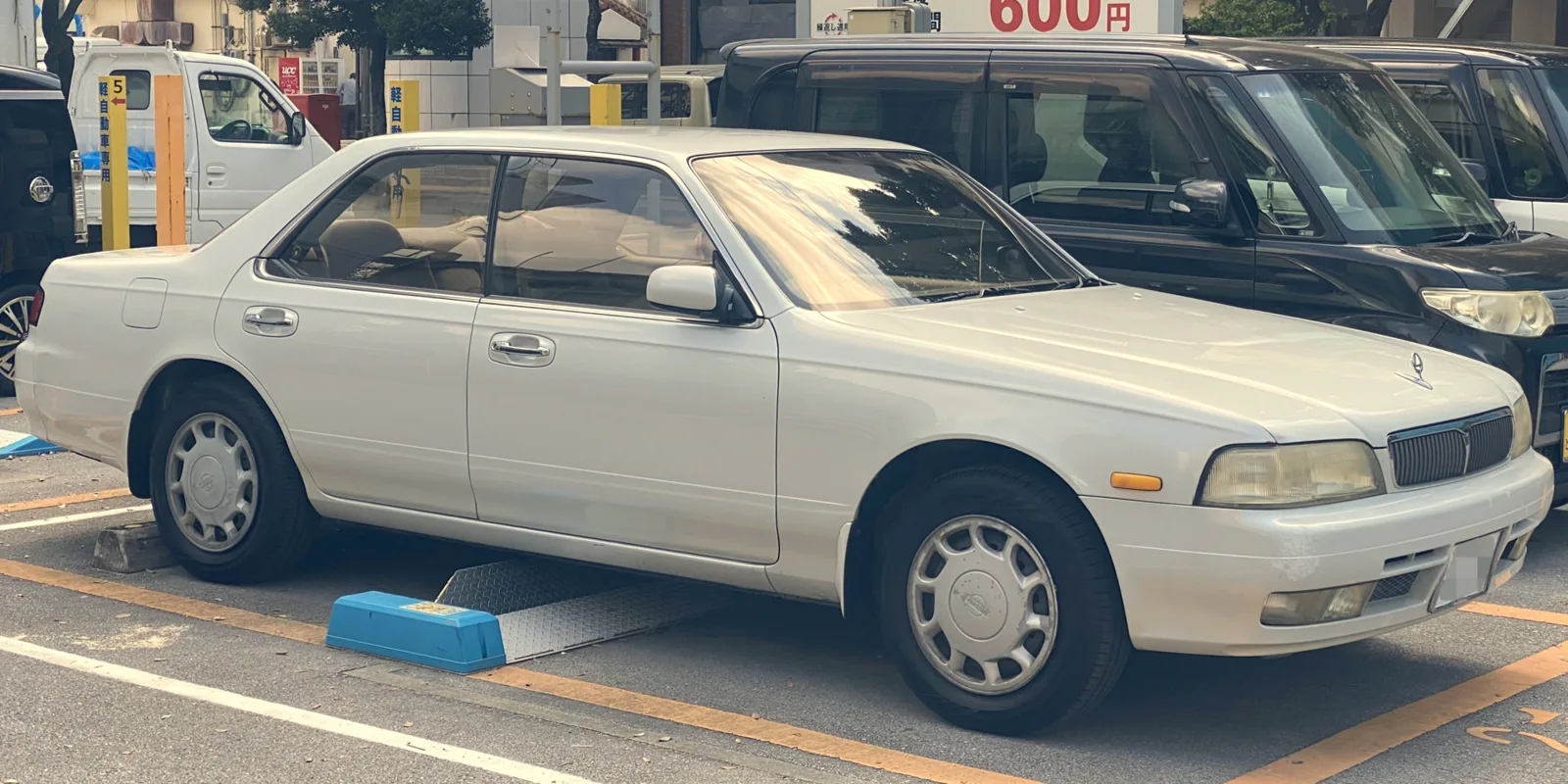
From the 1968 two-door hardtop to the 1997 saloon with Compass Link navigation, the Laurel sat above the Bluebird, beside the Skyline and beneath the Cedric.
The Nissan Laurel was a sedan built from 1968 to 2002, positioned above the Datsun Bluebird and as the luxury version of the Skyline. Its eight generations ranged from 1.8-litre fours to turbocharged sixes, and the C33 later became a popular drift car.
The Nissan Laurel was a two- and four-door sedan that Nissan built and sold from 1968 to 2002. It sat above the Datsun Bluebird 510 in the range and acted as the luxury version of the Skyline family, sharing engines, suspension and handling while riding on a longer wheelbase. Over eight generations it grew from a modest hardtop into a turbocharged, all-wheel drive sedan before production ended in 2002.
What does the Laurel name mean?
The name refers to the laurel wreath, a symbol of triumph worn around the head or hung around the neck. Nissan applied it to a car that was positioned as the junior luxury model, with the Cedric and the Gloria sitting in other parts of the range.
A Skyline's luxury sibling that ran for 35 years, turned from a hardtop into a turbo six, and became a favourite of drifters.
Where was the first Laurel developed?
The first Laurel was developed by the Nissan Tsurumi research and development division, and it was assembled at the Musashimurayama plant of the former Prince Motor Company. The car was built in two-door and four-door forms from 1968, after Nissan had acquired Prince.
The Laurel was conceived as a junior version of the new Gloria before the Prince merger. It shared the same luxury intent as that car, but on a shorter wheelbase, and its competitors at launch included the Toyota Corona Mark II and the Mazda Luce.
How did the first-generation Laurel sell?
In April 1968 Nissan introduced the Laurel as a four-door saloon in deLuxe and Super deLuxe versions, both with a 1.8-litre inline-four. A two-door hardtop coupe joined the range in June 1970, and a 2000 cc engine became available in the four-door a year after launch.
Sales were weaker than expected. The design looked too much like the smaller and cheaper Bluebird, which had been developed as a competitor before Nissan bought Prince. Both cars were sold at Nissan Store, and buyers had little reason to choose the more expensive Laurel when the Bluebird offered much of the same look.
The 2000GX, introduced in June 1970, was Nissan's first hardtop. It used the Prince-developed SOHC 1,990 cc G20 four-cylinder, with a single carburettor producing 110 PS (81 kW; 108 hp) and a twin-carburettor version producing 120 PS (88 kW; 118 hp). Premium fuel lifted the dual-carburettor output to 125 PS (92 kW; 123 hp).
The 2000GX shared its chassis with the GT-X and the GT-R. It used the same five-speed manual, an optional limited-slip differential and semi-trailing arm rear suspension, along with sequential rear turn signals that flashed from the centre outwards. Every Laurel coupe came with a vinyl roof as standard.
What made the second generation the Butaketsu?
The second generation arrived in April 1972 as a four-door saloon and a two-door hardtop coupe. Its rounded rear quarter panels and tail section, with the tail lights built into the bumper, earned it the nickname Butaketsu, a term that refers to a pig's behind.
The saloon kept MacPherson struts at the front but used a rear beam axle with semi-elliptic leaf springs. The hardtop kept the semi-trailing arm rear suspension it shared with the 2000 GTX-E. The coupe's styling showed influence from the 1970 Ford Torino and the 1971 Mercury Cougar, reflecting the popular coke-bottle look of the period.
Sales in Japan ran to about 96,000 per year, and roughly three-quarters of them were saloons. Very few cars were exported. The Toyota rival was the Mark II in both saloon and coupe guise.
The engine range grew over time. In October 1973 the 2565 cc L26 six-cylinder arrived in a model badged 2600SGL. Because it was over two litres, it escaped the size limits that governed smaller engines, and the car carried larger bumpers as a result. The car's higher engine size also meant that owners paid higher annual road tax.
In September 1975 the L26 gave way to the 2753 cc L28 six, and by October the carburettors on the L20 had been replaced with electronic fuel injection, creating the L20E. The twin-carburettor engines were dropped in February 1976 because of emissions rules, and carburettored 1.8 and 2.0-litre engines meeting the 1976 rules were identified with the Nissan NAPS badge.
Nissan also built an electric passenger sedan based on the Laurel in 1974. Known as the C130-EV in Japan and the Datsun 200L-EV for export, it was developed for VIP use at the 1975 International Oceanographic Exposition in Okinawa. Its rear-mounted motor produced 16.0 kW (21.5 hp) and drove the rear axle through a two-speed automatic. It was said to reach 85 km/h (53 mph) and cover 65 km (40 mi) per charge.
How did the third-generation C230 change the car?
The third generation appeared in January 1977 as the C230. For the first time the Laurel came as a saloon, a hardtop coupe and a hardtop saloon without B-posts, although the hardtop saloon was offered only with six-cylinder engines. Buyers could choose from a 1.8-litre four, a 2.0-litre inline-six, which was a first for the Laurel, and a 2.0-litre diesel four.
The diesel was sourced from Nissan Diesel as an alternative to the diesel Toyota Mark II and the Isuzu Florian. Transmissions were mostly four- or five-speed manuals or a three-speed automatic, with a three-speed manual using a column shift in lower-specification and commercial versions.
In autumn 1978 the C230 received a mild facelift that changed the round double headlights to square units. A tenth anniversary edition arrived in January 1978 in a deep red shade called Laurel's Crimson, with trim-specific emblems and aluminium wheels. The 2.4-litre L24 six joined the range in 1979.
The Medalist name first appeared on the top trim of this generation. It would remain on the range until 1999, when the Laurel was cancelled. The Medalist gained an electric sunroof on the hardtop in February 1980, which was the first year a sunroof was offered as a model option.
What was the fourth-generation C31 like?
The C31 arrived in November 1980 and was the first Laurel offered only as a four-door, either as a saloon or a hardtop. The coupe was replaced by the new Nissan Leopard F30, and the Laurel stayed exclusive to Nissan Store dealers. It aimed for more luxury and a higher price point, and it sat above the Bluebird as an upscale choice.
Its four-door hardtop achieved a drag coefficient of 0.38. Engines included the 1.8-litre Z18, the 2.0-litre Z20 and the L20 six, with fuel-injected L20E and turbocharged L20ET variants. The L20ET was the first turbocharged Laurel, and the range topped out with the 2.8-litre L28E, plus diesel options from Nissan Diesel.
In November 1982 Nissan released the Laurel Turbo Medalist Givenchy version, promoted in Japan with adverts featuring Hubert de Givenchy. The borrowed idea came from the American Lincoln Continental Mark IV. Nissan also offered the Laurel Spirit from 1981 as a smaller companion car, with much of the Laurel's luxury equipment.
The fourth generation also added electric retractable door and fender mirrors in July 1983, a first for the model line. In 1984 the range was revised again, and the 1.8-litre GL models were withdrawn while the Turbo Medalist Givenchy III went on sale as a limited edition.
Which features defined the fifth-generation C32?
The C32 arrived in October 1984, and Osamu Ito, development supervisor for the R31 and R32 Skyline, redesigned it. It gained a four-door saloon body, a hardtop variant and a more angular overall look, and it offered electric retractable door mirrors, a world first.
The C32 was the last Laurel sold in Europe, where it was replaced by the front-wheel drive Nissan Maxima. It was also the only Laurel generation to carry a V6 engine, a 2.0-litre turbo V6 in the 1980s range. The suspension remained MacPherson struts at the front with a semi-trailing arm and four links at the rear.
Some models offered Super Sonic Suspension. A sonar module under the front bumper scanned the road surface and adjusted the coil-over shock absorbers through actuators. A centre console switch let drivers choose Auto, Soft, Medium or Hard settings, and the steering and automatic shift points changed with the chosen mode.
The Medalist could be fitted with a six-inch CRT television screen in the dashboard, which worked only when the car was in Park with the parking brake applied. The stereo and video equipment came from Sony, and a Partner Comfort Seat tilted the front passenger seatback forward to support the shoulders.
The C32 gained the RB20DET turbocharged 24-valve DOHC six in October 1986, and the LD28 diesel was replaced by the RD28. The Laurel also received a longer sister, the Gloria Cima, from January 1988, which offered an improved V6 and a turbocharged version of it.
Why did the sixth-generation C33 become a drift favourite?
The C33 was announced in December 1988 and went on sale in January 1989 as a four-door hardtop only. The V6 engines were gone, replaced by straight-sixes. The base model kept the 1.8-litre CA18i four, while the six-cylinder choices included the 2.0-litre SOHC RB20E, the DOHC RB20DE and the DOHC turbo RB20DET, along with a 2.8-litre diesel RD28.
Early in 1991 a DOHC 2.5-litre six joined the range, paired with a five-speed automatic. A driving school version used the four-cylinder CA18i or the RD28 diesel. The C33 was repositioned as a larger luxury sedan, with dimensions that matched the Cedric and Gloria, which were sold through separate Nissan dealerships.
The C33 became a favourite for drifting because it shared its floor plan with the Nissan Cefiro and the four-door Nissan Skyline R32. Many of its parts were interchangeable with those cars, which made it easy to modify. Multi-link rear suspension borrowed from the Skyline was offered, along with optional HICAS II rear-wheel steering on the Club S and Twin Cam Medalist.
What changed in the seventh-generation C34?
The C34 arrived in January 1993 and was no longer available as a pillarless hardtop, because of stricter side-impact rules. The only body was a regular saloon with B-posts. The four-cylinder engine was dropped, and the range used 2.0-litre SOHC or DOHC sixes, a 2.5-litre DOHC six and a 2.8-litre diesel six with three valves per cylinder.
Some later models added Nissan's Super HICAS four-wheel steering and ATTESA E-TS four-wheel drive, both of them shared with the Skyline. The Medalist VG Selection featured cruise control on the steering wheel. Only the Medalist diesel could be had with a manual gearbox, while the more powerful petrol cars all used five-speed automatics.
A mid-life facelift came in January 1994. The Club S received a sportier grille, an exclusive bumper and a new turbocharged 24-valve DOHC RB25DET six, which needed a four-speed automatic to cope with its torque. The Club S Type X was a more expensive version, while the basic Grand Cruise model was replaced by the Grand Saloon.
Nissan introduced its first four-wheel drive Laurel and a Medalist Turbo in September 1994. The Club S Selection followed in January 1995, and the Celencia range with dedicated seat fabric, a unique grille and tinted glass arrived in 1996. The seventh generation stopped being built in May 1997, and dealers sold remaining stock until the eighth generation arrived.
What was the final C35 Laurel like?
The eighth and last generation debuted in June 1997. It was a slightly longer version of the Skyline, with a softer look and a luxury approach to equipment and handling. Rivals came from inside the group, including the Cedric and Gloria Gran Turismo and the Cima Grand Touring, as well as the Skyline.
The engine line-up comprised two RB25DET turbo variants, plus the RB25DE NEO and RB20DE NEO, all using Nissan's NEO variable valve timing. The RD28E diesel SOHC six carried on. The model codes were HC35 for the 2.0-litre car, GC35 for the two-wheel drive version and GNC35 for the four-wheel drive version.
The all-wheel drive cars were called the 2.5 Club S-Four and used ATTESA E-TS with a multi-link suspension at all four wheels. The Dualmatic M-ATx transmission with a manual mode was an option on rear-drive cars. In October 1997 a 25 Club S 30th Anniversary edition marked the car's thirtieth year, finished in Red Pearl with 15-inch alloy wheels.
Nissan's Compass Link telematics navigation was offered as an extra-cost option in every trim from this generation, beginning with the Medalist NAVI Edition. Production moved from Murayama to Tochigi in March 2001, and the line ended in late 2002 after 35 years. The competitors at the end were the Toyota Cresta and the Honda Inspire, and the car was replaced in 2003 by the Nissan Teana.
How did the Laurel sell outside Japan?
Nissan sold the Laurel intermittently in various Asian, European and South American markets. Overseas it was called the Datsun Laurel or Datsun 200L, and exports from Japan stopped after 1989. Very few second-generation cars were exported.
The third generation was popular in Europe, where buyers liked its reliability, low price and equipment. Datsun-Nissan South Africa developed a two-litre four-cylinder option not offered elsewhere, using a cheaper, torquier L20B engine. The Laurel was introduced to the Middle East, mainly Saudi Arabia, in 1982 with a detuned L24 engine.
European buyers preferred the diesel, which saw the lion's share of sales because it was used heavily as taxis. The C32 was the last generation sold in Europe. The fourth generation was also sold in Indonesia and other Asian countries, but it never reached Australia or New Zealand.
How did the Laurel become a motorsport and drift icon?
The 2000GT-R was built and raced for that purpose, and it drew much of the attention in the early years. The 2000GX was built for comfortable but spirited driving rather than racing.
What are the Nissan Laurel specifications?
| Specification | Detail |
|---|---|
| Body styles | Two- and four-door sedan; saloon and hardtop |
| Production | 1968 to 2002 |
| First generation (C30) engine | Prince G18 1,815 cc four-cylinder SOHC |
| 2000GX engine | Prince G20 SOHC 1,990 cc; 110 to 125 PS (81 to 92 kW) |
| Second generation (C130) engines | 1,770 cc L18; 1998 cc L20 six; 2565 cc L26; 2753 cc L28 |
| Electric C130-EV | 16.0 kW (21.5 hp) rear motor; 85 km/h (53 mph) top speed; 65 km (40 mi) range |
| Third generation (C230) | 1.8-litre four; 2.0-litre six; 2.0-litre diesel four; L24 from 1979 |
| Fourth generation (C31) | Four-door only; Cd 0.38 on the hardtop; L20ET first turbo |
| Fifth generation (C32) | Gasoline V6 and four-cylinder engines; RB20DET turbo six from October 1986 |
| Sixth generation (C33) | CA18i four; RB20E, RB20DE and RB20DET sixes; RD28 diesel |
| Seventh generation (C34) | RB25DET turbo six from January 1994; Super HICAS and ATTESA E-TS available |
| Eighth generation (C35) | RB25DET NEO, RB25DE NEO, RB20DE NEO and RD28E diesel |
| Cumulative production | 2 million units by January 1992 |