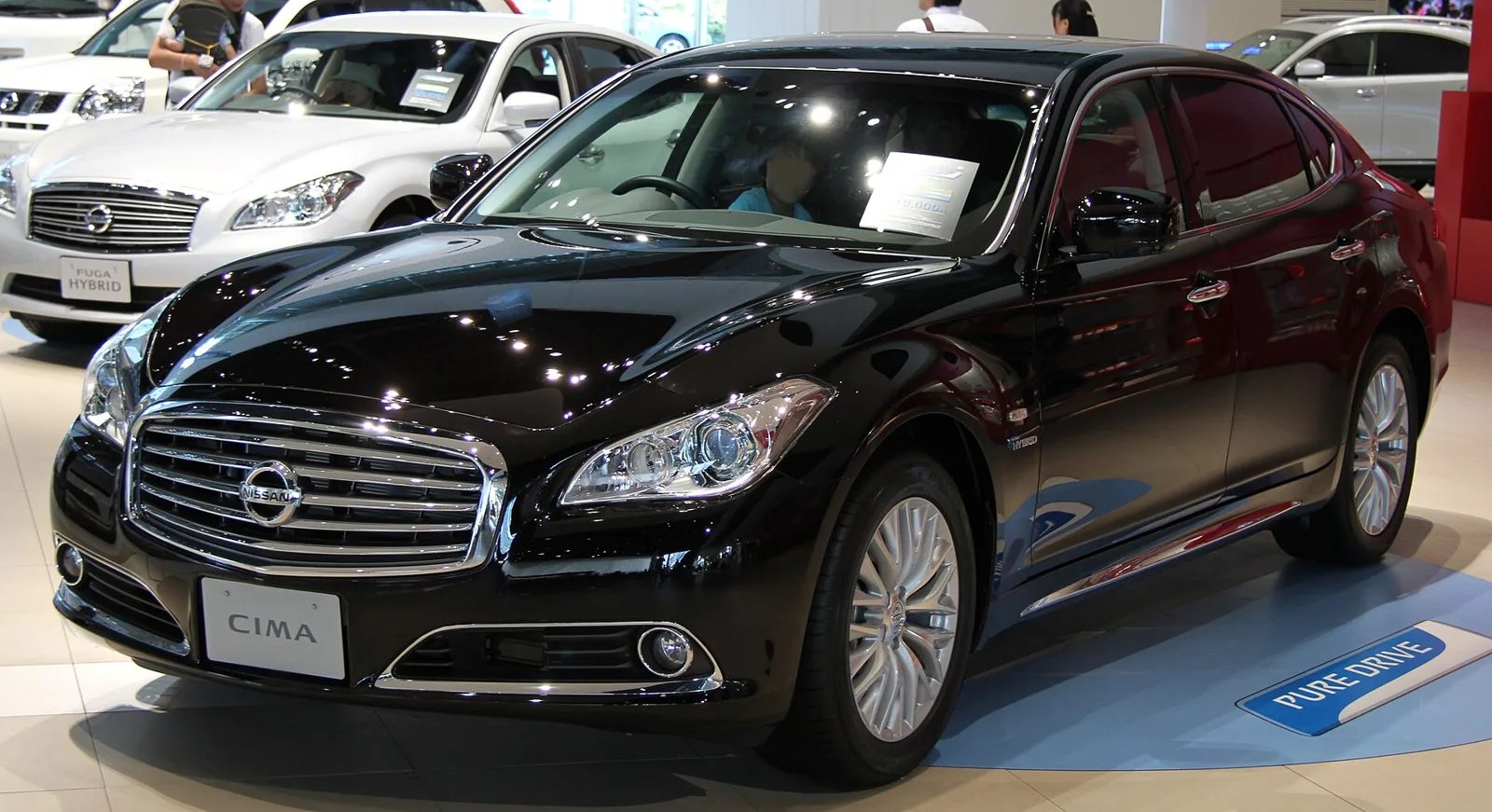
Between 1986 and 1991 land and shares in Japan soared on cheap money, and a large Nissan saloon with turbo power, lacquer trim and an optional car phone caught the mood.
The Japanese asset price bubble was a 1986 to 1991 run-up in land and share prices, fed by cheap credit after the yen surged. Nissan's Cima, on sale from 1988, was a large luxury saloon whose strong sales made it the car most linked with the boom.
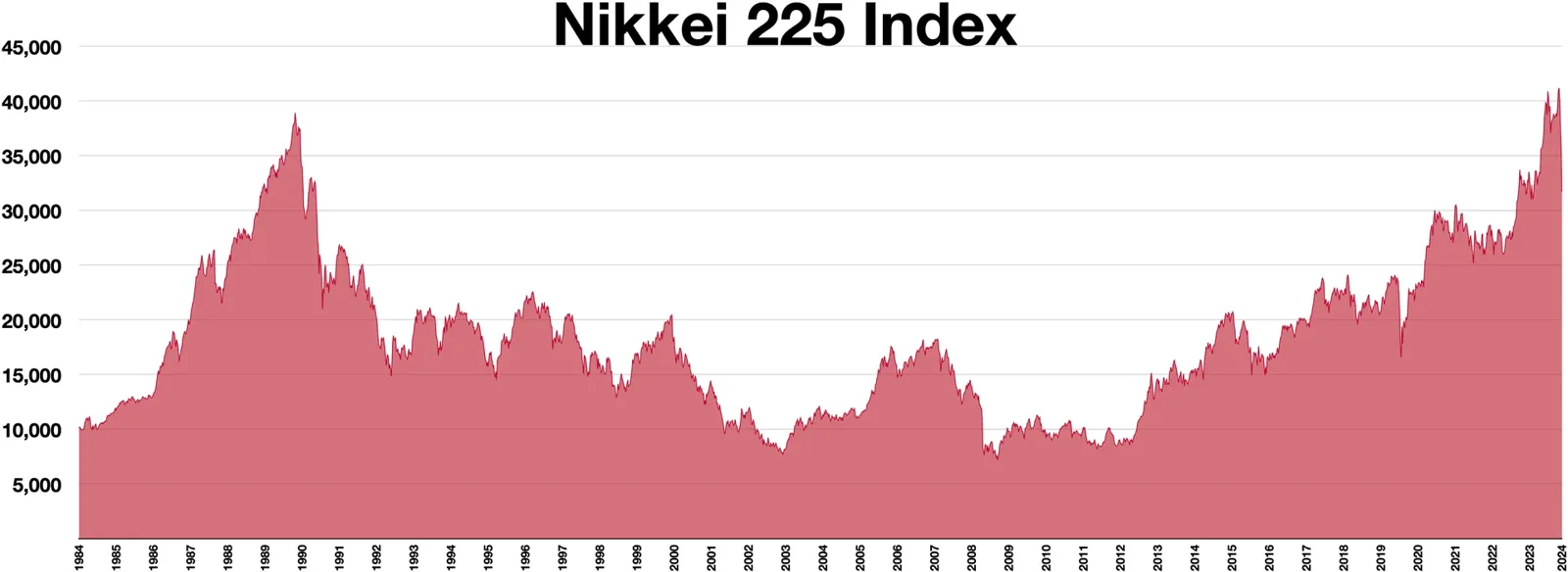
In 1986 the average price of a square metre of commercial land in Tokyo rose by roughly 122%. It more than doubled in twelve months, and the share market was racing alongside it. By the last days of 1989 the Nikkei 225 had touched 38,957.44, a level no one in Japan had seen before.
That frenzy has a name, the Japanese asset price bubble. It ran from 1986 to 1991 and collapsed in early 1992. In January 1988, in the middle of it, Nissan put a big luxury saloon called the Cima on sale, and the car sold so strongly that it became a symbol of the bubble economy.
What was the Japanese asset price bubble?
The Japanese call it baburu keiki, literally the bubble economy. Its defining feature was a sharp rise in the price of real estate and shares, driven by an uncontrolled money supply and a fast expansion of credit. Confidence ran ahead of reason, and speculation fed on itself. Policy is blamed for adding fuel: measures that made assets easier to trade, loosened access to credit and encouraged speculation helped to start and prolong the surge.
The ending was long and painful. The price collapse left banks and other lenders holding an enormous pile of non-performing loans, and the economy kept sliding for more than a decade. Many people call that stretch the Lost Decade. Average nationwide land prices did not post a year-on-year increase until 2018, and that rise was only 0.1% over 2017.
Nearly every cut in the discount rate was presented as a way to steady the yen, not to cool the domestic economy.
How a strong yen and cheap money fed the boom
The trigger was exchange rates. In September 1985 the Plaza Accord was ratified, and the yen began a steep climb against the dollar that carried on through the final months of the year. For an economy built on exports and on investment aimed at export production, that was a body blow. The result was the endaka recession, the name for a downturn caused by a rising yen, which hit in 1985 and 1986 and worsened in the final quarter of 1985.
Policymakers answered on two fronts. The government turned to an aggressive fiscal policy, chiefly more public investment. The Bank of Japan, which had declared that stopping the yen's rise was a national priority, slashed its official discount rate from 5.0% to 3.0% during 1986, and then to 2.5% by February 1987 under the Louvre Accord. At first the cuts failed to hold the yen down. It kept strengthening, from 200.05 to the dollar at the first round of easing to 128.25 by the end of 1987, and only turned in the spring of 1988 when the dollar began to recover.
Researchers point out that these decisions were not purely domestic. Apart from the first cut, the later four were heavily influenced by the United States, as joint announcements or as part of Japan-US or G-7 statements. Almost all of them spoke of stabilising the exchange rate rather than steadying the home economy. Cheap money was being released to manage the currency while land and shares were already soaring.
Opinions differ on why it was not withdrawn sooner. Early research blamed delayed action by the Bank of Japan. At the end of August 1987 the bank signalled that it might tighten, then held off because of the uncertainty after Black Monday in the United States. It had voiced concern about excessive easing that summer, when money supply and asset prices were both climbing fast, yet left the rate untouched. Later research argued the reluctance continued even though the economy had gone into expansion in the second half of 1987. Economist Richard Werner goes further. In his view, outside forces like the Plaza Accord, along with a Ministry of Finance policy of lowering the official discount rate, cannot account for what the Bank of Japan did. The official discount rate finally went up on 31 March 1989, and a consumption tax arrived in April of that year.
Land and shares: how far prices went
Tokyo was the centre of the frenzy. By the early 1980s it housed a dense cluster of international financial firms, and demand for office space kept rising faster than supply. Government policy concentrated economic activity in the capital, and other cities had little variety in their own economies. By 1985 there was simply not enough commercial land to meet demand.
The numbers are startling. A square metre of Tokyo commercial land averaged 1,333,000 yen in 1984 and 1,894,000 yen in 1985, a rise of about 42%. In 1986 it reached 4,211,000 yen, the 122% jump. Tokyo residential land rose from an average of 297,000 yen to 431,000 yen a square metre between 1985 and 1986, up 45%, and industrial sites gained about 14%. In Osaka, commercial land went from 855,000 yen to 1,159,000 yen, a gain of 35%.
Share prices climbed in step. The Nikkei 225 was above 13,000 by 12 December 1985 and reached 18,821 by 26 December 1986.
- It passed 20,000 by 30 January 1987 and hit 26,118 on 1 September 1987, then slipped back to 21,564 by 28 December after Black Monday.
- It broke through 30,000 and reached 30,159 on 28 December 1988.
- It touched 38,957.44 on 29 December 1989.
Because land in central Tokyo was so scarce, investors looked outward in 1987. They bought around the Greater Tokyo area, especially in Kanagawa prefecture (Yokohama), Saitama and Chiba, while Osaka, Kyoto, Aichi (Nagoya) and Hyogo (Kobe) also saw unusual price growth. The Japan Real Estate Institute treats Tokyo's 23 special wards, Yokohama, Nagoya, Kyoto, Osaka and Kobe as the six major cities that felt the bubble most. Cities in prefectures closer to Tokyo saw far more price inflation than those farther away.
Six major cities against the national average
| Land type | Six major cities, 1991 against 1985 | Nationwide |
|---|---|---|
| Commercial | Up 302.9% | Up 80.9% |
| Residential | Up 180.5% | Up 51.1% |
| Industrial | Up 162.0% | Up 51.7% |
How the bubble burst
Tokyo cooled first. In 1988 price growth there stagnated and land in some wards began to drop, while the rest of the Greater Tokyo area kept rising and Osaka, Kyoto, Nagoya and Kobe were largely unaffected. In 1989 Tokyo residential land fell by an average of 4.2%. By late December 1989 the Bank of Japan had lifted its official discount rate from 2.5% to 4.25%, and during 1990 it went on to 6.00%.
Shares reacted faster than land. The Nikkei went from 37,189 on 4 January 1990 to 23,849 on 28 December, a loss of more than 35% in a single year. By 1991 the pain had reached property. Tokyo land prices fell sharply, other big cities that had been growing modestly or sitting flat turned negative toward the end of the year, and the Nikkei closed 1991 at 22,984.
One response came from the property market itself. The first draft of Japan's J-REIT legislation was adopted in November 2000 after consultation with developers Mitsubishi Estate and Mitsui Fudosan and with the financial regulator, and with backing from Dutch pension managers. Nippon Building Fund, sponsored by Mitsui Fudosan, became the first J-REIT to list in Tokyo. As banks and developers paid down debt, Tokyo condominium and office values steadied in 2002.
The Nissan Cima: a car named for the summit
The word cima is Spanish for summit or top, and Nissan chose it with the Toyota Crown in its sights. Early cars wore a hood ornament showing an acanthus leaf, the plant the ancient Greeks wove into victory crowns, which fitted a car whose chief rival in Japan was a Crown. Over five generations it was Nissan's luxury saloon for the home market, and for three of them it was sold abroad as the Infiniti Q45.
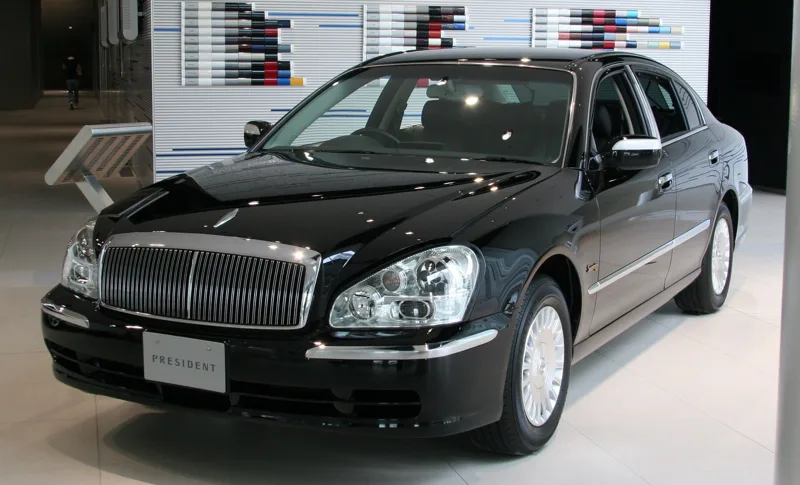
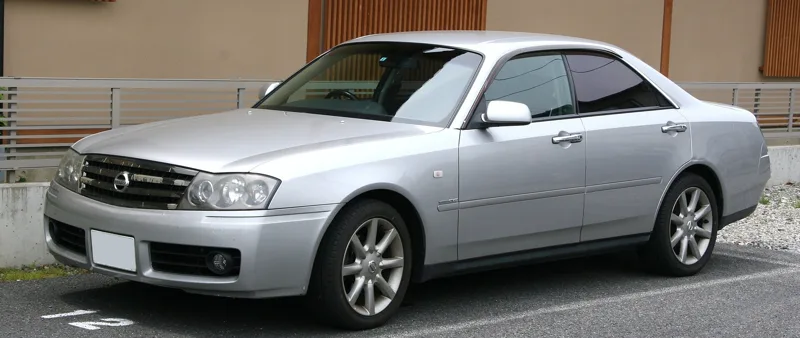
The first two generations were longer, richer versions of the Cedric and Gloria, built on an elongated Cedric/Gloria chassis and sharing a V8 with the President, Nissan's flagship and its answer to the Toyota Century. The Cedric Cima went to Nissan Store dealers and the Gloria Cima to Nissan Prince Store outlets. Later generations moved onto the President platform as shorter versions of it, which let Nissan keep offering the car at Prince Store locations.
Nissan Cima Y31: the car that arrived in 1988
Japan's tax rules shaped the cars Nissan and Toyota built. Until 1989 the tax bracket divided cars at 4,700 mm (185.0 in) long, 1,700 mm (66.9 in) wide and with a 2-litre engine. Both the Cedric/Gloria and the Crown had been stretched right up to that limit. Larger-engined versions got bigger bumpers because exterior size was no longer restricted for them, but the bodies stayed narrow, which made them a half measure.
A rumour that Toyota was developing a wider Crown, called the 4000 Royal Saloon G, pushed Nissan into a hurried reply. The wider car could not be ready for the June 1987 launch of the all-new Y31 Cedric and Gloria, so Nissan announced its intention on 2 September 1987 and showed the Cima at the Tokyo Motor Show on 29 October 1987, next to the MID4-II. Sales began in January 1988. The half-year gap forced many design changes, and the car benefited from Project 901, Nissan's technology update across all its products.
Why the Cima became one of the bubble economy cars
Two engines were offered. The VG30DE made 200 PS (147 kW; 197 hp) and the turbocharged VG30DET made 255 PS (188 kW; 252 hp). The turbo version was especially popular in the booming economy, and the Japanese media coined the phrase the Cima phenomenon for the rush to buy it.
Sales were strong: the first generation sold about 129,000 cars in all.
Only one body was offered, a four-door hardtop without a B-pillar, so the front and rear side glass met with nothing between them. The earlier Cedric and Gloria hardtops used the same style. The cabin was lavish, with genuine lacquer wood and a choice between Connolly leather and a silk and wool cloth. Nissan aimed the car at private buyers, drawing on features from the President limousine that company fleets and chauffeur services favoured.
Equipment mattered as much as size. The turbocharged versions at the top of the range carried an interactive CRT display, supplied by Fujitsu Ten, that handled climate and sound functions, and a Sony CD changer. The controls sat on a stationary centre hub while the steering wheel turned around it, so stereo and cruise buttons stayed in the same place whatever the wheel was doing. An optional cellular phone sat in the armrest console, with dialling buttons on that hub. The Type III, the grade with every option fitted as standard, could also have air chambers inside its front MacPherson struts. Coil springs sat at the rear.
One owner shows how long those cars can last. Japanese actress Kazue Ito bought a first-generation Cima at 24 and kept driving it. It passed 250,000 km, and in April 2021 Nissan offered to restore it and replace every worn part at no charge. The work took about eight months and finished on 7 December 2021, her birthday, when the car was handed over at the Nissan Ginza showroom in Tokyo. The bill is said to have exceeded the car's original price, which was 5 million yen in 1990, or US$44,000.
After the crash: Y32 to F50
The second-generation Y32 followed the Cedric/Gloria in August 1991, just as the bubble was deflating. It had a premium role at Nissan Prince Store dealers alongside the Skyline, Gloria and Infiniti Q45. Toyota launched the Crown Majesta that year, and the Aristo competed in the same segment. Sales of both fell short of the Y31's, a drop tied to the collapse of the bubble. Interior colours were cut back to black, grey or tan.
The Y32 started with a VH41DE V8, a short-stroke relative of the President's VH45DE, and kept the 3.0-litre VG30DET turbo V6 for its pull and its lower yearly road tax. All that acceleration had limited use in Japan, where city two-way roads are usually zoned for 40 km/h (25 mph) or less. Four-wheel drive arrived, and in September 1992 the Type II Limited S-Four paired the ATTESA E-TS system with the V8, giving 270 PS (199 kW; 266 hp) at 6000 rpm and 371 Nm (274 lb ft) at 4400 rpm. A hydraulic Full-Active Suspension replaced the air system. In 1993 the Cima was pitched as the private-ownership alternative to the President JS, whose wheelbase measured 2,880 mm (113.4 in), and it was longer than the Gloria at 2,760 mm (108.7 in).
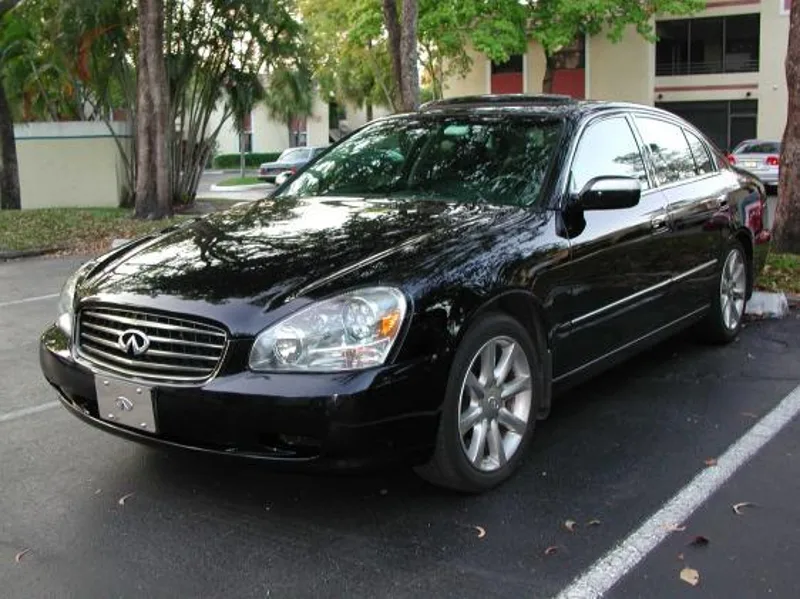
The third generation, the Y33, was unveiled in June 1996 with European-style trim names such as 41LX that included engine displacement. It was also sold overseas as the second-generation Infiniti Q45. The Japanese Q45 ended in August 1997 and the Cima took its place. In 1999 side airbags became standard on it, a first among cars sold in Japan, and it also became Nissan's first model with laser adaptive cruise control.
The fourth generation, the F50, appeared in January 2001 with seven-reflector headlights. Its Japanese engines, a VK45DD V8 and a VQ30DET turbo V6, both made 280 PS (206 kW), while the Infiniti V8 made 340 hp (254 kW; 345 PS). The 450XV Limited was the first vehicle anywhere to offer lane departure warning, using CCD cameras to read painted lines. August 2003 brought Intelligent Brake Assist, a pre-crash seatbelt and Active AFS headlights. The turbo V6 was dropped in July 2005, and exports of the Q45 to the United States ended after the 2006 model year.
What became of the Cima after 2010?
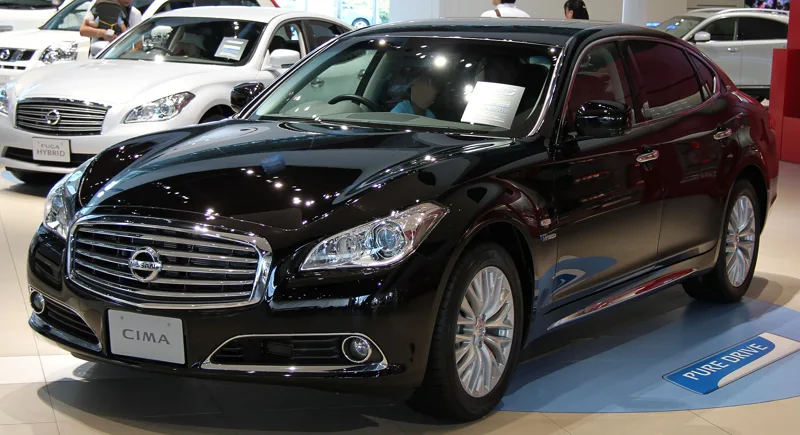
Production of the Cima and the President, which shared a chassis, stopped in August 2010. In April 2012 Nissan revived the name as a long-wheelbase Fuga Hybrid and returned it to flagship status in Japan. Production halted at the end of 2020, restarted in October 2021, and ended for the third and last time in 2022, leaving the Skyline as the only sedan in Nissan's Japanese range.