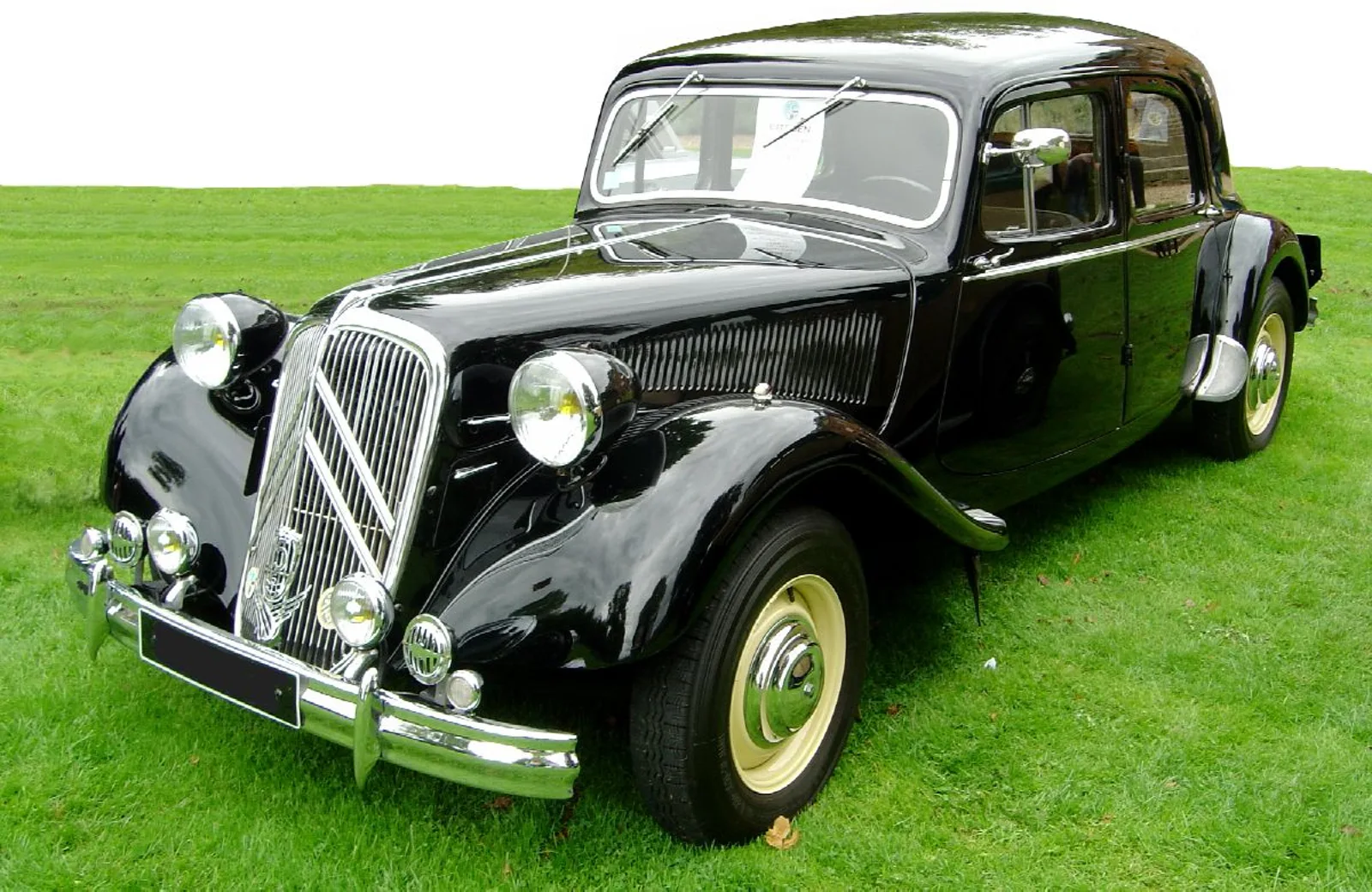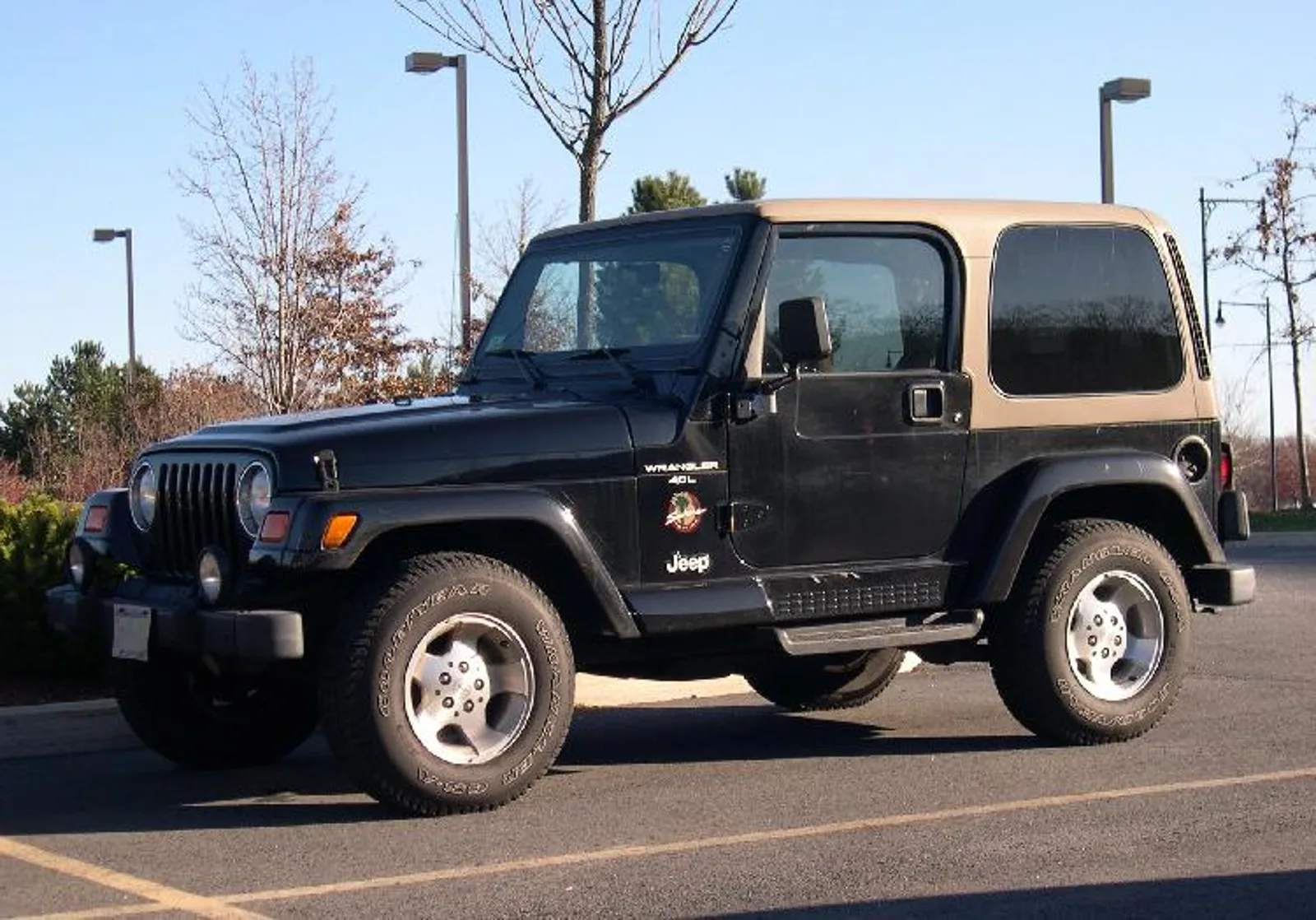
How 4x4 systems grew from steam traction engines and wartime Jeeps into full-time all-wheel drive, with the differential problem that shaped every design.
Four-wheel drive sends engine torque to all wheels, using a transfer case, a centre differential or a coupling. It can be part-time, full-time or on-demand. The concept dates to 1893 steam traction engines and became standard after the Second World War.
Four-wheel drive, also called 4x4 or 4WD, is a drivetrain in which torque reaches all of a two-axle vehicle's wheels at the same time. It may run full-time or on demand, and it is usually linked through a transfer case that adds an output shaft and, often, extra gear ranges. The idea is more than a century old, and it has been used in everything from steam engines to family SUVs.
What do 4x4 and AWD actually mean?
The terminology is messy. Manufacturers have used the labels for marketing as much as engineering, and there is no universally accepted set of names. The standard SAE J1952 recommends only the term all-wheel drive, with subclasses covering every type of AWD, 4WD and 4x4 system on production vehicles.
The 4x4 figure is a shorthand for wheel ends. The first number counts the total axle ends and the second counts the powered ones, so a 4x2 sends torque to two wheels out of four. A 6x4 has three axles with two driven. During the Second World War the American military wrote the notation as 4 X 2 or 6 X 4, and dual rear tyres count as one wheel for traction, which is why a 4x4 truck can have six tyres.
In North America 4WD usually refers to a system built for off-road work, with a transfer case that switches between two-wheel and four-wheel modes. AWD historically meant four-wheel drive on four-wheeled vehicles, and six-wheel drive on six-wheelers, a usage that dates to at least the 1920s. Today the term covers both heavy vehicles and passenger cars that are built for on-road grip rather than rough terrain.
Four-wheel drive began as a fix for a single problem, the differential, and it still shapes every design today.
How do differentials keep 4WD working?
Two wheels on the same axle must turn at different speeds in a curve, because the inside wheel covers less ground. If they were locked to a single shaft, one wheel would have to slip or the drivetrain would wind up and hop. A differential solves the problem by sharing torque evenly while letting the output shafts turn at different speeds. Once a vehicle is powered on all four wheels, a third, centre differential divides power between the front and rear axles.
The weakness is recovery. If one wheel loses grip on ice, the open differential sends most of the power to the spinning wheel, so the others get little. Four-wheel drive has twice as many wheels that can lose traction, which makes the problem more likely, although each wheel carries roughly half the torque of a two-wheel-drive car and so is less prone to slip.
Designers have several fixes. Limited-slip differentials restrict how much the output shafts can diverge, and locking differentials join them together when slip occurs, which suits the centre differential. Electronic traction control uses the brakes to slow a spinning wheel, emulating a limited-slip or locking differential. Because it only reacts after slip begins, it cannot prevent the slip, and it is best seen as a system that allows slip and then routes torque to the wheels with the most grip.
What are the operating modes?
Many systems can run in several modes. In two-wheel drive, usually just the rear axle is driven and the other is disconnected, a 0:100 torque split. Four-wheel drive comes in three forms. Part-time mode rigidly couples the axles, which suits loose surfaces because the driveline cannot cope with speed differences between them. Full-time mode keeps both axles driven through an interaxle differential, which avoids wind-up on any surface, and it gives a 50:50 torque split with standard bevel-gear differentials.
On-demand mode runs mostly in two-wheel drive and feeds torque to the second axle only when needed. The clutch that does this can be modulated by active electronic or hydraulic control, or by passive devices that respond to wheel slip or torque. Some systems combine modes, for example by letting a centre clutch slip between a full-time split and the two-wheel mode.
| Type | How it works | Typical use |
|---|---|---|
| Part-time | No centre differential; axles rigidly coupled | Off-road and loose surfaces, not dry tarmac |
| Full-time | Centre differential keeps both axles driven at all times | All surfaces, on road and off |
| On-demand | Mostly two-wheel drive; coupling engages the second axle when slip occurs | Everyday road cars seeking better traction |
Part-time systems have no centre differential, so a little tyre slip has to happen in turns. On dry pavement that means a hopping or binding feel, and continued use can damage the driveline. That is why part-time transfer cases remain the standard in the 4x4 truck market.
Where did four-wheel drive begin?
In 1893 the English engineer Bramah Joseph Diplock patented a four-wheel-drive steam traction engine with four-wheel steering and three differentials. It used his pedrail wheel system and was one of the first four-wheel-drive machines to show an ability to cope with rough ground. Ferdinand Porsche, then a young electrical engineer, built a four-wheel-drive electric vehicle in 1899 at Lohner in Vienna, using electric hub motors fed by a combustion-engined generator. It was shown at the 1900 Paris World's Fair.
The first four-wheel-drive car powered directly by an internal combustion engine was the Dutch Spyker 60 H.P., built for the Paris to Madrid race of 1903. It had a front engine, permanent four-wheel drive, four-wheel braking and a six-cylinder engine. Mass production followed with the American Four Wheel Drive Auto Company, founded in 1908 in Wisconsin. Along with the Nash Quad, its trucks served the armies of the First World War, and about 16,000 FWD Model B trucks were built for the British and American forces.
The Quad, built by Jeffery and later Nash, had four-wheel brakes and four-wheel steering as well. About 11,500 went to war between 1913 and 1919, and production reached 41,674 units by 1928. In Germany, Mercedes and BMW introduced the G1 and G4 four-wheel-drive vehicles in 1926.
How did military needs shape four-wheel drive?
Until go-anywhere vehicles were needed in large numbers, four-wheel and all-wheel drive had little place in the world. The Marmon-Herrington company was founded in 1931 to convert Ford trucks to 4WD, and the Dodge K-39-X-4 of 1934 served the US Army in its 796 examples. Timken supplied the front axle and a transfer case that was the first part-time design, letting the driver engage four-wheel drive from the cab.
The Mercedes-Benz G5 and BMW 325 of 1937 had full-time four-wheel drive, four-wheel steering and three locking differentials. They were made to meet a government demand for a four-wheel-drive passenger vehicle. Mercedes' Gelandewagen work shaped the later G-Class, and the Unimog also owes something to that line of engineering. In the Soviet Union the GAZ-61 arrived in 1938.
The World War II Jeep, built by Willys and Ford after Bantam first developed it, became the best-known four-wheel-drive vehicle in the world. North America produced about 1.5 million 4x4 vehicles during the war. Constant-velocity joints and transfer cases were the bottlenecks, and from spring 1942 Ford, Dodge and Chevrolet joined the effort to make them in far greater numbers.
When did four-wheel drive reach civilian buyers?
Willys introduced the CJ-2A in 1945, the first full-production four-wheel-drive vehicle sold to the general public. Its rugged utility set the pattern for many 4WD vehicles that followed, and Dodge began building the civilian Power Wagon for the 1946 model year. The Land Rover, which appeared at the Amsterdam Motor Show in 1948, was inspired by a Willys MB that its chief engineer had run off road on his farm. The Range Rover followed in the 1970s as a more luxurious 4WD.
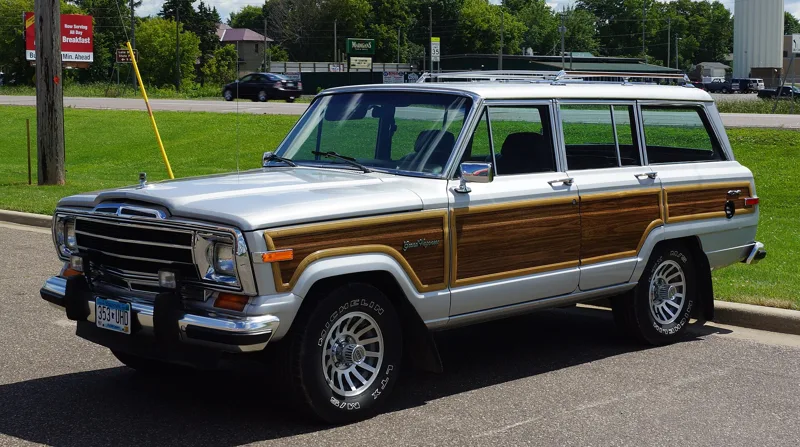
Kaiser Jeep's Wagoneer of 1963 was a turning point. It had independent front suspension and the first automatic transmission coupled to 4WD, and it was finished like an ordinary passenger car. In effect it was the ancestor of the modern SUV. Jensen applied Ferguson's full-time all-wheel-drive system to 318 examples of its Jensen FF from 1966 to 1971, the first 4WD used in a production GT sports car, splitting torque roughly 40 per cent front and 60 per cent rear.
How did all-wheel drive become mainstream?
American Motors bought Kaiser's Jeep division in 1970, and its Quadra Trac full-time AWD for the 1973 Jeep Cherokee and Wagoneer relieved drivers of locking hubs and mode selection. The approach dominated many rivals in FIA rally competition, and Gene Henderson and Ken Pogue won the Press-on-Regardless Rally championship with a Quadra Trac Jeep in 1972.
The AMC Eagle, introduced for the 1980 model year, was the first American mass-production car with a complete front-engine four-wheel-drive system. It was offered as a sedan, coupe and estate with permanent automatic AWD, and it helped create the crossover and sport-utility category. Its viscous centre differential sent power to the wheel with the most grip without a low range. Almost 200,000 Eagles were built, and in 1980 Audi also introduced the permanently all-wheel-drive quattro, a rally-inspired road car.
Most of the large-volume AWD in use today descends from that line. In late 2013 AWD made up 32 per cent of new light vehicles sold in the United States, up 5 per cent since 2008, largely because of the popularity of the crossover. Carmakers now promote AWD as a safety feature, although its real advantage lies in acceleration rather than braking or steering. Tests have shown that it helps on snow when accelerating, but it does not shorten braking distances.
Has four-wheel drive helped in racing?
The Dutch Spyker marque gets credit for the first four-wheel-drive race car, which appeared in 1903. Bugatti made three Type 53 four-wheel-drive racers in 1932, but they were notorious for poor handling. The 1938 Miller Gulf Special was the first 4WD car to qualify for the Indianapolis 500. Ferguson Research's front-engined P99 won a non-championship Formula One race with Stirling Moss in 1961. In 1968 Team Lotus raced turbine-powered 4WD cars at Indianapolis, and Lotus, Matra, McLaren and Cosworth all tried 4WD in Formula One before aerodynamic downforce made the idea unnecessary.
Nissan's Skyline GT-R, introduced in 1989, dominated Japanese circuit racing and then won in Australia before weight penalties effectively barred it. Its 1990 Macau Grand Prix win, from start to finish, was controversial. Audi's dominance in the 1988 Trans-Am series led to a midseason weight penalty and a rule banning AWD cars, and its Super Touring success led to an FIA ban in 1998. New Le Mans rules in 2011 allowed AWD only in hybrid prototypes, and the Audi R18 e-tron quattro won the 2012 race as the first hybrid 4WD to do so.
Which trucks and machines use four-wheel drive?
Medium-duty and heavy-duty trucks have adopted 4x4 drivetrains in recent decades, and 4x4 medium-duty trucks became common after Ford began selling its Super Duty range. Parts are shared across light and medium trucks to cut costs, with the Dana 60 front axle used on both. Volvo introduced a four-wheel-drive backhoe loader, the Model 646, in 1977.
What unusual four-wheel-drive designs were tried?
The Citroen 2CV Sahara of 1958 was built for oil exploration in North Africa. Instead of a transfer case it had two engines, one driving each axle, with the rear unit facing backwards. The two throttles and gear changes could be linked, or the car could run on one engine. Only about 700 were built, and just 27 are known to survive.
Other experiments were more speculative. BMC toyed with a twin-engined Mini Moke in the mid-1960s, Volkswagen Motorsport used a twin-engined Golf Mk2 at Pikes Peak from 1985 to 1987, and Suzuki's Escudo Pikes Peak Edition of 1996 used a twin-turbocharged V6. Nissan's E-4WD powers the rear wheels of front-drive cars with electric motors. Jeep's 670 hp Hurricane concept of 2005 could rotate on the spot by driving each side as a pair. The Ferrari FF and Purosangue use a rear-biased layout with a front transaxle that engages only when the rear wheels slip.