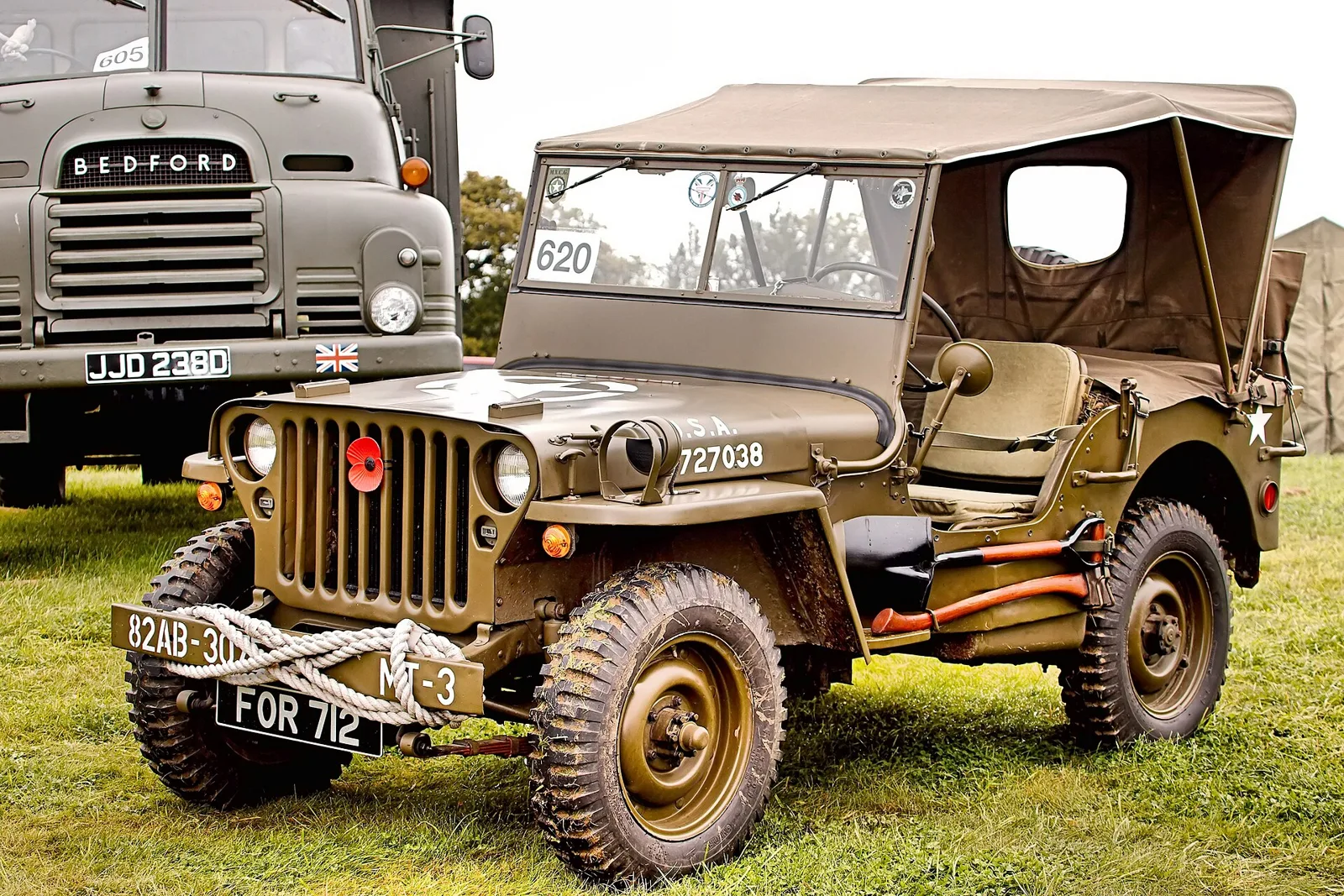
Specified in weeks in 1940 and built in the hundreds of thousands, the Willys MB and its Ford GPW twin set the template for the jeep and for the civilian 4x4.
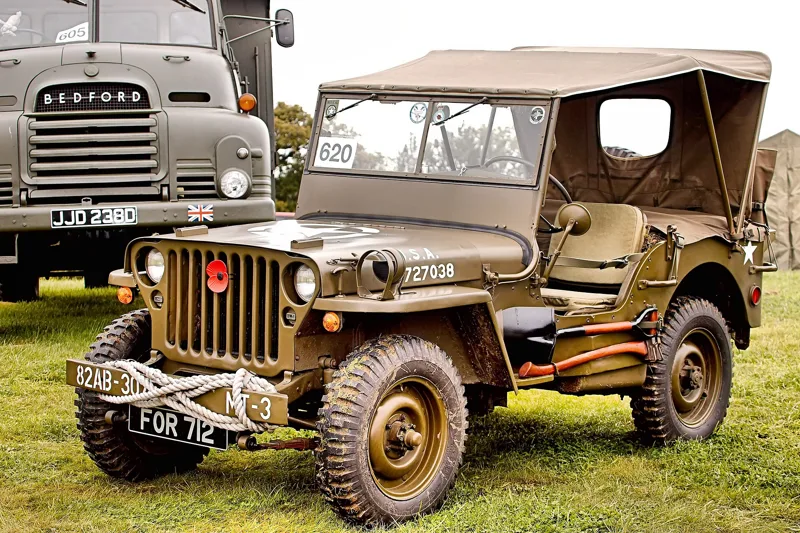
The Willys MB and the Ford GPW were the US Army's quarter-ton 4x4 reconnaissance vehicles of the Second World War, better known as the Jeep. The Army chose Willys in 1941 for production, and 626,727 units were built to one standard design from 1941 to 1945. Its layout became the template for many light four-wheel-drive vehicles.
The Willys MB, and its near-identical Ford GPW twin, were the US Army's quarter-ton, 4x4 command reconnaissance vehicles of the Second World War. They are better known as the Willys Jeep, and their design became the template for a whole family of light four-wheel-drive vehicles. The Army ordered them in the hundreds of thousands, and the car's success reshaped what a military vehicle could be.
The jeep's story is one of speed, competition and branding. It was specified in weeks, built by three companies, and then claimed by more than one of them. The argument over who created it still runs on decades later, and it tells as much about wartime publicity as it does about engineering.
What led the US Army to want a light 4x4?
In 1940 the Army's trucks were too large and heavy for reconnaissance and messaging work, and the half-ton Dodge 4x4s were not agile enough off-road. The Quartermaster Corps had introduced a quarter-ton class in June 1940, and the Army moved quickly to fill it with a new design.
The Army formalised its requirements on 11 July 1940 and sent them to 135 US automotive manufacturers. Bids were due on 22 July 1940, which gave bidders just eleven days to respond. The first stage demanded a working prototype within seven weeks of award.
Specified in weeks, built in the hundreds of thousands and claimed by more than one maker, the jeep became the template for the modern 4x4.
How did the Bantam prototype come about?
American Bantam was the only firm to submit a proper set of technical drawings, and its chief engineer, Harold Crist, led the work. Designer Karl Probst drew full plans for the Bantam Reconnaissance Car in just two days, and the bid was submitted with blueprints on the 22 July deadline.
Bantam's own engines made only 22 hp, so the team chose a Continental four making 45 hp and 86 lb ft (117 N m) of torque. It was mated to a Warner Gear transmission, and Spicer supplied the transfer case and axles. The hand-built prototype was delivered on 23 September 1940, just half an hour inside the deadline.
What were the Army's technical demands?
The first specification was demanding. It called for a payload of 600 lb (270 kg) and an empty weight of no more than 1,275 to 1,300 lb (580 to 590 kg). The engine had to deliver 85 lb ft (115 N m) of torque, and the vehicle had to carry three crew on a short wheelbase.
Those limits proved unrealistic in practice. The weight limit was later raised to 2,160 lb (980 kg), which gave the designers room to make the car rugged enough for field use without wrecking its light character.
Who else built early jeeps?
Ford and Willys both submitted pilot models after the Army saw the Bantam. Willys' Quad used a 60 hp four, and its engine was the strongest of the early entries. Ford's Pygmy relied on a tractor engine, which was tuned from 30 bhp to the specified 40 bhp with a new camshaft and a larger carburettor.
Early production began in different forms. Bantam built 2,605 BRC-40s, starting on 31 March 1941. Ford's GP reached about 4,458 units, and Willys produced 1,555 MA models from 5 June 1941, most of them for the Soviet Union under Lend-Lease.
Why did Willys win the production contract?
By July 1941 the War Department wanted one manufacturer to supply the next order of 16,000 vehicles. Willys won mainly because of its more powerful 60 hp L134 Go Devil engine, which soldiers praised, along with its lower cost and silhouette.
The winning design took the Willys MA and absorbed the best features of the Bantam and Ford entries. The Ford GP's front clamshell and wide, flat hood were adopted, with the headlights set inside a single straight grille. Delmar G. Roos filed the design patent for the result, which codified the familiar jeep shape.
How did Ford come to build the GPW?
In early October 1941 Willys could not keep up with the Army's needs, so Ford received contracts for 30,000 units built to Willys drawings and patents. The Army insisted that Ford adopt the Willys engine and parts for full interchangeability, and no licence fee was paid to Willys.
Ford retooled at a cost of $4 million to build Willys engines, and its first GPW came off the line on 2 January 1942. A further 63,146 GPWs were ordered in late December 1941. Ford spread production across several plants, including River Rouge, Dallas, Louisville, Chester and Edgewater.
What was the Ford GPA?
The Ford GPA was an amphibious jeep, nicknamed Seep for Sea Jeep, with about 13,000 units built. Its design was inspired by the DUKW amphibian, but it was about one third longer than the standard jeep and proved unwieldy on land. It also had too little freeboard for coastal landings from open sea.
The GPA suffered losses in the Sicily landings in July 1943, and about 3,500 went to the Soviet Union. The Soviets later built their own version after the war, the GAZ-46, after finding the GPA useful for crossing rivers and swamps.
Who first called it a jeep?
The word had been in use before the war. Popeye's cartoon character Eugene the Jeep, created in March 1936, was small, able to walk through walls and could go anywhere, and King Features trademarked the name in August 1936. Soldiers borrowed the word for new and unproven vehicles.
Early wartime slang was mixed. Soldiers called the quarter-ton a peep, a bug or a bantam, while the half-ton Dodge command cars were often called jeeps. Journalist Katherine Hillyer's 1941 Washington article, showing a jeep climbing the Capitol steps, is often cited as the moment the name stuck.
Did Willys or Bantam invent the jeep?
Willys advertising during and after the war claimed the company had created the jeep. Its design patent 136819, filed by Delmar G. Roos, described the nose of the car, and the company applied to trademark the Jeep name in February 1943.
Bantam, Ford and other companies objected. The Federal Trade Commission opened a case on 6 May 1943, and in 1948 it ruled that Willys had unfairly claimed sole creation. Bantam went bankrupt by 1950, and Willys was granted the Jeep trademark the same year.
How many jeeps went to the Allies?
The United States provided jeeps to almost all of its wartime partners. Some 182,500 units went to Allies under Lend-Lease, including almost 105,000 to the British Empire, over 8,000 to Canada and some 50,000 to the Soviet Union. The Free French received almost 10,000, and China nearly 7,000.
Shipments to the Soviet Union totalled 77,972 vehicles, including 49,250 quarter-tons, 25,200 Dodge 3/4-tons and 3,520 Ford GPAs. Britain also used the jeep in the North African desert, where it could rescue three-ton trucks stuck in sand.
How was the jeep used in the field?
Within the US military, the jeep was used in every branch. The Army assigned an average of 145 jeeps to each infantry regiment. It served in North Africa, the Pacific, the invasion of Europe in 1944 and on the Eastern Front, and some German soldiers believed every American soldier had a jeep of his own.
Units often improvised their own mounts and fittings, which made each jeep a little different from the next.
Jeeps towed supply trailers, carried water, fuel and ammunition, and worked as ambulances and hearses. The flat hood became a map table, a poker table and even a field surgery platform. Ernie Pyle praised the car for doing everything, going everywhere and carrying twice its design load.
What accessories and weapons were fitted?
The first standard production fitting was the SCR-193 radio, placed on the rear wheel well. The M31 pedestal mount for a .30-caliber or .50-caliber machine gun was the most common factory gun mount, with 31,653 produced during the war.
Some 150,000 quarter-ton trailers were built by more than ten firms, most of them by Bantam and Willys, and they roughly doubled the jeep's payload. A deep-water fording kit was introduced in 1943, which allowed jeeps to drive off landing craft into relatively deep water.
Which lighter and heavier jeeps were tried?
The Army wanted a truly lightweight model for airborne and jungle use. The Crosley CT-3 Pup weighed 1,125 lb (510 kg) and had a 13 hp engine, and six were deployed overseas. Willys worked on the MB-L at about 1,570 lb (710 kg), and later the WAC and JBC, the latter weighing just 561 lb (254 kg).
Heavier spin-offs were also tried. The Willys MT-Tug was a 3/4-ton 6x6 weighing 3,100 lb (1,400 kg), with a 300 miles (480 km) range and a top speed of 55 mph (89 km/h). Willys said every 6x6 Super Jeep would save 2,000 lb (910 kg) of steel compared with the Dodge trucks.
What happened after the war?
Willys marketed its four-wheel-drive vehicle to the public from 1945 onwards with the CJ-2A, which the company described as the world's first mass-produced civilian 4x4. The first CJs were close to the MB, with vacuum wipers, a tailgate and civilian lights.
The military line continued with the M38 in 1950, the M38A1 in 1953 and later the CJ-5 in 1955. The CJ-7 arrived in 1976 with a 10 in (25 cm) longer wheelbase, and from 1987 the evolutions became the Wrangler. Licences were issued in many countries, and Toyota built BJ and FJ models to Jeep specifications from 1950.
Specifications at a glance
| Model or variant | Key figures |
|---|---|
| Willys MB (1941 to 1945) | Willys L134 Go Devil, 60 hp; 626,727 built in total across both makers |
| Bantam BRC-40 (1941) | 112 cu in (1.8 L) Continental four, 45 hp, 86 lb ft (117 N m); 2,605 built |
| Crosley CT-3 Pup | 13 hp; 1,125 lb (510 kg) |
| Willys MB-L (1943) | About 1,570 lb (710 kg) |
| Willys JBC | 561 lb (254 kg) |
| Willys MT-Tug | 3,100 lb (1,400 kg); 300 miles (480 km) range; 55 mph (89 km/h) |
| Ford GPA (amphibious) | About 13,000 built; about one third longer than the standard jeep |