How a valve-in-block engine works, why Ford and Chrysler built millions of them, and what the layout cost in power and efficiency.
Flathead engines put their valves beside the cylinders, in the block, instead of in the head above them. The best-known examples are Ford's Model T four, built for 12,000 days between 1908 and 1941, and Chrysler's fours, sixes and eights, which date from 1924.
Ford's Model T engine was built continuously for exactly 12,000 days, from 27 September 1908 to 4 August 1941, which means it outlasted the car it was designed for by years. It was a flathead, and the way that layout works explains why Ford and Chrysler stayed with it for so long and why nearly everyone eventually gave it up.
What is a flathead engine?
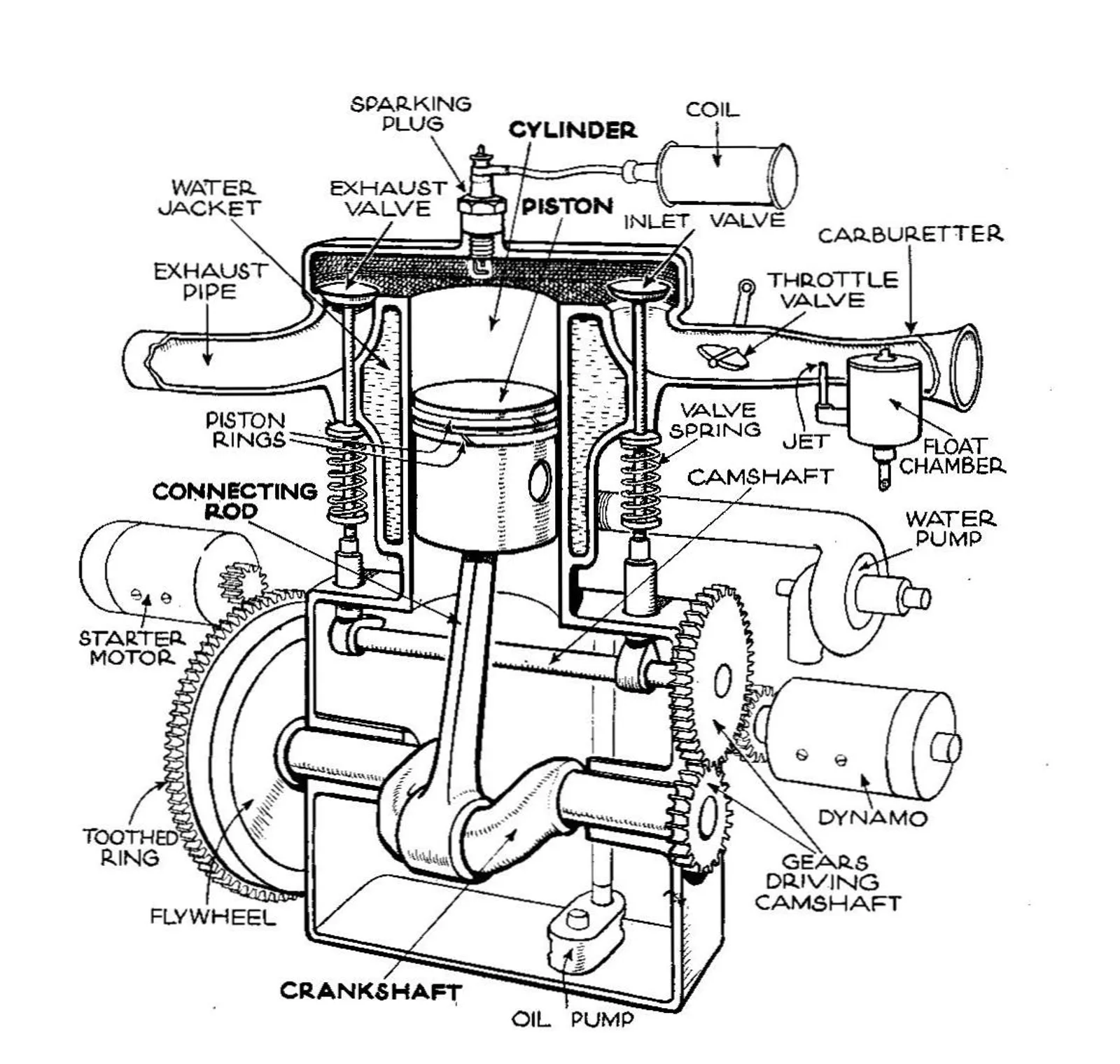
A flathead engine, also called a side valve engine or a valve-in-block engine, keeps its poppet valves inside the cylinder block rather than in the cylinder head. In an overhead valve engine the valves sit above the piston; in a flathead they sit beside it.
Car makers used flatheads around the world, starting in the late 1890s and carrying on until the mid-1960s, when more efficient overhead valve and overhead camshaft designs had displaced them. A small comeback has since begun among slow-turning light-aircraft engines, the D-Motor among them.
A flathead trades breathing for simplicity, and for decades that was a very good bargain.
How does a side valve engine work?
Picture a conventional engine, with a camshaft, pushrods, rocker arms and valves stacked above the cylinder. A flathead flattens all that into the block. A camshaft low in the block opens the valves through tappets and stubby pushrods, and some designs dispense with the pushrods altogether, so the long parts of an overhead valve engine are never needed.
The valves usually sit side by side along one flank of the cylinder. A less common variant, the crossflow T-head, puts the exhaust on the opposite side from the intake. Either way, the combustion chamber is not above the piston but off to one side, above the valves.
Designers sometimes fitted "pop-up" pistons, which poke above the top of the block at the top of their travel. Matched to the right head, they raise the compression ratio and improve the shape of the chamber, which helps to stop knocking.
Why did car makers choose the flathead?
For years it was simply the cheaper and tougher way to build an engine. The advantages are simplicity, reliability, a low part count, low cost and weight, compactness, responsive low-speed power, little mechanical noise and a tolerance for low-octane fuel. The head can be little more than a plain casting.
That is why flatheads went into passenger cars for so long, while overhead valve designs were reserved for high-performance uses: aircraft, luxury cars, sports cars and a few motorcycles. There is another benefit. At the top of the stroke the piston comes very close to the flat part of the head, and the squish turbulence this creates mixes fuel and air very well. And if a valve seizes partly open, the piston is not hit, so the engine runs on safely on its other cylinders.
What did the flathead cost in power and efficiency?
The trade-off is breathing. The sidevalve engine's weak points are poor gas flow, a poor combustion chamber shape and a low compression ratio, which add up to an engine that revs lazily, makes little power and wastes fuel. Because the fuel burns inefficiently, hydrocarbon emissions are high.
Gases take a winding route in and out, so volumetric efficiency, the engine's ability to fill its cylinders, is low, and the exhaust interferes with the incoming mixture. Exhaust that must travel a long way to escape can make the engine run hot; that is a bigger issue for V-type flatheads than for inline ones, whose intake and exhaust ports usually share one side. Such an engine can run at high speed safely, but its breathing deteriorates quickly, so big power at speed is not on offer.
The elongated combustion chamber is also prone to preignition if the compression ratio is raised. The shape suits only the Otto principle, because a diesel needs high compression to ignite, so flathead diesels are virtually unknown. Willys, Rover, Land Rover and Rolls-Royce used a compromise in the 1950s, the F-head, combining one side valve with one overhead valve for each cylinder.
Sir Harry Ricardo improved flathead efficiency in the 1920s after studying how gas flows through them. Later ideas include turbulence grooves to add swirl and torque at low revs, and laser or microwave ignition to tame knock.
What was the Ford Model T engine?
The Model T used a 177 cubic inch (2.9 litre) sidevalve inline four that produced 20 hp (14.9 kW), enough for 45 mph (72 km/h). The engine and the car's planetary transmission formed a single unit, sharing the same lubricating oil.
The engine was known for simplicity, reliability and economy, and it earned a place on Ward's list of the 10 best engines of the 20th century. Millions were built. Its life outlasted the Model T car, with industrial, marine and military uses running the production run on, although the passenger car and pickup market for it lasted 19 years, from 1908 to 1927.
What was inside?
All four cylinders were cast into one block, a monobloc design that was uncommon when production started in 1908 and that suited mass production. The head was detachable, which made valve jobs easier. Block and head were cast iron. Bore was three and three-quarter inches (95.25 mm) and stroke 4 inches (101.6 mm), and the crankshaft had three main bearings.
The compression ratio was 3.98 for most engines, low even then but typical of the time, and it made the engine forgiving of poor, low-octane fuel and easy to crank.
Cooling, fuel and spark
The first few hundred cars had a water pump, but Ford dropped it for a cheaper, more reliable thermosyphon system in which hot water rises to the top of the radiator and sinks as it cools. It overheated if worked hard, but it served most owners well.
The carburettor was a side-draft, single-venturi unit with a manual choke, a hand-lever throttle and no accelerator pump, supplied by firms including Holley, Zenith and Kingston. The 10 US gallon (38 L) tank sat under the front seat, and fuel reached the carburettor by gravity alone. With little fuel in the tank, the car could not climb a steep hill, so the answer was to climb it in reverse. In 1926 the tank moved forward and upward, under the cowl, which helped.
Ignition came from a flywheel magneto, a timer and four trembler coils. A spark advance lever on the steering column set the timing, and finding the right setting took experience. The magneto was the first part of the Model T to be built on an assembly line. Starting meant a hand crank, with the spark retarded so the engine could not kick back, and the thumb tucked under the handle so that a kick-back would throw the hand clear rather than break it.
Ford offered an electric starter from 1919 and electric headlights from 1915. The engine is also credited with giving birth to the aftermarket performance business, and later, when Ford's flathead V8 arrived in the early 1930s, to hot rod culture in the early 1940s.
How did the Model T and Model A engines differ?
Changes over the years were modest. A water pump disappeared in 1909, valve covers arrived in 1911, a higher head with a bigger water jacket in 1917, lighter rods and pistons in 1920, a single valve cover casting in 1922, and an extra boss at the rear to stiffen the transmission in 1926.
The Model A engine was an inline four, water-cooled, with an L-head design and 201 cubic inches (3.3 litres), making 40 hp (30 kW; 41 PS) and 174 Nm. Its bore and stroke were 3.9 by 4.3 inches (99 by 110 mm). No parts interchange with the Model T engine.
What did Chrysler do with the flathead?
Chrysler built flathead inline engines from 1924 through the early 1960s, in four-, six- and eight-cylinder forms and with cast iron or aluminium heads. They went into Chrysler, DeSoto, Dodge and Plymouth vehicles.
Chrysler flathead fours
The Chrysler flathead four appeared in 1926, after Maxwell was reorganised into Chrysler in 1925. The original displaced 185.8 cubic inches (3,044 cc) and made 38 hp (28 kW) for a single year. It shrank to 170.3 cubic inches (2,791 cc) for 1927 and 1928, with power raised to 45 hp (34 kW) during 1928.
Plymouth, launched in 1929, got a redesigned 175.4 cubic inch version, which Dodge light trucks also used. In 1930 the engine grew to 196.1 cubic inches (3,213 cc) and 48 hp (36 kW), then 56 hp (42 kW) for 1931 and 65 hp (48 kW) in 1932 for Plymouth only. Dodge stayed at 48 hp until 1933.
Narrower-bore export versions cut the British RAC tax rating from 21 to 15.6 hp in 1931 and to just under 15.5 for 1932. Chrysler did not sell another four-cylinder engine until 1981, with the 2.2 and 2.5 in the K platform.
Chrysler flathead sixes
The first straight-six was the seven-bearing B-Model in the 1924 B70, the first Chrysler Corporation production car. An E-Model went into the Imperial E80 in 1926 and a cheaper H-Model followed in 1927. By the time Chrysler bought Dodge Brothers in 1928, it had five straight-sixes in production.
The 1929 DeSoto brought a cheaper K-Model, with deep skirts and four main bearings, which partly replaced the earlier engines by mid-1930. When the Ford flathead V8 appeared in 1932 it shook the market and increased demand for larger engines even in entry-level brands, so Plymouth and Dodge received a new six in 1933, known as the "23 in block" after its 580 mm head length. A longer "25 in block" of 640 mm followed for the DeSoto S3 and Chrysler Royal C16 in 1937. When Chrysler set up an engine foundry in Windsor, Canada, in 1938, all Canadian-built engines used the long block.
The flathead six also did farm and military work. Massey Harris tractors used the 201 cubic inch (3,299 cc) six from 1938, the 218 (3,568 cc) from 1940, and the 242 (3,966 cc) in the 201 Super until 1942. In the Second World War, the 251 cubic inch (4,107 cc) six was the starting point for the A57, Chrysler's multibank tank engine.
The flathead six made its last appearance in an automotive product in 1968, in the Dodge Power Wagon WM300, with the 251. The much more efficient overhead valve Slant-6 of 1960 replaced it across the range, reaching most Dodge trucks from 1961, but the flathead stayed in industrial and agricultural production into the early 1970s.
The straight-eight
Chrysler's flathead eight was largely based on the DeSoto K-Model six, with five main bearings, the centre one wider, and a bore of three and a half inches. The Imperial (CG, CH) and Custom Imperial (CL, CW) got a nine-bearing version with a two-barrel downdraft carburettor, and an aluminium head from the CW. Dodge G-80 trucks and Fargo buses used it too.
How do the flathead fours compare?
| Engine | Displacement | Power |
|---|---|---|
| Ford Model T | 177 cu in (2.9 L) | 20 hp (14.9 kW) |
| Ford Model A | 201 cu in (3.3 L) | 40 hp (30 kW) |
| Chrysler four, 1926 | 185.8 cu in (3,044 cc) | 38 hp (28 kW) |
| Chrysler four, 1930 | 196.1 cu in (3,213 cc) | 48 hp (36 kW) |
| Chrysler four, 1932 Plymouth | 196.1 cu in (3,213 cc) | 65 hp (48 kW) |
Where else were flatheads used?
The Ford flathead V8 and Ford's sidevalve engines, and Cadillac's V-16 Series 90 of 1938 to 1940, were all flatheads. Packard and Pontiac built flathead straight-eights until 1954, and Britain's Morris Eight and the first Morris Minor used the layout too.
Early aero-engine designers judged flatheads too inefficient, with two exceptions: the Aeronca E-107 opposed twin of 1930, and Continental's A40, a flat four from 1931, which grew into a favourite among light aircraft engines through the 1930s. Harley-Davidson and Indian V-twins, British singles and BMW flat twins used flatheads in motorcycles, and small sidevalve engines still drive lawnmowers, rotavators and two-wheel tractors.
What happened to the flathead after the war
After the Second World War, flathead designs were superseded by overhead valve engines, surviving in more basic vehicles such as military Jeeps. Restored early Ford flathead V8s can still be found in American custom car and hot rod circles. The revival is Belgian: the D-Motor makes compact, oversquare flat-fours and flat-sixes that drive the propeller directly.