Nissan's luxury sedan for Infiniti, with an active suspension, a V8 in three generations and a long, uneven run from 1990 to 2006.
Nissan's Infiniti division sold the Q45 as a full-size luxury flagship from 1990 to 2006. Its first generation had a 4.5-litre V8, and the car used electronically controlled Full-Active Suspension on some versions before the M replaced it.
The Infiniti Q45 was the inaugural product and flagship sedan of Nissan's luxury division, sold in North America from the 1990 model year. It was built to take on established luxury names, and it went through three generations, each with its own engine and character, before the nameplate ended in 2006.
What is the Infiniti Q45?
The Q45 is a full-size luxury sedan that Nissan's Infiniti division marketed from 1990 to 2006. It was the brand's flagship, competing with the Acura Legend and Lexus LS 400, and it was matched in size against the BMW 7-Series and Mercedes-Benz S-Class. Three generations were produced.
In Europe the car fell in the F-segment, the large executive class. Nissan built it at Kaminokawa in Tochigi from 1989 to 2006, and the letter Q was borrowed from the Western Q-car tradition, in which an unassuming body hides serious performance.
A luxury flagship with active suspension and three V8 generations, built to challenge Lexus and reset a brand.
Why did Infiniti launch with a sedan like the Q45?
Infiniti arrived in the late eighties, when several Japanese makers were building dedicated luxury brands for North America. The Q45 was the first product in that line-up.
Nissan wanted a luxurious performance sedan, and it fitted technology designed to deliver that combination. The car was pitched against the Lexus LS 400 with comparable specification and price, but with more emphasis on handling.
How did the first-generation Q45 sell?
The first-generation Q45 sold poorly against the Lexus LS 400, despite similar specification and price. The shortfall was put down to unconventional styling, especially the grille and the absence of woodgrain or chrome trim, along with an advertising campaign that never showed the car.
Prices climbed during the first generation. The launch price of US$38,000 (equivalent to $99,000 in 2025) had risen to US$54,000 (equivalent to $114,000 in 2025) by 1995, and the higher figure slowed sales further.
Infiniti also tried Australia. The brand launched there in 1993 with the Q45 as its only model, priced at A$140,000, but the car sold badly and the brand was withdrawn in 1996.
In Japan the car was sold as the Nissan Infiniti Q45 from November 1989, exclusively through Nissan Prince Store outlets. Its platform twin, the President, went through Nissan Store locations, and the G50 chassis continued in Japan until 2002 in regular and extended wheelbase versions. The Japanese car carried options that never reached North America, and it sat above the Cima but below the President.
What did the Q45 offer when it launched?
The 1990 model used a 4.5-litre VH45DE DOHC V8 rated at 278 hp (207 kW) and 292 lb-ft (396 N-m) in North American trim. Every car had a viscous limited-slip differential and a multi-link suspension at both ends.
At launch the only option was the Touring Package, which added Super HICAS four-wheel steering, a decklid spoiler and alloy wheels. Standard equipment covered a Bose sound system, leather upholstery, power front seats with memory, one-touch power windows and keyless entry.
What was Full-Active Suspension?
Full-Active Suspension was an electronically controlled system introduced in 1989 on the Q45a. It used 10 sensors that signalled microprocessor-controlled, one-way hydraulic actuators at each wheel, reducing body roll, dive and pitch.
The system responded to road features up to roughly 3 Hz, a limit set by the bulk of the extra hardware and the power needed to pressurise the accumulator. It added 202 lb (92 kg) and cut fuel economy by 10%, and it reached the United States for the 1991 model year.
Rivals pursued similar ideas. Toyota offered its Active Control Suspension on a limited-production Celica Active Sports in Japan, and Mercedes-Benz introduced Active Body Control in 1999 on the C215 CL-Class.
How was the Q45's design shaped?
The design team set out to express the Japanese concept of luxury. The first Q45 launched with no front grille and no wood on its dashboard, and Nissan drew on Poltrona Frau for the minimalist interior.
The car grew out of Nissan's 901 Movement, a programme started in 1985 that aimed to produce the best-handling line-up in the industry. Its results included the 300ZX Z32, the Primera, the Silvia and the Skyline R32, and the Q45's multi-link rear suspension was derived from the Z32.
A grille arrived in 1993 and interior wood by 1995. From the 1994 model year onward, the car could be recognised by its chrome grille.
What changed in the second generation?
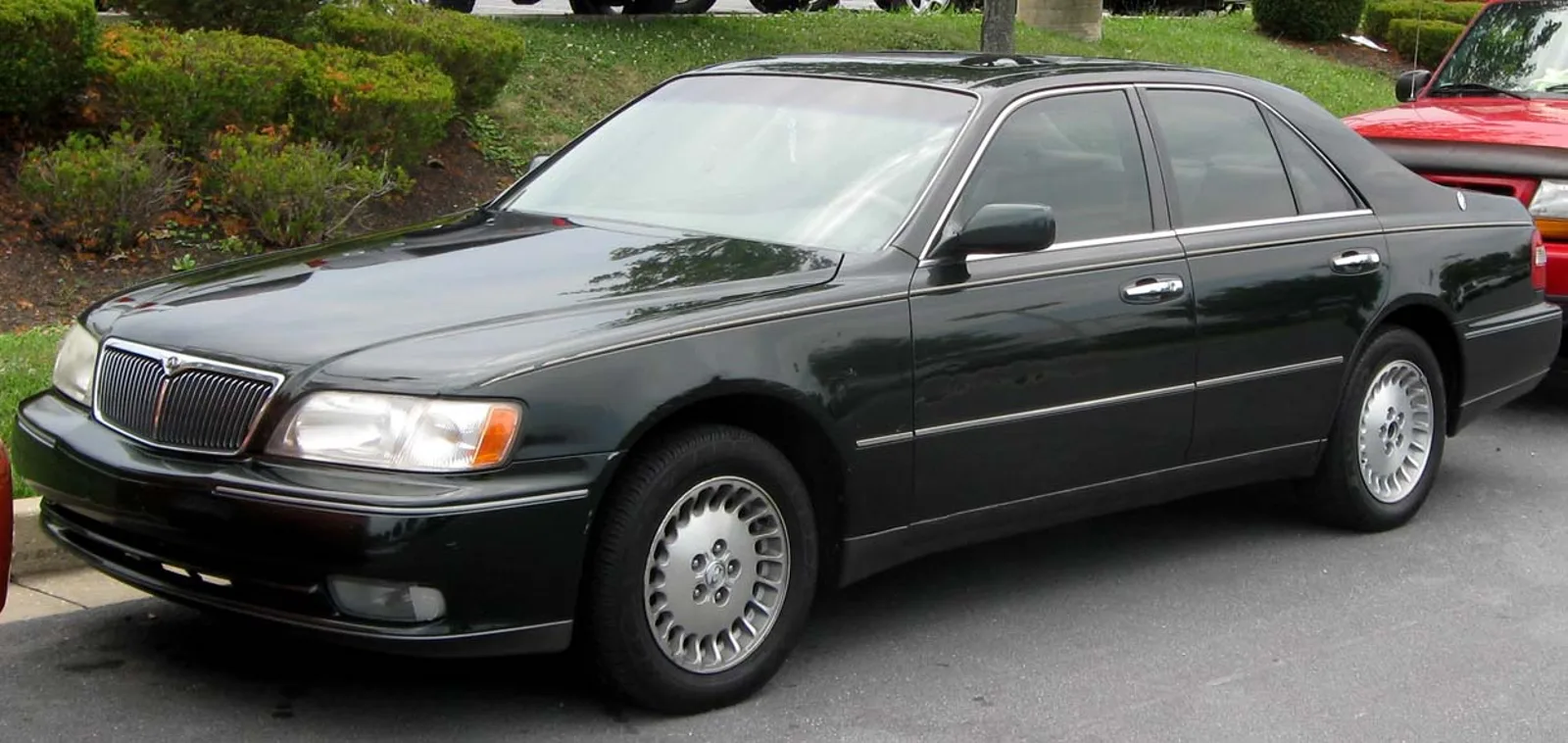
The second generation, the Y33 of 1997, was a lightly revised version of the Nissan Cima sold in Japan, sharing its platform with the Cedric and Gloria. It moved to a smaller 4.1-litre V8 in place of the 4.5-litre unit.
Rear legroom grew by 3.9 in (99 mm), but owners criticised the trunk, which offered 12.6 ft3 (360 L). Standard kit included traction control, leather with faux wood trim and a Bose system with eight speakers.
The front suspension moved to MacPherson struts, and the car was about 200 lb (91 kg) lighter than the first generation. Steering was slowed from 17.0:1 to 18.5:1, and a viscous limited-slip differential and electronic traction control came as standard.
The second generation also broke Infiniti's naming pattern. Most models pair a series letter with a two-digit number for engine displacement, so the first-generation Q45 took its name from its 4.5-litre V8. The Y33 used a smaller 252 cu in (4.1 L) VH41DE engine, an exception shared by the QX4, which was derived from the Nissan Pathfinder.
How did the Y33 perform?
The Y33 with the VH41DE engine produced 267 hp (199 kW) and 278 lb-ft (377 N-m), enough to reach 0-60 mph (97 km/h) in about 7.5 seconds. In 1997 Edmunds observed that the car no longer aspired to be a sport sedan.
The emphasis had moved to comfortable motorway cruising, and the Touring package, badged Q45t, added 17-inch wheels, a performance-tuned suspension and a blacked-out grille and headlight treatment.
Updates arrived for 1999 with HID headlights and an analogue clock. The Anniversary Edition, limited to 3,000 units, was offered on 2000 models and became standard on the 2001 models.
Changes from January 1998 production replaced the mechanical odometer with a liquid crystal display. Later cars gained a power rear-window sunshade, power trunklid pull-down and high-intensity xenon headlights, and the taillights moved off the boot lid. The Touring edition gained dual-mode electronically controlled shock absorbers.
What made the third generation different?
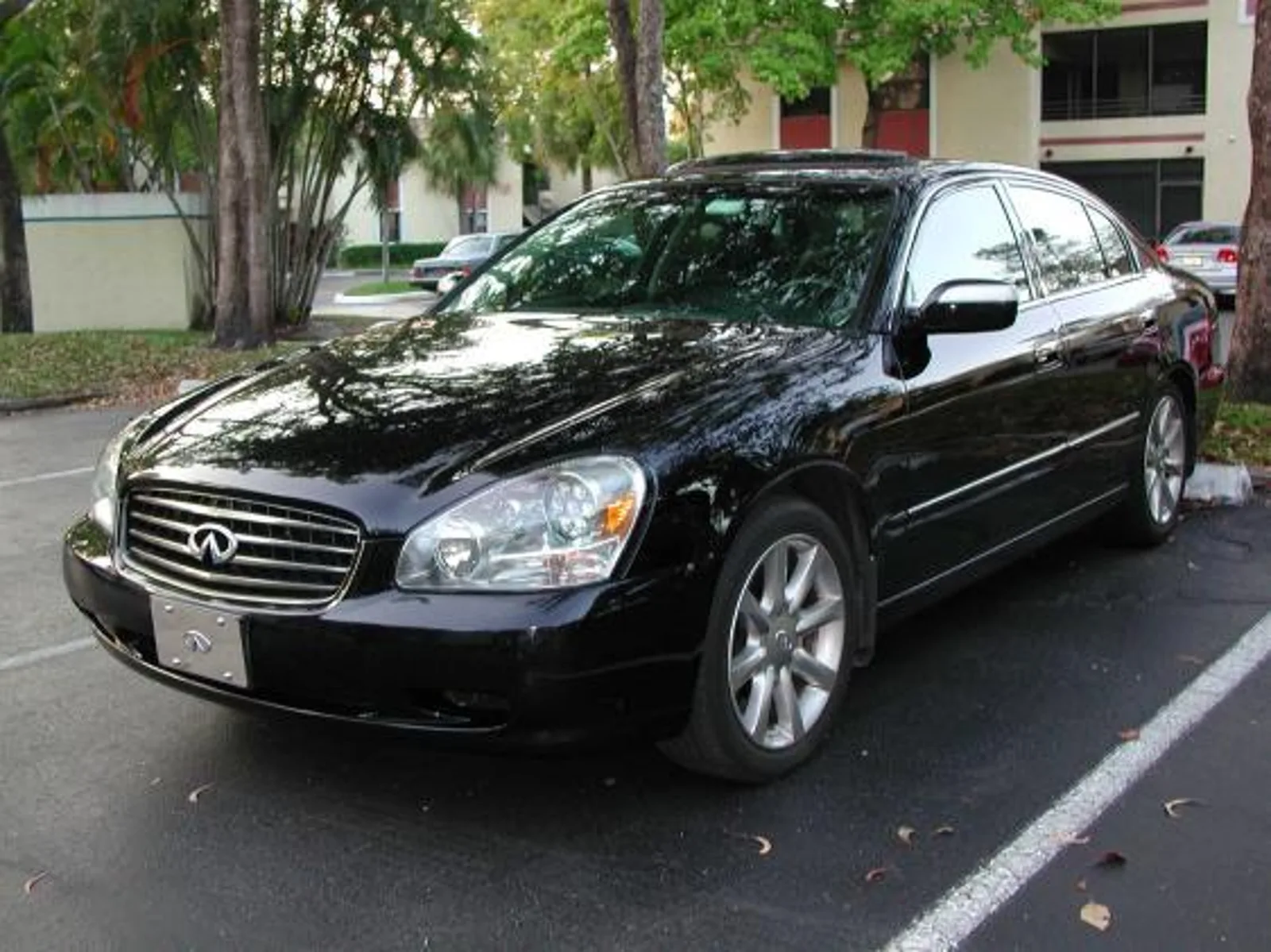
The third generation, the F50, was introduced at the 2000 New York Auto Show and built in Tochigi. Like the Y33, it was based on the Japanese-market Cima, but it was wider, had a longer wheelbase and used a new twin-cam 4.5-litre V8.
Development began in 1996. Mamori Aoki's exterior design was frozen in 1998 and patented in March 2000, and Aoki wanted the car to feel like a driver's car rather than a chauffeur-driven limousine.
The F50 was roomier, with 5 ft3 (0.14 m3) more interior volume than its predecessor, and its torsional rigidity was improved by 40%. It was the first Infiniti to carry laser-based autonomous cruise control, and its gatling-gun HID headlights used 11 bulbs on each side.
The third generation began at a starting price of US$50,500 (equivalent to $91,800 in 2025), and marketing started in April 2001 for the 2002 model year. Its premium options put the car in the same bracket as the Audi A6 and Lexus GS it was compared with.
Voice navigation came from Visteon, whose recognition system was trained on 50,000 words in 150 dialects. The 2002 Q45 was also the first car to offer voice-controlled navigation and a reverse parking camera outside Japan, after the 1991 Toyota Soarer had shown those features in Japan.
How did the F50 perform?
The twin-cam VK45DE is rated at 340 hp (254 kW) with 333 lb-ft (451 N-m), which took the sedan from 0 to 60 mph (97 km/h) in 6.0 seconds. It was paired with a five-speed automatic with overdrive.
Premium options included adjustable suspension, 18-inch alloy wheels on 245/45R18 tyres, a 7.0-inch LCD navigation screen and climate-controlled front seats with heating and cooling functions.
The 2003 model received a revised security system, a numerically higher final drive ratio for stronger acceleration and a mid-year satellite radio option. For 2005 the car received a mild facelift with new fascias and LED taillights, and 1129 were marketed in the US that year.
How did reviewers judge the F50?
Brock Yates, writing for Car and Driver, measured the third-generation Q45 against the Audi A6 and Lexus GS. He praised its refinement, comfort and distinctive looks at its introduction.
The Q45 was judged against mid-luxury V8 sedans rather than against limousines, which fitted Infiniti's stated aim for a driver's car. The F50 body had a drag coefficient of 0.30 and seated five.
How did the Q45 come to an end?
Infiniti dropped the Q45 after the 2006 model year, and its flagship role passed to the Infiniti M, a shorter mid-luxury car with more interior room and a rear multi-link suspension. The Y51 series M arrived in November 2009.
The M was shorter in length than the Q45, but it offered greater interior room and performance, with a rear multi-link suspension and a front double wishbone. The 2009 M was only 50 mm (2.0 in) shorter than the final Q45 and shared its 1,845 mm (6.1 ft) width. In Japan the Cima and its President sibling were discontinued by August 2010, and when the Fuga took over as the top sedan there, Nissan no longer sold a premium V8 saloon in Japan. The North American Infiniti M56 kept a V8 shared with the QX56.
Mark Igo, general manager of Infiniti North America, said a new flagship was expected but doubted it would be especially profitable. In Japan the Cima was discontinued by August 2010, and the Fuga became Nissan's top sedan.
Infiniti announced on 17 December 2012 that its future sedans would take the Q prefix, beginning with the Q50 as the replacement for the G37.
What are the key specifications?
| Generation | Years | Engine | Output | Torque |
|---|---|---|---|---|
| G50 | 1990 to 1996 | 4.5 L VH45DE V8 | 278 hp (207 kW) | 292 lb-ft (396 N-m) |
| Y33 | 1997 to 2000 | 4.1 L VH41DE V8 | 267 hp (199 kW) | 278 lb-ft (377 N-m) |
| F50 | 2002 to 2006 | 4.5 L VK45DE V8 | 340 hp (254 kW) | 333 lb-ft (451 N-m) |
How is the Q45 remembered?
The Q45 is remembered as Infiniti's first flagship, a car with an unusually advanced suspension. It sold in smaller numbers than its Lexus rival, but it gave the brand its first large sedan.
The Q name returned on the Q50 and Q70, and the 2013 branding change carried the prefix across the range.