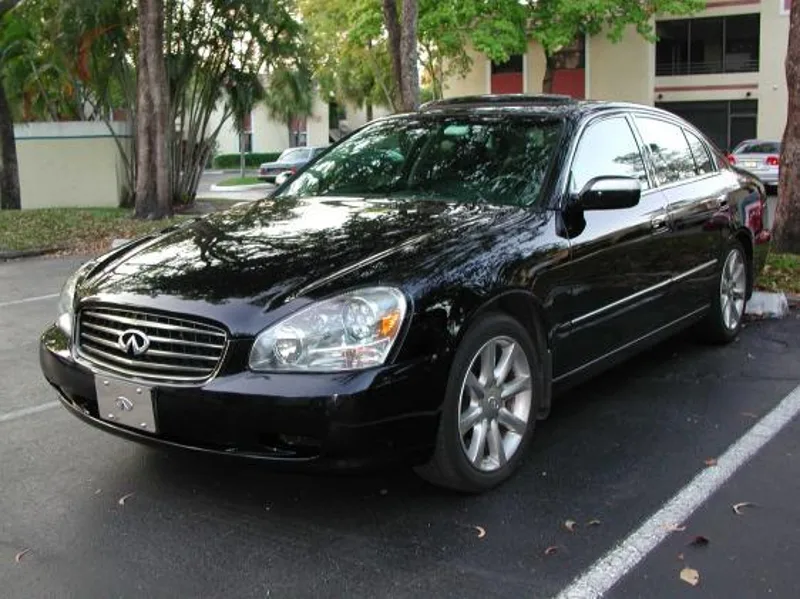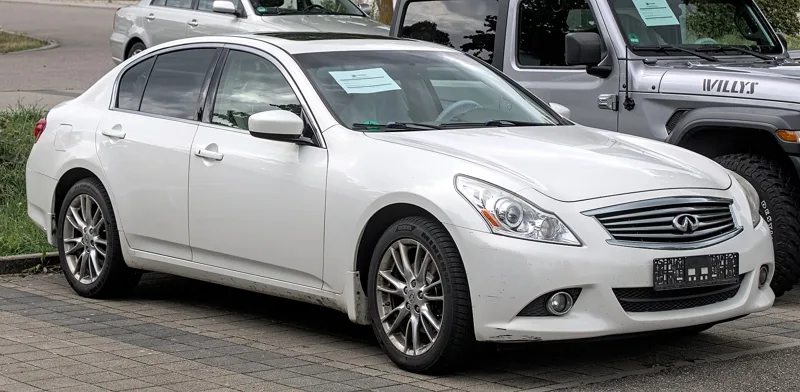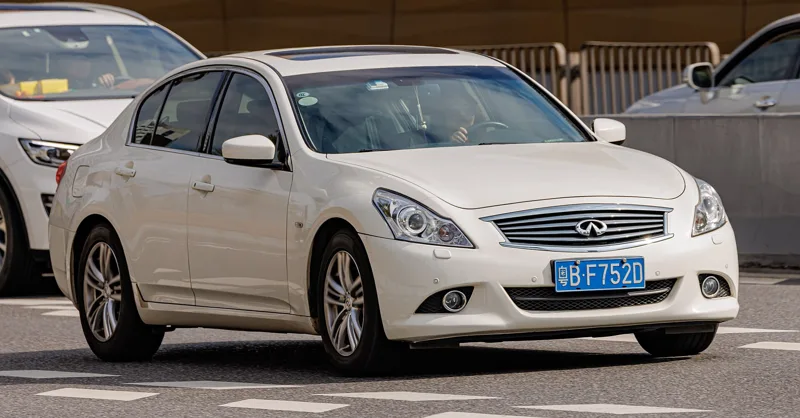
A mid-size sedan with less cabin room than a Nissan Sentra, a 400 hp coupe, an executive saloon dropped for crossovers, and an SUV with a compression ratio that changes.
The Infiniti J30 was a rounded executive sedan sold from 1993 to 1997. The Q60 coupe and Q70 sedan took their names from Infiniti's 2013 renaming of the G and M lines, and the QX50 crossover grew from the EX. Infiniti has since ended the Q70, the Q60 and the QX50 in key markets.
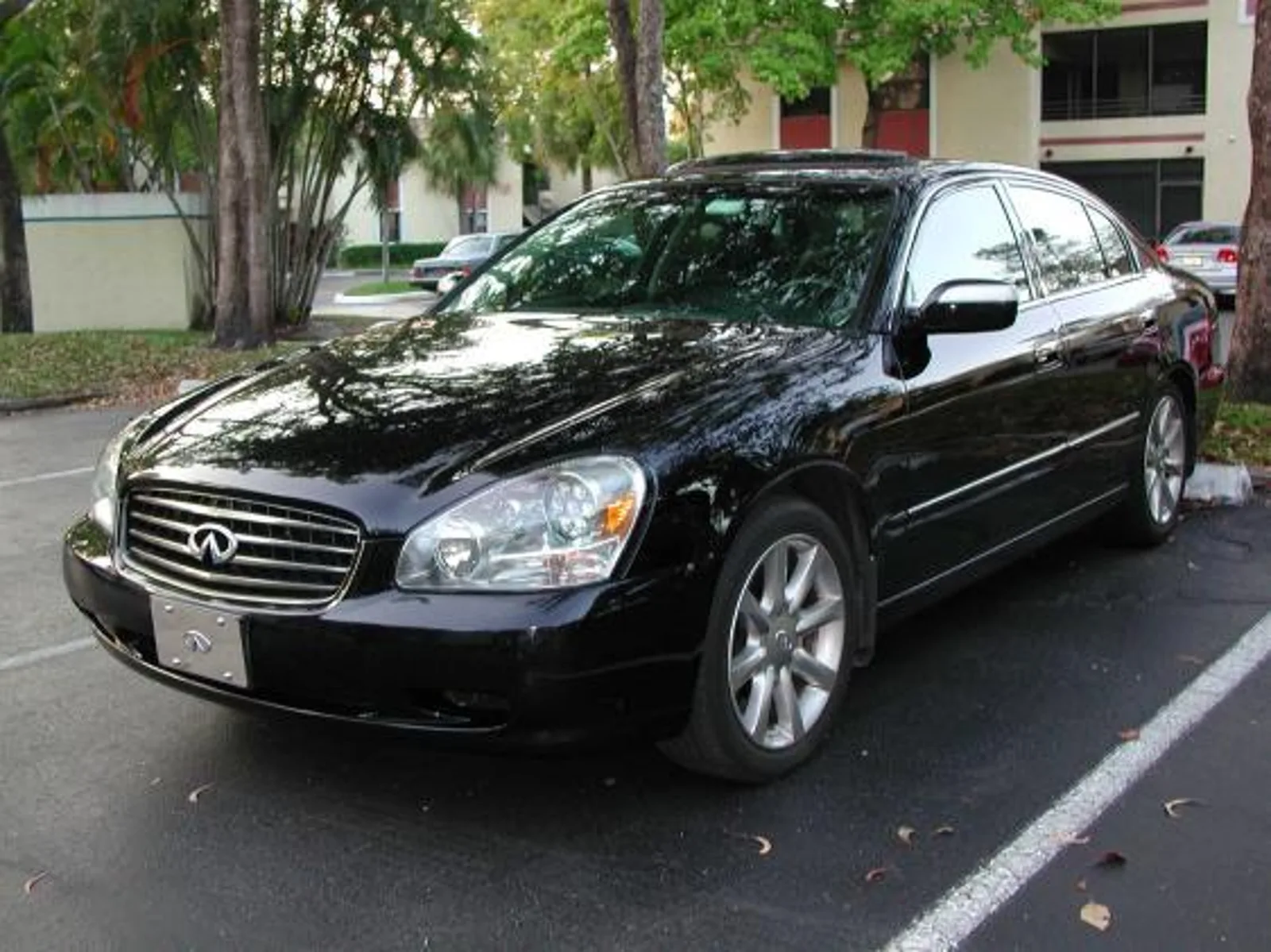
On the outside, the Infiniti J30 was a mid-size luxury sedan. On the inside, key interior dimensions were smaller than a Nissan Sentra's, because of a sloping roofline and a shrunken boot. That tension between a car's shape and its usefulness runs through the other Infinitis here. The Q60 coupe, the Q70 saloon and the QX50 crossover each trace back to an earlier name, and each of the three has since been dropped in at least some markets.
Understanding how the four fit together starts with a naming decision made in 2013. Before it, Infiniti's cars carried a letter and a number tied to engine size. After it, they carried a Q and two digits tied to rank. The J30, from the 1990s, predates all of that, which is why it sits apart in the story.
Infiniti J30: the rounded sedan of the 1990s
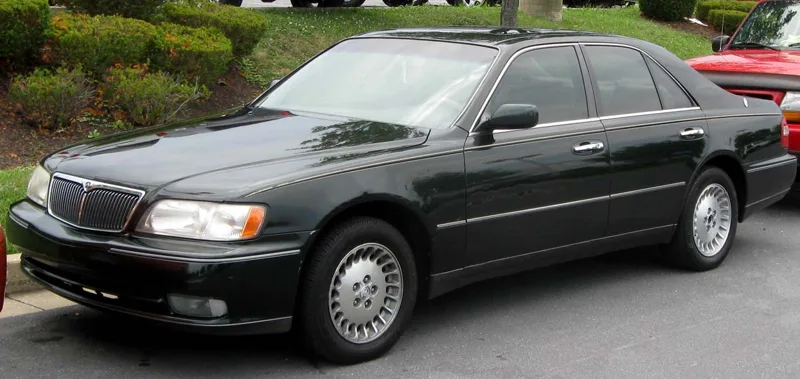
The Infiniti J30 was an executive car. Production began on 7 April 1992 for the 1993 model year, and it replaced the M30 coupe. It was sold in Japan as the Nissan Leopard J Ferie. Infiniti launched it in the United States after the Lexus GS and Acura Legend, and by size and price it slotted in above the G20 and below the Q45. Its rounded styling was unusual in a crowded class, and it is now seen as an early four-door coupe.
J30 design and reception
Nissan Design International in La Jolla, California, drew the J30 in 1988 and 1989, led by Jerry Hirshberg with Doug Wilson responsible for the exterior. Hirshberg described it as the first car in a trend away from the wedge shape. At the launch event he summed up the theme as a line and an egg drawn in calligraphy, and said it was meant to give the new Infiniti brand an instant heritage. A 1994 promotional video called it a personal luxury sedan, as a way of positioning it as a four-door coupe.
Critics split. Paul Dean of the Los Angeles Times likened it to a melted 1961 Jaguar Mark X, while Bob Sikorsky drew a parallel with the 1947 Studebaker Champion and praised the engineering for its smoothness and silence. Looking back, Mickey Kaus found the styling pretentious, with a rear end that sagged.
Inside, Italy's Poltrona Frau helped design the cabin, as it had on the Q45. The long standard list included leather, bronze-tinted glass, digital climate control, burlwood trim, a Bose sound system, a power metal sunroof, dual 8-way heated seats, dual airbags, ABS and ventilated discs at both ends. Its main shortcoming was space. Despite mid-size exterior dimensions, the interior was comparable to a subcompact's.
J30 engine and touring model
Power came from the 3.0-litre VG30DE V6 shared with the 300ZX, here producing 210 hp (157 kW) and 192 lb ft (260 N.m). Weight of 3,527 lb (1,600 kg), about 300 lb more than the 300ZX, blunted performance: a 1992 test recorded 128 mph (206 km/h) and about 9 seconds from 0 to 60 mph. The engine's valve timing was retarded slightly for smoother shifts. The chassis was Nissan's Y32, shared with the Cedric, Cima and Gloria, with MacPherson struts at the front, a multi-link rear and a viscous limited-slip differential. In Japan the Leopard J. Ferie was offered with the V6 as the Type L and a VH41DE V8 as the Type X, always with a four-speed automatic.
The touring J30t added a rear spoiler, firmer suspension, BBS-style wheels and Super HICAS four-wheel steering, which was offered only in 1993 and 1994. A few gold-package cars had gold-plated badges and grille. For 1995, Nissan's financial troubles led Infiniti to decontent the J30t, which became essentially a base J30 with a spoiler.
J30 sales and end
Chicago saw the J30's unveiling on 5 February 1992. Prices for the 1993 base car and the J30t were set at $30,000 and $34,700 in early March, though another version of events says the base car launched at $33,000. By 1995 the base car cost $39,000, with the J30t $2,000 more. Heated seats became standard in 1994, and otherwise the car changed little between 1993 and 1997. All J30s were built in Tochigi, Japan.
US buyers took roughly 70,000, with over 20,000 a year in 1993 and 1994, then 17,899 in 1995, 7,564 in 1996 and 4,594 in 1997. Under 8,000 were sold in Japan. Production ended on 18 June 1997, and the Infiniti I30 took over. Its advertising was unusual for the segment, with jazz music, artistic camera shots and the Welsh actor Jonathan Pryce as spokesman.
Despite mid-size exterior dimensions, the J30's interior was comparable to a subcompact.
Why Infiniti switched to Q and QX names
Infiniti's former president Johan de Nysschen said the brand needed a new identity and direction to build familiarity as the range grew. From 2014 every passenger car would carry a Q followed by two digits that matched its place in the hierarchy. In 2013 the M sedans became the Q70, a name reflecting rank rather than engine size, and the G coupe's successor became the Q60. The EX became the QX50 to match the new Q and QX scheme, which reached China for the 2013 model year.
Infiniti Q70: the M series renamed
The Infiniti Q70 and the long-wheelbase Q70L are mid-size luxury executive cars, essentially a lightly touched-up M series. The Chinese model went on sale in 2012, and US cars for the 2014 model year came as the 3.7, 3.7 AWD, 5.6, 5.6 AWD and Hybrid. All had a seven-speed automatic with Adaptive Shift Control and a manual mode.
The Q70 update brought new front and rear fascias, a new grille, LED headlights and fog lights, three new body colours, 18-inch wheels, optional Backup Collision Intervention and standard Active Noise Control. The hybrid could be ordered with Around View Monitor and moving-object detection. Infiniti showed the car at the 2014 New York International Auto Show and then in Paris. US 2015 cars offered a 3.7-litre engine and a 5.6-litre engine, and European deliveries began in December 2014 with a diesel and the Hybrid. UK buyers could choose the diesel, the 3.7 or the Hybrid.
Q70L and recalls
The Q70L (Y51), shown at Auto Shanghai in 2015, was based on the Nissan Cima. Changes included redesigned daytime running lights, extra LED sources, a split rear bumper, semi-aniline leather, silver powder wood veneers, electromagnetic rear doors, a rear entertainment system and rear seats with adjustable angles. A Bespoke Edition borrowed design from the Q80 Inspiration and interior from the Q60 Concept, with four seats. Chinese sales began in the second quarter of 2015.
Recalls hit the 2014 hybrid for cracking housings and a software error that could stop the electric motor while driving, and the 2014 to 2015 car for loosely fitted fuel pressure sensors.
Why the Q70 ended
In 2019 Nissan confirmed that the Q70, Q70L, Q30 and QX30 would be discontinued after the 2019 model year because of poor sales, as buyers in Canada, Mexico and the United States preferred crossovers and SUVs. The company was also planning to withdraw Infiniti from many markets by the end of 2020, having already left South Africa in 2017. Nissan said it did not plan to abandon sedans entirely and might introduce an Infiniti EV in 2021 for the 2022 model year, based on the QS Inspiration concept. Even so, the Q70L was still offered in China as of 2022.
Infiniti Q60: the G coupe's successor
Nissan's Infiniti Q60 is a two-door luxury coupe that followed the G coupe and convertible. The first generation (V36, 2013) was the fourth-generation G Coupe renamed. The second generation (V37) was shown as a concept at the 2015 North American International Auto Show, the production car followed there in 2016, and the European version debuted at the 2016 Geneva Motor Show. US cars went on sale as 2017 models, with a Mercedes-sourced 2.0t, a 300 hp (224 kW; 304 PS) 3.0t in August 2016 and the Red Sport 400 in September. European sales began in October 2016.
Q60 engineering
The new coupe was lower and wider, and it added the second generation of Direct Adaptive Steering, a drive mode selector, Dynamic Digital Suspension, an adjusted seven-speed automatic, active grille shutters and, for the first time, turbocharging. The convertible and the manual gearbox both disappeared. The drag coefficient is 0.28, with no lift at front or rear. The grille shutters stay shut in normal use and open when the engine needs cooling.
Trims were Pure, Luxe, Sport and Red Sport 400. Pure and Luxe used a Mercedes-Benz 2.0-litre turbo four, while Sport and Red Sport got Nissan's new 3.0-litre turbocharged VR V6, with 300 hp in the Sport and 400 hp (298 kW; 406 PS) in the Red Sport. The Red Sport 400 added 14-inch front and 13.8-inch rear brake rotors with red calipers, sport suspension, leather sport seats, 20-inch wheels and red S badges. Optional safety packages included Predictive Forward Collision Warning and emergency braking with pedestrian detection, and a higher-tier package added adaptive cruise control and lane departure prevention.
Special Q60 projects and the end
A Neiman Marcus Edition of just 50 Red Sport 400s went on sale in the United States on 11 February 2017, with Solar Mica paint, carbon mirror housings and a white leather interior. The Project Black S concept, developed with the Renault Sport Formula One Team and shown at the 2017 Geneva show, added a motor and battery that recovered energy, with a second motor attached to the turbocharger to remove turbo lag. It was estimated at 500 hp (370 kW; 510 PS). An updated version appeared at the 2018 Paris show, but Infiniti confirmed in March 2021 that the project had been cancelled.
Tochigi, Japan, built the Q60 for export only. Kit Harington starred in a short film called Tyger for the launch. In August 2022 Infiniti confirmed that the Q60 would end at the close of the year, as the brand focused on crossovers, SUVs and an upcoming US-built EV.
Infiniti QX50: from EX to variable compression
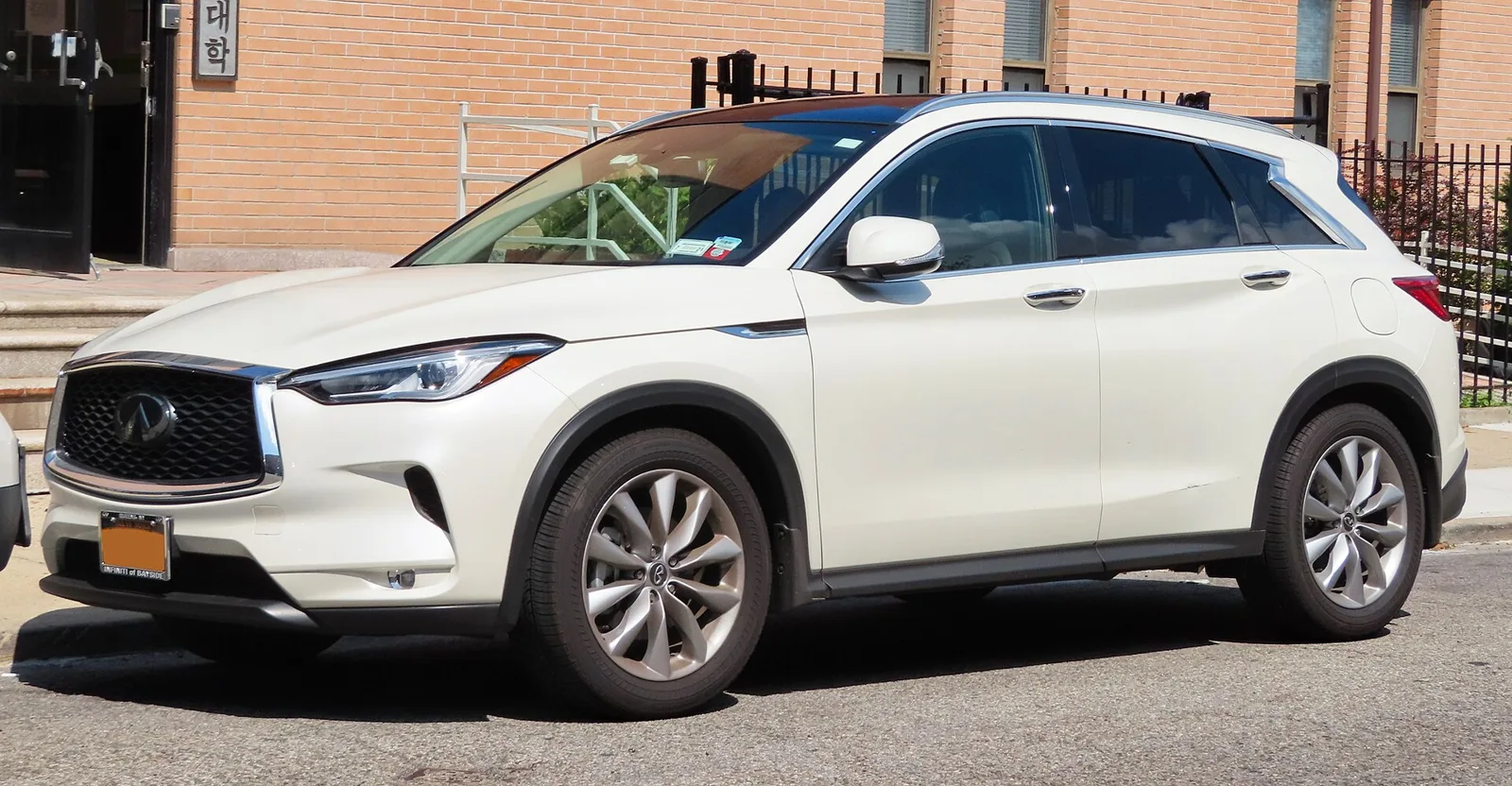
The Infiniti QX50 is a crossover SUV that Infiniti sold from 2007 to 2025, known as the EX until 2013. The first generation was the J50, and the second the J55. The first generation was also sold as the Nissan Skyline Crossover in Japan.
QX50 first generation: the EX35 and the surround-view camera
An EX concept appeared in New York in 2007, and the EX35 production car debuted that year at Pebble Beach. North American cars went on sale in December 2007 as 2008 models, rear- or all-wheel drive on the Nissan FM platform. The EX35's 3.5-litre V6 made 297 hp (221 kW; 301 PS), and the EX37 of 2013 had a 3.7-litre V6 with 325 hp (242 kW). Europe got the EX30d, a 3.0-litre diesel V6 with 235 hp (175 kW) and 550 N.m, the first diesel in the brand's 20-year history. China got the EX25.
The EX was the first production car with a surround-view camera, branded Around View Monitor, and one of the first with self-healing paint, which repairs fine scratches over a period of one day to one week. It was also the second Infiniti, after the 2008 M, with Lane Departure Prevention. The EX35 covered 0 to 60 mph in 5.8 to 6.2 seconds. The QX50 was unveiled at the 2013 Nanjing Auto Show and reached US dealers as a 2014 model. A 2015 update stretched the body by 80 mm (3.1 in) and added LED running lights, an optional power tailgate and an optional panoramic roof, and the long QX50L was made at Xiangyang in China.
QX50 second generation: VC-T
Los Angeles hosted the second-generation QX50 in 2017, a 2019 model whose turbocharged 2.0-litre KR20DDET engine used Nissan's VC-T system to vary the compression ratio. The 2016 QX Sport Inspiration concept had previewed an engine whose compression ratio varied between 8:1 and 14:1. Production began in November 2017 at the plant in Aguascalientes, Mexico, which Nissan ran jointly with Daimler AG. In 2021 Infiniti added the QX55, a coupe-style version with a more sloped roof, meant as the spiritual successor to the FX.
The NHTSA opened an investigation on 13 December 2023 after complaints of engine failure in two Nissan turbo engines, the KR15DDT and the KR20DDET, the latter fitted to the J55 QX50. Owners reported loss of power, knocking and metal in the oil pan, and the apparent cause is damage to main bearings and L-links. Nissan said it was changing its manufacturing process.
January 2025 brought the announcement that both the QX50 and QX55 would end by the close of 2025. On 3 April 2025, citing tariffs on non-American-built cars, Nissan suspended all new US orders for both and said it would sell the remaining inventory. Production would continue for other markets.
Four Infinitis side by side
| Model | Former name | Years | Body | How it ended |
|---|---|---|---|---|
| J30 | Replaced the M30 | 1993 to 1997 | Rounded executive sedan | Replaced by the I30 |
| Q70 | M series | 2012 to 2019 (Q70L in China to 2022) | Executive saloon | Dropped after poor sales |
| Q60 | G coupe | 2013 to 2022 | Two-door coupe | Final model year 2022 |
| QX50 | EX | 2007 to 2025 | Crossover SUV | Discontinued by end of 2025 |
What does Infiniti's line look like after the Q60 and Q70?
Infiniti has said the Q60 ended in 2022 so that the brand could concentrate on crossovers, SUVs and an upcoming electric vehicle to be built in the United States. In 2019 Nissan had said it might introduce an Infiniti EV based on the QS Inspiration concept. The QX50 continues outside the United States after Nissan's April 2025 order suspension.
Which version of each Infiniti stands out?
A J30 buyer gets a smooth, quiet but cramped car, and the 1993 and 1994 J30t is the one with Super HICAS rear steering. The Q60 Red Sport 400 is the strongest of its coupes, and it is the only second-generation trim at 400 hp, though there is no manual option. For a Q70, the 5.6-litre engine was the most powerful in the line-up. Anyone considering a QX50 from 2019 onward should look at the NHTSA investigation into the KR20DDET engine, and the EX-based first generation used a conventional 3.5 or 3.7-litre V6.