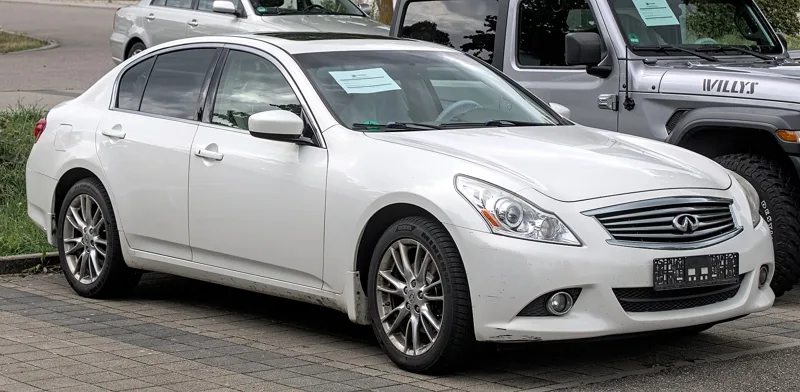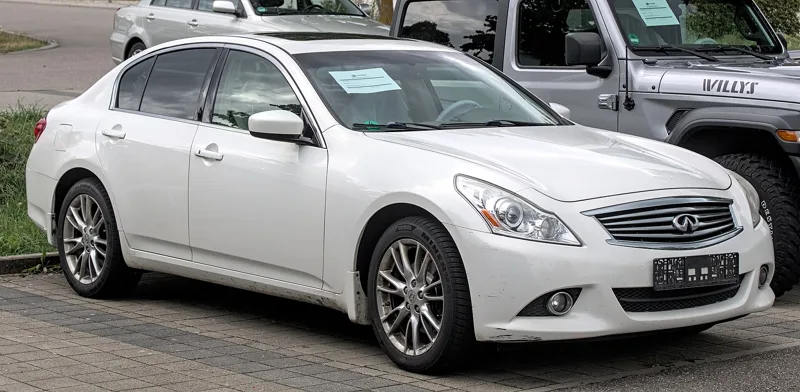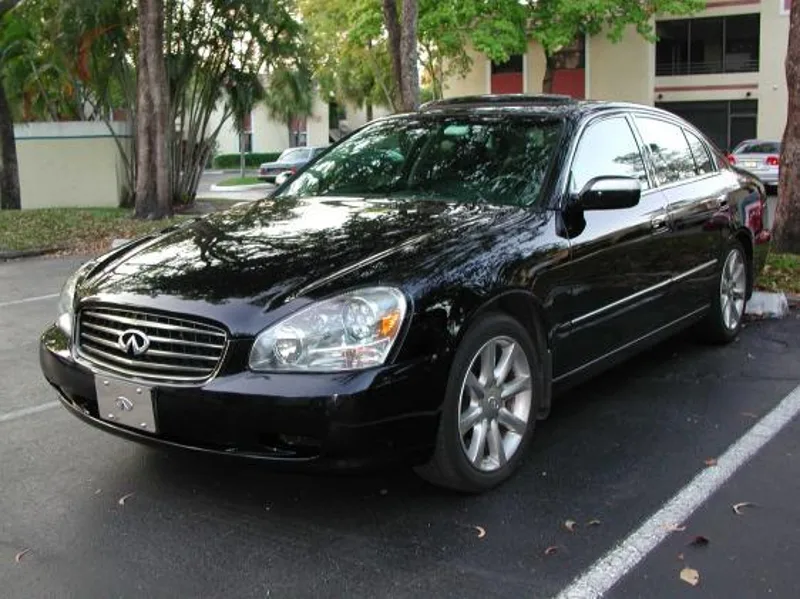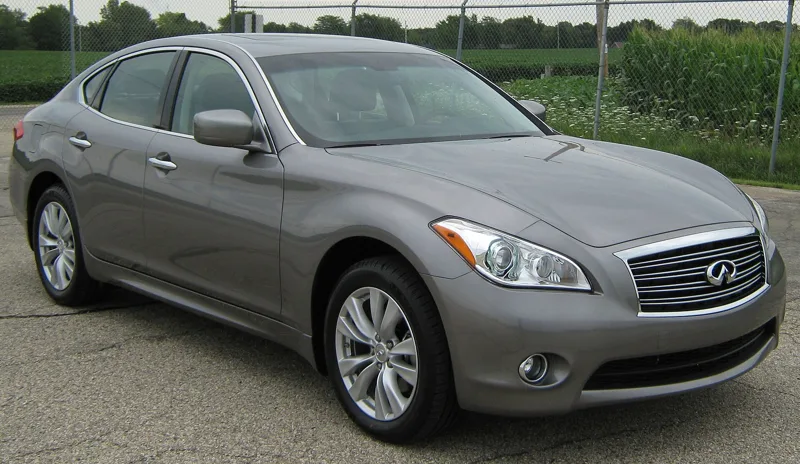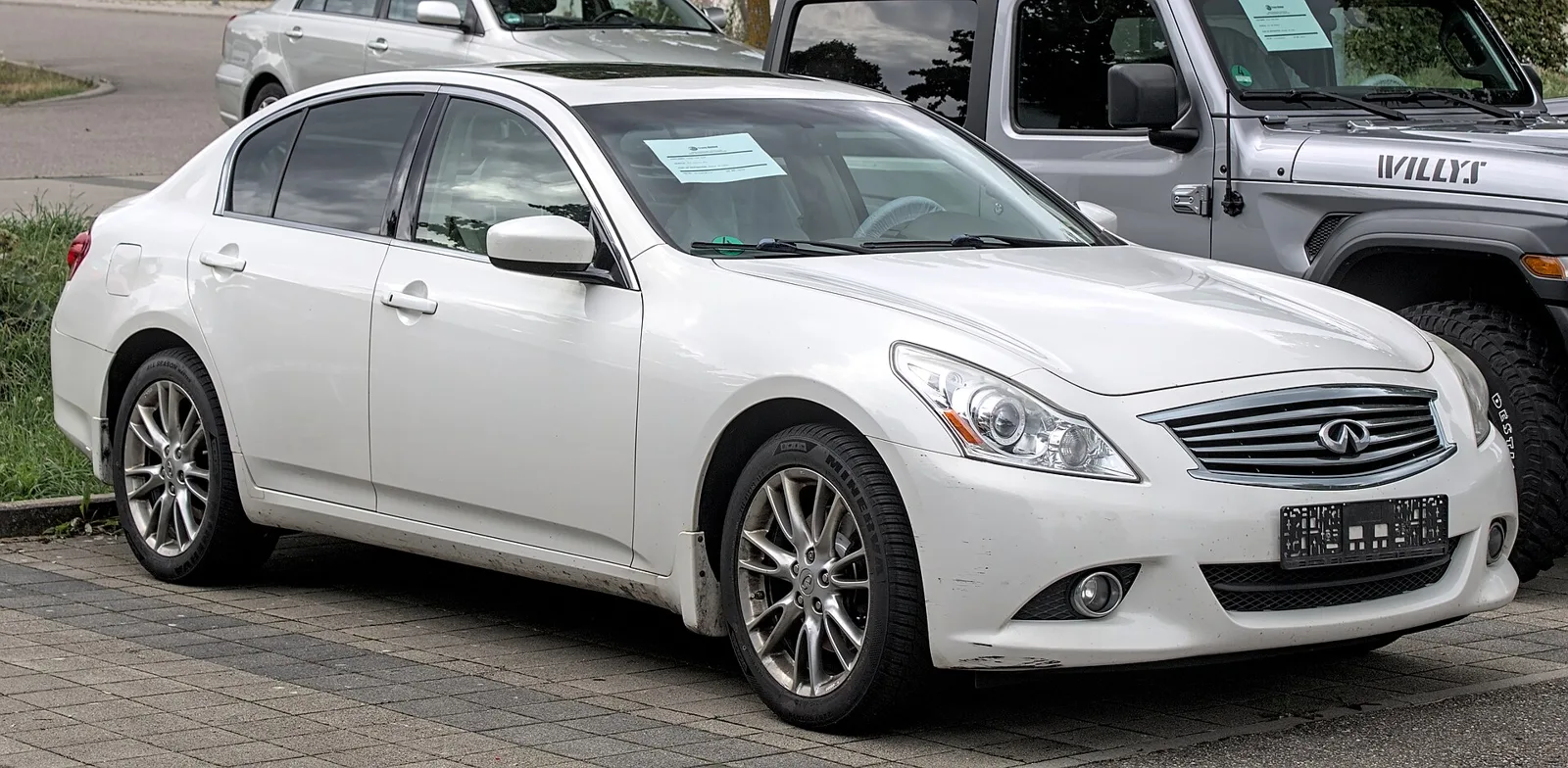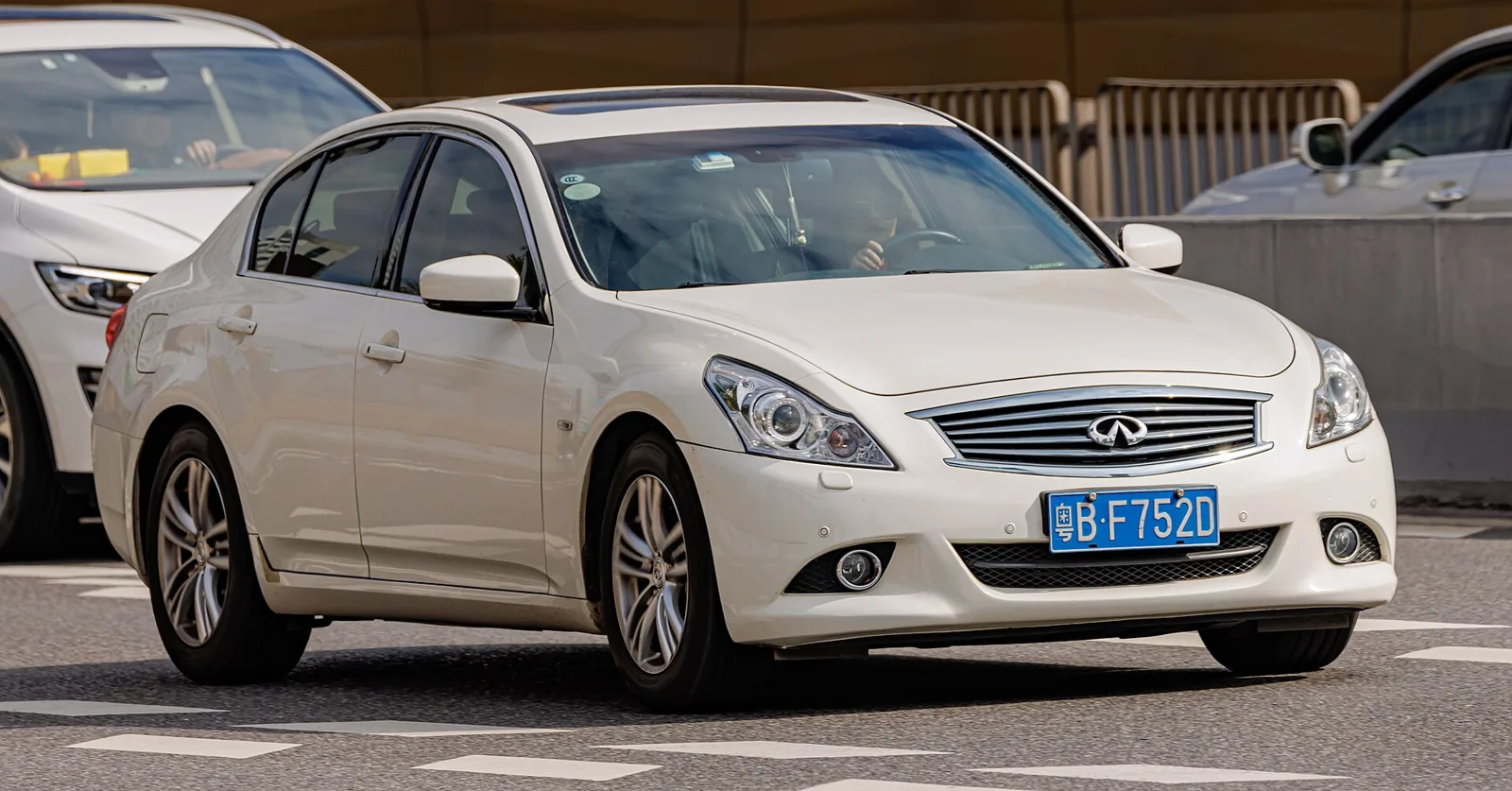
Nissan's luxury division built a compact executive car in 1990, turned it rear-wheel drive in 2003 and kept the G name until the Q40 arrived in 2015.
The Infiniti G was a compact executive car from Nissan's luxury division, sold across four generations in the US. It began as the front-wheel drive G20 in 1990, became the rear-wheel drive G35 in 2003, and returned as the Q40 in 2015.
Nissan's luxury arm, Infiniti, sold a compact executive car under the G name for most of two decades in the United States. It began life as a rebadged Nissan Primera, then took on a rear-wheel drive layout from 2003, and it finished its life as a coupe, convertible and sedan family. Each generation changed the car's character, and the name survived until the Q40 replaced it.
Where did the Infiniti G20 come from?
In the US, the G20 was Infiniti's entry car from 1990 until 2002. There was a two-year gap in the late 1990s, when the I30 took over as the entry-level car. The G20 was the first of its family and was built alongside the Nissan Primera in Japan.
Mamoru Aoki styled the exterior and interior of the P10 in 1987. The car went on sale in September 1990 as Infiniti's first small car, offered as an entry point below the Q45. The first series production example was assembled on July 10, 1990, and the last 1996 car rolled off the line on July 19, 1996.
The G20 was a badge-engineered Primera, but Infiniti pitched it as a premium product, so it came with a higher level of equipment than its European and Japanese relatives. The car was front-wheel drive throughout its life.
A Primera-based compact that became a rear-drive Skyline-derived coupe and sedan, then gave way to the Q40 name.
What made the P10 chassis notable?
The P10 introduced Nissan's multi-link front suspension to a front-wheel-drive car for the first time. The rear used an independent MacPherson strut arrangement. Its standard transmission was a 5-speed manual, with a 4-speed automatic as an option.
The only early options were the automatic, leather upholstery and a power glass moonroof. In 1994 Infiniti added the Touring package, badged G20t, which brought black leather, sport front buckets and fold-down rear seats.
The G20t also gained a limited-slip differential and a spoiler on the rear decklid. Those touches made the Touring car the sportier end of the range, while the standard car stayed focused on comfort.
What was the G20 engine?
The G20 was powered by the SR20DE, a transversely mounted dual overhead cam 2.0 L (1,998 cc) inline-four. It was naturally aspirated, with a redline of 7500 rpm, which was unusually high for the period. The engine was shared with the US-spec Nissan Sentra and 200SX SE-R, and with many non-US Nissans.
In the United States the engine made 140 hp (104 kW). Three main variants of the SR20DE existed in the G20. Highport engines ran from July 1990 to December 1993, with the injectors above the intake plenum.
In January 1994 emissions rules pushed Nissan to a lowport design, with the injectors and fuel rail moved below the plenum. That version ran from 1994 to 1996 and again in 1998. In 1999 Nissan replaced the hydraulic rocker arms with a roller-rocker valvetrain while keeping the lowport intake.
How did the G20 handle the road?
The G20 offered a 5-speed manual as standard and a 4-speed automatic as an option. Standard kit was generous for the price, including electric windows and locks, air conditioning, ABS-equipped four-wheel discs, alloy wheels and cruise control.
The standard car also included a Bose stereo, a theft-deterrent system, floor mats and a leather-wrapped steering wheel. The G20 was praised for its manual gearbox, which many reviewers regarded as one of the best in the business.
Later models added dual front airbags. The trim was called Luxury as standard, and the sporty Sport version appeared in model year 2002 without a badge change.
What changed in the G20 refresh?
The P10 was introduced at the 1993 New York Auto Show. A midyear refresh in April 1993 replaced motorised seat belts with dual airbags and added leather with power front seats as standard. The refresh also updated the audio to a six-speaker system with a CD player.
In February 1994 the 1994 model year brought a larger chrome-plated grille, a lowport engine, a move to OBD-II and bigger tyres. The G20 was then discontinued after the 1996 model year, leaving the I30 as Infiniti's cheapest car.
What was different about the second-generation P11?
The second-generation G20 adopted a multi-link beam rear suspension that was similar to the one used on the Nissan Maxima of that era. It kept the independent multi-link strut front suspension of the P10, which was also seen on the 300ZX and Skyline GT-R.
Enthusiasts disliked the beam, but several publications praised it as an effective way to avoid lateral movement while keeping a comfortable ride. The car grew by 2.7 inches (69 mm) in length and 0.4 inches (10 mm) in height over the P10. That gave rear-seat passengers 1.4 inches (36 mm) more legroom.
The added size and extra luxury equipment pushed the weight up to 3000 pounds. The 140-145 horsepower engine was not enough to keep performance at the old level.
When did the P11 reach the market?
The first P11 rolled off the Oppama line on May 18, 1998, and went on sale in July 1998 as a 1999 model. The final second-generation car was assembled on January 11, 2002, and the G20 was phased out during the first quarter of that year.
Standard equipment grew in the P11 era. Automatic climate control was fitted to all but the cloth-seat Luxury models, and 15-inch 16-spoke alloy wheels and a double-DIN Bose radio became standard. Keyless entry and power moonroofs were also standard on most trims, and side-impact airbags arrived later.
What did the 2000 refresh change?
The late-1999 refresh for the 2000 model year brought a 145 hp roller-rocker version of the SR20DE, newer automatic and manual transmissions and anti-theft immobiliser circuitry. Anti-glare mirrors came as standard, and the keyless fob gained a remote trunk release.
In 2001 the G20t was dropped and a Sport model took its place. It had two-tone leather and suede sport seats, 16-inch wheels and a number of cosmetic changes, while the 2002 base car received the 12-spoke Touring alloy wheels as standard.
Why did the G20 give way to the G35?
The G20 was discontinued in favour of the rear-wheel drive Infiniti G35. The G35 was a badge-engineered export version of the Japanese-market V35 Nissan Skyline, which went on sale in Japan in 2001. It was priced about US$7,000 above the G20's average MSRP of $23,000, and it still became a sales success for Infiniti.
The G35 was significantly larger and more powerful than the G20. It aimed at the entry-level premium sports sedan market, while the G20 had served the premium sport compact segment. The Nissan Primera continued outside the United States, and the all-new P12 Primera ended production in 2006 as a 2007 model.
What was the third-generation G35?
The third-generation G (V35) was unveiled in June 2001 and went on sale in North America as the G35 on March 12, 2002. It moved from the front-wheel drive Primera platform to the rear-wheel drive Skyline platform, which made it a different car from the G20 it replaced.
Hiroshi Hasegawa designed both the sedan and the coupe. The sedan was previewed as the Nissan XVL Concept at the Tokyo Motor Show in October 1999, and an Infiniti XVL Concept followed at the NAIAS in January 2000. The first G35 was built in Kaminokawa, Tochigi, Japan.
The G35 used the FM platform, shared with the Nissan 350Z and the Infiniti FX crossover. FM stands for front midship, meaning the engine sits further back in the bay to improve weight distribution. The car was Motor Trend's Car of the Year for 2003.
How did the G35 perform?
The G35 used the VQ35DE engine, and the 2003 and 2004 sedan had 194 kW (264 PS; 260 hp) and 353 N m of torque in the 2003 and 2004 sedan. Coupes were rated slightly higher. Those figures sat alongside the car's front-midship, rear-drive layout.
From 2005 to 2006, automatic cars were rated at 284 PS (209 kW) with 270 lb ft (366 N m), while manual cars reached 302 PS (222 kW) and 258 lb ft (350 N m). The G35x all-wheel drive sedan used the ATTESA E-TS system, which could send up to 50% of torque to the front wheels under acceleration.
The Infiniti G35 was also a drifting car. Team Falken campaigned it, and Calvin Wan's twin-turbo G35 won Formula DRIFT honours during its 2004-2007 life cycle. In Europe Paul Cheshire raced a heavily modified 2JZ-GTE V35 for the same team at the Nurburgring.
What changed in the 2005 and 2006 refreshes?
The sedan was refreshed inside and out for the 2005 model year, and the coupe for 2005 and 2006. Revised gauges, backlighting and trim were added, with aluminum trim replacing the tinted interior trim, and MP3/WMA playback arrived on the standard six-disc in-dash CD player.
The 2006 models received new headlights, taillights, a spoiler, sport side sills and a front bumper, along with Bluetooth for hands-free calling. Rear active steering became an option on the 2006 coupe.
What did the fourth-generation V36 bring?
The five-year development programme for the V36 began in 2002. The sedan was completed in 2006 and the coupe in 2007, and the fourth-generation sedan went on sale in November 2006 as a 2007 model. It used a heavily revised 3.5 L VQ35HR engine with a 5-speed automatic as the standard transmission.
The 2007 sedan's VQ35HR produced 306 hp (228 kW), peaking at 6,800 rpm, with 268 lb ft (363 N m) at 4,800 rpm. Electrically actuated variable valve timing on the exhaust cams broadened the torque curve, and the redline went higher.
The coupe followed in August 2007 as the G37, a 2008 model with a larger 3.7 L VQ37VHR engine. It was the first Infiniti engine to feature VVEL, and it made 328 hp for both coupe and sedan. Each coupe came with either a 5-speed automatic or a 6-speed manual.
How did the G37 change from 2009?
The G37 convertible was launched in June 2009. The 2009 G sedan replaced the G35 sedan and used the same VQ37VHR engine, rated at 328 hp (245 kW) at 7,000 rpm, with peak torque arriving at 5,200 rpm. The 5-speed automatic gave way to a new seven-speed unit across the range.
The 2009 Sport package brought larger brakes and a viscous limited-slip differential. Buyers could also choose a self-healing paint finish, which the company called Scratch Shield, on the 2009 models that went on sale in September 2008.
A facelift for the 2010 sedan went on sale in January 2010, with fog lamps moved into separate housings and a new grille. The G37 convertible came third of four cars in a March 2010 comparison test by Car and Driver, behind the BMW 328i and Audi A5.
What was the Infiniti G25?
Infiniti debuted the G25 sedan at the 2010 Paris Motor Show. It used a 2.5 L VQ25HR V6 producing 218 hp (163 kW) and 187 lb ft (254 N m). It was priced below the G37 and aimed at rivals such as the Lexus IS250, the Audi A4 and the BMW 328i.
The G25 offered rear-wheel drive or all-wheel drive and had no six-speed manual or navigation option in the US. It was discontinued in the United States in 2012.
What was the Infiniti Performance Line?
In July 2010 Infiniti launched its Performance Line, known as IPL. The first IPL model was the G37 coupe, followed by the convertible. Its retuned engine produced 348 hp (353 PS; 260 kW) at 7400 rpm.
The IPL cars got a redesigned exhaust, sportier suspension tuning, more aggressive bumpers and sideskirts, and 19-inch alloy wheels. The interior had red Monaco leather seats, and the cars came only in Graphite Shadow gray metallic and Malbec Black.
How did the G end and the Q names begin?
From 2014 Infiniti named its passenger cars with a Q, so the G37 sedan was renamed Q40 for the period from June 2014 to June 2015. The Q50 sedan was sold alongside it as a lower-cost option. The Q40 went largely unchanged for its final year in 2015.
The Q60 replaced the G37 coupe and convertible as the new sporty model. Infiniti's broader line-up had shifted the G name into the past by the time the last sedans were built.
What are the Infiniti G specifications?
| Specification | Detail |
|---|---|
| First model | G20, launched September 1990 |
| G20 engine | 2.0 L (1,998 cc) SR20DE inline-four; 140 hp (104 kW) in the US |
| G20 redline | 7500 rpm |
| P11 weight | 3000 pounds |
| G35 2003-2004 sedan | 194 kW (264 PS; 260 hp); 353 N m |
| G35 2005-2006 manual | 222 kW (302 PS; 298 hp); 350 N m (258 lb ft) |
| G35 2007 sedan VQ35HR | 306 hp (228 kW) at 6,800 rpm |
| G37 VQ37VHR | 328 hp (245 kW) at 7,000 rpm; 269 lb ft (365 N m) |
| G37 convertible | 325 hp (242 kW); 3.7 L V6 |
| G25 VQ25HR | 218 hp (163 kW); 187 lb ft (254 N m) |
| Infiniti Performance Line G37 | 348 hp (353 PS; 260 kW) at 7400 rpm |
| Renamed | Q40 from the 2015 model year |