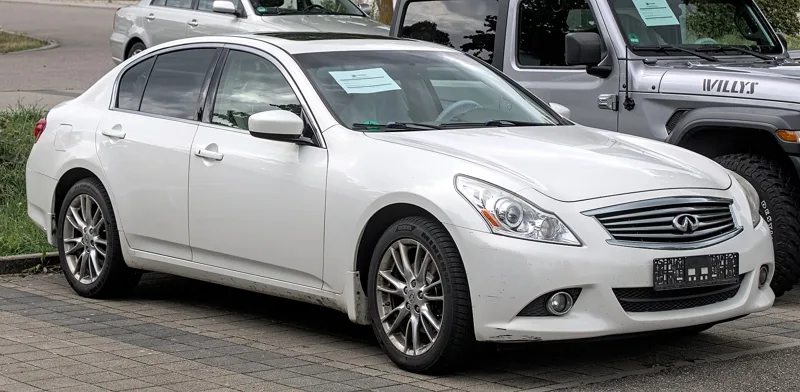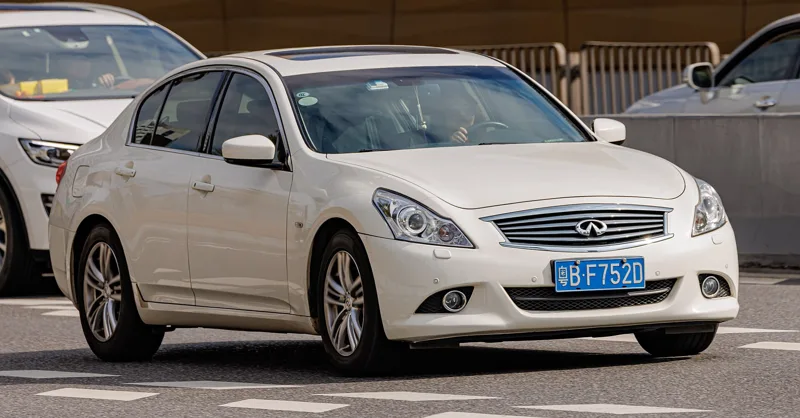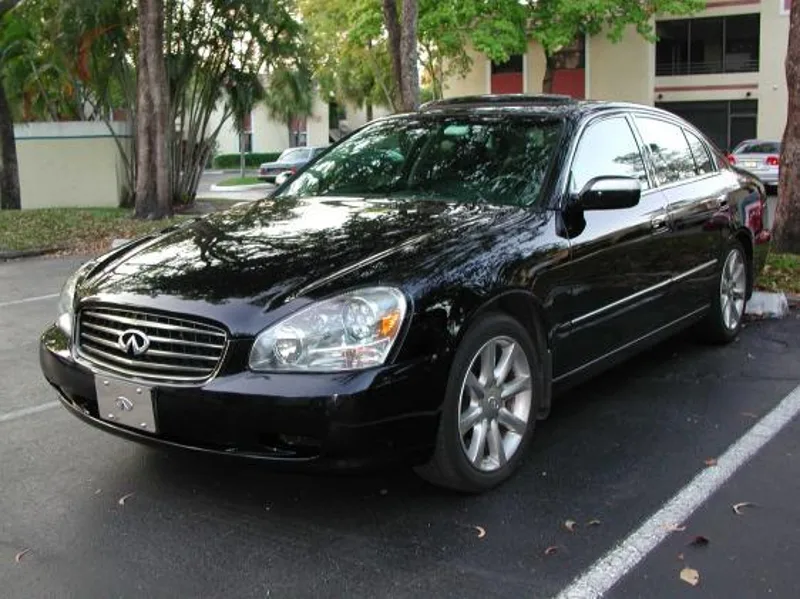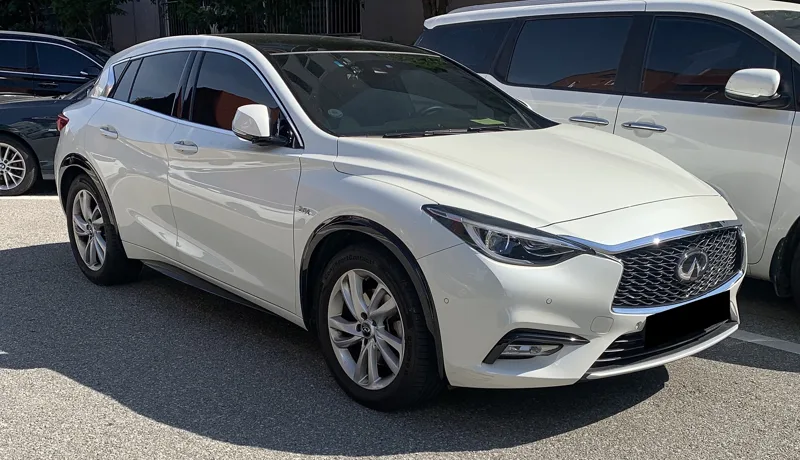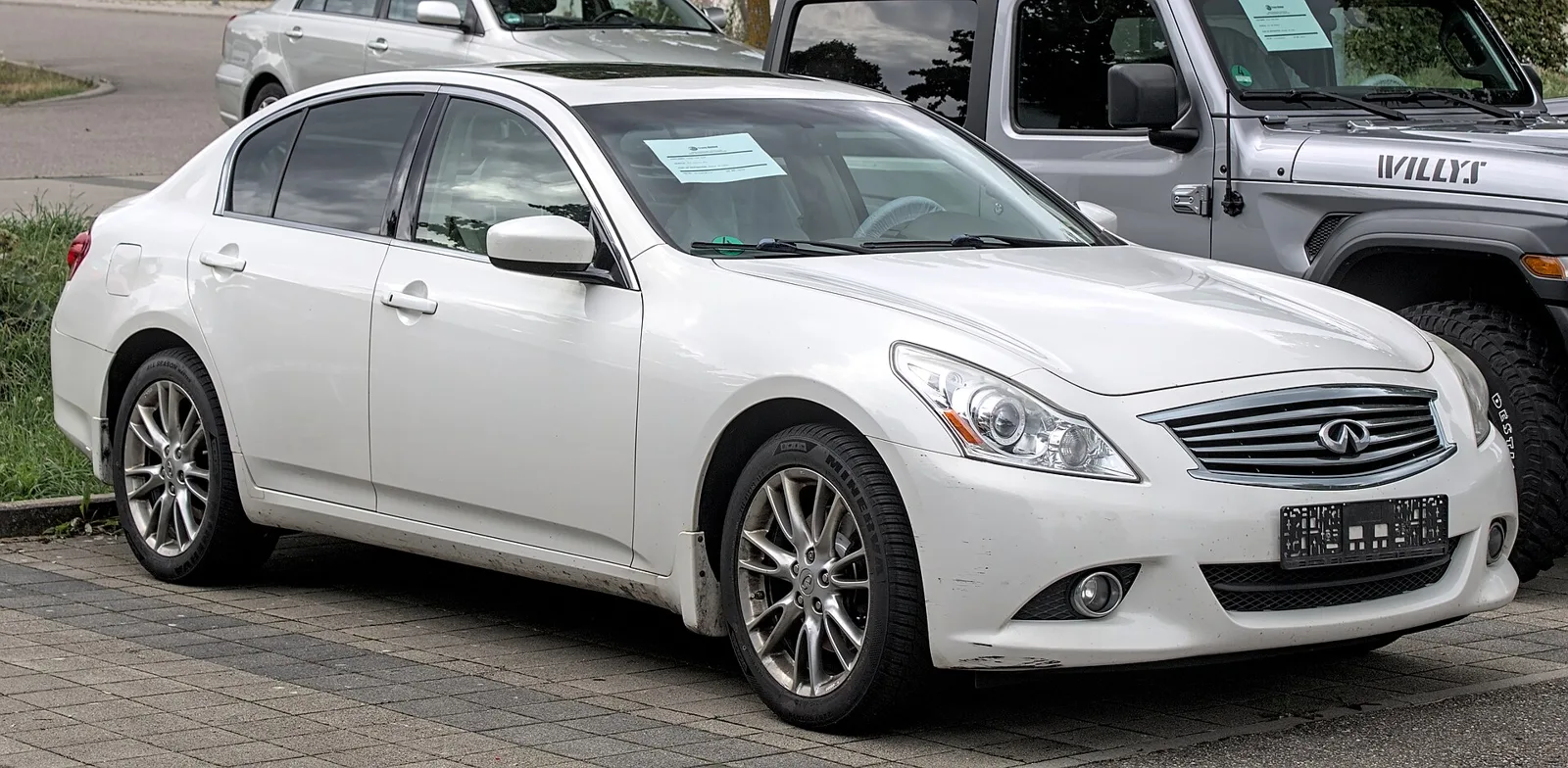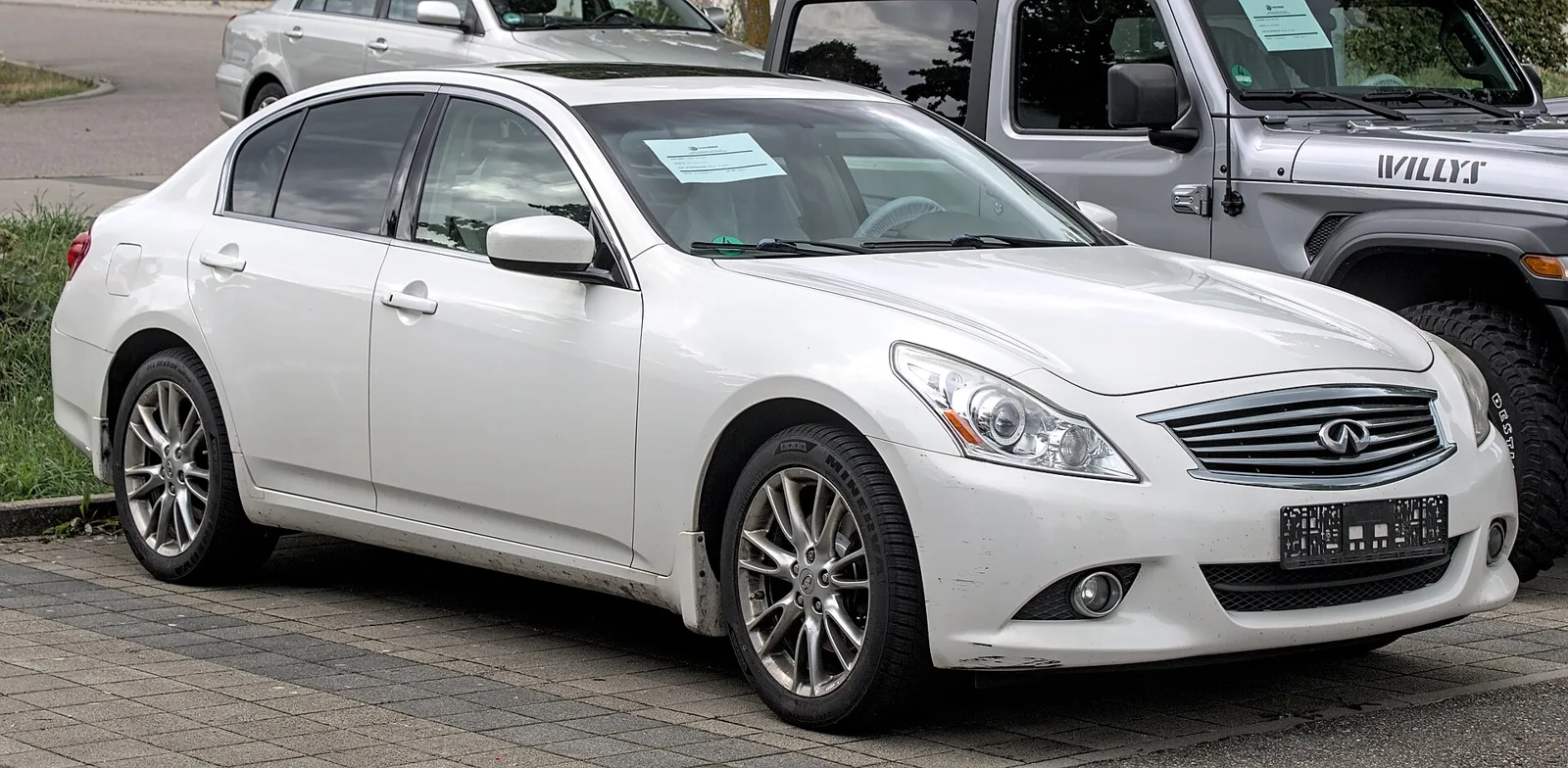
A front-drive Infiniti G20 from the early 1990s and the first Audi A5 coupe, set side by side on engines, power, body styles and what each one was built to do.
Set against the 2007 Audi A5, the Infiniti G20 and its 140 hp four-cylinder look modest. The later G35 brought rear-wheel drive and a step up in size and output, which moved the nameplate closer to the Audi, though the G20 itself stayed a front-drive sedan to the end.
The Infiniti G and the Audi A5 sit in the same broad class of compact executive cars, but they were built for different owners and in different decades. The G20 was Infiniti's entry-level car from 1990, a front-drive sedan with a 140 hp four-cylinder, while the A5 arrived in 2007 as a coupe with a 3.2-litre V6. The Infiniti G later became rear-drive with the G35, which narrows the gap with the Audi.
Why compare the Infiniti G with the Audi A5?
Both were pitched at buyers who wanted more than a mainstream family saloon. The G20 was Infiniti's cheapest route into the brand, and the A5 was Audi's return to the compact coupe market. The G20 stopped in 2002 just as the rear-drive G35 arrived, so the two cars overlapped only in the early 2000s.
The Audi came later, so the comparison works best if the G20 is read as Infiniti's starting point and the G35 as the car that moved the brand closer to the A5's class.
An entry-level Infiniti sedan with a 140 hp four, set against a coupe that ran from a V6 to a 450 PS RS5.
How did the G20 begin?
The G20 was a rebadged Nissan Primera, a car designed mainly for Europe and developed under Nissan's Project 901. It debuted in September 1990 as the brand's first small model, positioned below the Q45 flagship.
Dealers saw the car first, at the 1989 New York show, and the public followed at the 1990 edition. The first production example was assembled on 10 July 1990, and the final 1996 car left the line on 19 July 1996. Mamoru Aoki styled the P10's exterior and interior in 1987.
Because Infiniti pitched itself as a premium brand, the G20 was fitted with more equipment than its Japanese and European relatives. Buyers got power windows, air conditioning, ABS-equipped disc brakes at all four corners, alloy rims, a Bose sound system and a leather-wrapped wheel as standard.
What was the G20 like to drive?
The G20 used the SR20DE, a dual overhead cam unit that sat sideways in the bay and breathed naturally, a 2.0-litre inline four with 1,998 cc of capacity. Its bore and stroke were both 86 mm, which made the engine a square design. The US version produced 140 hp (104 kW) at the crank and 132 or 136 lb ft (179 or 184 N m) of torque.
The engine was fairly high-revving for its time, with a redline of 7500 rpm. Front-wheel drive ran through a 5-speed manual that came as standard, with a 4-speed automatic as an option.
The P10 was notable for its suspension. It used Nissan's multi-link front arrangement in a front-drive car for the first time, paired with an independent MacPherson strut at the rear. The Touring trim, badged G20t from 1994, added a limited-slip differential, black leather sport seats, fold-down rear seats and a rear spoiler.
How did the second-generation G20 change?
The P11, launched for the 1998 model year, grew in every direction. It was 2.7 inches (69 mm) longer and 0.4 inch (10 mm) taller than the P10, which gave rear passengers 1.4 inches (36 mm) more legroom. Its weight rose to 3000 pounds, and the rear suspension became a multi-link beam borrowed from the 1995 to 1999 Nissan Maxima.
Enthusiasts disliked the beam, but several magazines praised the updated car for keeping lateral movement under control while still riding well. The P11 split its weight 61% front and 39% rear, and it gripped laterally at 0.80 to 0.94g.
Performance did not keep pace with the extra mass. A 1999 model with the automatic reached 60 mph in 10.9 seconds, and its quarter-mile run took 18.4 seconds, crossing the line at 77 mph (124 km/h), with the stock 140 to 145 horsepower engine doing most of the work.
The G20's engine did change during its life. From July 1990 to December 1993 it used a highport layout, with the injectors and fuel rail above the intake. In January 1994, tighter emissions rules pushed Nissan to a lowport design, and the 1999 refresh brought a roller-rocker valvetrain that kept the lowport intake.
The Touring models stood out from the base car. They added a limited-slip differential, sportier black leather bucket seats and a rear spoiler. In 2001 the G20t was dropped in favour of a Sport model with two-tone leather and suede seats and 16-inch wheels.
What did the G35 change?
The V35, the third-generation G, was shown in June 2001 and reached North America on 12 March 2002 as the 2003 G35. It shifted from the front-drive Primera platform to the rear-drive Skyline platform, and it had little in common with the G20 that came before.
Hiroshi Hasegawa designed the sedan and the coupe. The G35 cost roughly US$7,000 more than the G20's average MSRP of $23,000, and it was pitched at entry-level premium sports saloon buyers rather than the G20's compact premium audience. It was a clear step up from the G20 in size and output.
The G20 itself was discontinued to make way for the G35. The final second-generation 2002 car was assembled on 11 January 2002, and the model phased out during the first quarter of that year.
How did the Audi A5 arrive?
The A5 made its appearance at Geneva in March 2007, and it marked Audi's return to the compact executive coupe market. The previous Audi 80-based coupe had ended production in 1996, and the A5 took its place as a distinct nameplate.
Audi confirmed production on 10 May 2006. The A5 was the first car in the B8 family to reach the market, ahead of the A4 and the Q5, and it was built on the Modular Longitudinal Platform that later underpinned the A6 and A8. The design drew on the Nuvolari quattro concept.
Orders opened on the day of the unveiling, 6 March 2007, and the first deliveries followed in June 2007. Launch models included the 3.2-litre FSI V6 with multitronic transmission and the 3.0-litre TDI quattro, with a 1.8-litre TFSI to follow in late 2007.
The Audi's Canadian story was a little different. The A5 went on sale there in 2008 with the 3.2-litre FSI and a choice of six-speed manual or Tiptronic. From 2011 only the 2.0-litre turbo engines were offered in Canada, and Audi introduced a Black Edition in 2013.
The Sportback had a different character again. It had four frameless doors and a long fastback-style roofline, and its interior resembled the A4 saloon's. Although the A5 shares its platform with the A4, the Sportback sits closer in design to the A4 than to the coupe.
Specifications side by side
| Specification | Infiniti G20 | Audi A5 (first generation) |
|---|---|---|
| Years built | 1990 to 2002 in the US; G35 from 2003 | Sold from June 2007 |
| Drive | Front-wheel drive | quattro all-wheel drive on the 3.2 FSI and S5 models |
| Engine | 2.0-litre SR20DE inline four, 1,998 cc | 3.2-litre FSI V6 and 3.0 TDI at launch; 2.0 TFSI later |
| Power | 140 hp (104 kW) in US trim | 265 PS (195 kW; 261 hp) on the launch 3.2 FSI |
| Body styles | Four-door sedan | Coupe, cabriolet and Sportback |
Which car was quicker?
The figures in this comparison do not line up neatly. The G20 automatic of 1999 reached 60 mph in 10.9 seconds, but no Audi A5 acceleration time appears alongside it.
The Audi engine range offers the clearest performance evidence. The launch 3.2-litre V6 made 265 PS, the S5 V8 made 349 hp, and the RS5 reached 450 PS (331 kW; 444 hp), so the 140 hp G20 sits at the bottom of this list.
How did the engines compare?
The G20's SR20DE was a modest unit, with its 140 hp rating and a torque figure of 132 or 136 lb ft. The SR20DE was also fitted to several Nissan models, including the Sentra SE-R and the NX2000.
The A5 range covered a wider spread. Launch cars used the 3.2-litre FSI V6, while a 2.0-litre TFSI quattro produced 155 kW (211 PS; 208 hp) and a 2.0 TDI made 125 kW (170 PS; 168 hp) with a six-speed manual and start-stop.
Audi's larger engines came later. The S5 coupe used a 4.2-litre FSI V8 with 260 kW (349 hp) for the 2010 to 2012 model years, while the S5 Cabriolet and Sportback used a supercharged 3.0-litre TFSI V6 with 245 kW (329 hp).
What were the S5 and RS5 like?
The RS5 came in coupe form and used the 4.2 FSI V8 at 450 PS (331 kW; 444 hp) at 8250 rpm, coupled to a seven-speed S-Tronic gearbox. It ran quattro permanent all-wheel drive with a crown-gear centre differential and electronic torque vectoring, and it was unveiled at the 2010 Geneva Motor Show.
Its weight was 1,800 kg (3,968 lb), with 56.3% on the front axle. Quattro typically sends 60% of the torque to the rear, rising to as much as 85% depending on conditions, and the RS5 had an active rear differential that could shift power between the rear wheels.
The S5 Special Edition was a 125-unit run for the US market in 2012, commemorating the end of the S5 4.2 FSI Quattro coupe. It included the Prestige Package, Daytona Grey paint and 19-inch five-spoke wheels, with a piano black instrument cluster.
How did the A5 try to save weight?
Audi built an aluminium A5 coupe prototype to demonstrate its aluminium space frame concept. It used punch riveting, bonding and laser-MIG hybrid welding in place of spot welding, and it was 110 kg (243 lb) lighter than the equivalent steel-bodied car.
The Ethanol E100 coupe was a different sort of prototype, built for the Michelin Challenge Bibendum 2010 series. Its 2.0 TFSI engine made 132 kW (179 PS; 177 hp), and the car ran 0 to 100 km/h in 6.9 seconds with a top speed of 236 km/h (147 mph). It weighed 1,310 kg (2,888 lb).
Which body styles did each car offer?
The G20 was a four-door sedan, and its Touring and Sport packages changed the trim rather than the body. Later G models widened the range, but the G20 itself never offered anything else.
The A5 spread across three body styles. The coupe launched first, followed by a cabriolet with a fabric roof, which went on sale in the US as 2010 models. The Sportback, a five-door liftback, arrived in Europe in 2009 and reached North America as a 2018 model.
Which car suits which buyer?
A buyer who wants an entry-level luxury sedan with a front-drive layout and a long run of Infiniti heritage will look closely at the G20. A buyer who wants a coupe with a choice of quattro four-wheel drive, plus a V8 or RS model, will find more in the A5.
Body choice favours the Audi on the figures here, with three styles against the G20's single sedan. Performance choice also favours the Audi, since its engine list runs from 170 PS up to the 450 PS RS5.
The G20 has its own advantages. Its equipment was generous for the money, and its average MSRP of $23,000 was well under what the later G35 cost. It also has a clearer history as Infiniti's entry point.
Neither car is better on every count. The G20 gives an early Infiniti sedan with plenty of equipment, while the A5 gives Audi's coupe design and a wide engine range that reaches into the RS5's performance territory.