From 1769 steam tractors and 1930s DKW sales to the 1959 Mini and the Fiat 128, how the front-drive layout became the default for mass-market cars.
Front-wheel drive sends engine power to the front wheels only, usually through a transverse engine. Early experiments date to 1769, but the layout reached mass production with the DKW F1 in 1931. The 1959 Mini and the Fiat 128 of the 1970s set the modern standard.
Front-wheel drive (FWD) is a layout in which the engine drives only the front wheels. Most modern front-drive cars use a transverse engine, mounted across the car rather than along it as on conventional rear-drive and four-wheel-drive vehicles. Front-drive is now the default for mass-market cars, although it took more than a century to get there.
Who built the first front-wheel-drive vehicles?
Experiments date back to the earliest days of the car. Nicolas-Joseph Cugnot's steam tractor of 1769 to 1770, often called the fardier a vapeur, was a three-wheeled machine driven through its front wheel. It took more than a century before combustion-engined cars gained traction. Between 1895 and 1898 the Austrian Graf brothers, who were also bicycle makers, commissioned Josef Kainz to build a voiturette with a one-cylinder De Dion-Bouton engine at the front. Only one prototype was made.
In 1898 the French firm Latil devised a front-drive system for motorising horse-drawn carts. The same year, the Societe Parisienne patented a front-wheel-drive articulated design called the Victoria Combination, and by mid-1901 more than 400 had been sold at about 3,000 francs each. Ferdinand Porsche's Lohner-Porsche of 1897 used an electric motor in each front wheel. Henry Sutton's Sutton Autocar, built in 1899, may have been the first front-drive car in the world, although the cost of its two prototypes ruled out production.
| Year | Vehicle or event | Significance |
|---|---|---|
| 1769 | Cugnot's fardier a vapeur | Early front-wheel-driven steam tractor |
| 1897 | Lohner-Porsche | Electric motor in each front wheel |
| 1899 | Sutton Autocar | Possibly the first FWD car, built in Australia |
| 1904 | Christie prototype | A FWD car raced in the United States |
| 1925 | Alvis 12/50 and Miller 122 | Front-drive racers at Kop Hill and Indianapolis |
| 1929 | Cord L-29 | First American FWD car offered to the public |
| 1931 | DKW F1 | First FWD car sold in large numbers |
Early 1900s experiments came from many directions. J. Walter Christie built a front-drive prototype in 1904 and raced his cars in the United States, even entering the 1906 Vanderbilt Cup and the French Grand Prix. In Australia, G.J. Hoskins patented a front-drive system in 1915, using a spherical radial gear fitted to a Standard car.
Front-wheel drive spent most of a century on the margins before the Mini and the Fiat 128 turned it into the default.
Why did front-wheel drive take so long to reach production?
Motor racing led the way in the 1920s. The supercharged Alvis 12/50 racer appeared at the 1925 Kop Hill Climb, and the Miller 122 entered the 1925 Indianapolis 500. Few manufacturers tried front drive on production cars, and Alvis's 1928 commercial version was not a success.
The engineering problem was the joints. Constant-velocity joints let power reach steered wheels more smoothly than universal joints, and the Tracta joint was developed in France in 1926. Cord's L-29 of 1929 was the first American front-drive car to use them, but it was discontinued by 1932 with 4,400 sold, while the Ruxton of 1929 sold just 200 cars that year. The Great Depression and the buyers' expectations for more than its 80 mph (130 km/h) top speed did not help.
Which early front-drive car became a mass seller?
The first successful consumer application came in 1929 with the BSA three-wheeler, built until 1936. The DKW F1 of 1931 put a transverse engine behind the front axle, and sales of 4,353 units in 1931 and 1932 made it the first front-wheel-drive car sold in large quantities. Its successor, the F2, sold about 27,000 by 1935, and by 1942 DKW had produced about 270,000 front-drive cars. The layout continued in Germany for three decades.
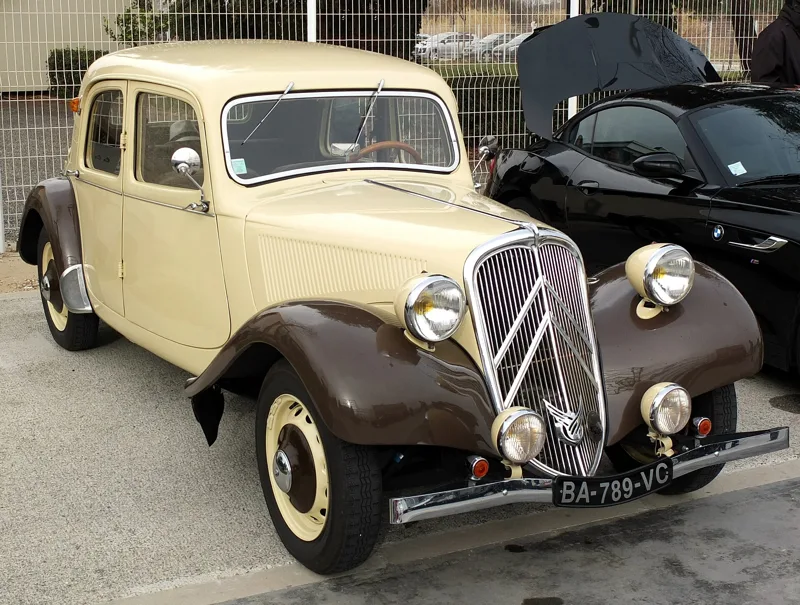
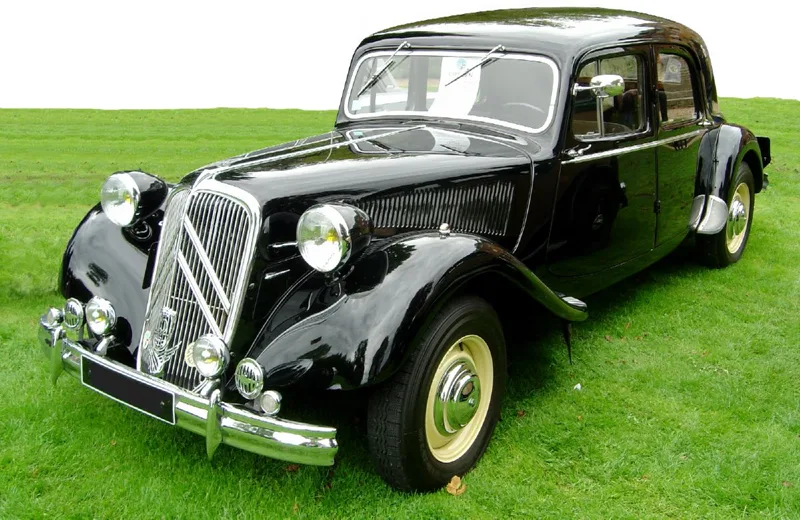
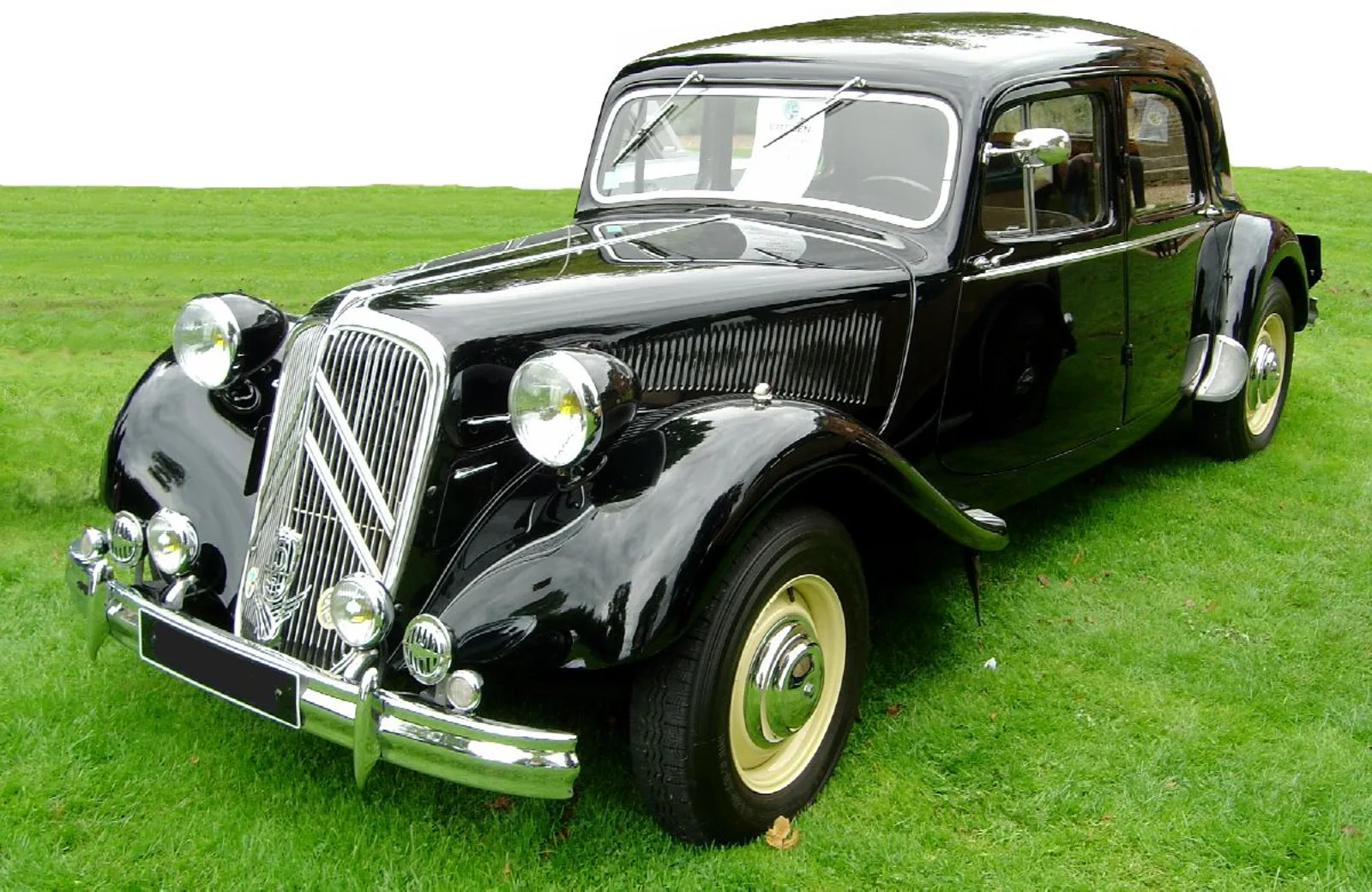
Other German makers followed. Stoewer offered a front-drive car in 1931, Adler in 1932 and Audi in 1933. Adler's Trumpf sold over 25,600 units from 1932 to 1938, and its cheaper Trumpf Junior passed 100,000 by August 1939. In France, Citroen introduced the Traction Avant in 1934, and it built about three-quarters of a million through 1957.
How did the Mini change the layout?
The Austin Mini launched in 1959. Alec Issigonis designed it as a response to the 1956 Suez Crisis and the boom in bubble cars that followed. It used a transverse water-cooled inline four with the transmission in the sump, and it gave about eighty percent of its floor plan to passengers and luggage. Its suspension, low centre of gravity and radial tyres gave a large gain in grip over most cars of the day, and GKN constant-velocity joints at the outer ends of the driveshafts let the wheels steer.
The Mini revived front drive after decades in which it had largely been abandoned. The sump-mounted gearbox was not perfect, though. Its shared oil and awkward cooling air meant the clutch often needed the whole engine removed for service.
What were the rival layouts?
Designers tried several arrangements. Audi kept a longitudinal engine sitting over the front wheels from the 1970s, which allowed equal-length half shafts and an easy route to all-wheel drive, though it made a 50/50 weight split hard to reach. Saab and Renault's Douvrin engines also ran longitudinally. The Oldsmobile Toronado of 1966 revived American front drive after the Cord 810, using a longitudinal V8 and a split transmission that turned the power through 180 degrees.
The Peugeot and Renault "suitcase" engine of the 1970s, with the transmission beside a canted four-cylinder block, became unpopular because it generated transmission whine. Renault dropped it for its compact models in 1982, and Peugeot-Citroen phased it out in favour of the TU engine in 1986.
How did the Fiat 128 settle the design?
Dante Giacosa's Fiat 128 gave the transverse layout its modern form. Fiat had first tested the approach on the Autobianchi Primula, ready for production in 1964. The Primula offset its gear train from the differential, so the engine and gearbox sat side by side without sharing oil, and the cooling fan drew in fresh air. Its problems, including uneven power transmission and torque steer, were largely solved by making one driveshaft solid and the other hollow so that both twisted by roughly the same amount.
Fiat also showed the layout's flexibility by turning the 128 drivetrain into a mid-engined Fiat X1/9. The Giacosa layout, with a transverse engine, a side-mounted transmission, unequal-length driveshafts, MacPherson struts and an independently mounted radiator, became the industry standard. Fiat promoted the 128 by saying its mechanical parts used only 20 per cent of the car's volume.
Why did American makers switch to front drive?
The Corporate Average Fuel Economy standard drove a mass changeover in the United States. It began in 1978 with the Plymouth Horizon and Dodge Omni, the first American-built transverse-engined cars, and continued with the 1980 Chevrolet Citation. Japanese and European competition had already made the case. Volkswagen's Golf of 1974, the 1973 Honda Civic and the 1976 Honda Accord acted as a wake-up call for the Big Three, and captive imports were the first American response to the demand for economy cars.
Front drive reached the mid-sized class in 1982 with the Chevrolet Celebrity and Toyota Camry, and by the mid-1990s most American brands sold only a handful of rear-drive models. Volvo moved its entire range to front drive after the 900 series, arguing that the transverse layout allowed more crumple zone in a head-on crash. Ford's automobiles for the 2012 model year onwards are front-drive, except for the Mustang.
Has front-wheel drive set any records?
The Nissan GT-R LM Nismo race car is credited with the most powerful front-drive output, with about 500 hp from its combustion engine. The 1970 Oldsmobile Toronado W-34 option, at 400 hp, remains the most powerful street-legal front-drive production car. A production Dodge Neon SRT-4 from RaceDeck Racing set a land speed record for its class at Bonneville on 16 August 2006, averaging 221 mph (356 km/h) over a five-mile course.
On the Nurburgring Nordschleife, the fifth-generation Honda Civic Type R set a time of 7:43.80 in April 2017, a record for front-drive cars. The Renault Megane RS Trophy-R took it with 7:40.10 in July 2019, and the Limited Edition Civic Type R beat the Megane's Suzuka time by one and a half seconds in 2020.